
NEWS
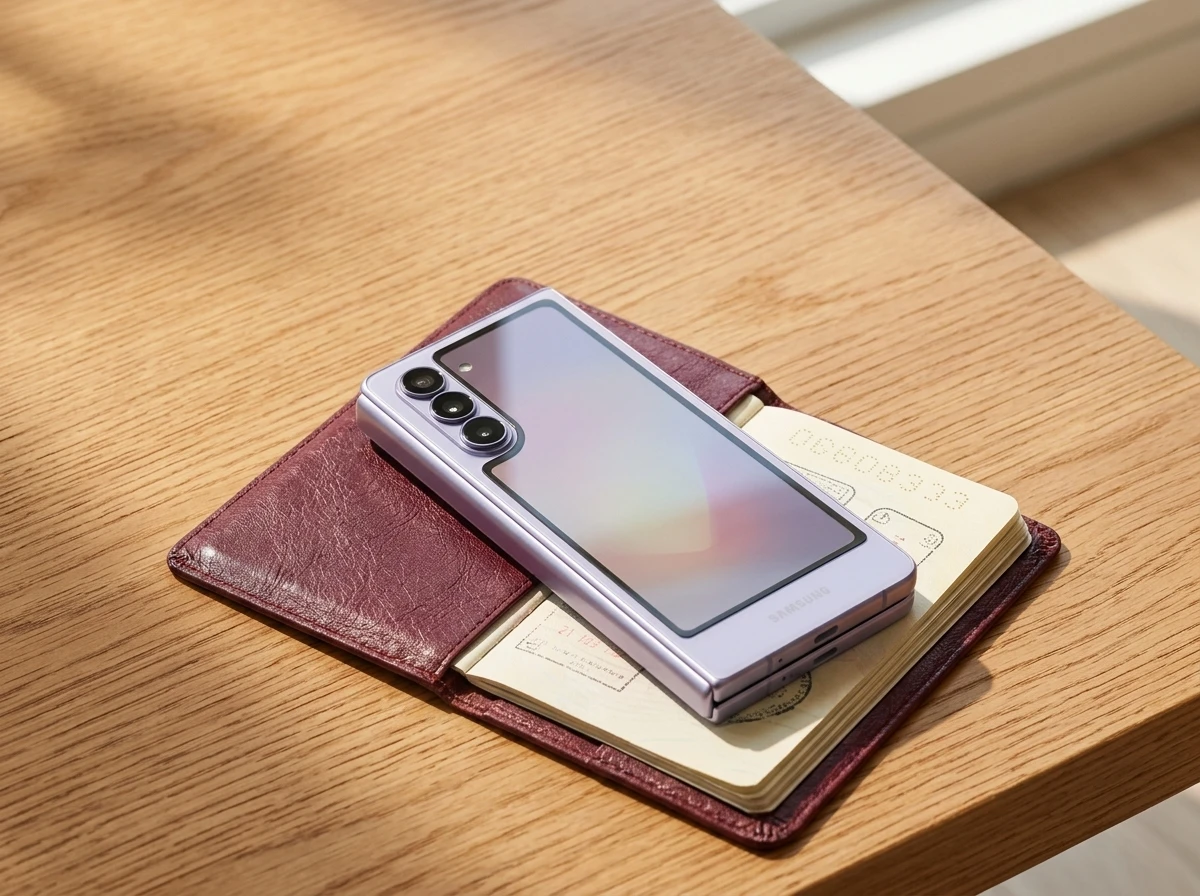
Samsung’s Design Chief Molds the Fold8 Like a Passport
Samsung’s design chief explains why the Galaxy Z Fold8 borrows a passport’s proportions, even as Counterpoint predicts its foldable share will shrink this year.

Samsung’s mobile design chief shaped the new Galaxy Z Fold8 around an object almost nobody thinks of as a design reference: his own passport. Hubert Lee, the company’s executive vice president of mobile experience design, told Monocle the phone’s proportions came from studying how people actually hold a passport with one hand, not from chasing a thinner slab.
Samsung unveiled the phone at Galaxy Unpacked in London on July 22, 2026, its first summer Unpacked staged in the UK capital. It landed the same year Counterpoint Research, a market analytics firm, projects Samsung’s own share of the foldable category sliding from 40% to 32% as Apple prepares to enter the market it has watched Samsung build alone for seven years.
A Wider Shape Splits Into Two Phones
The headline change is a cover screen that is shorter and wider than any previous Z Fold, opening into a nearly square tablet display, the same 4:3 ratio as a standard tablet rather than the tall, narrow unfold Samsung has used since 2019. Unfolded, it looks closer to a small iPad than to a stretched phone.
What is not obvious from the Unpacked stage is that Samsung shipped two different shapes under one family name. GSMArena’s spec breakdown notes that the Z Fold8 Ultra is, confusingly, the actual successor to last year’s Z Fold7, keeping the familiar taller proportions, while the standard Z Fold8 carries the new wide shape. A leak from weeks earlier had already mapped a leaked two-phone strategy aimed squarely at Apple, and the final specs confirm it: Samsung didn’t replace its old formula, it ran it alongside the new one.
| Spec | Galaxy Z Fold8 | Galaxy Z Fold8 Ultra |
|---|---|---|
| Shape | New wide, passport-style cover | Taller shape carried over from Fold7 |
| Unfolded thickness | 4.5mm | 4.1mm |
| Weight | 201g | 218g |
| Battery | 4,800mAh | 5,000mAh |
| Main camera | 50MP, f/1.8, OIS | 200MP, f/1.7, OIS |
| Charging | 45W wired, wireless | 45W wired, wireless |
Those figures come from specifications that leaked in the days before launch and converged across multiple outlets, so treat exact camera and battery numbers as close to final rather than officially stamped by Samsung down to the decimal.
Lee Modeled the New Hinge on a Passport
Lee, who joined Samsung in 2023 and asked to be called Hughie, said the team went looking for a shape people already trust in their hands. “We looked at familiar objects that we live with. In this case, the passport,” he told Monocle. “Its utility is based on one-handed usage and this is inspiring. We like that proportion.”
He was direct about why the hinge itself looks flatter than rivals’.
Some brands have much rounder sections but if you go too round, it reminds you of a baby’s butt cheek. We tend to go flatter on the sections.
That is Lee describing Samsung’s house style at the fold line, where the two halves meet. He framed the whole exercise as resisting anything that feels forced. “The natural way is so important, because if you force something, if it’s unnatural, then people don’t like using it,” he said.
The hardest problem, he added, was the gap between the two halves when closed. “When the gap is bigger, it’s easier to put your fingers in between and open. But at the same time, if the gap is too big, it becomes visually awkward because then you have this huge gap,” Lee said, describing a trade-off with no clean engineering answer, only a judgment call.
Why Is Samsung Betting Wider Right Now?
Samsung is widening the Fold’s cover screen because people now spend more of their screen time inside AI-driven apps on their phones, and Lee wants foldables to become the default device for that, not a niche add-on that only sells to enthusiasts.
“People are consuming more media content. They’re spending more time with their devices because of AI and most of that usage is coming from our mobile phones,” Lee said. “This new form factor has come about because of a different way of using our devices or foldables.”
He did not oversell where the category stands today. “Folding phones are still a bit niche. It’ll be awesome if we could get our foldables to become the household’s mainstream device. But, of course, we have to back it up with reliability, durability and the highest quality that we can provide,” he said.
The market numbers explain the urgency. Counterpoint Research expects foldable shipments growing roughly a fifth in 2026, with the field getting more crowded, not less.
| Vendor | Projected 2026 Foldable Share |
|---|---|
| Samsung | 32% (down from 40% in 2025) |
| Apple | 25% (first year in category) |
| Huawei | 24% |
| Motorola | 8% |
| HONOR | 3% |
Liz Lee, an associate director at Counterpoint Research, said the shift is structural, not a one-year blip. “2026 will mark a new phase for the foldable smartphone market,” she said, pointing to Apple’s arrival as the trigger for wider consumer awareness of the category Samsung has largely owned since it launched the original Fold.
Apple’s Own Fold Is Circling for September
Apple has not confirmed a foldable iPhone. But supply chain reporting has been consistent for weeks: the device, referred to variously as the iPhone Fold or iPhone Ultra, is in mass production and tracking toward a September 2026 unveiling alongside the iPhone 18 Pro line, with no delay currently expected.
Apple has reportedly told suppliers to prepare close to 10 million units, up from an earlier forecast nearer 7 to 8 million. Analyst Ming-Chi Kuo has said the foldable iPhone will likely be shown the same day as the iPhone 18 Pro models but may not go on sale at exactly the same time, a staggered rollout rather than a shared launch date.
Apple is also said to be chasing a crease-free hinge “regardless of cost,” according to supply chain reports, the same physical problem Samsung is attacking from a different direction. Samsung separately announced a titanium layer inside its display stack, and its own coverage has detailed a titanium layer built to close the crease gap before Apple ships a rival design. Whichever company solves the crease more convincingly gets to claim the more durable-feeling phone at a moment when both brands need durability to justify premium prices.
Samsung Chose Weight Over the Slimness Race
Lee was unusually blunt about where Samsung has decided to stop chasing thinness for its own sake. “There’s going to be a limit of how thin the devices will be. But again, it’s not about becoming the slimmest device in the world,” he said. “A core value for Samsung Design is about being slim and light. When you’re using our devices, we believe the biggest factor is weight. The lighter it is, the more comfortable it is to use and carry around.”
The category’s weight history backs up why that matters:
- The original Galaxy Fold weighed 273g, roughly 50% heavier than the flagship phones of its day.
- Google’s first Pixel Fold weighed 283g, an even heavier entry into the format.
- The new Galaxy Z Fold8 weighs 201g.
- The Galaxy Z Fold8 Ultra weighs 218g, carrying a bigger 5,000mAh battery and a 200MP camera.
Notably, the Ultra is thinner unfolded (4.1mm) than the standard Fold8 (4.5mm) despite weighing more, evidence that Samsung is trading thickness for battery and camera hardware rather than treating either spec as an absolute target. Pricing tells a similar story: leaks point to the Fold8 starting near €1,999 in Germany (roughly $1,899 to $1,999 in early US estimates), with the largest storage tiers climbing past $2,700. That climb tracks with wider industry pricing pressure, including foldable prices climbing as its chip unit hit record profit on the memory shortage squeezing the whole phone industry.
Why AI Gets No Button of Its Own
Lee’s team sits between two instincts that pull in different directions on every product cycle. “It’s in a designer’s basic nature to design something that is inspiring, something that stands out, something that can make a huge impact. Designers are like artists, they’re visionary people,” he said. “At the same time, engineers make things work. And it’s always about the solution.”
That tension shows up most clearly in how Samsung treats AI on the device. Early folding-phone concepts reportedly included a dedicated AI button, an idea Lee’s team has since dropped. “A designer’s responsibility is to ensure that AI is seamlessly integrated into our devices. Why would you want to see AI? It should be embedded so that it’s there when you need it. But you don’t really need to be aware of it,” Lee said.
He is also betting the screen itself does not disappear, even as wearables multiply. “There’s a lot of talk about the display going away and everything being done by voice. We believe the display will stick around because whether you have glasses, watches or all these new AI wearables, we believe the phone will still be the mainframe,” he said.
Samsung’s Unpacked event closed without a word about Apple’s plans. The next chapter in this rivalry opens in September 2026, when Apple’s first foldable iPhone is expected to reach a stage in London, New York or Cupertino, whichever city Apple picks.
Frequently Asked Questions
What is the difference between the Galaxy Z Fold8 and the Galaxy Z Fold8 Ultra?
The standard Z Fold8 wears Samsung’s new wide, passport-inspired shape and comes in Lavender and Pistachio finishes. The Z Fold8 Ultra keeps the taller shape carried over from the Z Fold7 and adds exclusive Green Shadow and Violet Shadow colorways, alongside a higher-resolution 200MP main camera and a larger 5,000mAh battery.
When can you buy the Galaxy Z Fold8, and how much does it cost?
Samsung opened reservations ahead of the July 22, 2026 Unpacked event in London, offering early reservers a $30 credit and a chance at one of ten $500 gift cards. Leaked pricing puts the Fold8 starting near €1,999 (roughly $1,899 to $1,999 in early US estimates), climbing past $2,700 for the largest Ultra storage configuration.
Is Apple really making a foldable iPhone?
Multiple supply chain reports say yes, with a launch expected alongside the iPhone 18 Pro line in September 2026. Analyst Jeff Pu has suggested Apple could even be developing two foldable sizes, 7.9 inches and 8.3 inches, though no other reporting has confirmed a second model exists.
Does the Galaxy Z Fold8 still show a crease down the middle?
Samsung’s leaked specifications point to a new titanium layer in the display stack, called Flex Titanium, designed to flatten the crease visible on every folding phone before it. Leaked battery certifications for the Fold8 line also promise 1,200 charge cycles before capacity drops below 80%.


Workers Still Trust Judgment Over the AI Tools They Use

DigitalOcean’s $894 Million Backlog Rewrites the Old Cloud

Companies Froze Job Design and Called AI a People Problem

AI Capex Looks Unique Because the Chips Wear Out

Samsung Medison’s HERA Z10 Aims at the Sonographer Shortage

GPT-6 Astra Ships as OpenAI’s First Critical Cyber Model

Palms Sells Clean Air Without Ending Casino Smoking

OnlyFans Promo Bots on X Now Pass the Humanity Tests

Datamaran Drops the ESG Label After Winning the Argument

Xiaomi’s Own Chip Lands While Apple Argues Over Color

Oracle Cuts 21,000 Jobs in a Year, Cites AI in 10-K Filing

Fable 5 and Mythos 5 Return as US Lifts Anthropic Export Controls

SpaceX’s Google Deal Turns a Rocket Company Into a Cloud Landlord

CD Projekt Red Co-CEO: Redemption Arc Isn’t Done, Witcher 4 in 2027

XPL Rallies 30% Ahead of Plasma One Card Tier Launch

Google Search Profiles Build a Follow Graph Inside Discover

DGO App Brings Rs 549 Mobile Pass for FIFA World Cup 2026 in Nepal

Moonshot AI Targets $30 Billion in China’s Fastest AI Funding Sprint

Oppo’s ColorOS 17 Eligibility List Leaves A-Series Buyers Behind

Microsoft Xbox Layoffs Start in July as Sharma Slams 3% Margin
-
 AI3 months ago
Oracle Cuts 21,000 Jobs in a Year, Cites AI in 10-K Filing
-
 AI2 months ago
Fable 5 and Mythos 5 Return as US Lifts Anthropic Export Controls
-
 AI3 months ago
SpaceX’s Google Deal Turns a Rocket Company Into a Cloud Landlord
-
 GAMING3 months ago
CD Projekt Red Co-CEO: Redemption Arc Isn’t Done, Witcher 4 in 2027
-
 CRYPTO3 months ago
XPL Rallies 30% Ahead of Plasma One Card Tier Launch
-
 NEWS3 months ago
Google Search Profiles Build a Follow Graph Inside Discover
-
 APPS3 months ago
DGO App Brings Rs 549 Mobile Pass for FIFA World Cup 2026 in Nepal
-
 AI3 months ago
Moonshot AI Targets $30 Billion in China’s Fastest AI Funding Sprint