
NEWS
Blue Angels Pilot Faces No Discipline After Low Pensacola Beach Pass
The Navy says no Blue Angels pilot will be punished after a jet buzzed a packed Pensacola Beach crowd, scattering chairs and tents on July 15.

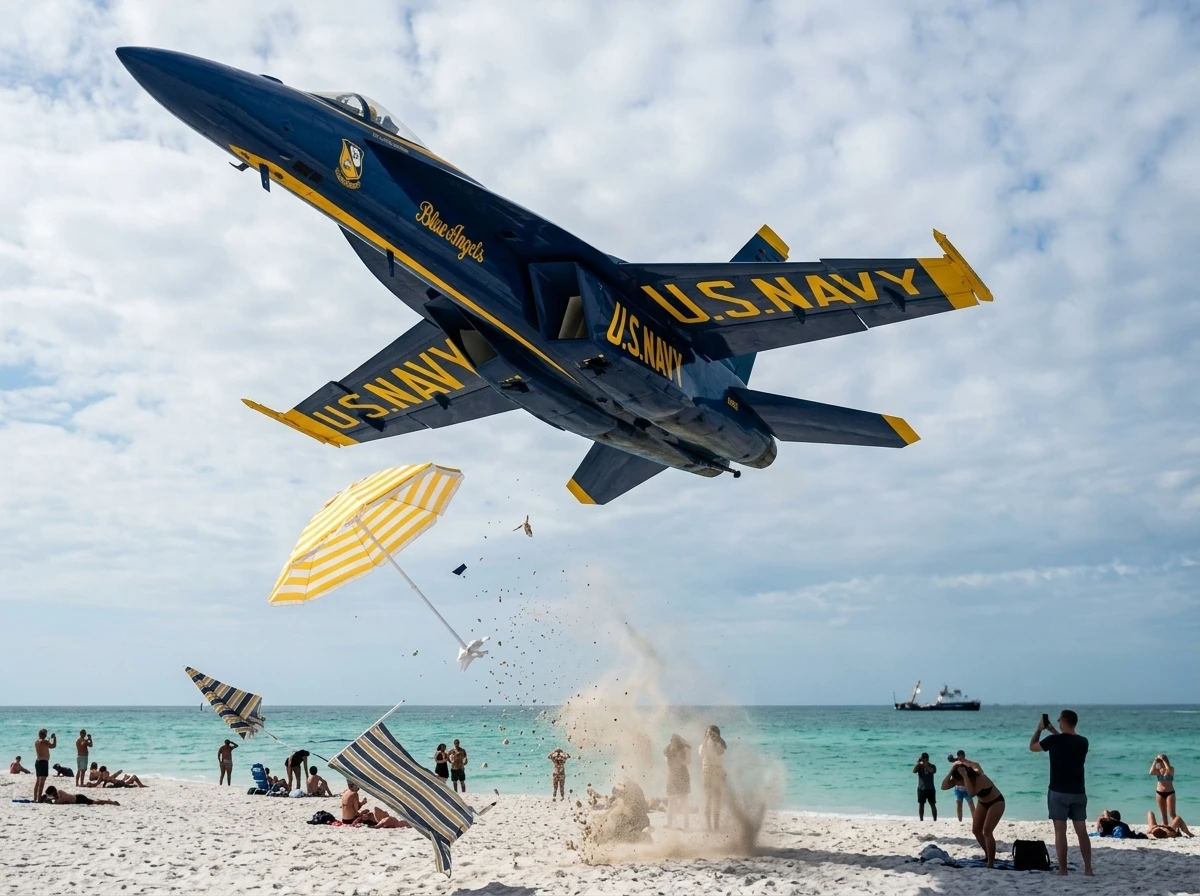
A Blue Angels fighter jet screamed low enough over Pensacola Beach on Wednesday to send tents, umbrellas and beach chairs tumbling across the sand. By Thursday, the Navy had cleared the pilot of any discipline. No injuries were reported, and the video went viral within hours, splitting reaction online.
Beachgoers who felt the jet’s wake called it the thrill of a lifetime. A former congressman called it reckless. In 2011, a Blue Angels commander stepped down for a maneuver he described in nearly identical terms to the one the Navy waved off this week.
The Pass That Sent Beach Gear Flying
Wednesday’s flight was supposed to be routine. It opened Red, White and Blues Week, the run-up to the annual Pensacola Beach Air Show, and thousands of people packed the sand for “Breakfast with the Blues,” a free morning practice session the squadron has flown for decades.
This year’s crowd ran bigger than usual. The Casino Beach and Quietwater parking lots filled by about 7 a.m., and spectators lined the shore for nearly two hours while the Blue Angels ran their routine over the Gulf. Brenda Bennett, who has attended the event for decades, told a local outlet, “I’ve been coming since 1997 and this is the best kept secret, but I think the secret’s out because there’s more people here than normally.”
Then one jet broke from the script. It dropped low, banked sideways over the crowd, and its wake tore through the beach. Chairs cartwheeled. Umbrellas collapsed. Tents folded over. Hats flew off heads.
“During an arrival maneuver, an aircraft flew lower than standard profiles, resulting in a disturbance on the beach that affected civilian chairs and umbrellas,” the Blue Angels said in a statement. One beachgoer, Samantha Mayne, said the jet felt so close she assumed it was the squadron’s cargo plane instead of a fighter: “It was so big we thought it was Fat Albert. It was huge because it was so close.”
The squadron, formally the U.S. Navy Flight Demonstration Squadron, flies the Boeing F/A-18 Super Hornet and a Lockheed Martin C-130J Super Hercules nicknamed Fat Albert, and is based at Naval Air Station Pensacola (NAS Pensacola, the squadron’s home in the Florida Panhandle). It is celebrating its 80th anniversary this year, a run that traces back to more than 5.9 million spectators by 1959 alone, according to the squadron’s own history.
Navy Clears the Pilot in a Day
By Thursday afternoon, the review was effectively over. Acting Secretary of the Navy Hung Cao wrote on X, “Flight debrief complete. No reprimands. No firings. No problem. That’s the sound of Freedom! Semper fi and Hooyah.”
That announcement came less than 24 hours after the squadron itself had struck a far more cautious tone, saying team leadership was “reviewing the circumstances surrounding the maneuver and conducting a thorough safety review to ensure all operations adhere to strict Navy and FAA safety standards.” The Federal Aviation Administration (FAA, the agency that regulates U.S. airspace) sets the civilian half of that standard. The Navy sets its own for demonstration flying.
The pilot who flew the pass has not been publicly identified. WEAR News, the ABC affiliate that first aired the video, reported separately that the Department of War, as the Trump administration now brands the Pentagon, had opened a formal investigation, even as Cao’s own statement suggested the matter was already closed.
How Low Can a Military Jet Legally Fly Over a Crowd?
Federal rules normally require aircraft to stay at least 1,000 feet above the ground within 2,000 feet of any open-air crowd. Air show performers fly under special waivers that let some passes drop to roughly 500 feet. Video from Wednesday showed the jet clearing spectators by what looked like just feet, well under even that waiver floor.
That gap is why the Blue Angels’ own wording carried weight. Calling the pass lower than standard profiles is a technical way of saying the jet broke its own approved plan, not a general rule written for someone else’s aircraft.
Pentagon Allies Cheer, Critics Call It Reckless
Senior officials treated the viral clip as something to celebrate rather than explain.
- Defense Secretary Pete Hegseth posted on X, “The flyovers will continue until morale improves.”
- Sean Parnell, the Pentagon’s chief spokesperson, shared a still from the video with the caption, “Carry on Patriots.”
- Eric Trump, the president’s son, shared a news report on the incident and wrote that he could not “stand the manufactured outrage by the low-T mainstream media.”
- Rep. Jimmy Patronis of Florida praised the pilots as “the best of the best” and credited the moment with boosting attention on Navy recruitment.
Not everyone was cheering.
This is not safe. I’m all for low passes, seriously but this is too much.
Adam Kinzinger, a former Republican congressman from Illinois, posted that reaction on X. Other users cited the string of recent low-altitude incidents involving military aircraft and civilians, calling the Pensacola pass “legitimately dangerous” compared with earlier flybys. One beachgoer, recorded on video, put it more bluntly, saying the group had gotten “sugar cookied” by the Blue Angels, Navy slang for getting sprayed by another aircraft’s wash.
The Third Low-Altitude Pass Without Punishment
Pensacola was not an isolated case. It was the third time in months that a low-altitude military flight over civilians ended without punishment.
| Date | Aircraft | Location | Outcome |
|---|---|---|---|
| Earlier this year | Two AH-64 Apache helicopters | Kid Rock’s home near Nashville, Tennessee | Hegseth lifted the pilots’ suspension; no investigation followed |
| July 4, 2026 | AH-64 Apache helicopters, South Carolina National Guard | South Carolina beaches | Eight pilots suspended, then reinstated days later |
| July 15, 2026 | Blue Angels F/A-18 Super Hornet | Pensacola Beach, Florida | Safety review closed with no reprimands or firings |
Each case followed a similar arc: a viral video, a brief suspension or review, then a senior official stepping in to call it fine. In the South Carolina case, the Guard described the suspension as “a routine, non-punitive safety measure,” not discipline at all.
The squadron’s own history once took a harder line. In 2011, Blue Angels Commander Dave Koss stepped down after flying what he called a maneuver with “an unacceptably low minimum altitude,” almost the same phrase the Navy used to describe Wednesday’s pass. Nobody asked him to leave. He did it himself.
Eighty Years of Risk Inside the Diamond Formation
The squadron’s history helps explain why a close pass draws such different reactions depending on who is watching.
- 27 pilots have died in Blue Angels training or demonstration accidents, according to a tally running through the 2017 season, a fatality rate close to 10 percent among the roughly 261 aviators who have flown with the team.
- 18 inches is about as tight as jets fly in the signature diamond formation, at speeds that can top 700 mph, according to a breakdown of the squadron’s risk factors.
- 2016 was the year of the squadron’s last fatal crash, when Capt. Jeff “Kooch” Kuss died practicing a Split S maneuver in Tennessee, a loss that led to mandatory rest periods for pilots.
- 2007 saw a jet crash during a show in Beaufort, South Carolina, killing the pilot and injuring eight people on the ground; a Navy investigation blamed disorientation brought on by heavy g-forces.
No pilot has died flying for the Blue Angels since 2016, a run of nearly a decade that made Wednesday’s pass a scare rather than a tragedy.
Two Shows Left This Week
Red, White and Blues Week closes with two more public performances, Friday and Saturday, when the full Blue Angels demonstration returns to Pensacola Beach. Nothing in the Navy’s statements points to any change in the routine or the arrival pass that broke from script on Wednesday.
The same jets fly this weekend. So does the same 500-foot floor nobody enforced the first time.


Google Opens Gmail to Voice and Gates Docs Live

Lenovo Prices the IdeaPad Vibe Against Apple’s $699 Neo

Xbox Caps Game Pass Cloud Gaming at 15 Hours

GTA 6 DualSense Controllers Follow Sony’s Usual $84.99 Script

South Korea Retail Investors Face Reckoning After KOSPI AI Rally Collapses

Surrey AI Maps Three Heart Attack Paths and Their Molecular Roots

Germany Locks Neutral Apple ATT Prompts Across Most of Europe

Apple’s 5% EU Fee Quietly Rewrites Alternative App Store Math

Apple’s EU Fee Truce Cuts Complexity but Leaves Rivals Fuming

Pixel 11 Pro Fold Trades Thinness for Durability and Seven-Year Stay

Oracle Cuts 21,000 Jobs in a Year, Cites AI in 10-K Filing

Fable 5 and Mythos 5 Return as US Lifts Anthropic Export Controls

SpaceX’s Google Deal Turns a Rocket Company Into a Cloud Landlord

CD Projekt Red Co-CEO: Redemption Arc Isn’t Done, Witcher 4 in 2027

XPL Rallies 30% Ahead of Plasma One Card Tier Launch

Google Search Profiles Build a Follow Graph Inside Discover

DGO App Brings Rs 549 Mobile Pass for FIFA World Cup 2026 in Nepal

Moonshot AI Targets $30 Billion in China’s Fastest AI Funding Sprint

Oppo’s ColorOS 17 Eligibility List Leaves A-Series Buyers Behind

Microsoft Xbox Layoffs Start in July as Sharma Slams 3% Margin
-
 AI2 months ago
Oracle Cuts 21,000 Jobs in a Year, Cites AI in 10-K Filing
-
 AI2 months ago
Fable 5 and Mythos 5 Return as US Lifts Anthropic Export Controls
-
 AI3 months ago
SpaceX’s Google Deal Turns a Rocket Company Into a Cloud Landlord
-
 GAMING2 months ago
CD Projekt Red Co-CEO: Redemption Arc Isn’t Done, Witcher 4 in 2027
-
 CRYPTO3 months ago
XPL Rallies 30% Ahead of Plasma One Card Tier Launch
-
 NEWS3 months ago
Google Search Profiles Build a Follow Graph Inside Discover
-
 APPS3 months ago
DGO App Brings Rs 549 Mobile Pass for FIFA World Cup 2026 in Nepal
-
 AI3 months ago
Moonshot AI Targets $30 Billion in China’s Fastest AI Funding Sprint