
NEWS
Redmi Note 17 Battery Wins by Leaving Power Behind
Redmi Note 17 5G packs an 8000mAh silicon-carbon cell that lasts days, yet its Snapdragon 4 Gen 4 trails last year’s Note and midrange rivals on speed.

The Redmi Note 17 5G goes on open sale today in India from Rs 27,999 packing an 8000 mAh silicon-carbon battery that Xiaomi calls its biggest ever in the Note line. That single number erases charge anxiety for most users and sets the phone apart in a crowded mid-range field. It also forces every other choice on the device.
Sale starts on Amazon and the Xiaomi store after the August 6 launch. Colors are Dark Night, Arctic Blue and Starlight Purple. The 6 GB + 128 GB model sits at Rs 27,999; the 8 GB + 128 GB climbs to Rs 30,999.
An 8000 mAh Cell That Rewrites Daily Rhythm
Redmi fitted a high-density silicon-carbon cell managed by the Surge G1 chip and rated at 8000mAh typical capacity and full specs. Official claims put light use past three days. Heavy days of maps, streaming, social apps and light gaming still clear a full 24 hours with room left.
- 8000 mAh Si/C cell, largest Redmi Note battery to date
- 45W wired turbo charging, charger included in the box
- 22.5W reverse wired charging for accessories or another phone
- Beyond two days typical mixed use per Xiaomi lab framing
Silicon-carbon chemistry lets makers pack far more energy into the same volume because silicon holds roughly ten times the capacity of graphite by weight. The trade-off is greater expansion during charge cycles, which can shorten lifespan if left unmanaged. Xiaomi’s Surge G1 monitors health and throttles rates to keep degradation in check. The body stays 8.4 mm thick and 225 g despite the cell. Earlier leaks had pointed at even larger packs for the line; the earlier 9000mAh mid-range battery tips landed on the Pro models instead.
The Hindu’s hands-on found battery anxiety simply gone. Even mixed heavy sessions left charge after a full day. That matches the FAQ promise of up to 3-plus days of light usage. Buyers who hate evening plugs will notice first.
The cell changes how the phone is used across a week, not just a day. Light users can skip the charger from Monday into Thursday. Heavy users still finish the evening with reserve instead of hunting for a cable. Reverse charging at 22.5W turns that reserve into a practical backup for earbuds or a second handset when outlets are scarce.
Capacity this large also softens the impact of moderate charging speed. Forty-five watts is not the fastest figure in the segment, yet the pack starts each top-up from a higher floor. Shorter daily sessions at the wall become enough for most routines. The included charger removes one extra purchase from the unboxing list.
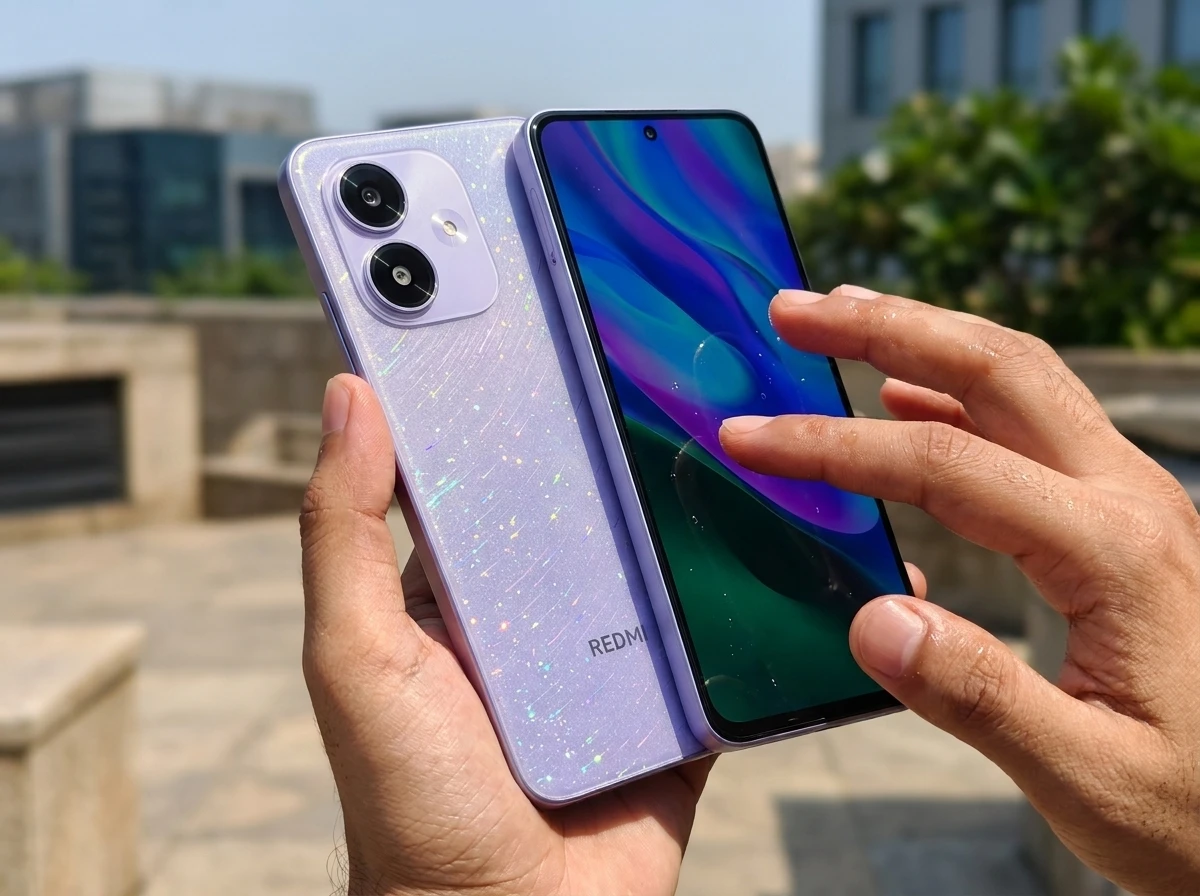
The Big Screen Stays Responsive When Hands Get Wet
The front is a 17.75 cm (roughly 6.9-7.0 inch) flat TrueColour AMOLED running 2396 × 1080 at up to 120 Hz. Peak brightness hits 1800 nits. It covers the full DCI-P3 gamut and carries TÜV eye-care certification plus 960 Hz PWM dimming. Touch sampling reaches 240 Hz normal and 2160 Hz in select games. HydroTouch 2.0 keeps the panel alive when fingers are wet, soapy or greasy.
Outdoor maps and streaming stay readable. Long sessions feel easier on the eyes than older LCDs in the same price band. The size makes the phone taller and wider than the Note 15’s more compact panel, yet the thin profile keeps it from feeling brick-like. Gorilla Glass 7i covers the front. IP65 rating handles dust and low-pressure water jets. Dual speakers sit without a 3.5 mm jack.
HydroTouch 2.0 matters most outside clean office conditions. Field workers, kitchen users and commuters in rain keep full control without wiping the glass first. High touch sampling in games pairs with that wet-finger tolerance, so casual matches stay playable even when hands are not dry.
The flat AMOLED choice favors uniform brightness and simpler screen protectors over curved drama. Full DCI-P3 coverage and 1800 nits keep HDR streaming and midday navigation legible. PWM dimming at 960 Hz plus TÜV certification aim at buyers who scroll late and want less eye strain than older LCD panels delivered at this price.
Snapdragon 4 Gen 4 Chooses Efficiency Over Punch
Power comes from the Snapdragon 4 Gen 4 on a 4 nm process. The octa-core setup peaks at 2.3 GHz with an Adreno GPU. Daily apps, multitasking and 1080p video stay smooth thanks to HyperOS 3 tuning and a large graphite cooling layer. Benchmarks tell a different story.
| Device / Chip | AnTuTu (approx) | Geekbench Single / Multi | Notes |
|---|---|---|---|
| Redmi Note 17 / 4 Gen 4 | 623k-629k | 943 / 2307 | Review unit scores |
| Redmi Note 15 (prior) | Higher | 1015 / 2933 | Predecessor edge |
| Motorola Edge 70 Fusion | ~1.15M | 1242 / 3454 | Segment rival |
| OnePlus Nord CE 6 | ~1.14M | 1098 / 3111 | Segment rival |
The numbers lag the previous Note and current rivals by a clear margin. Gaming holds moderate settings in BGMI or Call of Duty Mobile. Demanding titles like Genshin Impact expose frame drops and mild heat on longer sessions. Redmi optimized for battery life first. Power users and serious gamers will feel the gap. Crowds on X already split on whether the endurance premium justifies the SoC at this price.
Efficiency is the point of the 4 nm choice here. The same graphite layer that limits heat also helps the large cell last longer under mixed loads. HyperOS 3 keeps everyday multitasking fluid even when raw benchmark totals trail the Note 15 and the Motorola or OnePlus alternatives.
Buyers who stay inside social apps, maps, video and light games will rarely notice the ceiling. Those who push Genshin Impact or want the highest stable frame rates already have clearer options in the same broad price band. The split on X reflects that fork in priorities rather than a surprise in the spec sheet.
Cameras Stay Capable, Software Stretches to 2032
The rear holds a 50 MP main sensor with f/1.8 aperture and 5P lens plus a secondary unit. The front is 8 MP. Daylight shots keep natural colors and solid dynamic range without heavy saturation. Night mode lifts shadows without blowing highlights. 2x in-sensor zoom works for casual close-ups. Portraits deliver usable edge detection. Selfies stay balanced for social use but trail higher-megapixel rivals.
HyperOS 3 on Android 16 ships with four years of OS upgrades and six years of security patches. That support window runs into 2032. Features lean practical: HyperIsland notifications, adaptive resource management, AI tools that stay in the background, and Battery Health 4.0. No flashy gimmicks. The focus is keeping the phone fluent for buyers who keep devices four or five years.
- 4 years of Android OS updates
- 6 years of security patches
- AI Night Mode, HDR, Dynamic Shots and Editor
- Long-Term Fluency Engine for sustained smoothness
The package includes the 45W charger, case, pre-applied screen protector and cable.
Camera behaviour matches the rest of the brief. Natural color and controlled night highlights suit social sharing and documentation more than studio work. In-sensor 2x zoom covers quick close-ups without a dedicated telephoto. The 8 MP front camera stays adequate for calls and stories while higher-megapixel rivals pull ahead on crop room.
Software length is the quieter half of the value case. Four OS upgrades and six years of security patches push the device into 2032 for buyers who dislike frequent replacements. Battery Health 4.0 and the Long-Term Fluency Engine aim to keep that long window feeling usable rather than merely secure.
Price Points and the Buyers Who Match
At Rs 27,999 and Rs 30,999 the phone undercuts some flashier mid-rangers while undercutting none on battery capacity. Instant bank discounts of Rs 3,000 have appeared on early listings. It suits heavy media consumers, navigation users, and anyone who cannot charge midday. Students, field workers and multi-day travelers fit the profile. Gamers chasing high frame rates or creators needing faster multi-core will look at the Motorola or OnePlus options, or wait for higher Note Pro variants.
The India launch details from early August already framed the battery as the headline. The Pro sibling pushes durability further with higher IP ratings and a larger cell; its tougher Pro sibling durability claims sit one tier up for buyers who want both endurance and toughness.
Bank offers that trim Rs 3,000 lower the entry cost further for shoppers who time the purchase. The two memory tiers keep the decision simple: 6 GB for lighter multitasking, 8 GB for users who keep more apps open. Neither configuration changes the battery or display story.
- Heavy media and navigation users who need all-day maps and streaming
- Students and field workers without reliable midday charging
- Multi-day travelers who treat the phone as a hotspot and camera
- Anyone comparing pure endurance ahead of peak frame rates
Where the Note 17 Lands Against Its Own Past and Rivals
| Feature | Note 17 5G | Note 15 (prior) | Typical Rival |
|---|---|---|---|
| Battery | 8000 mAh Si/C | ~5500-6000 mAh | 7000 mAh class |
| Display | 6.9-7″ 120 Hz AMOLED 1800 nits | Smaller, higher peak nits | 1.5K or 144 Hz options |
| Chip performance | Entry midrange 4 Gen 4 | Stronger multi-core/GPU | Higher AnTuTu tiers |
| Software support | 4 OS + 6 security | Shorter windows common | Varies 3-5 years |
| Charging | 45W + reverse 22.5W | Similar or higher wattage | Often 45-80W |
The Note 17 improves battery life dramatically over its predecessor while accepting a performance step back on paper. Against current rivals it wins pure endurance and screen size, then concedes raw speed and sometimes resolution or camera resolution. The irony sits in plain view: the feature that makes the phone special also defines its limits. Buyers who prioritize days between charges get exactly that. Everyone else will measure the gap on their own apps and games.
The comparison table makes the exchange rate clear. Battery and software support move forward. Chip scores and some display or camera peaks move sideways or back. Rivals that post AnTuTu totals near 1.14M or 1.15M still trail on cell size. Shoppers decide which column matters more for their own week.
How the Large Cell Guides the Rest of the Design
The opening claim still holds: the 8000 mAh pack forces every other choice. Thickness stays at 8.4 mm and weight at 225 g only because silicon-carbon chemistry raises energy density. A conventional graphite cell at this capacity would have pushed the body thicker or heavier. Surge G1 management exists to contain the expansion trade-off that comes with that chemistry.
Chip selection follows the same logic. The Snapdragon 4 Gen 4 on 4 nm favors sustained efficiency over peak scores that would drain the pack faster under load. Graphite cooling and HyperOS 3 tuning reinforce that bias. Benchmark gaps versus the Note 15 and versus the Motorola Edge 70 Fusion or OnePlus Nord CE 6 are the visible cost of that choice.
Display size and 120 Hz operation become easier to live with when the cell can fund them for a full day and beyond. HydroTouch 2.0 and IP65 protection fit users who take the phone into wet or dusty settings where charging opportunities are irregular. Even the decision to ship the 45W charger and a case in the box reduces friction for buyers who want the endurance story working on day one.
Pro variants absorb the larger cell tips and higher durability ratings that earlier leaks suggested for the wider line. The standard Note 17 keeps the headline battery while landing at Rs 27,999 and Rs 30,999. That split lets shoppers match toughness and capacity to budget without losing the core endurance brief.
What the Support Window Means Through 2032
Four years of OS upgrades and six years of security patches stretch the useful life well past the usual mid-range cycle. A device bought at launch can still receive security updates into 2032. That timeline pairs with Battery Health 4.0 and the Long-Term Fluency Engine so the hardware side of aging stays in view alongside the software side.
- August 6 – launch event sets the battery as the lead story
- Open sale day – Amazon and Xiaomi store listings go live at Rs 27,999 and Rs 30,999
- Support horizon – OS and security updates run into 2032
Long support changes the math for students, field workers and travelers already drawn to the cell. Replacing a phone less often offsets the performance gap against flashier rivals for anyone whose apps stay inside the Snapdragon 4 Gen 4 comfort zone. AI tools that remain in the background and HyperIsland notifications keep daily use simple rather than adding features that age poorly.
The same window also raises the stakes on battery longevity. Surge G1 throttling and Battery Health 4.0 exist so an 8000 mAh advantage does not fade after a year of charge cycles. Buyers who plan to keep the handset four or five years are the audience that framing serves.
Sale is live today. The 8000 mAh cell will decide most purchase conversations for the next few weeks.


Google Opens Gmail to Voice and Gates Docs Live

Lenovo Prices the IdeaPad Vibe Against Apple’s $699 Neo

Xbox Caps Game Pass Cloud Gaming at 15 Hours

GTA 6 DualSense Controllers Follow Sony’s Usual $84.99 Script

South Korea Retail Investors Face Reckoning After KOSPI AI Rally Collapses

Surrey AI Maps Three Heart Attack Paths and Their Molecular Roots

Germany Locks Neutral Apple ATT Prompts Across Most of Europe

Apple’s 5% EU Fee Quietly Rewrites Alternative App Store Math

Apple’s EU Fee Truce Cuts Complexity but Leaves Rivals Fuming

Pixel 11 Pro Fold Trades Thinness for Durability and Seven-Year Stay

Oracle Cuts 21,000 Jobs in a Year, Cites AI in 10-K Filing

Fable 5 and Mythos 5 Return as US Lifts Anthropic Export Controls

SpaceX’s Google Deal Turns a Rocket Company Into a Cloud Landlord

CD Projekt Red Co-CEO: Redemption Arc Isn’t Done, Witcher 4 in 2027

XPL Rallies 30% Ahead of Plasma One Card Tier Launch

Google Search Profiles Build a Follow Graph Inside Discover

DGO App Brings Rs 549 Mobile Pass for FIFA World Cup 2026 in Nepal

Moonshot AI Targets $30 Billion in China’s Fastest AI Funding Sprint

Oppo’s ColorOS 17 Eligibility List Leaves A-Series Buyers Behind

Microsoft Xbox Layoffs Start in July as Sharma Slams 3% Margin
-
 AI2 months ago
Oracle Cuts 21,000 Jobs in a Year, Cites AI in 10-K Filing
-
 AI2 months ago
Fable 5 and Mythos 5 Return as US Lifts Anthropic Export Controls
-
 AI3 months ago
SpaceX’s Google Deal Turns a Rocket Company Into a Cloud Landlord
-
 GAMING2 months ago
CD Projekt Red Co-CEO: Redemption Arc Isn’t Done, Witcher 4 in 2027
-
 CRYPTO3 months ago
XPL Rallies 30% Ahead of Plasma One Card Tier Launch
-
 NEWS3 months ago
Google Search Profiles Build a Follow Graph Inside Discover
-
 APPS3 months ago
DGO App Brings Rs 549 Mobile Pass for FIFA World Cup 2026 in Nepal
-
 AI3 months ago
Moonshot AI Targets $30 Billion in China’s Fastest AI Funding Sprint