
NEWS
HarmonyOS 7 Gaming Tools Cut Power While Lifting Frames
HarmonyOS 7 brings AI super-resolution, 13.6% higher frames at 21.4% less power, foldable split controls and hardware ray tracing to Huawei phones.

Huawei’s closed beta of HarmonyOS 7 already ships one-second game launches, and a fresh SDK drop shows the rest of the package: AI super-resolution, AI super-frame that lifts average frame rates 13.6% while cutting power 21.4%, a foldable-only control-and-display split, hardware ray-tracing acceleration, and refined Game HDR. The numbers matter less for the pretty screenshots than for what they do to session length and heat on devices that already carry large batteries and advanced NPUs.
These tools sit inside the same vertical stack that powers the rest of the OS update. The second-order result is longer, cooler play on foldables that now behave more like dedicated handhelds, plus a clearer path for developers to ship native titles that stay inside Huawei’s ecosystem.
The AI Pair That Trades Power for Pixels
AI super-resolution runs on the device NPU and GPU. It reconstructs frames beyond the panel’s native resolution so games look sharper without the full cost of rendering every extra pixel from scratch. In a HDC 2026 demo of the title Yihuan, the tech lifted rendered resolution to 1080P and claimed 1.5 times higher clarity on fine details such as underwater light shafts and fish schools.
The reconstruction step matters because mobile GPUs already run near their thermal ceiling. By handing detail recovery to the NPU, the pipeline avoids a full high-resolution render pass and still delivers a sharper final image. That trade keeps the GPU freer for lighting and geometry work.
AI super-frame works the other side of the same coin. It uses NPU cycles to generate or smooth frames, cutting visual stutter during motion while the average power draw falls. Huawei’s figures put the average frame-rate gain at 13.6% and the average power reduction at 21.4%.
| Feature | Reported Gain | Reported Power Change |
|---|---|---|
| AI Super-Frame | +13.6% average FPS | -21.4% average power |
| Separate Control and Display | +30% picture quality | -9.2% game power |
| Game Launch | 1 second start | N/A |
Both features lean on edge-side compute rather than cloud offload. That keeps latency low and works even when the phone has no strong signal, a practical edge for mobile sessions.
Running the pair together multiplies the benefit. Super-resolution raises perceived sharpness while super-frame fills motion gaps, so the player sees a smoother, cleaner image without asking the GPU to render every pixel at the final rate. The NPU absorbs the extra work, which is why average power can fall even as the picture improves.
Foldables Get a Proper Handheld Layout
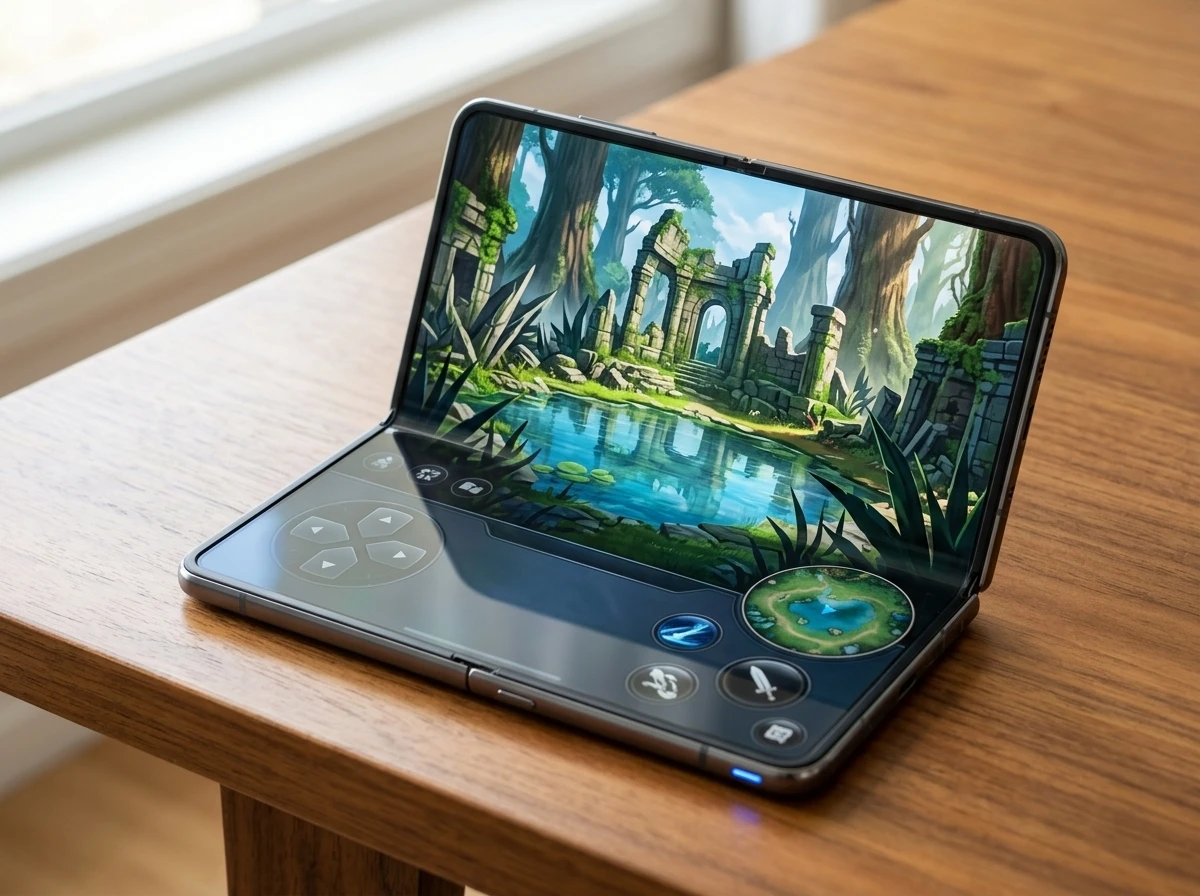
Separate Control and Display is built for foldables. The upper half of the open screen stays dedicated to the rendered game world. The lower half becomes a fixed control deck with virtual buttons, sticks and status info. Huawei says the layout delivers a new immersive handheld feel, with 30% better picture quality and 9.2% lower game power draw.
The split arrives from API 26.0.0 and currently needs Vulkan. It echoes classic dual-screen handhelds without forcing a full redesign of every title. On a large inward-folding panel the upper image can stay large and uncluttered while thumbs rest naturally on the lower half.
- Upper screen carries full game rendering only
- Lower screen hosts controls, mini-map and system overlays
- Claims 30% picture-quality lift and 9.2% power cut
- Targets foldables first; Vulkan path required
That layout pairs cleanly with the next Mate fold design direction Huawei has been exploring. A phone that already opens into a near-square canvas suddenly gains a purpose-built control surface without external controllers.
Because the control deck no longer overlays the game world, the renderer can devote the full upper panel to the scene. Status icons and sticks stop competing for pixels, which helps explain the claimed picture-quality gain. Lower power follows when the UI layer stops being composited over a full-screen 3D pass on every frame.
Ray Tracing Moves From Chip to System
Hardware ray-tracing acceleration is now listed for HarmonyOS 7. Lighting, reflections and shadows update in real time with the scene instead of relying solely on baked maps or screen-space approximations. On the Mate 80 Pro Max Wind Edition the company has already shown 30 million concurrent rays in Dark Zone Survival while holding 90 fps with balanced ray-tracing enabled.
The same Computer Graphics Kit that Huawei publishes for developers already lists real-time ray tracing and super resolution tools alongside volumetric clouds, fog and occlusion culling. The OS update simply surfaces more of that stack to a wider set of titles and devices.
Beta testers have posted short clips of real-time physical lighting effects under HarmonyOS 7 builds shown at ChinaJoy. The effect is still hardware-dependent, but the software path is now explicit.
Making the path explicit changes the developer calculation. Studios no longer need private chip docs or one-off engine forks to try ray-traced lighting. They can target the documented flags, test on shipping silicon such as the Mate 80 Pro Max Wind Edition, and ship the same binary path to any device that exposes the acceleration.
Game HDR Gets Flexible Tone Mapping
Game HDR receives three practical upgrades: flexible adjustment, hue-preserving tone mapping, and inverse tone mapping so SDR content can better match HDR panels. The SDR-to-HDR path restores contrast and recovers light-and-shadow detail that older pipelines flattened.
Hue-preserving tone mapping keeps colors stable when brightness shifts. Without it, saturated objects can drift toward gray or neon as the mapper compresses highlights. Flexible adjustment lets the system or the title tune the curve per scene rather than locking one static map for the whole session.
The most immediately noticeable change for many users is launch speed. Games such as Genshin Impact and Roco Kingdom already open in roughly one second on HarmonyOS 7 developer and Pollen beta builds. That figure matches the “game second start” promise first floated with SDK 26 in June.
- June 2026, HarmonyOS SDK 26 launches with game second-start capability listed
- July-August 2026, ChinaJoy booth and beta builds show 1-second launches live
- August 2026, SDK game-feature package (AI super-res, super-frame, split display, RT) shared publicly
The same beta wave also brought the HarmonyOS 7 beta camera format shift from JPG to HEIF. Small storage and pipeline wins accumulate across the system.
Earlier Super Frame and the Wider Mobile Race
Huawei first talked about a Super Frame Game Engine back in the HarmonyOS 3 era. That earlier work already aimed at higher frame rates with lower power. The new AI super-frame is a clearer NPU-centric evolution of the same idea, now paired with super-resolution and explicit hardware ray-tracing support.
On the broader market the move mirrors what Qualcomm and others have shipped. The Snapdragon Game Super Resolution approach likewise uses temporal data and on-device AI to upscale and smooth frames. Apple’s metal and Neural Engine paths follow similar logic. Huawei’s version is simply tuned to its own NPU, GPU and Kirin silicon, and it arrives as a first-class OS feature rather than a chip-vendor add-on.
| Approach | Compute Focus | Delivery Model |
|---|---|---|
| Huawei AI Super-Frame / Super-Res | Own NPU, GPU, Kirin | First-class OS feature |
| Snapdragon Game Super Resolution | On-device AI, temporal data | Chip-vendor add-on |
| Apple Metal / Neural Engine | Neural Engine paths | Platform graphics stack |
The practical difference is control. Because Huawei owns the OS, the chip and the large foldable panels, the power and thermal budgets can be co-tuned more tightly than on a generic Android skin. That is where the second-order effect appears: sessions that used to throttle after 20-30 minutes can now run longer before fans or frame drops intervene. Huawei’s parallel active cooling plans for sustained loads only reinforce the same goal.
Who Gains From Cooler, Longer Sessions
Foldable owners sit at the front of the line. A device that already costs a premium and opens into a large canvas suddenly gains a purpose-built control layout and measurable power savings. The upper-screen image stays large and sharp; thumbs stay on the lower deck; battery drain slows.
Native-game developers gain a clearer checklist: Vulkan path, AI super-res hooks, ray-tracing flags, and a documented second-start path. Huawei already counts more than 30,000 games on the Harmony platform and more than 1,000 partner studios. Tools that make those titles look and run better on flagship hardware give studios a reason to keep optimizing for the store that is still growing inside China.
Casual players simply notice games that open instantly and stay smooth longer. Heat and battery have always been the quiet killers of mobile sessions. Cutting average power more than 20% while raising frames is the kind of change that turns a 40-minute bus ride into a full level or two without the phone becoming uncomfortable.
- Foldable users get immersion and efficiency in one layout
- Developers get system-level hooks instead of one-off patches
- Heavy gamers gain longer thermal headroom
- Huawei gains stickier native titles inside its own store
The features remain labeled as under consideration for the stable release, yet several pieces (instant launch, early ray-tracing demos) are already visible in public beta builds. The SDK packaging makes the rest of the stack easier to ship once the final OS lands later this year.
Power and Heat Shape the Whole Session
Frame rate and resolution grab the headlines, yet the session itself is limited by heat and battery. A 21.4% average power cut from AI super-frame and a further 9.2% game-power cut from the foldable split both push in the same direction. Less energy per minute means the battery lasts longer and the chassis stays cooler.
Cooler silicon holds boost clocks for more of the session. That is why the same 13.6% average frame-rate gain can feel larger in the final half-hour of play than in the first five minutes. Throttling that once arrived after 20-30 minutes now has more headroom before it intervenes.
Active cooling plans for sustained loads reinforce the same loop. Software that draws less and hardware that sheds heat faster keep the device inside its comfort band. Players finish the level instead of pausing to let the phone cool.
- AI super-frame trims average power by 21.4%
- Separate Control and Display trims game power by 9.2%
- Longer boost windows protect the frame-rate gain late in a session
- Cooling hardware and software savings work as one budget
The SDK Gives Studios One Checklist
The August 2026 SDK game-feature package bundles AI super-resolution, AI super-frame, the split display path, and ray-tracing support in one drop. Developers no longer chase separate previews for each piece. One package, one API floor at 26.0.0, and a Vulkan requirement for the foldable layout set a single target.
That clarity matters for the more than 1,000 partner studios already on the platform. A studio can schedule engine work against a known list rather than waiting for piecemeal docs. Instant launch, already live for titles such as Genshin Impact and Roco Kingdom on beta builds, shows the path is not theoretical.
When the stable OS lands later this year, the same hooks that beta testers already exercise become the default surface for new releases. Titles optimized against the checklist stay native, keep their visual and power gains, and remain inside the store that counts more than 30,000 games today.
The graphics will look better. The quieter win is that the same phone will stay cooler and last longer while it does the looking.


South Korea Retail Investors Face Reckoning After KOSPI AI Rally Collapses

Surrey AI Maps Three Heart Attack Paths and Their Molecular Roots

Germany Locks Neutral Apple ATT Prompts Across Most of Europe

Apple’s 5% EU Fee Quietly Rewrites Alternative App Store Math

Apple’s EU Fee Truce Cuts Complexity but Leaves Rivals Fuming

Pixel 11 Pro Fold Trades Thinness for Durability and Seven-Year Stay

Mayo AI Flags HCM Obstruction From Everyday Ultrasound Videos

Indian Brands Quietly Scale Landmark Screens and Home Tech

Navin Vatsa Turns Grief Into a Lifetime of Quiet Seeing

Google Bets Pixel 11 Agentic AI Will Redefine Phones

Oracle Cuts 21,000 Jobs in a Year, Cites AI in 10-K Filing

Fable 5 and Mythos 5 Return as US Lifts Anthropic Export Controls

SpaceX’s Google Deal Turns a Rocket Company Into a Cloud Landlord

CD Projekt Red Co-CEO: Redemption Arc Isn’t Done, Witcher 4 in 2027

XPL Rallies 30% Ahead of Plasma One Card Tier Launch

Google Search Profiles Build a Follow Graph Inside Discover

DGO App Brings Rs 549 Mobile Pass for FIFA World Cup 2026 in Nepal

Moonshot AI Targets $30 Billion in China’s Fastest AI Funding Sprint

Oppo’s ColorOS 17 Eligibility List Leaves A-Series Buyers Behind

Microsoft Xbox Layoffs Start in July as Sharma Slams 3% Margin
-
 AI2 months ago
Oracle Cuts 21,000 Jobs in a Year, Cites AI in 10-K Filing
-
 AI2 months ago
Fable 5 and Mythos 5 Return as US Lifts Anthropic Export Controls
-
 AI3 months ago
SpaceX’s Google Deal Turns a Rocket Company Into a Cloud Landlord
-
 GAMING2 months ago
CD Projekt Red Co-CEO: Redemption Arc Isn’t Done, Witcher 4 in 2027
-
 CRYPTO3 months ago
XPL Rallies 30% Ahead of Plasma One Card Tier Launch
-
 NEWS3 months ago
Google Search Profiles Build a Follow Graph Inside Discover
-
 APPS3 months ago
DGO App Brings Rs 549 Mobile Pass for FIFA World Cup 2026 in Nepal
-
 AI3 months ago
Moonshot AI Targets $30 Billion in China’s Fastest AI Funding Sprint