
GADGETS
OpenAI’s $230 Codex Micro Keypad Signals a Bigger AI Hardware Trend
OpenAI’s first hardware, the $230 Codex Micro keypad built with Work Louder, ships as rivals race to give AI its own physical button.

OpenAI shipped its first hardware product this week: a $230 keypad called Codex Micro, built with keyboard maker Work Louder to give developers physical controls over its AI coding agents. Pre-orders opened Wednesday, with shipping estimated for July 24. The launch lands five days after Apple sued OpenAI over an unrelated hardware project, accusing the company of stealing trade secrets.
Codex Micro looks like a novelty for a few thousand power users, and in dollar terms it probably is. But it also fits a pattern nobody has quite named yet. Microsoft put a dedicated AI key on its keyboards two years ago, and Nokia’s owner just did the same on feature phones costing a fraction of Codex Micro’s price. A physical button is becoming the AI industry’s preferred answer for how people reach a model.
Six Glowing Keys
OpenAI calls the device a “command center for agentic work.” Officially, it is the kbd-1.0-codex-micro, a name that reads like a version number because that is exactly how OpenAI is treating it.
OpenAI first showed the pad in silhouette on June 29 at the AI Engineer World’s Fair in San Francisco. The teaser clip, captioned about upgraded Codex shortcuts, pulled in nearly a million views within 24 hours. When pre-orders opened, OpenAI’s developer account kept it short: “Yes, we heard you”, followed by a link to buy one.
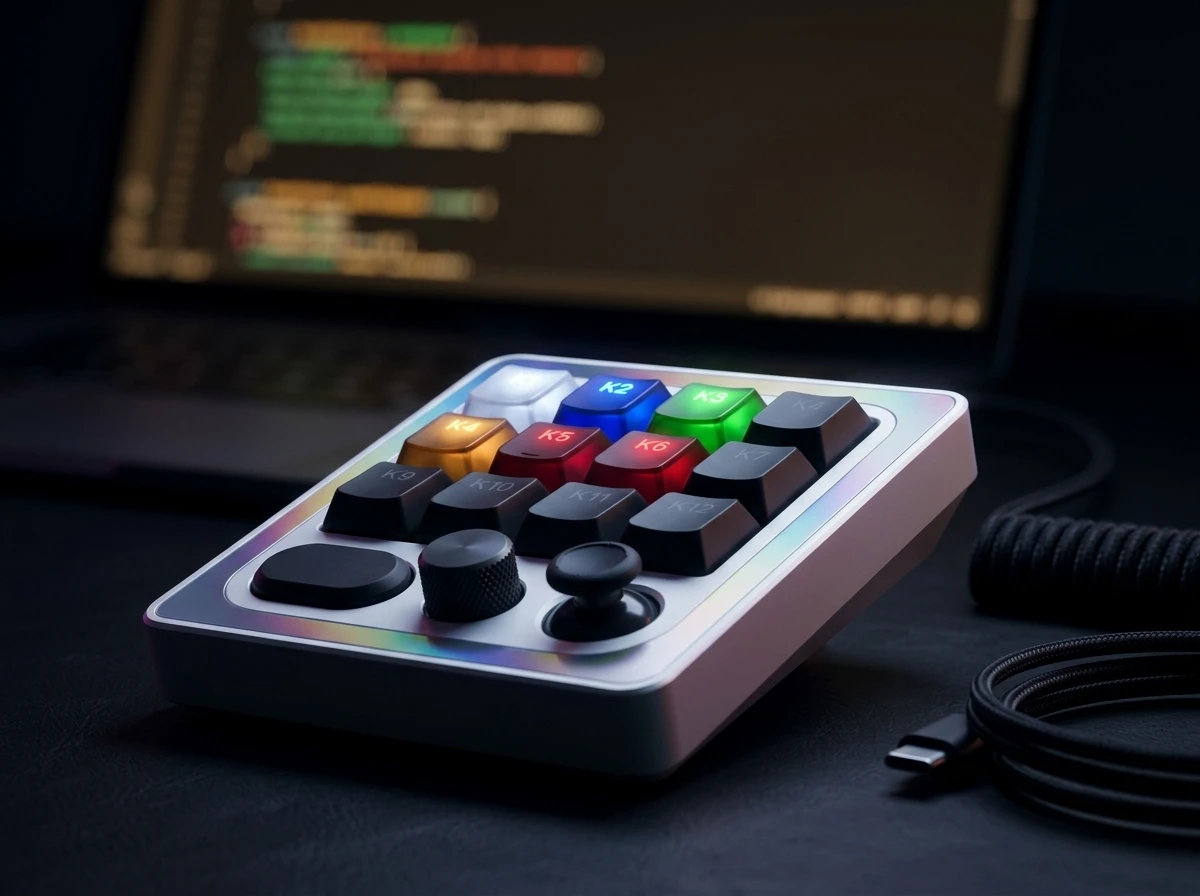
The square pad packs 13 mechanical switches, a touch sensor, a rotary dial and a planar joystick into a case machined from polycarbonate and aluminum, finished with a sandblasted anodized aluminum bottom panel.
It ships in clicky and silent switch variants, connects over Bluetooth or USB-C, and works with both Mac and Windows. OpenAI’s own product listing pitches it as a way to map your most-used Codex actions to tactile controls instead of hunting through menus.
- Agent Keys – six frosted, illuminated keys that mirror a live Codex thread: white for idle, blue for thinking, green for finished, amber when an agent needs input, and red for an error.
A single tap on an Agent Key jumps to that thread. A double tap brings it to the front. Work Louder co-founder Mike Di Genova walked through the scheme in a demo video, explaining that the colors let a developer glance at the pad instead of alt-tabbing through a stack of windows.
- A rotary dial for adjusting Codex’s reasoning level (how much time and compute an agent spends on a task) without opening a settings menu
- A planar joystick for launching saved workflows, like reviewing a pull request, debugging an error or refactoring code
- Command Keys for frequent actions such as accepting or rejecting code, push to talk, or starting a new chat
- 32 extra icon keycaps and six programmable layers, remapped through the ChatGPT desktop app or Work Louder Input
Every key can be reassigned. The bundled keycaps exist so a developer’s version of the pad ends up looking nothing like the factory default.
Codex Users Tripled Before This Keyboard Even Shipped
OpenAI is not building this for a small crowd. Weekly active users on Codex climbed from 3 million in early April to 4 million by the end of that month, after an update added Computer Use and image generation. By mid-July, following the launch of GPT-5.6 and a unified ChatGPT desktop app that folds Codex into one super app, that figure hit 8 million, with the most recent counts nearing 9 million.
Tibo Sottiaux, the engineering lead for Codex at OpenAI, suggested combined Codex and ChatGPT Work usage was nearing 8 million within days of the update, a surge covered as GPT-5.6 pushed Codex past 8 million users in days.
Within hours of OpenAI’s earlier 7 million milestone, Anthropic extended Claude Fable 5’s promotional pricing through July 19 and raised Claude Code’s weekly usage limits by 50%.
Trade coverage has taken to calling this crowd “agentmaxxers,” developers who spend entire days supervising fleets of coding agents instead of writing code by hand. That growth is the actual business case for Codex Micro: a keyboard accessory only makes sense once the audience managing multiple agents at once is large enough to notice.
Work Louder Has Run This Playbook Twice Before
Work Louder is not new to this kind of arrangement. The company built its Figma Creator Micro in December 2023, shipping it with pre-configured Figma shortcut keys and matching icon keycaps. A Framer Creator Micro 2 followed the same formula, tuned for Framer’s prototyping tools. Codex Micro is the third time Work Louder has reskinned its own hardware for someone else’s software.
| Partner | Product | Launched | Detail |
|---|---|---|---|
| Figma | Figma Creator Micro | December 2023 | Pre-configured Figma shortcut keys and matching icon keycaps |
| Framer | Framer Creator Micro 2 | After the Figma launch | Same macro pad chassis, tuned for prototyping workflows |
| OpenAI | Codex Micro (kbd-1.0-codex-micro) | July 15, 2026 | $230, limited run, RGB Agent Keys tied to Codex |
OpenAI calls Codex Micro a limited-run collaboration, sold only while supplies last, and Work Louder’s own store page warns stock is a “limited quantity.” Work Louder’s unbranded Creator Micro 2 already sells for a comparable price, so OpenAI is not charging much of a premium for the Codex-specific firmware.
From One Copilot Key to a Whole Control Surface
Codex Micro has a direct ancestor. Microsoft added a dedicated Copilot key to some Windows keyboards in January 2024: one button that summoned a chatbot. Two years later, OpenAI has built an entire control surface instead, aimed at people who spend their day managing autonomous agents rather than typing single questions.
The same instinct just showed up at the opposite end of the market. HMD recently put a dedicated AI button on Nokia’s feature phones, wrapped around a 180-day free trial before the subscription meter starts, hardware priced for shoppers who will never spend $230 on a developer accessory.
Coding agents at work and a screen-free companion at home point toward the same shift. Axios drew a direct line between the two, arguing that both signal AI moving off the screen and into hardware people can actually touch.
Apple’s Lawsuit Shadows the Bigger Hardware Bet
Codex Micro is not the OpenAI hardware story keeping lawyers busy. Apple sued OpenAI and its hardware unit, io Products, on July 10, accusing the company of a pattern of trade secret theft tied to a separate, unreleased device.
The complaint centers on two former Apple employees. Chang Liu, a senior system electrical engineer at Apple, left the company in January 2026 to join OpenAI and, according to the filing, never returned his company laptop or sat for an exit interview.
Tang Tan, OpenAI’s chief hardware officer and a former Apple vice president, is also named. Apple’s filing accuses Tan of using job interviews to pump candidates for details on unreleased Apple products, at times asking them to bring in ‘actual’ Apple parts for ‘show and tell’ sessions.
Apple’s filing does not hedge. It describes OpenAI’s hardware business as “rotten to its core by its illegal reliance on misappropriated trade secrets.” OpenAI has denied wrongdoing. A company spokesperson said OpenAI has “no interest in other companies’ trade secrets” and remains focused on “building innovative technology that empowers people everywhere.”
What we know about the bigger device:
- It is a portable, screenless smart speaker with mechanical parts capable of moving on their own, built with io Products, the hardware startup Jony Ive co-founded and OpenAI acquired for roughly $6.5 billion in 2025.
- OpenAI’s Chris Lehane, the company’s chief global affairs officer, said in January the company was on track to unveil its first device in the second half of 2026, with a fuller consumer launch expected in 2027.
What’s still unconfirmed:
- Whether Apple’s lawsuit pushes back that announcement or the 2027 launch window.
- Final pricing, an exact release date, and how many Codex Micro units OpenAI and Work Louder actually plan to build.
Sam Altman has called the still-unnamed device “the coolest piece of technology that the world will have ever seen.” That is a bold claim for a product that has not shipped, remains the subject of active litigation, and still carries no confirmed release date.
Does Codex Micro Work Outside of Codex?
Yes, mostly. Strip away the branding and Codex Micro behaves like any programmable macro pad: its keys send standard input that works in any application, from a code editor to a spreadsheet. What disappears outside Codex is the live color coded status view, a feature no generic macro pad can copy.
That flexibility matters because Codex is not the only coding agent worth a permanent slot on a developer’s desk. Anthropic’s Claude Code remains the main alternative, and where Claude Code and Codex actually differ matters more to that decision than the color of the LEDs.
OpenAI is not committing much to find out whether the bet pays off. Work Louder is fronting the manufacturing, the run is limited, and neither company has said how many units exist.
That structure lets OpenAI test appetite for tactile Codex controls without building a supply chain or a roadmap around the answer. MacRumors has reported OpenAI is also exploring a smart lamp and glasses, though those products won’t be ready until 2028 or later.
Pre-orders are open now through Supply Co. and Work Louder’s site. Shipping is estimated for July 24. The Jony Ive-designed speaker that started this whole hardware conversation is still, at the earliest, a 2027 product.


Google Opens Gmail to Voice and Gates Docs Live

Lenovo Prices the IdeaPad Vibe Against Apple’s $699 Neo

Xbox Caps Game Pass Cloud Gaming at 15 Hours

GTA 6 DualSense Controllers Follow Sony’s Usual $84.99 Script

South Korea Retail Investors Face Reckoning After KOSPI AI Rally Collapses

Surrey AI Maps Three Heart Attack Paths and Their Molecular Roots

Germany Locks Neutral Apple ATT Prompts Across Most of Europe

Apple’s 5% EU Fee Quietly Rewrites Alternative App Store Math

Apple’s EU Fee Truce Cuts Complexity but Leaves Rivals Fuming

Pixel 11 Pro Fold Trades Thinness for Durability and Seven-Year Stay

Oracle Cuts 21,000 Jobs in a Year, Cites AI in 10-K Filing

Fable 5 and Mythos 5 Return as US Lifts Anthropic Export Controls

SpaceX’s Google Deal Turns a Rocket Company Into a Cloud Landlord

CD Projekt Red Co-CEO: Redemption Arc Isn’t Done, Witcher 4 in 2027

XPL Rallies 30% Ahead of Plasma One Card Tier Launch

Google Search Profiles Build a Follow Graph Inside Discover

DGO App Brings Rs 549 Mobile Pass for FIFA World Cup 2026 in Nepal

Moonshot AI Targets $30 Billion in China’s Fastest AI Funding Sprint

Oppo’s ColorOS 17 Eligibility List Leaves A-Series Buyers Behind

Microsoft Xbox Layoffs Start in July as Sharma Slams 3% Margin
-
 AI2 months ago
Oracle Cuts 21,000 Jobs in a Year, Cites AI in 10-K Filing
-
 AI2 months ago
Fable 5 and Mythos 5 Return as US Lifts Anthropic Export Controls
-
 AI3 months ago
SpaceX’s Google Deal Turns a Rocket Company Into a Cloud Landlord
-
 GAMING2 months ago
CD Projekt Red Co-CEO: Redemption Arc Isn’t Done, Witcher 4 in 2027
-
 CRYPTO3 months ago
XPL Rallies 30% Ahead of Plasma One Card Tier Launch
-
 NEWS3 months ago
Google Search Profiles Build a Follow Graph Inside Discover
-
 APPS3 months ago
DGO App Brings Rs 549 Mobile Pass for FIFA World Cup 2026 in Nepal
-
 AI3 months ago
Moonshot AI Targets $30 Billion in China’s Fastest AI Funding Sprint