
AI
Claude Code vs OpenAI Codex: Where Each Tool Actually Wins in 2026
Claude Code and OpenAI Codex each lead in different agentic coding benchmarks in 2026. A grounded comparison of cost, autonomy, and fit.

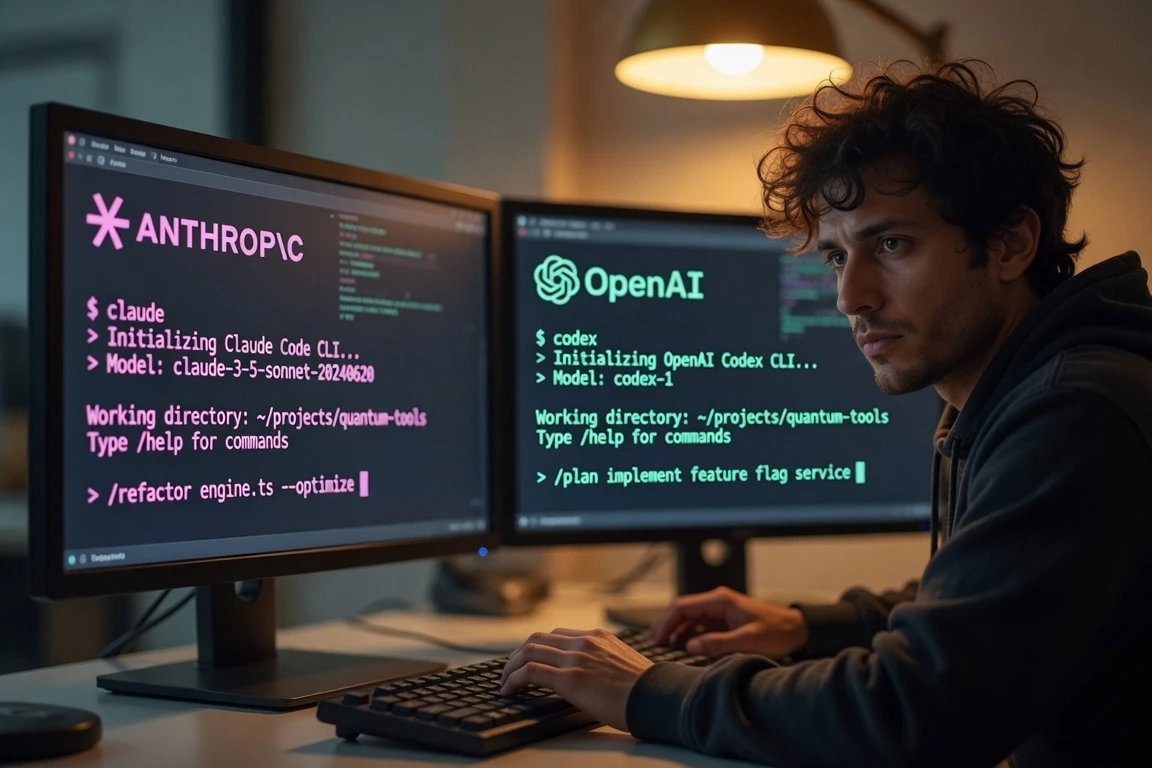
Claude Code vs OpenAI Codex is no longer a contest between a CLI assistant and a code-suggestion engine. Both tools now ship as mature agentic platforms that plan, edit, run, and verify code across entire repositories, and they each lead in a different half of the 2026 benchmark table. Codex wins terminal-heavy work by a wide margin; Claude Code wins on repository-level code quality and multi-file refactors.
Each platform now anchors on a single model family. Claude Code rides Claude Opus 4.7, which Anthropic describes as a “notable improvement on Opus 4.6 in advanced software engineering, with particular gains on the most difficult tasks.” OpenAI Codex rides GPT-5.5, which OpenAI calls its “strongest agentic coding model to date,” plus the GPT-5.3-Codex variant that ships 25% faster than its predecessor. The 13-point gap on Terminal-Bench 2.0 (GPT-5.5 at 82.7% versus Opus 4.7 at 69.4%) is the single largest spread between the two tools, and the rest of the comparison falls out from there.
What Each Tool Actually Is in 2026
Anthropic positions Claude Code as a terminal-native agentic system with a companion desktop app and Skills, lifecycle hooks, and CLAUDE.md configuration files. Power comes primarily from Claude Opus 4.7, with Sonnet variants handling lighter tasks. Per Claude Opus 4.7’s launch announcement and partner results, the model is available across Anthropic’s API, Amazon Bedrock, Google Cloud Vertex AI, and Microsoft Foundry, and ships with new safeguards tied to Project Glasswing.
OpenAI Codex runs as a CLI, a macOS and Windows desktop app, IDE extensions, and a cloud-delegated sandbox, all powered by GPT-5.5 and GPT-5.3-Codex. Per GPT-5.5’s launch and agentic coding claims, the platform supports Skills, Plugins, MCP, and “Subagents and custom agents” as documented on OpenAI’s Codex pricing page. The same page lists its non-developer surface area too: 62 apps and 110 skills across six Codex plugins now target sales, analytics, and investment banking workflows alongside software engineering.
Both vendors agree on a few ground rules that matter to developers. Each tool runs Skills (directory-based, SKILL.md-formatted extensions of the agent’s prompt), each supports the Model Context Protocol so the same server definitions move between them, and each can fan work out across multiple sub-agents that operate on isolated git worktrees. The differences live in how each tool spends its context, where each tool’s model excels, and what each charges for daily use.
Where Codex Pulls Ahead on Benchmarks
GPT-5.5 set a new industry high on Terminal-Bench 2.0, the test that measures command-line fluency across planning, iteration, and tool coordination. OpenAI’s launch page records 82.7% accuracy, a 7.6-point jump over GPT-5.4’s 75.1% on the same test. That number matters most for developers who hand the agent shell scripting, DevOps work, or any task that lives in a terminal rather than an IDE. GPT-5.3-Codex setting industry highs on agentic coding set the earlier 77.3% bar on Terminal-Bench 2.0 before GPT-5.5 pushed it further.
The table below compares the two flagship models on the benchmarks OpenAI’s own announcement tabulates side by side, with Opus 4.7 figures drawn from a third-party benchmark breakdown.
| Benchmark | GPT-5.5 (Codex) | Opus 4.7 (Claude Code) |
|---|---|---|
| Terminal-Bench 2.0 | 82.7% | 69.4% |
| SWE-Bench Pro | 58.6% | 64.3% |
| OSWorld-Verified | 78.7% | 78.0% |
Opus 4.7 also trails on OSWorld-Verified by a narrow 0.7-point margin, and on Expert-SWE, OpenAI’s internal long-horizon coding eval with a 20-hour median human-completion time, GPT-5.5 scores 73.1% to GPT-5.4’s 68.5%. Neither vendor publishes an Opus 4.7 number for that benchmark. The pattern is consistent: Codex wins where the work happens in a shell or on a desktop, and Claude Code wins where the work happens inside a codebase.
Where Claude Code Holds Its Edge
Claude Opus 4.7 leads the head-to-head on SWE-bench Pro, the multi-language, contamination-resistant sibling of SWE-bench Verified. Claude Opus 4.7’s full benchmark breakdown records 87.6% on SWE-bench Verified and 64.3% on SWE-bench Pro, a 10.9-point jump over Opus 4.6’s 53.4% on the Pro test. For developers working on real GitHub issues across multi-language codebases, that gap is the single largest advantage Claude Code holds over Codex.
Opus 4.7 also leads on MCP-Atlas scaled tool use at 77.3%, on Finance Agent v1.1 at 64.4%, and on CharXiv visual reasoning (82.1% without tools, 91.0% with tools). The vision jump is unusually large: per Vellum’s breakdown, Opus 4.7 accepts images up to 2,576 pixels on the long edge, more than 3x the resolution of prior Claude models. XBOW, a partner that runs autonomous penetration testing, saw its visual-acuity score climb from 54.5% on Opus 4.6 to 98.5% on Opus 4.7, a single workload where the older model’s biggest pain point effectively disappeared.
Claude Code also introduces a new xhigh effort level between high and max, giving developers finer control over the reasoning-latency tradeoff, and ships a /ultrareview command inside Claude Code that runs a dedicated review pass to flag bugs and design issues. Warp, an early-access tester, confirmed in Anthropic’s launch announcement that “Opus 4.7 passed Terminal Bench tasks that prior Claude models had failed, and worked through a tricky concurrency bug Opus 4.6 couldn’t crack.” That kind of qualitative jump, alongside the 64.3% SWE-bench Pro figure, is what most strongly supports Claude Code’s positioning as the quality-first choice.
GPT-5.5 delivers the sustained performance required for execution-heavy work. Built and served on NVIDIA GB200 NVL72 systems, the model enables our teams to ship end-to-end features from natural language prompts, cut debug time from days to hours, and turn weeks of experimentation into overnight progress in complex codebases.
Justin Boitano, vice president of enterprise AI at NVIDIA, in OpenAI’s GPT-5.5 announcement. The phrasing matters: even inside OpenAI’s own announcement, the strongest named-partner endorsement frames GPT-5.5 as execution-speed, not code quality.
What Daily Users Actually Pay
The pricing models look similar at a glance and diverge sharply underneath. Anthropic’s Opus 4.7 API is $20/month on the Claude Pro subscription, but the API itself runs at $5 per million input tokens and $25 per million output tokens, the same rate Opus 4.6 charged. Token costs scale with how deeply the model thinks at higher effort levels, and the xhigh effort setting burns more tokens per task than the standard high setting.
OpenAI Codex wraps its pricing around four tiers, all listed on Codex plan tiers, usage limits, and credit pricing:
- Go at $8/month. Lightweight Codex tasks only; limited rate budget; smaller models prioritized.
- Plus at $20/month. Full Codex surface area: web, CLI, IDE, iOS. Includes GPT-5.5, GPT-5.4, and GPT-5.4 mini. Cloud features excluded.
- Pro at $100 or $200/month. Five-times or twenty-times the Plus rate limits. Adds cloud tasks, Slack integration, automatic GitHub code review, and Codex-Spark research preview.
- API key at per-token rates. Codex CLI, SDK, and codex exec with pay-as-you-go billing; no cloud features; ideal for CI pipelines.
The two $20 tiers diverge on what they include. Claude Pro’s $20 includes Claude Code, but heavy Opus usage on complex tasks routinely hits usage limits before the end of a workday. Codex Plus’s $20 ships GPT-5.5 with “generous usage limits despite GPT-5.5 being a significantly more capable model,” per OpenAI’s pricing page, and a typical message costs 5 to 45 credits. Developers who treat Codex Plus as their daily driver report fewer rate-limit interruptions than on Claude Pro at the same price point, though OpenAI’s own usage dashboard is the only source for an exact daily count.
How Each Tool Handles Long-Running Work
Both vendors now treat long-horizon autonomy as a first-class feature. Codex’s macOS and Windows apps manage multiple agents in parallel from a single visual interface, and the Codex CLI supports isolated sub-agents running in separate git worktrees. Claude Code introduced Agent Teams earlier in the cycle, which coordinates multiple agents across worktrees under a shared orchestration layer. Both tools share the AGENTS.md convention as a cross-tool project memory file, and both support MCP servers, which means the same server definitions move between the two without rewriting configuration.
The numbers that matter most for long-running work, drawn from this article’s verified sources:
- 82.7% on Terminal-Bench 2.0 (GPT-5.5, OpenAI announcement).
- 64.3% on SWE-Bench Pro (Opus 4.7, Vellum breakdown).
- 25% speed gain over its predecessor (GPT-5.3-Codex, OpenAI announcement).
- 5 to 45 credits per typical Codex message (OpenAI Codex pricing page).
- 3x visual resolution jump over prior Claude models (Opus 4.7, Vellum breakdown).
Enterprise integrations reinforce the long-running case. Anthropic’s 150-billion-object graph open to Claude Code agents shows what an at-scale integration looks like in production: Atlassian opened its Teamwork Graph to MCP-compliant agents, which means a Claude Code agent can query the same context substrate as any other MCP tool without a separate adapter. Codex’s plugin catalog reaches into non-engineering work, with the six business plugins OpenAI shipped in 2026 covering 62 apps and 110 skills.
Which Developer Should Pick Which
The cleanest way to pick is to start from the workload. Claude Code fits when the work lives in a repository: multi-file refactors, architectural changes that span modules, code-quality reviews where idiomatic style matters, or any task where running a longer reasoning pass before the first edit produces a better result than a fast first attempt. Vellum’s breakdown recommends the same upgrade path: “Opus 4.7 is worth upgrading to” for any agent that does “meaningful coding, tool use, or visual reasoning.”
Codex fits when the work lives in a terminal or a desktop. Long-running shell scripting, CI pipeline generation, DevOps automation, parallel sub-agents working on isolated repos, and tasks that benefit from the Codex app’s polling and steering mode all lean toward GPT-5.5. Cost-sensitive daily use where the Plus tier’s headroom covers most of the day is also a Codex-shaped problem, since OpenAI publishes the credit cost of every model and every speed setting on its pricing page.
Some triggers make the choice close to automatic:
- Refactor of a 200-file Python service: Claude Code.
- Generate a Kubernetes operator with end-to-end tests: Codex.
- Code-quality review on a security-sensitive PR: Claude Code.
- Parallel agents each owning a different microservice for a week: Codex.
- Long-running analysis of a single legacy codebase: Claude Code.
- Daily CI work, scripts, and quick fixes inside an existing repo: Codex.
These are not hard rules. They are starting points for a decision that should be re-tested each quarter, because both vendors ship new flagship models every few months and the gaps shift each time.
The Hybrid Workflow Most Teams Run Now
The most common serious-use pattern in 2026 is not a single tool, it is a routing layer. Developers who handle both architectural code reviews and terminal-driven scripting tend to keep both agents installed, route repository-level work to Claude Code, and route terminal-heavy iteration to Codex. The plumbing for this is already in place: AGENTS.md is supported as a cross-tool project memory file, MCP servers written for one agent run on the other, and Skills (SKILL.md directories) work the same way in both ecosystems. The cost of running both is also realistic for an individual developer, since OpenAI’s Codex Plus tier at $20 per month and Anthropic’s Claude Pro at $20 per month can run in parallel on a single laptop.
The forward-looking signal worth naming is convergence, not divergence. Both vendors added Skills, Plugins, and MCP-style extensibility in roughly the same twelve months, both extended their context windows past 1 million tokens, and both now publish parallel sub-agent orchestration in their flagship releases. Anthropic’s Project Glasswing work and OpenAI’s cyber-safeguard rollout on GPT-5.3-Codex are separate enterprise bets, but the developer-facing surface keeps drifting closer. Teams that learn the conventions of both tools now will not have to relearn them if a future model release moves the lead around again.
Frequently Asked Questions
Is Claude Code better than OpenAI Codex in 2026?
Neither tool is uniformly better. Claude Code leads on repository-level refactors and code-quality scoring; Codex leads on terminal fluency and cost-efficient daily use. The choice depends on which half of the workload dominates the developer’s day.
Which AI coding tool has better benchmarks in 2026?
GPT-5.5 leads on Terminal-Bench 2.0 (82.7% vs Opus 4.7’s 69.4%) and OSWorld-Verified (78.7% vs 78.0%). Opus 4.7 leads on SWE-Bench Pro (64.3% vs 58.6%), MCP-Atlas tool use (77.3%), Finance Agent v1.1 (64.4%), and SWE-bench Verified (87.6%). On Expert-SWE, OpenAI’s internal long-horizon eval, GPT-5.5 scores 73.1%; Anthropic does not publish an Opus 4.7 number for that test.
What does each tool cost?
Claude Code API access for Opus 4.7 is $5 per million input tokens and $25 per million output tokens, the same rate as Opus 4.6. Codex Plus is $20 per month and includes GPT-5.5, GPT-5.4, and GPT-5.4 mini; Codex Pro tiers run to $100 or $200 per month for higher rate limits; API key access is pay-per-token.
Can Claude Code and OpenAI Codex be used together?
Yes. Both tools read AGENTS.md for project memory, both support MCP servers, and both run Skills formatted as SKILL.md directories. Developers commonly route architecture-level work to Claude Code and terminal-driven iteration to Codex inside the same repository.
Which AI coding tool should a new developer learn first?
If the work is repository-level, start with Claude Code: its CLAUDE.md configuration maps closely to standard developer workflows, and its Skills ecosystem is the most mature in the field. If the work is terminal-driven or the developer is already inside the ChatGPT ecosystem, Codex is the easier on-ramp at the $20 per month Plus tier.

Instagram Plus Tests a Read-Only Mode That Cuts Stories

Altman Asks the Public to Accept Some AI Harm

Google Freezes OSS VRP Product Reports After AI Flood

AI Agents Make Payment Rails the Scarce Prize

Turkey’s Crypto Boom Now Runs Through Three Banks

Fable 5 Came Back Under a Commerce On-Off Switch

Google’s SpaceX GPU Lease Has a Sept. 30 Deadline

Plasma One’s XPL Locks Face a 1.81 Billion Cliff

DGO’s Rs 549 World Cup Pass Cost Fans Sleep and Data

Moonshot AI’s $30 Billion Ask Became a $35 Billion Close
-
 AI4 months ago
Fable 5 Came Back Under a Commerce On-Off Switch
-
 AI4 months ago
Google’s SpaceX GPU Lease Has a Sept. 30 Deadline
-
 CRYPTO4 months ago
Plasma One’s XPL Locks Face a 1.81 Billion Cliff
-
 APPS4 months ago
DGO’s Rs 549 World Cup Pass Cost Fans Sleep and Data
-
 AI4 months ago
Moonshot AI’s $30 Billion Ask Became a $35 Billion Close
-

 NEWS4 months ago
ColorOS 17 Device List Spans Oppo, OnePlus and Realme
-

 GAMING4 months ago
Xbox Cuts 3,200 Jobs After Five Years of Thin Returns
-

 GAMING4 months ago
The RTX 4050 Under Rs 70,000 Hides a Wattage Gap