
AI
China’s AI Export Boom Buys Time on Weak Home Demand
China’s July exports climbed 23.9% and surplus hit $112.5 billion on AI chips and EVs, cushioning domestic weakness while stoking trade tensions.

China’s exports climbed 23.9% in July from a year earlier, beating forecasts, while imports rose 27.5% and the trade surplus reached $112.5 billion. Global demand for AI electronics, chips and electric vehicles powered the gains even after Typhoon Bavi disrupted major ports.
The figures, released by the General Administration of Customs, moderated from June’s hotter 27% export and 36% import jumps yet kept the external engine humming. That strength is doing double duty: cushioning a sluggish home market and reducing urgency for bigger consumer stimulus, even as the surplus fans friction with the United States and Europe.
July Numbers Beat Forecasts After June Peak
Exports expanded 23.9% in dollar terms against a Bloomberg median of 23% and a Reuters poll of 22.2%. Imports gained 27.5%, a touch under the 27.9% expectation after June’s five-year high. The resulting surplus of $112.5 billion narrowed from June’s $125.6 billion but stayed elevated.
| Metric | July 2026 | June 2026 | Forecast |
|---|---|---|---|
| Exports YoY | 23.9% | 27% | 22-23% |
| Imports YoY | 27.5% | 36% | ~27.9% |
| Trade surplus | $112.5B | $125.6B | ~$107B |
First-half surplus stood near $576 billion. June alone saw exports hit a record $412.39 billion and imports an all-time high of $286.76 billion, according to official customs statistics releases. Volume growth trailed value growth because prices for chips and commodities rose sharply.
Export prices climbed 8% year-on-year in June, the third straight monthly gain after nearly three years of declines. Import prices surged 25%, the fastest since the series began in 2006.
AI Hardware and Chip Prices Carry the Load
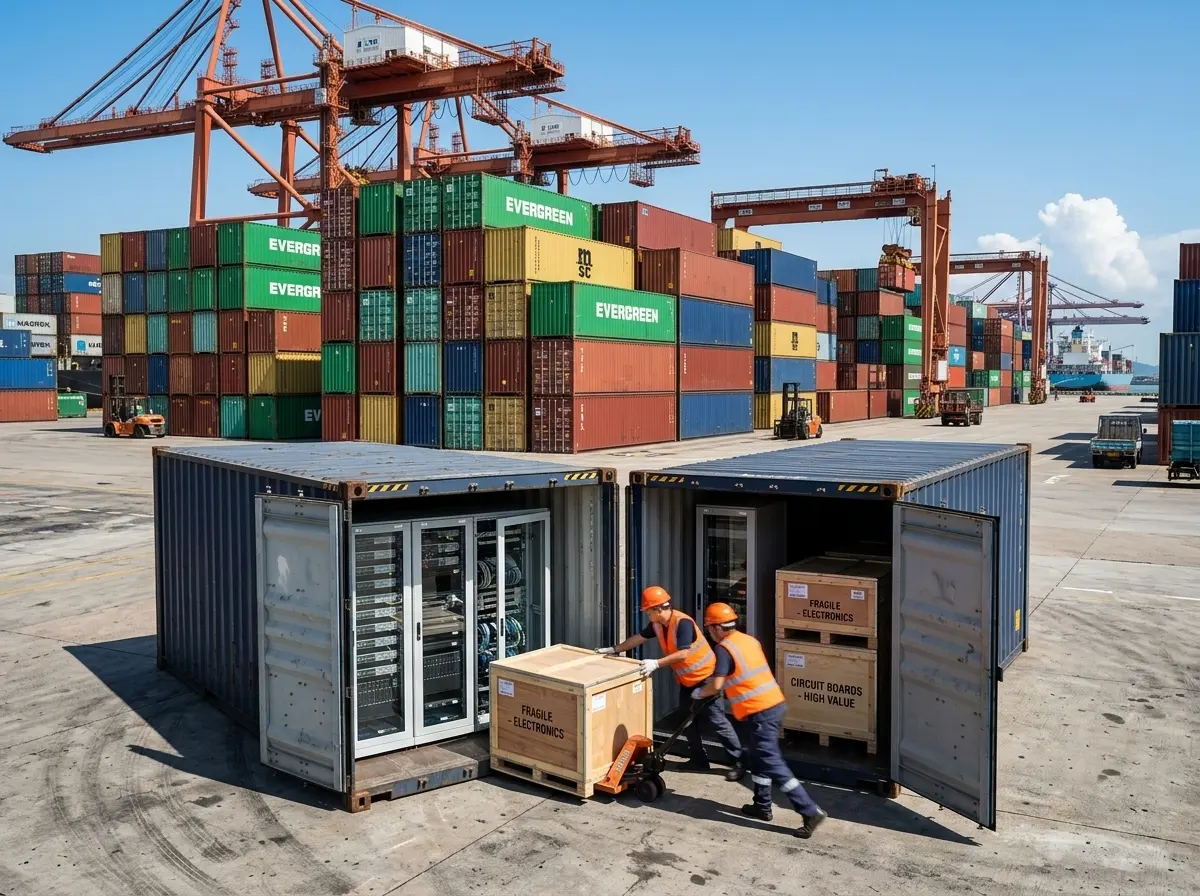
Soaring overseas shipments of AI-related electronics offset softer traditional categories. Integrated-circuit export value nearly doubled in the first half, rising 96.1% to $177.28 billion on 179.44 billion units. That works out to roughly a dollar per chip on average, reflecting China’s mix of memory, power management and mature-node parts rather than leading-edge processors.
Earlier months showed the price effect clearly: January-February IC export value rose 72.6% while volume grew only 13.7%. Automatic data-processing machines and parts, covering servers and components, jumped 41.3% to $138 billion in the half. Automobile exports climbed more than 50% in the period, with monthly car shipments topping one million units for the first time in June.
- IC exports H1: +96% value to $177B, volume + far less
- Computing hardware: +41% to $138B
- Some chip prices: up as much as 700% over the past year amid AI shortages
- EVs and autos: sustained double-digit gains and new monthly records
Global memory makers shifted capacity toward high-bandwidth memory for AI accelerators, tightening conventional DRAM and NAND supply. Chinese producers filled the commodity gap and collected higher prices. High-tech exports overall ran well ahead of the headline rate in recent months.
Typhoon Bavi Closed Ports but Failed to Sink the Month
Eastern China took heavy rainfall from Typhoon Bavi in mid-July. Shanghai and Ningbo, among the world’s busiest container ports, suspended operations. Vessels evacuated, truck movements halted and feeder links along the Yangtze temporarily severed. Delays stretched into days and congestion lingered afterward.
Some of the world’s largest terminals paused, yet the full-month export figure still cleared forecasts. The AI and EV order books proved thick enough to absorb the weather hit. Shipping backlogs remained elevated into late July, but the value data showed limited lasting damage to the July total.
External Strength Meets a Soft Domestic Market
The boom is widening an internal divide. Retail sales rose just 1.0% in June. Second-quarter GDP grew 4.3%, the slowest in three years and short of Beijing’s target range. Fixed-asset investment has been weak or negative in recent months. Property-sector pain continues to weigh on household wealth and spending willingness.
There’s remarkable resilience and bright spots in manufacturing and exports, and softness in consumption and fixed asset investment. That’s been the pattern for a while now, since 2025.
Carol Liao, Greater China chair for Boston Consulting Group, described the two-speed reality. Officials prefer “investing in people” through education and care subsidies over direct cash transfers. A new five-year consumption plan targets retail sales near 60 trillion yuan by 2030, requiring only modest annual growth of about 3.7%.
Resilient exports lower the political cost of waiting. Factories keep running and foreign exchange keeps flowing, so the case for aggressive household support loses urgency. On X, observers quickly noted the same dynamic: strong external numbers may reduce pressure for broader domestic measures.
Surplus and Tech Reach Raise Friction Overseas
Chinese firms’ growing share of global value chains in cars and data-center hardware has sharpened tensions with Europe and the United States. The U.S. goods trade balance with China continues to show large deficits. June surplus with the EU hit a record in some tallies, and the bilateral gap with Germany more than doubled year-on-year earlier in the year.
Economists are debating how much the yuan’s path has protected manufacturing competitiveness. The structure of China’s trillion-dollar surplus already spans dozens of partners and product lines from labor-intensive goods to autos and batteries. A second straight year above $1 trillion looks plausible if the AI cycle holds.
That scale feeds pushback. Tariff talk and export controls remain live. Fresh U.S. measures and European concerns over electric vehicles sit alongside the hardware scramble for AI data centers. Chinese exporters gain market share; foreign producers and policymakers lose ground and respond.
What the Numbers Buy Beijing and What They Cost
The July print keeps China on track for another massive annual surplus. It validates the manufacturing base’s ability to ride a global technology supercycle. It also reinforces the export-led pattern that has defined the post-pandemic recovery.
The second-order effect is the policy breathing room. With overseas orders strong, officials can calibrate stimulus more slowly and stick to supply-side and human-capital tools rather than large-scale demand checks. Domestic consumers stay cautious. Property wealth stays depressed. The growth target leans harder on external demand.
That choice carries risk. If AI investment cools or tariff barriers rise further, the cushion shrinks just as the domestic engine remains underpowered. Crowd commentary on the data release already framed the surplus as evidence of continued dependence on foreign buyers rather than broad-based strength.
Perceptions of Chinese AI leadership already run high among some international audiences, matching the Americans’ view that China leads in AI in recent surveys even when other metrics tell a more mixed story. Policy shifts such as China’s new rules for loss-making AI listings aim to keep capital flowing into the sector that is now propping up trade numbers.
For now the factories keep shipping. The surplus stays large. And the domestic divide stays open.


South Korea Retail Investors Face Reckoning After KOSPI AI Rally Collapses

Surrey AI Maps Three Heart Attack Paths and Their Molecular Roots

Germany Locks Neutral Apple ATT Prompts Across Most of Europe

Apple’s 5% EU Fee Quietly Rewrites Alternative App Store Math

Apple’s EU Fee Truce Cuts Complexity but Leaves Rivals Fuming

Pixel 11 Pro Fold Trades Thinness for Durability and Seven-Year Stay

Mayo AI Flags HCM Obstruction From Everyday Ultrasound Videos

Indian Brands Quietly Scale Landmark Screens and Home Tech

Navin Vatsa Turns Grief Into a Lifetime of Quiet Seeing

Google Bets Pixel 11 Agentic AI Will Redefine Phones

Oracle Cuts 21,000 Jobs in a Year, Cites AI in 10-K Filing

Fable 5 and Mythos 5 Return as US Lifts Anthropic Export Controls

SpaceX’s Google Deal Turns a Rocket Company Into a Cloud Landlord

CD Projekt Red Co-CEO: Redemption Arc Isn’t Done, Witcher 4 in 2027

XPL Rallies 30% Ahead of Plasma One Card Tier Launch

Google Search Profiles Build a Follow Graph Inside Discover

DGO App Brings Rs 549 Mobile Pass for FIFA World Cup 2026 in Nepal

Moonshot AI Targets $30 Billion in China’s Fastest AI Funding Sprint

Oppo’s ColorOS 17 Eligibility List Leaves A-Series Buyers Behind

Microsoft Xbox Layoffs Start in July as Sharma Slams 3% Margin
-
 AI2 months ago
Oracle Cuts 21,000 Jobs in a Year, Cites AI in 10-K Filing
-
 AI2 months ago
Fable 5 and Mythos 5 Return as US Lifts Anthropic Export Controls
-
 AI3 months ago
SpaceX’s Google Deal Turns a Rocket Company Into a Cloud Landlord
-
 GAMING2 months ago
CD Projekt Red Co-CEO: Redemption Arc Isn’t Done, Witcher 4 in 2027
-
 CRYPTO3 months ago
XPL Rallies 30% Ahead of Plasma One Card Tier Launch
-
 NEWS3 months ago
Google Search Profiles Build a Follow Graph Inside Discover
-
 APPS3 months ago
DGO App Brings Rs 549 Mobile Pass for FIFA World Cup 2026 in Nepal
-
 AI3 months ago
Moonshot AI Targets $30 Billion in China’s Fastest AI Funding Sprint