
NEWS
SWS Poll Shows Filipino Trust Still Backs US-Japan Pivot
June 2026 SWS survey keeps US and Japan at good net trust while China stays poor, giving Manila quiet public cover for deeper trilateral security ties.

Filipinos gave the United States a +42 net trust rating and Japan +36 in the June 2026 Social Weather Stations survey, while China stayed poor at -16. Australia sat at moderate +29; Israel and Russia were neutral; Palestine and Iran also poor.
The face-to-face poll of 1,200 adults ran June 20-29 and carries a ±3-point national margin. The hierarchy is familiar. What it quietly enables is newer.
The June Scoreboard in Full
Net trust equals percent “much trust” minus percent “little trust.” SWS labels +30 to +49 “good,” +10 to +29 “moderate,” +9 to -9 “neutral,” and -10 to -29 “poor.”
| Country | Net Trust | Much Trust | Little Trust | Label |
|---|---|---|---|---|
| United States | +42 | 60% | 18% | Good |
| Japan | +36 | 55% | 19% | Good |
| Australia | +29 | 48% | 20% | Moderate |
| Israel | -5 | 30% | 34% | Neutral |
| Russia | -8 | 28% | 36% | Neutral |
| China | -16 | 25% | 41% | Poor |
| Palestine | -19 | 18% | 37% | Poor |
| Iran | -23 | 19% | 43% | Poor |
From the March round the United States rose three points, Japan two, and Australia six. China improved three points from -19 yet stayed poor. Palestine dropped seven points and Iran one. The June 2026 Social Weather Survey results remain non-commissioned public-service items.
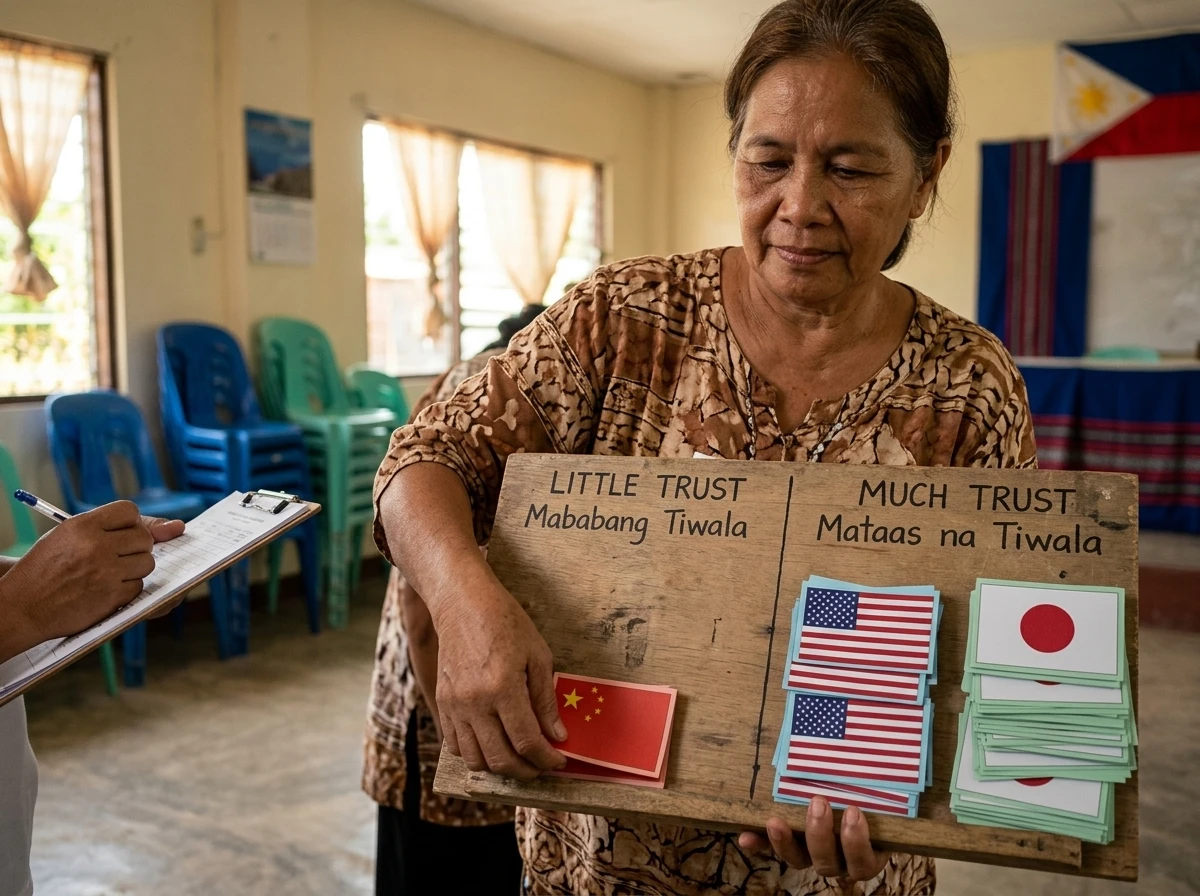
Thirty Years of the Same Hierarchy
SWS has tracked country trust since the mid-1990s. The pattern barely bends.
- December 1994: United States first measured; positive ever since, low of +18 in May 2005, high of +82 in December 2013.
- August 1994: China first measured; positive in only nine of 74 surveys, peak +17 in June 2010, trough -54 in June 2024.
- December 1994-1996: Japan neutral (-3 to +9); turned positive +17 in June 1997 and hit +54 in December 2017.
- February 2009: Palestine first measured at -28 and never left negative territory.
- November 2001: Iran’s sole positive reading, a neutral +4; all later rounds poor or worse.
Australia has stayed mostly moderate to good since the late 2000s. Russia has been negative almost continuously since 1995 except three brief positive readings in 2016-17. The June 2026 numbers sit comfortably inside those long bands.
How SWS Draws the Lines
Respondents place cards on a rating board for each country: very much, somewhat much, undecided, somewhat little, very little, or never heard. Net is simply much minus little; undecided and unaware drop out of the net calculation.
- +70 and above: excellent
- +50 to +69: very good
- +30 to +49: good
- +10 to +29: moderate
- +9 to -9: neutral
- -10 to -29: poor
- -30 to -49: bad
- -50 to -69: very bad
- -70 and below: execrable
The same board and wording have been used for decades, which is why the series can be read as a continuous public mood track.
West Philippine Sea Pressure Keeps China Underwater
China’s net trust has spent most of the last decade in poor or bad territory. The lowest reading, -54 in June 2024, landed amid repeated water-cannon and collision incidents at Second Thomas Shoal. Filipinos call the contested waters the West Philippine Sea.
The territorial disputes in the South China Sea center on overlapping claims inside the Philippine exclusive economic zone. A 2016 arbitral tribunal under UNCLOS rejected China’s nine-dash-line historic-rights claim; Beijing declared the ruling null. Coast-guard clashes and militia presence have continued under successive Philippine administrations.
That friction shows in the trust series. Even when China’s rating improves a few points, as it did from March to June 2026, it remains well below the neutral line. Soft-power efforts have not offset the maritime picture for most respondents.
The Trust Gap Underwrites the Trilateral Build-Out
High and stable trust in the United States and Japan gives the Marcos administration political room to expand defense cooperation without large domestic backlash. In February 2026 the two governments held their Bilateral Strategic Dialogue and reaffirmed the 1951 Mutual Defense Treaty, stating it covers armed attacks on forces, aircraft and public vessels, including coast-guard vessels, anywhere in the Pacific including the South China Sea.
Both sides condemned China’s illegal, coercive, aggressive, and deceptive activities in the South China Sea, recognizing their adverse effects on regional peace and stability.
That language came from the joint statement itself. The same document lists more than 500 military exercises and exchanges across 2024-2026, new EDCA site funding, and planned foreign-minister trilateral talks with Japan.
Japan and the Philippines already operate under a 2024 Reciprocal Access Agreement. In 2026 they marked 70 years of diplomatic ties; the United States and Philippines marked 80 years and the 75th anniversary of the Mutual Defense Treaty. Joint exercises such as KAMANDAG have drawn Japanese Ground Self-Defense Force participation alongside U.S. and Philippine Marines. Public trust numbers make these steps less costly at home.
Domestic Split Still Shows in the Numbers
China trust remains a domestic political marker. Some online commentary immediately framed the June results as a rebuke to pro-Beijing voices. The data itself is quieter: 41 percent little trust versus 25 percent much trust leaves a clear plurality on the negative side, yet a quarter of adults still express much trust. That residual keeps the issue alive inside Philippine politics even while the net stays poor.
Australia’s six-point rise to +29 tracks growing practical cooperation on maritime and economic corridors. Israel’s slide into negative territory and Russia’s continued neutral-to-poor band reflect global events filtered through local media. None of those movements alter the top two or the bottom cluster.
- US much-trust share: 60 percent, up from 56 percent in March
- China little-trust share: steady at 41 percent
- Japan much-trust share: 55 percent
- Survey mode: face-to-face, four major areas equally sampled then weighted to PSA projections
The second-order effect is simple. When the public consistently ranks the two key treaty and security partners well above the main maritime rival, Manila can keep expanding access, exercises and logistics arrangements. The June poll does not create the policy; it confirms the public foundation underneath it remains firm.
Frequently Asked Questions
What does net trust mean in an SWS survey?
Net trust is the percentage of respondents who say they have much trust in a country minus the percentage who say they have little trust. Undecided and “never heard” answers are excluded from the net figure, so the two percentages need not sum to 100.
How long has SWS measured trust in the United States?
SWS first asked about the United States in December 1994. Every subsequent reading has been positive, ranging from a moderate +18 in May 2005 to an excellent +82 in December 2013.
Why is China’s rating almost always negative?
China has posted a positive net trust score in only nine of 74 SWS surveys since August 1994. The series tracks closely with periods of heightened West Philippine Sea tension; the worst reading was -54 in June 2024.
What sample size and error margin does the June 2026 poll carry?
The survey interviewed 1,200 adults aged 18 and above, 300 each in Metro Manila, Balance Luzon, the Visayas and Mindanao. National estimates carry a ±3 percentage-point margin; area estimates ±6 points.
Are the country-trust questions commissioned by any government?
No. SWS includes the items on its own initiative and releases them as a public service. The countries chosen reflect foreign-affairs relevance at the time of each round.


South Korea Retail Investors Face Reckoning After KOSPI AI Rally Collapses

Surrey AI Maps Three Heart Attack Paths and Their Molecular Roots

Germany Locks Neutral Apple ATT Prompts Across Most of Europe

Apple’s 5% EU Fee Quietly Rewrites Alternative App Store Math

Apple’s EU Fee Truce Cuts Complexity but Leaves Rivals Fuming

Pixel 11 Pro Fold Trades Thinness for Durability and Seven-Year Stay

Mayo AI Flags HCM Obstruction From Everyday Ultrasound Videos

Indian Brands Quietly Scale Landmark Screens and Home Tech

Navin Vatsa Turns Grief Into a Lifetime of Quiet Seeing

Google Bets Pixel 11 Agentic AI Will Redefine Phones

Oracle Cuts 21,000 Jobs in a Year, Cites AI in 10-K Filing

Fable 5 and Mythos 5 Return as US Lifts Anthropic Export Controls

SpaceX’s Google Deal Turns a Rocket Company Into a Cloud Landlord

CD Projekt Red Co-CEO: Redemption Arc Isn’t Done, Witcher 4 in 2027

XPL Rallies 30% Ahead of Plasma One Card Tier Launch

Google Search Profiles Build a Follow Graph Inside Discover

DGO App Brings Rs 549 Mobile Pass for FIFA World Cup 2026 in Nepal

Moonshot AI Targets $30 Billion in China’s Fastest AI Funding Sprint

Oppo’s ColorOS 17 Eligibility List Leaves A-Series Buyers Behind

Microsoft Xbox Layoffs Start in July as Sharma Slams 3% Margin
-
 AI2 months ago
Oracle Cuts 21,000 Jobs in a Year, Cites AI in 10-K Filing
-
 AI2 months ago
Fable 5 and Mythos 5 Return as US Lifts Anthropic Export Controls
-
 AI3 months ago
SpaceX’s Google Deal Turns a Rocket Company Into a Cloud Landlord
-
 GAMING2 months ago
CD Projekt Red Co-CEO: Redemption Arc Isn’t Done, Witcher 4 in 2027
-
 CRYPTO3 months ago
XPL Rallies 30% Ahead of Plasma One Card Tier Launch
-
 NEWS3 months ago
Google Search Profiles Build a Follow Graph Inside Discover
-
 APPS3 months ago
DGO App Brings Rs 549 Mobile Pass for FIFA World Cup 2026 in Nepal
-
 AI3 months ago
Moonshot AI Targets $30 Billion in China’s Fastest AI Funding Sprint