
NEWS
Bicol’s 42,000 Struggling Readers Signal Deeper Literacy Compounding
EDCOM 2 data put Bicol fourth in Key Stage 1 reading shortfalls at 42,000 learners, exposing how early gaps still feed senior-high non-proficiency despite.

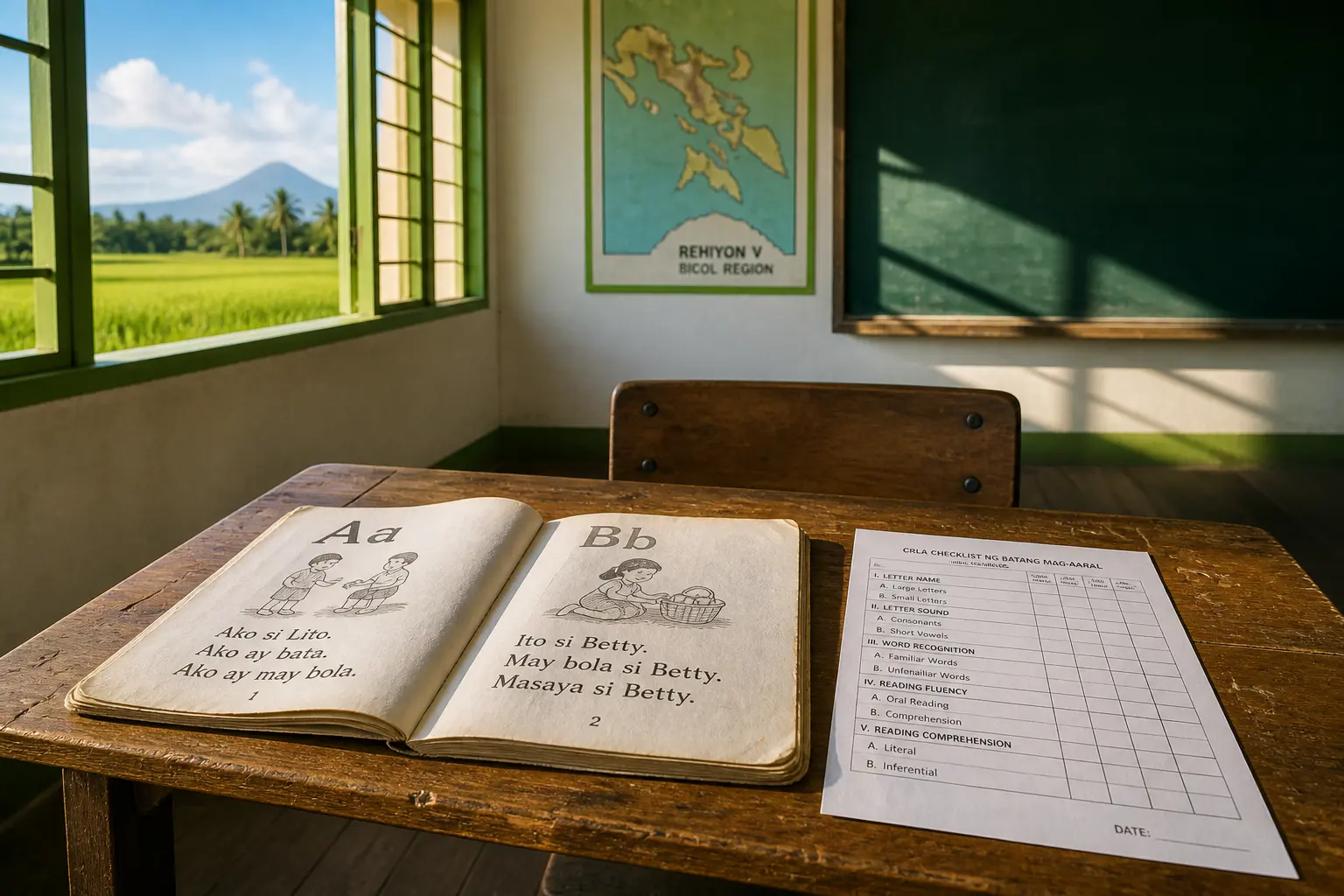
Roughly 42,000 Key Stage 1 learners in the Bicol Region finished School Year 2025-2026 below grade-level reading proficiency, EDCOM 2 reported from Department of Education Comprehensive Rapid Literacy Assessment data. That figure is about 12 percent of the national total of struggling Grades 1-3 readers and places Bicol fourth among regions.
The numbers arrive after the first full year of the Academic Recovery and Accessible Learning Program. National proficiency rose, yet large absolute gaps remain, especially where early shortfalls feed into later grades.
The same dataset that ranks the regions also shows why the absolute count matters as much as the percentage share. A region that holds only a modest slice of the national pool can still send tens of thousands of children into Grade 4 without the decoding base the rest of the curriculum assumes. Bicol’s position, fourth by volume, therefore sets both a recovery target and a pipeline warning for the grades that follow.
Bicol’s Share of the Early Reading Shortfall
EDCOM 2 placed the Bangsamoro Autonomous Region in Muslim Mindanao first with about 84,000 struggling Key Stage 1 readers, or 24 percent of the national pool. Region XII followed at around 63,000 (18 percent) and Region IX at about 52,500 (15 percent). Bicol’s 42,000 put it next.
The national average for that Key Stage 1 slice stood near 10 percent, or roughly 35,000 learners in the commission’s framing of the same dataset. Inside Bicol, Camarines Sur alone accounted for 15,251 of the struggling readers. Albay recorded 5,237 and Sorsogon 4,878.
| Area | Struggling KS1 Readers | Share of National |
|---|---|---|
| BARMM | ~84,000 | 24% |
| Region XII | ~63,000 | 18% |
| Region IX | ~52,500 | 15% |
| Bicol (Region V) | ~42,000 | 12% |
| Camarines Sur | 15,251 | – |
| Albay | 5,237 | – |
| Sorsogon | 4,878 | – |
These counts come from the end-of-year CRLA, which classifies Grades 1-3 learners from Low Emerging through Grade Level Ready. The concentration in a handful of regions means remediation resources must travel unevenly if the national program is to move the largest absolute numbers.
Camarines Sur’s 15,251 struggling readers alone exceed the combined Albay and Sorsogon totals. That single-province load is larger than many full division targets elsewhere in the country. Any tutor allocation built only on regional averages would under-serve the province that holds the densest cluster and over-serve lighter provinces inside the same region.
The top four regions together account for well over half the national pool of Key Stage 1 strugglers. BARMM, Region XII, Region IX and Bicol therefore form the primary geography for absolute-number reduction in the next ARAL cycle. Progress measured only in percentage-point gains at the national level can mask whether those four high-count areas are moving fast enough.
What the Full-Year Assessments Showed
EDCOM 2’s May analysis of DepEd’s three tools found clear within-year gains. An average of 40 percent of Grades 1-10 learners began the year as struggling readers. By March 2026 the share classified Grade Level Ready or Independent had climbed from 19 percent to 48 percent, a 29-percentage-point rise.
Even so, nearly half still failed grade-level expectations at year’s end. Across the full assessed population of about 16.5 million learners, 18 percent or 3 million remained non-proficient after ARAL’s first full year.
- 40% average struggling readers Grades 1-10 at beginning of year
- 19% to 48% grade-ready or independent by end of year
- 18% / 3 million still non-proficient overall
- 12.58% of Grade 11 students independent readers on the new SHS-LNA pilot
DepEd separately reported that about 4.5 million struggling readers improved their proficiency levels by year-end and that the absolute number of struggling readers fell to around 2.2 million from 6.7 million earlier counts. Key Stage 1 saw the largest relative drop. The commission’s broader cut of the same data still left one in two learners below the line that matters for the next grade.
The two framings are compatible once the units are kept distinct. DepEd’s 4.5 million improvers and the drop toward 2.2 million describe movement off the lowest rungs. EDCOM 2’s residual 3 million non-proficient and the near-half still below grade level describe the stricter standard of full grade-level readiness. Both can be true in the same year: many children climbed, yet not all climbed far enough to clear the next grade’s entry bar.
Key Stage 1’s larger relative drop is the brightest signal inside that mixed picture. Early-grade interventions appear to move faster than upper-grade ones when tutorials and materials are concentrated. That pattern supplies the operational logic for keeping tutor density highest where the CRLA counts remain largest.
How ARAL Landed in Its First Year
Republic Act No. 12028 created the ARAL Program to deliver free academic support in reading, mathematics and science for Grades 1-10 learners behind grade-level competencies. The ARAL Program Act IRR signed in record time after the law’s effectivity. Formal rollout began 13 September 2025; School Year 2025-2026 was the first complete cycle.
- Republic Act No. 12028 established free academic support in reading, math and science
- IRR signed in record time after the law took effect
- 13 September 2025 marked the formal program rollout
- School Year 2025-2026 became the first complete ARAL cycle
- March 2026 closed the year with full CRLA, Phil-IRI and SHS-LNA readings
Middle-of-year snapshots already showed individual schools posting 30-40 percent readiness jumps in top schools. Malanday Elementary in Marikina moved Key Stage 1 developing-to-ready shares from 57 percent to 94 percent. Several NCR and Region IV-A schools hit or approached 100 percent readiness on certain metrics by mid-year. Nationally, reading readiness scores rose roughly five points in Grades 3-6, lifting 3.42 million students, with further gains in junior high.
DepEd plans to double reach to 6.7 million learners in the coming school year and engage more than 440,000 tutors so regular teachers are not left carrying the full load. The early school-level results prove rapid movement is possible when interventions are concentrated. The regional absolute counts show the program has not yet equalized outcomes.
- Free targeted tutorials and resources in reading, math and science
- Focus on learners already behind DepEd competencies
- Summer program and second-year full rollout now in preparation
- Tutor expansion to ease teacher overtime
The jump from first-year coverage to a planned 6.7 million learners is meant to match the earlier absolute count of struggling readers. Pairing that reach with more than 440,000 tutors is the mechanism intended to keep the load off regular classroom teachers. Whether the added tutors land in proportion to the provincial clusters, rather than by simple headcount averages, will decide if Bicol’s 42,000 and Camarines Sur’s 15,251 move at the same pace as the showcase schools.
Why Early Gaps Compound Into Senior High
CRLA covers only the first three grades. Phil-IRI tracks Grades 4-10 and the new Senior High School Literacy and Numeracy Assessment, piloted on roughly 1.4 million of 1.9 million Grade 11 learners in March 2026, supplies the upper end. There the picture is starker: only 12.58 percent of Grade 11 students read as Independent. Fifty-eight point nine percent sat at Frustration level, unable to handle grade-level text alone; another 28.5 percent needed instructional support.
| SHS-LNA Level (Grade 11) | Share of Piloted Learners |
|---|---|
| Independent | 12.58% |
| Instructional | 28.5% |
| Frustration | 58.9% |
We see that in the first full year of ARAL alone, significant progress has been made already in supporting our students, following the hard work of the agency and our teachers. Moving forward, our task now is to design specialized supports to our students in high school, and to better differentiate interventions to help our students actually reach grade level readiness.
EDCOM 2 Executive Director Karol Mark Yee said the baseline now exists for refining those supports. The second-order effect is mechanical. A learner who leaves Grade 3 still Low Emerging or Transitioning enters content-heavy subjects without the decoding and comprehension base. By junior high the deficit widens; by senior high the majority cannot read independently the texts the curriculum assumes. Bicol’s 42,000 early strugglers are not an isolated primary-school problem. They are the intake valve for the same pipeline that produces the 87 percent non-independent Grade 11 cohort.
The SHS-LNA pilot’s coverage, about 1.4 million of 1.9 million Grade 11 learners, is already large enough to treat the distribution as a system signal rather than a sample curiosity. When nearly six in ten sit at Frustration and fewer than one in eight read as Independent, the upper secondary curriculum is asking most students to work from texts they cannot handle alone. That mismatch begins years earlier, in the Key Stage 1 shortfalls the CRLA now quantifies by region and province.
Regional Concentration and Local Contrasts
EDCOM 2 repeatedly flagged large regional disparities. Some regions posted nearly double the struggling-reader shares of CAR, Region III or NCR. Mindanao divisions dominated earlier beginning-of-year rankings of highest struggling shares. Bohol, by contrast, posted one of the lowest division-level rates in its region by the later data, which provincial leaders linked to a deliberate governance roadmap.
Bicol’s provincial split mirrors the national pattern inside one region: Camarines Sur carries the heaviest load while smaller provinces still contribute thousands. Historical baselines make the stakes clearer. World Bank learning-poverty figures placed the Philippines at a 91 percent learning poverty rate pre-pandemic for late-primary-age children unable to read with comprehension. PISA 2018 ranked the country last in reading among participating economies; the 2022 cycle showed only marginal movement and still left the overwhelming majority below minimum proficiency. The ARAL year closed some of the gap created by those long-standing weaknesses and the pandemic disruption. It has not yet erased the geography of the shortfall.
The contrast between Bohol’s low division-level rate and the Mindanao divisions that led the early struggling-share rankings shows that governance choices inside a province can shift outcomes even when national conditions are shared. Bicol’s internal spread, with one province holding more than one-third of the region’s struggling Key Stage 1 readers, invites the same local focus. Uniform regional programming would miss that internal skew.
The Three Tools Follow One Learner Path
DepEd’s assessment stack is built as a sequence, not as three separate scorecards. CRLA reads Grades 1-3 and sorts learners from Low Emerging through Grade Level Ready. Phil-IRI continues the track through Grades 4-10. The SHS-LNA pilot then samples the Grade 11 cohort that those earlier cohorts become.
Because the tools hand off along the same path, a high CRLA struggling count in Bicol is an early reading of the same pipeline that later produces Frustration-level majorities in senior high. The 29-percentage-point rise in grade-ready or independent shares across Grades 1-10 shows the middle of the path can move inside a single year. The 12.58 percent Independent share at Grade 11 shows the upper end has not yet absorbed that movement in full.
ARAL’s design already matches this sequence on paper: free support in reading, mathematics and science for Grades 1-10 learners behind competency lines, with high-school supports flagged for a different design once comprehension and academic text demands rise after Grade 6. The open question is whether tutor density and mother-tongue materials will follow the CRLA map closely enough that the next Phil-IRI and SHS-LNA rounds register the same absolute-number drops the early grades have begun to show.
Tutor Scale Must Match Provincial Clusters
The planned rise to 6.7 million learners and more than 440,000 tutors is the largest single operational lever now on the table. That scale is meant to keep regular teachers from carrying overtime loads while still reaching the volume of children who began the first ARAL year behind grade level.
School-level proof already exists. Malanday Elementary’s move from 57 percent to 94 percent developing-to-ready in Key Stage 1, and the 30-40 percent readiness jumps in other top schools, show what concentrated attention can do inside one campus year. Several NCR and Region IV-A schools approached full readiness on selected metrics by mid-year. Those results set a pace, not a ceiling.
Scaling that pace to provincial clusters of 15,000 struggling readers requires the new tutors to land where the end-of-year CRLA counts are highest. BARMM’s roughly 84,000, Region XII’s 63,000, Region IX’s 52,500 and Bicol’s 42,000 are the volumes that dominate the national absolute total. Inside Bicol, Camarines Sur’s 15,251 forms the clearest sub-regional priority. LGU co-financing and mother-tongue materials, both named by EDCOM 2 as needed tightenings, matter most in exactly those high-count zones.
If the second-year deployment follows simple national averages instead of the provincial map, the showcase school gains will remain local while the intake valve into junior and senior high stays wide open. If deployment tracks the counts, the same mechanical pipeline that now converts early shortfalls into a 87 percent non-independent Grade 11 cohort can begin to narrow from the bottom up.
Where Interventions Must Tighten
EDCOM 2’s Thursday statement after the Bicol figures called for stronger literacy and numeracy work precisely where learner needs are highest. That points to denser tutor deployment, mother-tongue materials, and LGU co-financing in the high-count provinces rather than uniform national averages. The commission also noted that high-school supports need a different design from the early-grade playbook; comprehension and academic text demands rise sharply after Grade 6.
DepEd has the assessment infrastructure in place: CRLA for the foundation years, Phil-IRI through Grade 10, and the new SHS tool. The next cycle will show whether the planned doubling of ARAL reach and the summer program shrink the absolute numbers in Bicol and the three higher regions. Local bright spots already demonstrate that targeted intensity can move a school 30-plus points in a single year. Scaling that intensity to the 15,000-learner provincial clusters is the operational test now facing both the department and the congressional commission that wrote the law.
The 42,000 Bicol figure is therefore both a progress check and a warning light. Gains are real and measurable. The remaining stock of early non-readers continues to feed a senior-high cohort that still cannot read independently at the rate the economy and further education require.


South Korea Retail Investors Face Reckoning After KOSPI AI Rally Collapses

Surrey AI Maps Three Heart Attack Paths and Their Molecular Roots

Germany Locks Neutral Apple ATT Prompts Across Most of Europe

Apple’s 5% EU Fee Quietly Rewrites Alternative App Store Math

Apple’s EU Fee Truce Cuts Complexity but Leaves Rivals Fuming

Pixel 11 Pro Fold Trades Thinness for Durability and Seven-Year Stay

Mayo AI Flags HCM Obstruction From Everyday Ultrasound Videos

Indian Brands Quietly Scale Landmark Screens and Home Tech

Navin Vatsa Turns Grief Into a Lifetime of Quiet Seeing

Google Bets Pixel 11 Agentic AI Will Redefine Phones

Oracle Cuts 21,000 Jobs in a Year, Cites AI in 10-K Filing

Fable 5 and Mythos 5 Return as US Lifts Anthropic Export Controls

SpaceX’s Google Deal Turns a Rocket Company Into a Cloud Landlord

CD Projekt Red Co-CEO: Redemption Arc Isn’t Done, Witcher 4 in 2027

XPL Rallies 30% Ahead of Plasma One Card Tier Launch

Google Search Profiles Build a Follow Graph Inside Discover

DGO App Brings Rs 549 Mobile Pass for FIFA World Cup 2026 in Nepal

Moonshot AI Targets $30 Billion in China’s Fastest AI Funding Sprint

Oppo’s ColorOS 17 Eligibility List Leaves A-Series Buyers Behind

Microsoft Xbox Layoffs Start in July as Sharma Slams 3% Margin
-
 AI2 months ago
Oracle Cuts 21,000 Jobs in a Year, Cites AI in 10-K Filing
-
 AI2 months ago
Fable 5 and Mythos 5 Return as US Lifts Anthropic Export Controls
-
 AI3 months ago
SpaceX’s Google Deal Turns a Rocket Company Into a Cloud Landlord
-
 GAMING2 months ago
CD Projekt Red Co-CEO: Redemption Arc Isn’t Done, Witcher 4 in 2027
-
 CRYPTO3 months ago
XPL Rallies 30% Ahead of Plasma One Card Tier Launch
-
 NEWS3 months ago
Google Search Profiles Build a Follow Graph Inside Discover
-
 APPS3 months ago
DGO App Brings Rs 549 Mobile Pass for FIFA World Cup 2026 in Nepal
-
 AI3 months ago
Moonshot AI Targets $30 Billion in China’s Fastest AI Funding Sprint