
CRYPTO
Clarity Act Clock Forces a 90-Day Rulebook Choice
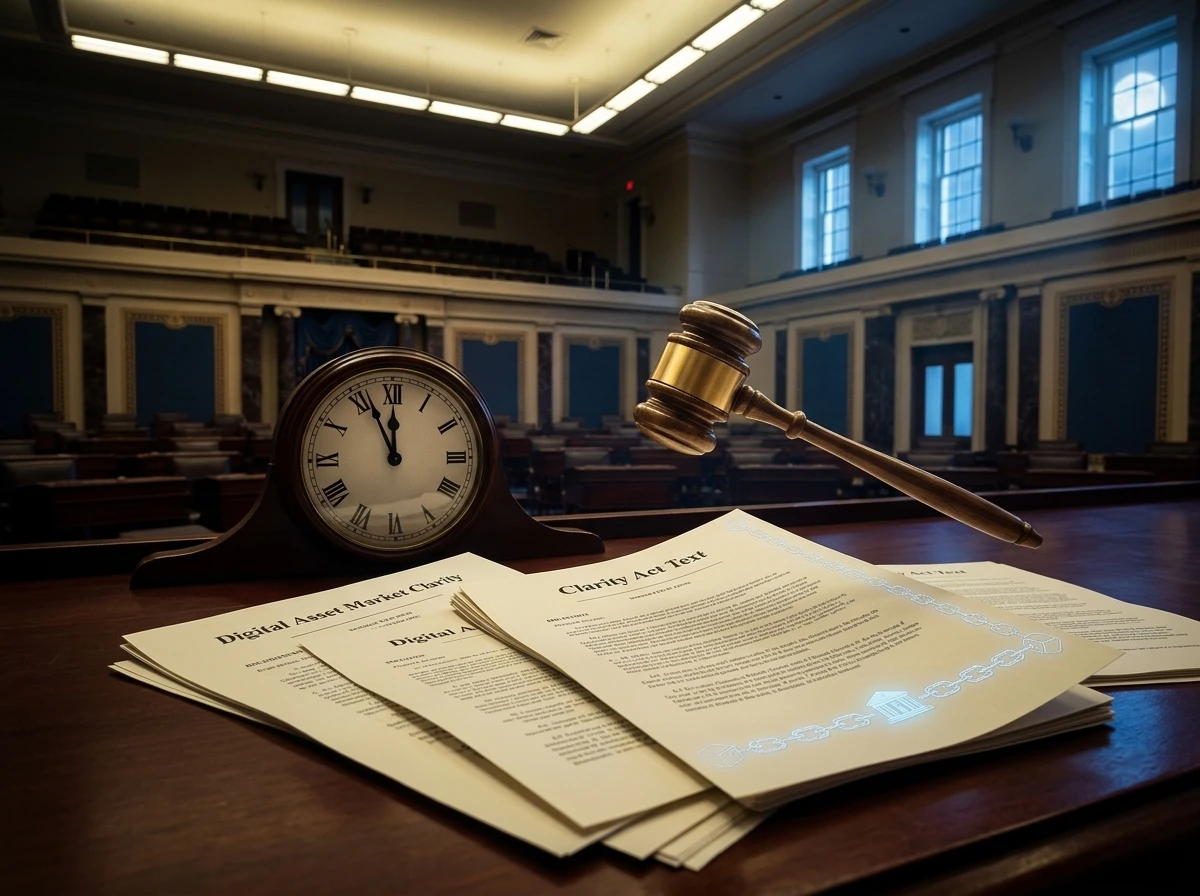
Senate has days left on the Digital Asset Market Clarity Act; a missed vote hands primary rule-writing to the SEC and CFTC for years.

The U.S. Senate has two days left before its target August 7 recess and still has not filed cloture on the Digital Asset Market Clarity Act. Majority Leader John Thune can still extend the session or return in September, but the procedural math now decides whether Congress or the agencies write the permanent U.S. crypto rulebook.
That fork is already priced into prediction markets and boardrooms. A first procedural vote this week keeps a statutory path alive. Silence cedes ground to SEC and CFTC rulemaking that will outlast the midterms.
The Clock and the Cloture Math
Senate rules require a full day after cloture is filed before the first procedural vote. If lawmakers leave Friday, Wednesday night was the practical last clean window. Thune can still announce a weekend or next-week extension on Thursday, buying time for Clarity after other business.
- June 1, 2026: Bill placed on Senate Legislative Calendar under General Orders after House passage.
- July 22, 2026: Senate Republicans release merged Banking and Agriculture text.
- August 5-6, 2026: No cloture filed; Tillis reports White House engagement on ethics language.
- August 7, 2026: Target end of session; possible extension into weekend or next week.
- August 10, September 11, 2026: Official state work period begins.
One live path has Thune filing cloture, clearing competing items, and holding a first vote Friday night before members scatter to campaign. Another has the chamber leave without action. A third extends the session because Todd Blanche’s Attorney General nomination remains pending. Industry sources note Thune already filed cloture on Ted Cruz’s college sports bill but has not invoked it, leaving room to pivot.
- Path one: Cloture filed, competing items cleared, first vote held Friday night before members scatter.
- Path two: Chamber leaves without action and the statutory track freezes until September at best.
- Path three: Session extended because the Blanche nomination remains pending, buying limited extra floor days.
Senator Cynthia Lummis posted that she believes a vote comes before recess “after 11 months of negotiating with Democrats and adding 300+ pages to the bill at their request.” The post drew more than 8,000 likes in hours.
I believe we will get a vote on the Clarity Act before August recess and get people on the record after 11 months of negotiating with Democrats and adding 300+ pages to the bill at their request. It’s just time to get people on the record.
Lummis, the Wyoming Republican who chairs the Banking Subcommittee on Digital Assets, has driven the effort for years. Her public clock-watching underscores how little procedural slack remains once the state work period begins.
Ethics Fight That Still Owns the Floor
Provisions on illicit finance and agriculture remain open, a legislative staffer told CoinDesk. The larger blocker is ethics language aimed at senior officials, including President Donald Trump, holding direct crypto industry ties. Senators Thom Tillis (R-N.C.) and Ruben Gallego (D-Ariz.) sent a bipartisan counter-proposal to the White House last week. It shifts enforcement so state authorities can police a ban on federal officials issuing or sponsoring tokens, rather than leaving sole power with the Attorney General.
Tillis told reporters Wednesday the White House had begun engaging: “We’ve got people working with White House right now… they’re going through some of the lines right now.” Punchbowl’s Brendan Pedersen reported the quote. White House acceptance or detailed feedback could unlock Democratic votes needed for the 60-vote cloture threshold. Silence keeps the bill stalled. This ethics collision echoes the earlier ethics collision with Ripple warning that already complicated floor timing.
The Tillis-Gallego shift matters because it redistributes enforcement away from a single federal officer and toward state authorities. That design aims to lower the partisan temperature around the Attorney General’s role while still barring senior officials from issuing or sponsoring tokens. Without White House sign-off, the 60-vote math stays incomplete even if illicit-finance and agriculture language closes.
Crowd chatter on X swung hard on unverified claims that Trump had already agreed. Those posts racked up thousands of likes while primary reporting showed only “engaging.” The gap between hopium and the actual text remains the live risk.
What the Bill Does
The House passed H.R. 3633 on July 17, 2025 by House passed 294-134 then Senate calendar placement. Banking advanced it 15-9 in May. The July 22 updated 616-page Senate text merges the committees’ work.
Core split: CFTC gets exclusive jurisdiction over spot digital commodities on mature or soon-to-mature blockchains. SEC keeps securities and certain dual-registered activity plus anti-fraud. A full section-by-section breakdown of titles runs more than 800 lines.
| Agency | Primary Role under Clarity | Key Tools |
|---|---|---|
| CFTC | Spot digital commodities, exchanges, brokers, dealers | Registration, trade monitoring, BSA AML |
| SEC | Securities, ancillary assets, dual-registered platforms | Disclosure, Regulation Crypto exemption, anti-fraud |
| Treasury | Illicit finance, sanctions, kiosks | Working groups, special measures, exams |
Key practical pieces include:
- Regulation Crypto: originators can raise the greater of $50 million per year for four years or 10% of outstanding ancillary-asset value, capped at $200 million gross, with initial and semi-annual disclosures.
- Insider disposition limits over any 12-month window to curb dumping.
- Digital commodity intermediaries treated as financial institutions under the Bank Secrecy Act.
- DeFi front-end guidance, voluntary NIST cybersecurity seals, and temporary hold safe harbors for suspicious transfers.
- Crypto ATM federal floor with fraud limits and helplines.
The bill also preserves state anti-fraud power while preempting some blue-sky requirements and modernizes recordkeeping for distributed ledgers. Those choices keep state attorneys general in the anti-fraud lane while giving market participants a single federal map for registration and disclosure once the implementing rules land.
Competing Priorities Crowd the Calendar
Clarity sits behind or beside the Blanche nomination, a continuing resolution to fund the government, Russia sanctions, and the Cruz college sports measure. Floor time is scarce. Even an extension buys only a few extra days before the Aug 10 to Sep 11 state work period.
September and October offer roughly 14 working days before the next long break for the midterm stretch. Funding the government will dominate. A legislative staffer told CoinDesk that if outstanding issues clear, the bill “would easily have a chance at passage in September.” Without that clearance, the window shrinks to a high-effort push that needs broad agreement to jump the queue.
Stats snapshot of the squeeze
- 60 votes needed for cloture in a chamber where Democratic support remains incomplete.
- 14 working days estimated in the September-October window.
- ~30% Galaxy Research odds of full 2026 passage as of late July; prediction markets recently showed 16-23% for enactment and ~31% for any pre-recess vote.
- 300+ pages added during Democratic negotiations, per Lummis.
Each competing item consumes the same scarce floor hours. The Cruz cloture already filed but not invoked shows how Thune can keep procedural options open without committing the calendar. That flexibility cuts both ways: it can clear space for Clarity, or it can let other measures jump ahead if ethics talks stall.
If September Becomes the Last Shot
A successful first procedural vote this week or next would send the bill into September with momentum. Final passage votes could then move relatively cleanly if ethics and illicit-finance language stick. Failure of that first vote almost certainly parks Clarity until after the November election. Post-election outcomes then turn on House and Senate margins and which party controls the White House agenda.
Andrew Cuomo’s public push for passage earlier this cycle, captured in the Cuomo call for Congress to pass Clarity, already framed the bill as overdue infrastructure. That political capital does not automatically survive a multi-month delay into a lame-duck or new Congress.
Even a September success still requires House-Senate reconciliation of the two versions and a presidential signature. The ethics sunset language floating in some drafts runs only to January 20, 2029, keeping the personal-conflict issue live for the next administration.
Reconciliation itself is not automatic. The House passed a shorter text; the Senate is working from a 616-page merged draft. Conferees would still have to align the CFTC-SEC split, the Regulation Crypto caps, and the ethics enforcement path before any bill reaches the president’s desk.
Prediction Markets Already Price Both Tracks
The same numbers that describe the calendar also describe the market’s split view of the outcome. Galaxy Research put full 2026 passage near 30 percent in late July. Prediction markets more recently showed 16-23 percent for enactment and roughly 31 percent for any pre-recess vote.
| Signal | Reading | What it implies |
|---|---|---|
| Galaxy Research (late July) | ~30% full 2026 passage | Statutory path still live but not base case |
| Prediction markets | 16-23% enactment | Full law seen as harder than a procedural step |
| Prediction markets | ~31% any pre-recess vote | First vote treated as the near-term binary |
A first procedural vote this week would re-anchor those odds around a live September path. Silence would push probability toward the agency track that Bernstein and CFTC Chair Michael Selig have already described. Boardrooms read the same tape: the next 72 hours decide whether compliance teams plan against a statute or against parallel dockets.
Why Dual Exams Persist Without a Statute
House and Banking majorities already endorsed the core SEC-CFTC split. That bipartisan signal has not removed the day-to-day friction firms face while the statute remains unfinished. Without Clarity, the same activity can still draw overlapping exams, divergent guidance, and enforcement risk from both agencies at once.
Project Crypto packages expected in the second half of 2026, with final rules stretching into 2027 if Congress does not act, would fill the gap on the agencies’ own timelines. CFTC Chair Michael Selig has warned that regulators will end up “writing all the rules” if Congress stalls and has called the state-by-state patchwork “really bad for business.” Those statements frame the cost of inaction as permanent dual oversight rather than a temporary pause.
Statute would not eliminate agency rulemaking. It would bound it. Implementing rules would still arrive, but inside congressionally set categories and roughly one-year clocks for most proceedings. That difference is what compliance officers mean when they treat the current delay as a governance deadline rather than a scheduling inconvenience.
Agencies Fill the Vacuum Either Way
Bernstein analysts told clients that a 2026 failure would produce a knee-jerk market sell-off yet accelerate SEC and CFTC work under Project Crypto rather than freeze it. CFTC Chair Michael Selig has warned publicly that regulators will end up “writing all the rules” if Congress stalls, calling the current state-by-state patchwork “really bad for business.”
What We Know
- House and Banking Committee votes already deliver bipartisan majorities on the core SEC-CFTC split.
- Agencies have begun preparatory coordination and classification work even without final statute.
- First Project Crypto packages are expected in the second half of 2026 with final rules stretching into 2027 if Congress does not act.
What’s Unconfirmed
- Exact White House markup on the Tillis-Gallego ethics text.
- Whether Thune extends the session past Friday.
- How many Democratic votes are truly locked once ethics language is final.
Boards and compliance officers already treat the delay as a governance deadline. Without statute, firms face dual exams, divergent guidance, and continued enforcement risk while the agencies draft. With statute, the same agencies still write implementing rules, but inside congressionally set boundaries and timelines of roughly one year for most rulemakings.
The predictive window is therefore short and binary. A cloture filing and first vote before members fully scatter keeps the statutory path dominant through year-end. Silence or failure hands the next 12-18 months to agency dockets. Either outcome ends the pure ambiguity era. One does it with elected accountability; the other does it with notice-and-comment and court challenges. The Senate’s next 72 hours set which track the industry rides into 2027.


South Korea Retail Investors Face Reckoning After KOSPI AI Rally Collapses

Surrey AI Maps Three Heart Attack Paths and Their Molecular Roots

Germany Locks Neutral Apple ATT Prompts Across Most of Europe

Apple’s 5% EU Fee Quietly Rewrites Alternative App Store Math

Apple’s EU Fee Truce Cuts Complexity but Leaves Rivals Fuming

Pixel 11 Pro Fold Trades Thinness for Durability and Seven-Year Stay

Mayo AI Flags HCM Obstruction From Everyday Ultrasound Videos

Indian Brands Quietly Scale Landmark Screens and Home Tech

Navin Vatsa Turns Grief Into a Lifetime of Quiet Seeing

Google Bets Pixel 11 Agentic AI Will Redefine Phones

Oracle Cuts 21,000 Jobs in a Year, Cites AI in 10-K Filing

Fable 5 and Mythos 5 Return as US Lifts Anthropic Export Controls

SpaceX’s Google Deal Turns a Rocket Company Into a Cloud Landlord

CD Projekt Red Co-CEO: Redemption Arc Isn’t Done, Witcher 4 in 2027

XPL Rallies 30% Ahead of Plasma One Card Tier Launch

Google Search Profiles Build a Follow Graph Inside Discover

DGO App Brings Rs 549 Mobile Pass for FIFA World Cup 2026 in Nepal

Moonshot AI Targets $30 Billion in China’s Fastest AI Funding Sprint

Oppo’s ColorOS 17 Eligibility List Leaves A-Series Buyers Behind

Microsoft Xbox Layoffs Start in July as Sharma Slams 3% Margin
-
 AI2 months ago
Oracle Cuts 21,000 Jobs in a Year, Cites AI in 10-K Filing
-
 AI2 months ago
Fable 5 and Mythos 5 Return as US Lifts Anthropic Export Controls
-
 AI3 months ago
SpaceX’s Google Deal Turns a Rocket Company Into a Cloud Landlord
-
 GAMING2 months ago
CD Projekt Red Co-CEO: Redemption Arc Isn’t Done, Witcher 4 in 2027
-
 CRYPTO3 months ago
XPL Rallies 30% Ahead of Plasma One Card Tier Launch
-
 NEWS3 months ago
Google Search Profiles Build a Follow Graph Inside Discover
-
 APPS3 months ago
DGO App Brings Rs 549 Mobile Pass for FIFA World Cup 2026 in Nepal
-
 AI3 months ago
Moonshot AI Targets $30 Billion in China’s Fastest AI Funding Sprint