
CRYPTO
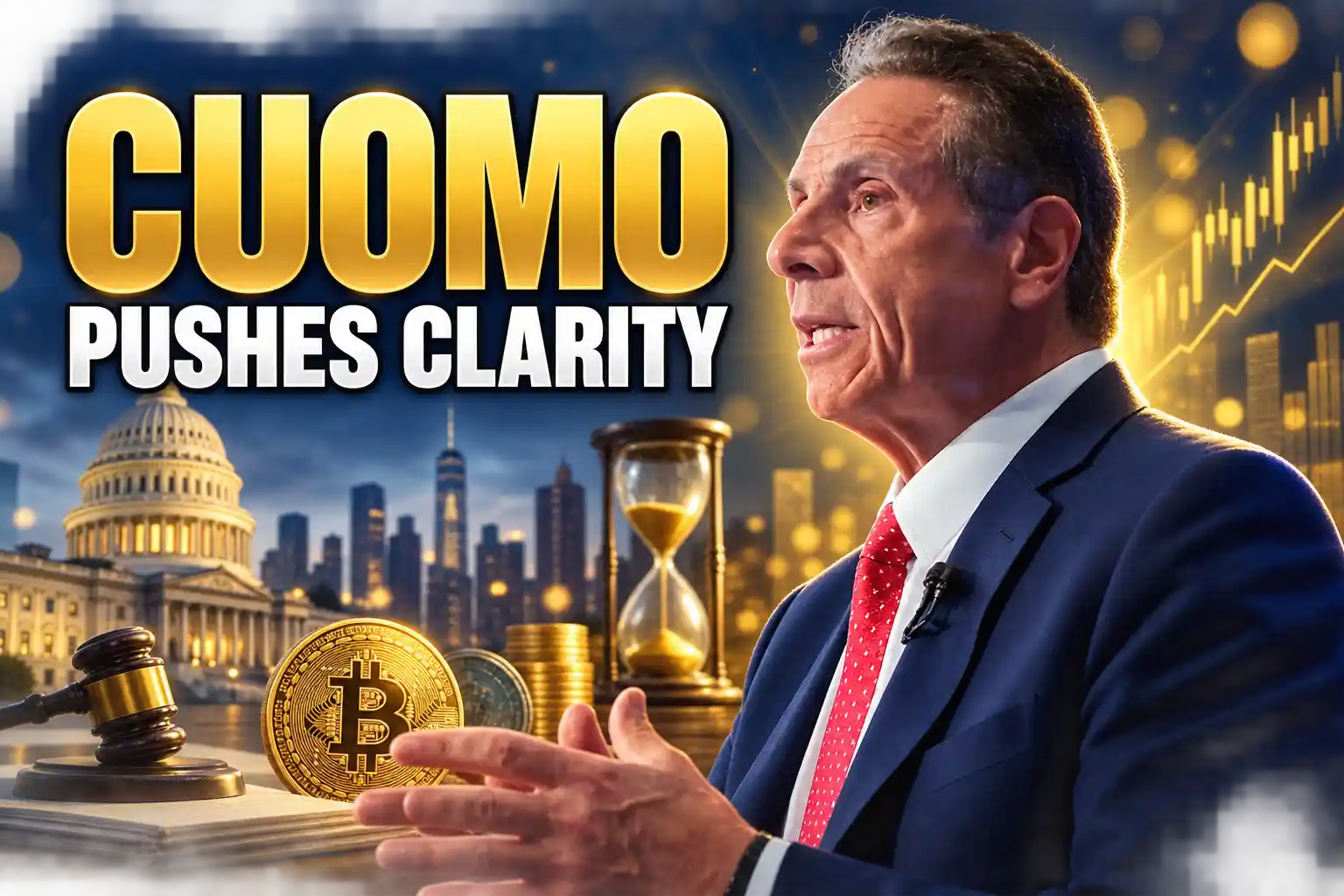
Cuomo Pushes the Clarity Act for His Crypto Venture
Andrew Cuomo’s Clarity Act pitch is the sales case for an OKX-ICE tokenized-stock venture, as the Senate’s 60-vote cloture test arrives.

Andrew Cuomo asked Congress in June to pass the Clarity Act and put a sheriff on crypto. He did it as co-chair of a new 50-50 venture between OKX and Intercontinental Exchange, the owner of the New York Stock Exchange, a product that still needs those federal rules.
The former New York governor framed the bill as help for unbanked families and a 24/7 market without bank middlemen. The same week, the companies put him at the front of a U.S. broker-dealer plan for tokenized NYSE stocks and ICE futures. The Senate’s first floor test is a cloture vote at 2:15 p.m. ET on Tuesday, September 15.
The Joint Venture That Needs a Federal Badge
On June 22, 2026, OKX and ICE named Cuomo co-chair of their joint venture, alongside Trabue Bland, ICE’s senior vice president of futures exchanges. The companies said the firm would seek registration as a U.S. broker-dealer and futures commission merchant so OKX customers could reach ICE futures and NYSE tokenized equities, subject to approvals.
That structure sits on a March 5, 2026 deal in which ICE valued OKX at $25 billion, took a board seat, and said it would license OKX spot crypto prices for U.S.-regulated futures. ICE did not disclose the cash terms. It put OKX’s reach at more than 120 million accounts. Jeffrey C. Sprecher, ICE’s chair and chief executive, said the tie-up would expand retail access to ICE’s regulated markets and speed plans for on-chain infrastructure and tokenized assets for U.S. investors.
Cuomo told interviewers the venture had already started work on oil futures and that its first job was to get licensed. The end state, he said, was fully tokenized securities, pending regulatory clarity. In the same conversation he urged Congress to pass the Clarity Act, calling crypto the latest chapter in American finance after the 1929 crash and the birth of the Securities and Exchange Commission.
You can’t claim an industry is the Wild West when there’s no sheriff. That’s why it’s the Wild West, because there’s no sheriff and there are no laws.
Andrew Cuomo, former New York governor, June 2026 interview
He had been on OKX’s payroll as a policy adviser since 2023, including through a federal criminal case. On February 24, 2025, Aux Cayes Fintech Co. Ltd., doing business as OKX, pleaded guilty in the Southern District of New York to operating an unlicensed money transmitting business and agreed to penalties totaling more than $504 million. The breakdown was $420.3 million in forfeiture and a criminal fine of about $84.4 million. Acting U.S. Attorney Matthew Podolsky said the platform had facilitated more than $5 billion in suspicious transactions after serving U.S. customers without registering as a money services business.
OKX later said Cuomo joined the OKX board in July. Founder and chief executive Star Xu called him a thoughtful voice who already shaped how the firm approached the U.S. market. The board seat landed a month after the sheriff interview, and after Cuomo’s 2025 loss in the New York City mayor’s race to Zohran Mamdani, who had used the OKX advisory work as a campaign line.
New York Already Wrote a Crypto Rulebook
Cuomo’s “no sheriff” line collides with the record of his own governorship. New York created the Department of Financial Services on his watch. In June 2015 the department issued virtual currency regulation 23 NYCRR Part 200, the BitLicense, designed by Benjamin Lawsky, the state’s first superintendent of financial services. The rule took effect on August 8, 2015.
Firms that wanted to hold, transmit, or exchange virtual currency for New Yorkers had to apply. At least ten bitcoin companies announced they would stop serving the state rather than file. Circle received the first BitLicense on September 22, 2015. A decade later the roster is still short and expensive to join.
THE NEW YORK RULEBOOK CUOMO OVERSAW
- July 17, 2014: NYDFS publishes the proposed BitLicense after hearings and subpoenas.
- June 3, 2015: Lawsky releases the final Part 200 text.
- August 8, 2015: The license takes effect; companies have a short window to apply.
- September 22, 2015: Circle receives the first BitLicense.
- December 31, 2024: The state comptroller counts 22 virtual currency licensees holding more than $404 billion in assets.
The comptroller’s December 2025 follow-up also found DFS still lagged on parts of its own oversight, including tax checks and aging anti-money-laundering reviews. New York never lacked a rulebook. It built one so tight that a small club of banks, trusts, and well-funded crypto firms could live with it, and many startups could not. Cuomo now wants a federal statute that, in his telling, would finally create the law that already exists in Albany.
Cuomo Said Washington Waited a Decade Too Long
In the June interview he went further than the sheriff metaphor. “You don’t have more time. The situation is already manifested. Businesses are operating. People are transacting business. This should have been done a decade ago,” he said. “You don’t have the luxury of time.” A decade before that interview, his department’s BitLicense had just taken effect.
He argued the fight was never really about crypto tokens. “When it first started, it was, ‘crypto was controversial,’ but it was never about crypto. It was about the blockchain technology,” he said. Strip out the banks, he argued, and a phone wallet could hold cash, pay bills, and move money with almost no fees. “You don’t need the intermediaries. Literally, you could trade directly, and it can be a 24/7 market, and it can be a global market.”
He also answered Jamie Dimon, the JPMorgan Chase chief executive, who has said the bill falls short of federal banking standards. Cuomo’s version was that traditional finance wants delay because the technology “may upend my business,” and that “you’re not putting the blockchain back in the box.” The line that ties the sermon to the job came at the end: what excited him most, he said, was bringing “the two giants together,” with the New York Stock Exchange as the symbol of American finance now wired to blockchain rails.
That is inclusion language with a product behind it. A wallet with no ATM fees is the consumer wrap. The license stack, the ICE futures, and the tokenized NYSE list are the business.
How the Clarity Act Got a Senate Floor Date
The bill Cuomo is selling is H.R. 3633, the Digital Asset Market Clarity Act, sponsored in the House by Rep. French Hill. The Congressional Research Service summary says it would put most “digital commodity” spot markets under the Commodity Futures Trading Commission, leave the SEC over securities-like activity, and extend Bank Secrecy Act duties to digital commodity exchanges, brokers, and dealers. It is the market-structure bill the industry has wanted since the House passed it last summer.
THE CLARITY ACT’S PATH TO THE FLOOR
| Step | Date | Result |
|---|---|---|
| House passage | July 17, 2025 | 294-134 |
| Senate Banking markup | May 14, 2026 | 15-9, with Ruben Gallego and Angela Alsobrooks joining Republicans |
| Senate legislative calendar | June 1, 2026 | Calendar No. 423, eligible but unscheduled |
| Cloture motion on the motion to proceed | August 8, 2026 | Filed in the Senate |
| Scheduled cloture vote | September 15, 2026, 2:15 p.m. ET | 60 votes required to open debate |
Gallego and Alsobrooks both said their committee votes were not floor votes. Alsobrooks tied her support to language on government officials’ crypto holdings, a direct answer to the Trump family’s coins, stablecoins, and mining interests. That ethics fight, not Cuomo’s fee sermon, is what ate the July window, the August recess, and most of the summer odds.
When Cuomo spoke in June, Polymarket priced 2026 passage around 41 percent, down from 74 percent a month earlier. After the September revision the same contract sat near about 30 percent. A scheduled vote is not a majority.
Seven Democratic Votes Still Decide the Bill
Republicans hold 53 Senate seats. Cloture takes 60. If the GOP conference holds, at least 7 Democrats have to walk over. Majority Leader John Thune teed up the first procedural vote for the afternoon the chamber returned from recess. Failure on Tuesday likely shelves market structure for the rest of this Congress. Sen. Cynthia Lummis has warned that a miss now would push the next real opening to 2030.
THE TUESDAY MATH
- Cloture bar: 60 votes to proceed to debate and amendments.
- Republican seats: 53, so the bill dies if the seven Democratic crossovers do not appear.
- Ethics text: Lummis, John Boozman, and Tim Scott released a final draft on September 13 and said President Donald Trump accepted new limits on officials, judges, and spouses.
- Market price: Polymarket still treats 2026 enactment as a long shot, about 30 percent after that draft.
Lummis put the ask in public on September 14, saying the text includes more than 120 of Democrats’ demands and that a no vote would leave Americans with no federal protections in digital asset markets.
After a year of intense daily bipartisan negotiations, this bill is ready. Here is the final text. President Trump voluntarily agreed to new ethics provisions holding every federally elected official, judge, and their spouses to some of the toughest ethics restrictions in U.S.…
— Senator Cynthia Lummis (@SenLummis) September 14, 2026
Sen. Chris Van Hollen, a Maryland Democrat, is not taking that yes. On September 13 he said Democrats had already stopped the bill in August and that, as written, “this bill does nothing to stop Trump’s crypto corruption or the use of crypto by bad actors.” The leftover argument is still the first family’s coins, even after the ethics chapter. Gallego and Alsobrooks have not, in public, converted their May committee votes into a floor whip count.
Cuomo has not been the September whip. The man who spent June talking about middle-class wallets and a missing sheriff has been quiet while Lummis, Thune, and Van Hollen argue over Trump and ethics. The commercial stake did not move. The political messenger did.
Tokenized NYSE Stocks Wait on the Same Vote
Even a cloture win is not a license. The joint venture still has to clear the agencies that already police brokers, futures merchants, and New York virtual currency activity. Cuomo’s own June list of chores is the cleanest inventory of what OKXICE cannot ship on a press release.
WHAT THE VENTURE STILL HAS TO CLEAR
- Broker-dealer registration: The U.S. wrapper for routing OKX users into NYSE tokenized equities.
- Futures commission merchant license: The ticket onto ICE’s regulated futures, including any contracts tied to OKX prices.
- Federal market structure: The Clarity Act’s SEC-CFTC split, without which tokenized stocks and crypto spot still sit in the same jurisdictional fog Cuomo called lawless.
- New York’s existing gate: Part 200 and limited-purpose trust rules remain in force in the state that already licensed 22 virtual currency firms.
If Tuesday’s 60-vote test fails, those applications do not get easier. They just proceed under the same split between the SEC, the CFTC, FinCEN, and NYDFS that OKX already pleaded through in 2025. If cloture lands, the bill still needs amendments, a final passage vote, a House deal, and a presidential signature, all inside a Senate calendar that empties toward the November 3 midterms.
Cuomo asked for a sheriff in June because his new market cannot open without one. New York already hired that officer in 2015. Congress gets the next chance on September 15 at 2:15 p.m.
Disclaimer: This article is news reporting and analysis for information only. It is not investment advice, legal advice, or a recommendation to buy, sell, or hold any cryptocurrency, tokenized security, or related product, and it is not a prediction of how any senator will vote. Readers who are considering digital-asset trades, corporate filings, or political donations should consult a licensed financial adviser, attorney, or compliance professional who can review their own facts. Vote counts, bill text, license rosters, penalties, and prediction-market prices are those published by the cited agencies, companies, and markets as of the dates given above and can change with the next draft or the next roll call.

Instagram Plus Tests a Read-Only Mode That Cuts Stories

Altman Asks the Public to Accept Some AI Harm

Google Freezes OSS VRP Product Reports After AI Flood

AI Agents Make Payment Rails the Scarce Prize

Turkey’s Crypto Boom Now Runs Through Three Banks

Fable 5 Came Back Under a Commerce On-Off Switch

Google’s SpaceX GPU Lease Has a Sept. 30 Deadline

Plasma One’s XPL Locks Face a 1.81 Billion Cliff

DGO’s Rs 549 World Cup Pass Cost Fans Sleep and Data

Moonshot AI’s $30 Billion Ask Became a $35 Billion Close
-
 AI4 months ago
Fable 5 Came Back Under a Commerce On-Off Switch
-
 AI4 months ago
Google’s SpaceX GPU Lease Has a Sept. 30 Deadline
-
 CRYPTO4 months ago
Plasma One’s XPL Locks Face a 1.81 Billion Cliff
-
 APPS4 months ago
DGO’s Rs 549 World Cup Pass Cost Fans Sleep and Data
-
 AI4 months ago
Moonshot AI’s $30 Billion Ask Became a $35 Billion Close
-

 NEWS4 months ago
ColorOS 17 Device List Spans Oppo, OnePlus and Realme
-
 GAMING4 months ago
Xbox Cuts 3,200 Jobs After Five Years of Thin Returns
-
 GAMING4 months ago
The RTX 4050 Under Rs 70,000 Hides a Wattage Gap