
GADGETS
Vertiv PowerUPS 100 Hits EMEA Below Its AI Brief
Vertiv’s EMEA PowerUPS 100 lithium UPS is 210 watts, under the 300 watt desktop-AI baseline in Vertiv’s own brief, which starts buyers on the PowerUPS 200.

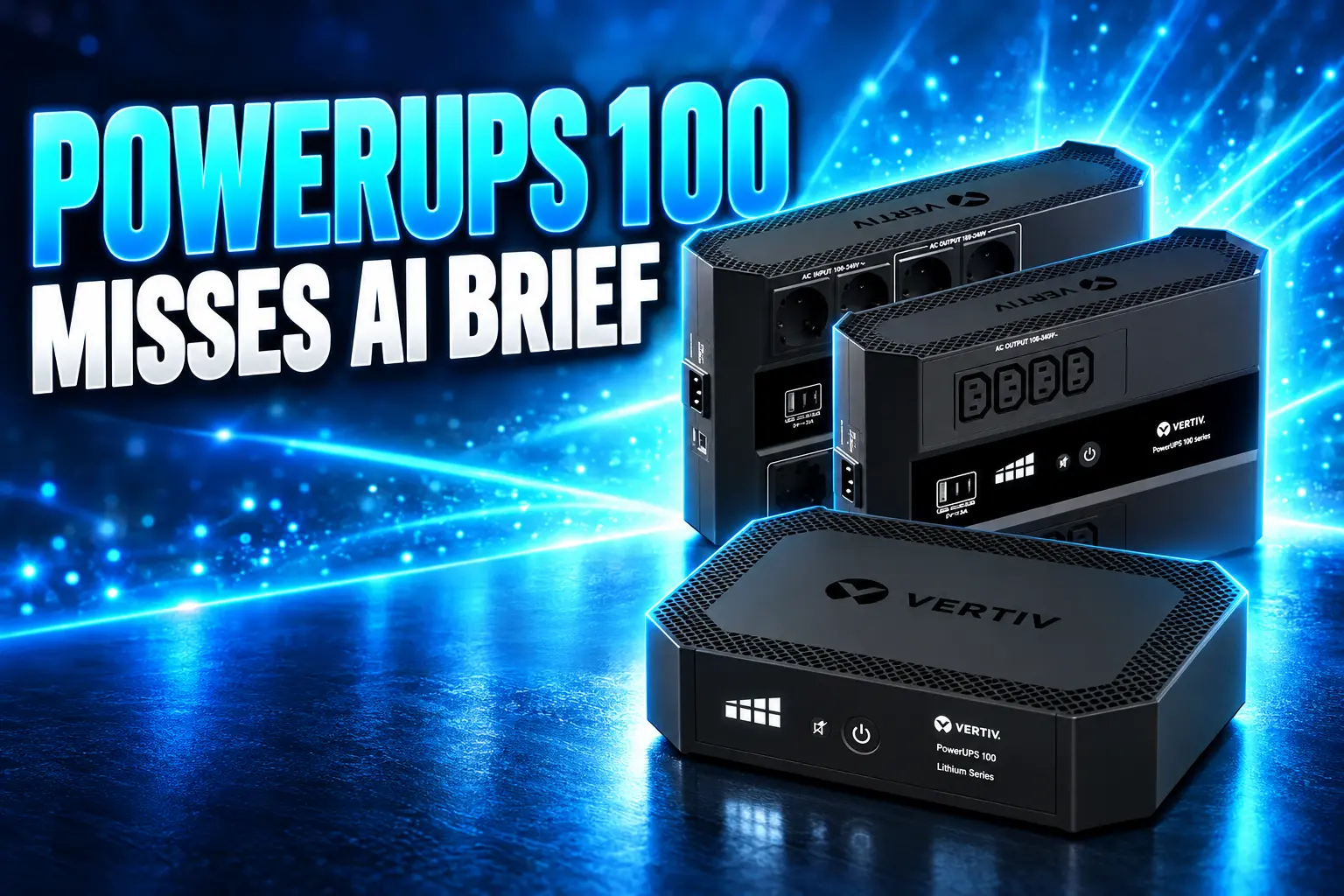
Vertiv’s new PowerUPS 100 lithium box for EMEA is rated at 210 W, under the 300 W baseline Vertiv uses for desktop AI. The 230V standby range went on sale from London on June 23, 2026, aimed at PCs, consoles, tills, networks and AI PCs.
The top VRLA unit reaches 550 W. Vertiv’s own AI worksheet still starts those buyers on the line-interactive PowerUPS 200 that landed in February 2026, not on this standby floor.
The EMEA Range Tops Out at 550 Watts
The 230V family is a compact offline UPS with a simulated sine wave, wall-mount keyholes, runtime LEDs and a mute button. VRLA units add USB-A and USB-C charging. Lithium does not list those ports on the EMEA sheet. Giuseppe Leto, senior director of IT systems business at Vertiv in EMEA, said the line finishes a desktop single-phase refresh built for distributed IT, not only for plant rooms.
The 230V PowerUPS 100 specification sheet lists three VRLA sizes in IEC and Schuko, plus one lithium IEC brick. IEC VRLA packs eight outlets. Schuko packs six battery outlets and two surge-only sockets. Lithium has three battery outlets and one surge-only IEC socket. Input is 220-240 VAC. VRLA accepts 140-290 VAC; lithium accepts 160-278 VAC.
EMEA 230V POWERUPS 100 SKUS
| Model | VA / W | Outlets | Listed backup (min) | Warranty |
|---|---|---|---|---|
| PUL-350IMT-IEC | 350 / 210 | 3+1 IEC | 2 / 8 | 5 years |
| PST6-500IT IEC/SCH | 500 / 305 | 8 IEC or 6+2 Schuko | 2 / 11 | 3 years |
| PST6-700IT IEC/SCH | 700 / 425 | 8 IEC or 6+2 Schuko | 2 / 10 | 3 years |
| PST6-900IT IEC/SCH | 900 / 550 | 8 IEC or 6+2 Schuko | 2 / 10 | 3 years |
The brochure prints those backup pairs without spelling out full load versus half load on the 230V page. Treat them as short shutdown windows, not hours of work. VRLA units transfer in 2-6 ms typical, 10 ms max. Lithium transfers in 8 ms typical, 10 ms max. Efficiency is up to 95% on VRLA at full load and up to 97% on lithium. Surge energy is 600 joules on VRLA and 375 joules on lithium. Overload holds 110% for 5 seconds, then 120% cuts the output at once.
Vertiv’s AI Brief Starts One Rung Higher
The same brochure names “AI Supercomputer (e.g. DGX Spark, Dell GB10)” as an application. Vertiv’s separate desktop-AI note, written around NVIDIA’s GB10 mini systems from Dell, ASUS, HP, Lenovo and Gigabyte, does not put the 100 series on the buy list.
Vertiv’s GB10 testing, based on NVIDIA DGX Spark, shows under 30W at idle, just under 140W in typical use and 170W under heavy load. A display adds 40-50W. For UPS sizing Vertiv uses 300 W per workstation to cover inrush at boot, and it estimates runtime at a 200W load for a box plus one screen.
NVIDIA’s hardware guide requires the included 240 watt adapter on DGX Spark, with GB10 TDP at 140W and about 100W left for ConnectX-7, storage and USB-C gear. Peak system power is 240W. That adapter rating and Vertiv’s 300W planning figure are not the same number as the 170W heavy-load test.
DESKTOP AI WATTS VERSUS THE 100
- Measured heavy load: Vertiv logged 170W on Spark, 210-220W once a 40-50W panel is added.
- Planning baseline: Vertiv sizes each AI workstation at 300W, 90W above the lithium brick.
- 500 VA VRLA: 305W clears that 300W line by 5W, with almost no spare for a dock.
- 900 VA VRLA: 550W leaves 250W above the 300W baseline, the first comfortable 100-series fit.
A 170W heavy Spark plus a 40W panel lands on 210W, which is the lithium ceiling. Add 50W for a brighter screen and the sum is 220W, over the rating. Headless idle at under 30W is easy. The 200W runtime case Vertiv uses for a workstation and display sits at 95% of the lithium watt limit, so the extra minutes on the chart will not show up in real use.
The AI note is blunt about topology. Because AI jobs are treated as critical, Vertiv recommends a line-interactive UPS for desktop AI. “Good” is PowerUPS 200 Standard at 850-1500VA with a step-approximated sine. “Better” is PowerUPS 200 Premium at 1500VA with a pure sine. “Best” is Liebert PSI5 mini-tower at 750-1500VA, with optional network gear. The 100 series is absent from that ladder.
What the PowerUPS 100 Can Carry
The 100 series is sized for short, mixed loads in tight rooms: a till, a router stack, a modest office tower, a console, a kiosk, a camera pack. Those are the brochure’s own use cases, and they match the watt ratings. A GB10 mini can live on the 700VA or 900VA VRLA unit if the display is modest and nothing else hungry shares the battery outlets. The lithium SKU is a different product: 1.40 kg, 243 x 187 x 58 mm, built for a light PC or a network pile, not for a 300W planning load.
Office towers that now carry a Gemini overlay on Windows PCs still trip the same watt budget as any other desktop. Local assistants do not shrink the PSU. Gaming rigs with a mid-range GPU sit above 425-550W once the panel and speakers join in, which is why the 100 series is a weak match for the “gaming consoles” line in the same press note unless the console is the only load.
LOADS THAT MATCH THE 100 SERIES
- Retail POS: A till, receipt printer and a small screen fit the 500VA 305W unit with room to spare.
- Wireless and cameras: Routers, an access point and a recorder sit well inside 210W if the NVR is modest.
- Thin office PCs: A 120-150W SFF box plus one monitor is the lithium SKU’s natural job.
- GB10 mini, VRLA only: The 700VA 425W and 900VA 550W sizes can hold Vertiv’s 300W AI baseline; the 210W lithium cannot.
No public runtime log against a GB10 workstation has shown up since the June launch. Channel copy kept stacking AI PCs next to consoles and tills. The watt math is in Vertiv’s PDFs, and it does not need a crowd to finish the sum.
Five-Year Lithium and a Software Carve-Out
Lithium is the TCO pitch. Vertiv puts standard battery life at 8-10 years against 3-5 years for VRLA, typical cycle life at 2000 against 200-260, and recharge to 90% at 2 hours against 6-8 hours. The lithium pack is sold as up to three times the life, with better heat behaviour and a smaller chassis. The 500VA IEC unit weighs 3.1 kg; the 700VA and 900VA IEC units weigh 4.1 kg. Lithium is 1.40 kg.
Warranty follows the chemistry. VRLA units carry three years, battery included, with advanced replacement. Lithium carries five years, battery included. Vertiv also writes an equipment protection plan of $300,000 on VRLA and $200,000 on lithium for surge damage to plugged-in gear. Replacement packs are VBATKIT102 for both 500VA plugs and the 700VA IEC, and VBATKIT104 for 700VA Schuko and both 900VA plugs. User-replaceable cells are a VRLA feature; the lithium pitch is that you should not need the swap for years.
Power Assist, Vertiv’s free shutdown tool, is the other split. The 230V brochure offers it on the VRLA range except PST6-500IT-IEC and PST6-500IT-SCH. Version 2.1 shipped on January 27, 2026 for Windows, macOS and Linux, talking to the UPS over USB, with optional SNMP on other families. A 500VA buyer who wanted a scripted shutdown has to step up a size or live without the app. Lithium’s EMEA sheet does not hang the same software callout on the 350VA brick.
The Inverter Outputs a Simulated Sine Wave
Standby, or offline, keeps the inverter idle until the wall fails, then switches. That is why the transfer window is 2-6 ms on VRLA and 8 ms on lithium, both capped at 10 ms. Line-interactive units, which is what PowerUPS 200 is, sit closer to the load, correct brownouts with AVR, and avoid a full break for everyday sags. Vertiv’s AI note calls line-interactive the starting point for GB10 work, and it calls a pure sine the better desktop choice.
Both 100-series chemistries write a simulated sine wave on battery. That waveform is common on cheap standby bricks. It is also the reason a “better” rung exists in Vertiv’s own AI table. Active-PFC power supplies on modern PCs can trip, click or derate on a stepped approximation. Vertiv does not publish a DGX Spark-on-simulated-sine test in the 100 brochure. It simply points AI buyers at a different topology.
Noise is under 40 dBA on the 500VA VRLA and under 45 dBA on the rest, measured at 1 m. Operating range is 0-40C. Wall-mount holes are there because the product is meant for a shelf, a till stand or a cupboard, not a rack. None of that makes it a line-interactive sine UPS.
Leto Called the Desktop Refresh Complete
PowerUPS 200 arrived in EMEA in February 2026 at 600-2200VA, line-interactive, with AVR, user-replaceable batteries and up to eight outlets. Essential models carry a two-year warranty. Standard models carry three years, battery included. Leto’s February line was about homes, offices and retail without extra complexity. Four months later the 100 series filled the cheaper offline rung under that stack.
THE DESKTOP SINGLE-PHASE LADDER
- February 2026: Vertiv ships PowerUPS 200 across EMEA, 600 to 2200VA, line-interactive with AVR, as the new desktop and SME rung.
- June 23, 2026: Vertiv adds PowerUPS 100 standby, 350 to 900VA, and Leto says the desktop single-phase refresh is complete.
The latest Vertiv PowerUPS 100 Standby Series completes the refresh of our desktop single-phase UPS portfolio, underscoring our focus on continuously evolving our offerings to help customers address technology advancements and changing usage requirements.
Giuseppe Leto, Senior Director, IT Systems Business, Vertiv EMEA, June 23, 2026 news release
Above both sit Edge line-interactive and Liebert GXT5 online units for network closets and racks. The 100 series is the floor of that ladder: simulated sine, short runtime, USB on the lead-acid boxes, a lithium brick for light loads, and a 550W cap. The 230V brochure still lists DGX Spark as an application. The AI brief still does not list the 100 series. Buyers who actually own a GB10 box are still pointed at line-interactive SKUs on Vertiv’s own AI page.
Frequently Asked Questions
Does the PowerUPS 100 Meet EMEA Safety Marks?
VRLA 230V units carry CB, CE, EN/IEC 62040-1, UKCA, RCM and EAC safety marks, plus EN/IEC 62040-2 emissions and IEC 61000-4-5 surge immunity, and they are listed RoHS, REACH and WEEE. The lithium IEC brick lists CB, CE and EN/IEC 62040-1 on the same brochure, with a narrower EMI line and the same RoHS, REACH and WEEE set.
What Surge Cover Does Vertiv Attach to the 100 Series?
The 230V brochure writes an equipment protection plan of $300,000 on VRLA models and $200,000 on the lithium model for devices damaged by a surge while plugged into the UPS, which is separate from the three-year and five-year unit warranties.
Which Replacement Battery Kits Fit the EMEA VRLA Units?
VBATKIT102 is listed for PST6-500IT-IEC, PST6-500IT-SCH and PST6-700IT-IEC. VBATKIT104 is listed for PST6-700IT-SCH, PST6-900IT-IEC and PST6-900IT-SCH. The lithium EMEA sheet does not publish a user kit number beside those VRLA packs.
How Does Power Assist Behave on the 500 VA Models?
Power Assist 2.1, dated January 27, 2026, runs on Windows, macOS and Linux and can shut a PC down from USB battery data, but the 230V brochure excludes PST6-500IT-IEC and PST6-500IT-SCH from that free software offer, so those two SKUs have no listed graceful-shutdown path from Vertiv.
What Happens If the Load Exceeds the Rating?
Both chemistries hold 110% for 5 seconds, then shut the output immediately at 120%, so a 210W lithium brick that sees a 220W display-plus-Spark spike is in the cut-out band rather than in a long brownout ride-through.

Instagram Plus Tests a Read-Only Mode That Cuts Stories

Altman Asks the Public to Accept Some AI Harm

Google Freezes OSS VRP Product Reports After AI Flood

AI Agents Make Payment Rails the Scarce Prize

Turkey’s Crypto Boom Now Runs Through Three Banks

Fable 5 Came Back Under a Commerce On-Off Switch

Google’s SpaceX GPU Lease Has a Sept. 30 Deadline

Plasma One’s XPL Locks Face a 1.81 Billion Cliff

DGO’s Rs 549 World Cup Pass Cost Fans Sleep and Data

Moonshot AI’s $30 Billion Ask Became a $35 Billion Close
-
 AI4 months ago
Fable 5 Came Back Under a Commerce On-Off Switch
-
 AI4 months ago
Google’s SpaceX GPU Lease Has a Sept. 30 Deadline
-
 CRYPTO4 months ago
Plasma One’s XPL Locks Face a 1.81 Billion Cliff
-
 APPS4 months ago
DGO’s Rs 549 World Cup Pass Cost Fans Sleep and Data
-
 AI4 months ago
Moonshot AI’s $30 Billion Ask Became a $35 Billion Close
-

 NEWS4 months ago
ColorOS 17 Device List Spans Oppo, OnePlus and Realme
-

 GAMING4 months ago
Xbox Cuts 3,200 Jobs After Five Years of Thin Returns
-
 GAMING4 months ago
The RTX 4050 Under Rs 70,000 Hides a Wattage Gap