
NEWS
Mid-Tier IT Gains as Tier-1 Defend Margins With Cuts
Kotak sees Tier-1 Indian IT at 0-2% sequential growth in Q2FY27 as AI deflation bites; mid-tier firms gain share while layoffs and delayed hikes protect margins.

Kotak Institutional Equities expects Tier-1 Indian IT firms to post only 0-2% sequential revenue growth in Q2FY27 as AI-driven pricing pressure and weak demand bite. Companies are turning to layoffs, delayed or smaller wage hikes, reduced variable pay and a weaker rupee to keep margins intact while mid-tier rivals pick up share.
The ANI-cited note paints an uneven sector. Profitability holds only through tight cost control. New AI work is growing, yet productivity gains on the existing book more than offset those tailwinds in the near term.
Kotak’s September-Quarter Call
Geopolitical tensions will keep weighing on decision cycles through the quarter ending September. Any easing in broader economic uncertainty could free delayed projects to start, the brokerage said.
Tier-1 names face the flatter path. Mid-tier firms should deliver moderate-to-healthy growth by winning share and new contracts. The report gave no company-specific layoff or hike numbers.
Cost levers already in play include:
- Layoffs and workforce reductions
- Delayed or smaller annual wage increases
- Lower variable pay and incentives
- Support from a weaker rupee on reported margins
These steps keep profitability resilient even as top-line growth stays muted. The same pattern appeared in earlier Kotak notes that flagged rising pressure from AI productivity and insourcing.
The brokerage frames the quarter as a test of patience more than of sudden recovery. Decision cycles stay long when clients face both macro noise and internal AI experiments that change how they buy external help. Relief on the first front would matter. It would not erase the second.
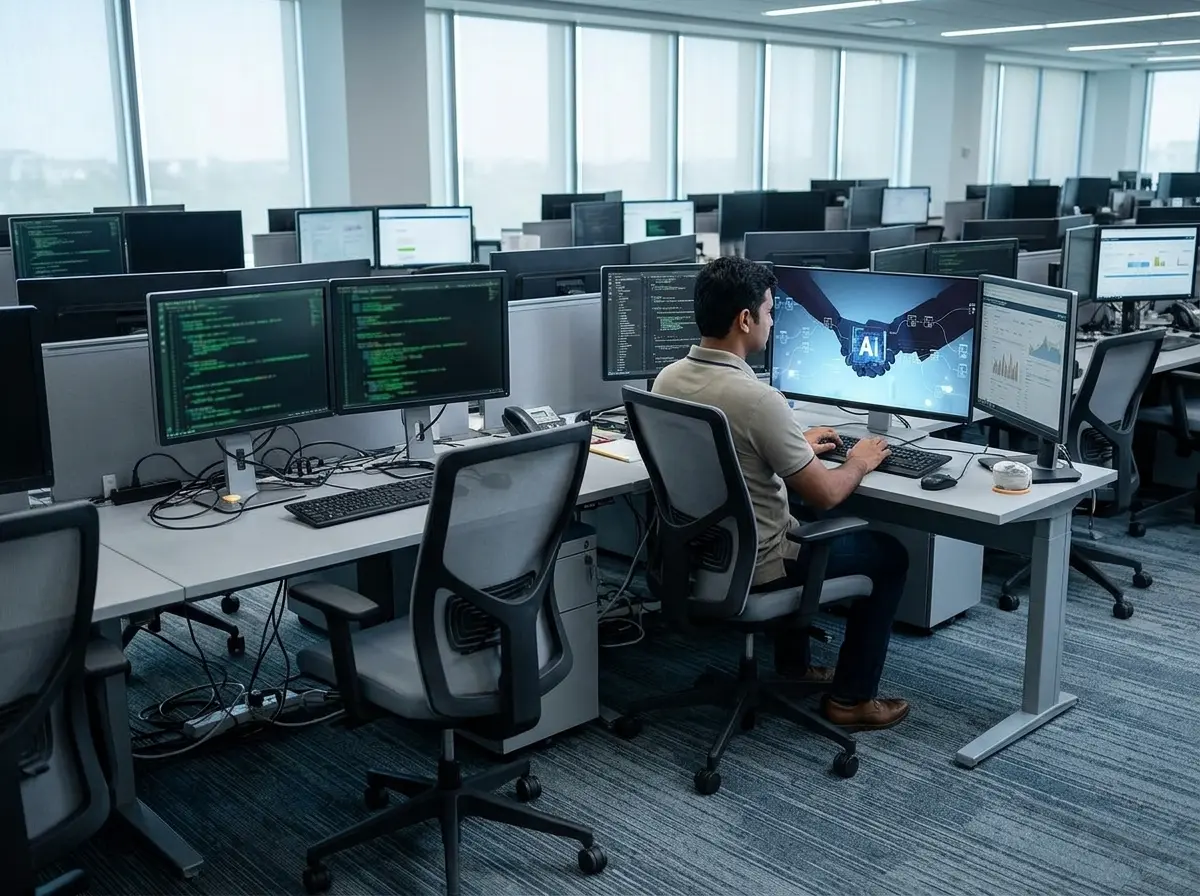
AI Revenue Grows While Base Business Shrinks
Generative AI is now deep inside client projects. Fresh AI-related revenue is rising strongly. At the same time, productivity tools cut the hours needed on existing work.
Time-and-material contracts feel it first because billing tracks effort. Fixed-price and managed-services deals face client demands to pass the gains through as lower prices.
The effect of deflation in the base business will more than offset tailwinds from new AI use cases in the near-to-medium term
Kotak said, according to ANI. Lower volumes in software development and tougher pricing talks in managed services already show the pressure. Earlier this year the same brokerage lifted its estimate of net annual revenue deflation from generative AI to 3.0-3.5% over the next two fiscal years, from a prior 2.0-3.0% range, in Kotak’s March revision to 3-3.5% revenue deflation.
That sits alongside HSBC’s earlier bear case on AI pricing, which also warned the sector loses whether AI spending rises or falls in certain scenarios.
The arithmetic is simple on paper and hard in practice. New AI work adds dollars. Productivity on the installed base subtracts more dollars in the near-to-medium window. The net is the deflation range Kotak now carries.
Tier-One Absorb the Deflation Hit
Established Tier-1 firms carry larger books of traditional contracts. Those are the most exposed to AI-led productivity resets. Clients push for the savings to show up in lower rates or fewer hours.
Mid-tier companies face less of that overhang. They have more room to take business from the incumbents through new deals and share gains. The result is a split growth profile that Kotak expects to continue.
Client commentary collected in a June Kotak note illustrates the productivity jump: HSBC reported 60% faster unit testing, Citi saw 30-40% developer productivity gains, and some NatWest agentic pilots claimed 10X improvements. Those internal wins translate into less outsourced volume or tougher renegotiations.
| Client signal | Reported productivity effect |
|---|---|
| HSBC unit testing | 60% faster |
| Citi developer work | 30-40% gains |
| NatWest agentic pilots | Up to 10X improvements |
Each of those internal results gives a client a concrete number to bring into the next vendor conversation. The larger the traditional book, the more surface area those conversations cover.
Mid-Tier Firms Take the Incremental Work
While large-cap growth stays near zero sequential, several mid-tier names have posted stronger numbers in recent quarters. Coforge and Persistent Systems have repeatedly delivered double-digit year-on-year expansion even as the broader environment cooled. LTIMindtree and others have also shown relatively better sequential traction in broker comparisons.
| Segment | Q2FY27 QoQ Outlook (Kotak) | Recent Pattern |
|---|---|---|
| Tier-1 (TCS, Infosys, Wipro, HCLTech etc.) | 0-2% sequential | Low-single-digit or flat CC; guidance often trimmed |
| Mid-tier (Coforge, Persistent, select peers) | Moderate-to-healthy | Share gains + new contracts; often double-digit YoY |
Deal activity remains solid in vendor consolidation, digital transformation, legacy modernisation, cost-focused outsourcing and global capability centres. The mid-tier is simply converting more of that flow into visible growth right now.
Share gains do not require the overall pie to expand quickly. They require the ability to win the next contract when a client consolidates vendors or opens a new programme. That is the lane mid-tier names have used while Tier-1 books absorb the reset on older work.
Cost Levers That Keep Margins Alive
Profitability across the sector looks resilient on the surface. Underneath it depends on the workforce and compensation tools listed earlier. Variable pay cuts and delayed hikes hit faster than headcount actions and protect the near-term P&L while demand stays soft.
Q1FY27 already showed the mixed picture. TCS reported roughly flat to low-single-digit constant-currency sequential growth with operating margins near 24%. Infosys posted stronger sequential revenue but later guided organic growth lower for the full year. Wipro saw IT services revenue decline sequentially in constant currency. HCLTech delivered a solid profit beat yet still guided full-year growth in a modest 1-4% constant-currency band and took restructuring charges that dented margins.
Stats snapshot from recent reporting:
- TCS Q1: Revenue ₹72,275 crore (+2.2% QoQ), AI annualised run-rate $2.6 billion
- Infosys Q1: Revenue ₹48,211 crore (+3.9% QoQ), net profit down sequentially
- Wipro IT services: Down ~1.2% sequential constant currency
- HCLTech: Operating margin 16.9% after 62 bps restructuring hit; FY27 guide held
Several firms cut organic growth forecasts after client delays. Discretionary tech spending remains the soft spot.
The sequence of levers matters. Pay and incentive adjustments land inside a single quarter. Headcount actions take longer to show fully in the run-rate. Currency support arrives without a management decision at all. Together they explain why margins can hold even when sequential revenue sits in a 0-2% band.
What the June Quarter Already Showed
Geopolitics, uncertain macro conditions and client-specific issues stretched deal closures and ramp-ups in Q1. Companies that had large deals moving into execution grew healthier. Those exposed to spending cuts or pricing pressure lagged.
Nasscom still sees the broader technology sector on a solid long-run path. The industry body projected Nasscom’s FY26 sector growth to $315 billion at 6.1%, with AI services already in the $10-12 billion range. The Nasscom Strategic Review on AI maturation frames FY27 as the year AI spending moves from pilots toward enterprise programmes, with overall tech spending still expected in a 5-7% band.
That longer view sits beside the near-term deflation arithmetic. New AI revenue must outrun the price and volume erosion on the base book. For Tier-1 firms that equation is harder because the base is larger.
- Near term: Base-book deflation offsets new AI revenue for large traditional portfolios.
- FY26 frame (Nasscom): Sector path to $315 billion at 6.1%, AI services already $10-12 billion.
- FY27 frame (Nasscom): AI moves from pilots to enterprise programmes; overall tech spend still in a 5-7% band.
The two clocks run at once. One measures quarterly sequential growth and margin defence. The other measures multi-year sector size and the shift of AI dollars from experiment to programme. Kotak’s note lives on the first clock. Nasscom’s figures describe the second.
How Fixed Price Deals Change the Risk
Time-and-material work shrinks first when tools cut hours. That is why managements push toward fixed-price and outcome-based contracts. The move protects revenue only if the vendor can estimate delivery cost under a faster productivity curve.
AI makes that curve harder to read, not easier, in the early innings. A contract priced on yesterday’s effort assumptions can turn unprofitable if tools compress the work faster than expected. The same tools can also help the vendor hit the outcome if the firm learns to use them inside its own delivery engine.
Wipro and peers have framed AI as the eventual answer to that estimation problem. The bet is explicit: the force that squeezes the old hour model becomes the force that makes outcome contracts reliable. Until the learning sticks, the shift itself adds risk even as it answers client demand for lower unit prices.
Why Insourcing Adds a Quiet Drag
Banks and financial firms that see large internal productivity jumps have less reason to keep every hour outside. Global capability centre expansion and vendor consolidation follow from the same client arithmetic that shows up in renegotiations.
Kotak has repeatedly listed insourcing and capability-centre growth alongside AI as risks that fall heaviest on the largest traditional portfolios. The mid-tier feels less of that drag because more of its book is newer work won in the current cycle rather than legacy volume subject to internal take-back.
The pattern reinforces the split already visible in sequential outlooks. Tier-1 firms defend a wide installed base. Mid-tier firms chase the incremental dollar in consolidation and modernisation deals that still clear. Both face AI. Only one carries the heavier legacy overhang.
The Hours Model Meets Productivity Gains
On X and in investor notes the sharpest observation is structural. Indian IT long sold human hours. AI tools make those hours more productive, so clients immediately demand the savings. Revenue per person or per hour falls even as total tech spend holds up. One widely circulated take put it plainly: the firms have a billing problem, not a technology problem.
That is why managements talk more about fixed-price and outcome-based contracts. The shift moves estimation risk onto the vendor at the exact moment AI makes cost curves harder to predict. Wipro and peers have framed AI as the tool that will eventually help them deliver those contracts more reliably. It is a bet that the same force causing the squeeze can also absorb it.
Crowd commentary also flags a trust gap. Loud AI promises have so far produced only tepid growth and margin defence at the large end. Mid-tier names that already specialise in product engineering, cloud modernisation or specific vertical AI work look better positioned for the incremental dollars. Nilekani’s view that AI will amplify Indian IT remains the optimistic long-term case many still hold, yet the near-term scoreboard shows the deflation first.
Insourcing and global capability centre expansion add another quiet headwind. Banks and financial firms are pulling more work inside or consolidating vendors after seeing internal productivity jumps. Kotak has repeatedly listed those trends alongside AI as risks that fall heaviest on the largest traditional portfolios.
The September quarter will test whether any macro relief shortens sales cycles enough to lift the Tier-1 numbers above the 0-2% band. Even if it does, the deeper split between firms that must defend a large legacy book and those still taking share looks set to define the next several quarters. Margins can stay healthy through people-cost levers. Growth will stay uneven.


South Korea Retail Investors Face Reckoning After KOSPI AI Rally Collapses

Surrey AI Maps Three Heart Attack Paths and Their Molecular Roots

Germany Locks Neutral Apple ATT Prompts Across Most of Europe

Apple’s 5% EU Fee Quietly Rewrites Alternative App Store Math

Apple’s EU Fee Truce Cuts Complexity but Leaves Rivals Fuming

Pixel 11 Pro Fold Trades Thinness for Durability and Seven-Year Stay

Mayo AI Flags HCM Obstruction From Everyday Ultrasound Videos

Indian Brands Quietly Scale Landmark Screens and Home Tech

Navin Vatsa Turns Grief Into a Lifetime of Quiet Seeing

Google Bets Pixel 11 Agentic AI Will Redefine Phones

Oracle Cuts 21,000 Jobs in a Year, Cites AI in 10-K Filing

Fable 5 and Mythos 5 Return as US Lifts Anthropic Export Controls

SpaceX’s Google Deal Turns a Rocket Company Into a Cloud Landlord

CD Projekt Red Co-CEO: Redemption Arc Isn’t Done, Witcher 4 in 2027

XPL Rallies 30% Ahead of Plasma One Card Tier Launch

Google Search Profiles Build a Follow Graph Inside Discover

DGO App Brings Rs 549 Mobile Pass for FIFA World Cup 2026 in Nepal

Moonshot AI Targets $30 Billion in China’s Fastest AI Funding Sprint

Oppo’s ColorOS 17 Eligibility List Leaves A-Series Buyers Behind

Microsoft Xbox Layoffs Start in July as Sharma Slams 3% Margin
-
 AI2 months ago
Oracle Cuts 21,000 Jobs in a Year, Cites AI in 10-K Filing
-
 AI2 months ago
Fable 5 and Mythos 5 Return as US Lifts Anthropic Export Controls
-
 AI3 months ago
SpaceX’s Google Deal Turns a Rocket Company Into a Cloud Landlord
-
 GAMING2 months ago
CD Projekt Red Co-CEO: Redemption Arc Isn’t Done, Witcher 4 in 2027
-
 CRYPTO3 months ago
XPL Rallies 30% Ahead of Plasma One Card Tier Launch
-
 NEWS3 months ago
Google Search Profiles Build a Follow Graph Inside Discover
-
 APPS3 months ago
DGO App Brings Rs 549 Mobile Pass for FIFA World Cup 2026 in Nepal
-
 AI3 months ago
Moonshot AI Targets $30 Billion in China’s Fastest AI Funding Sprint