
AI
Infosys’s Nilekani: AI Won’t Replace Indian IT, It Will Amplify
Infosys Chairman Nandan Nilekani told the 45th AGM that AI will amplify, not replace, Indian IT. Frontier AI firms are now signing up as Infosys partners.

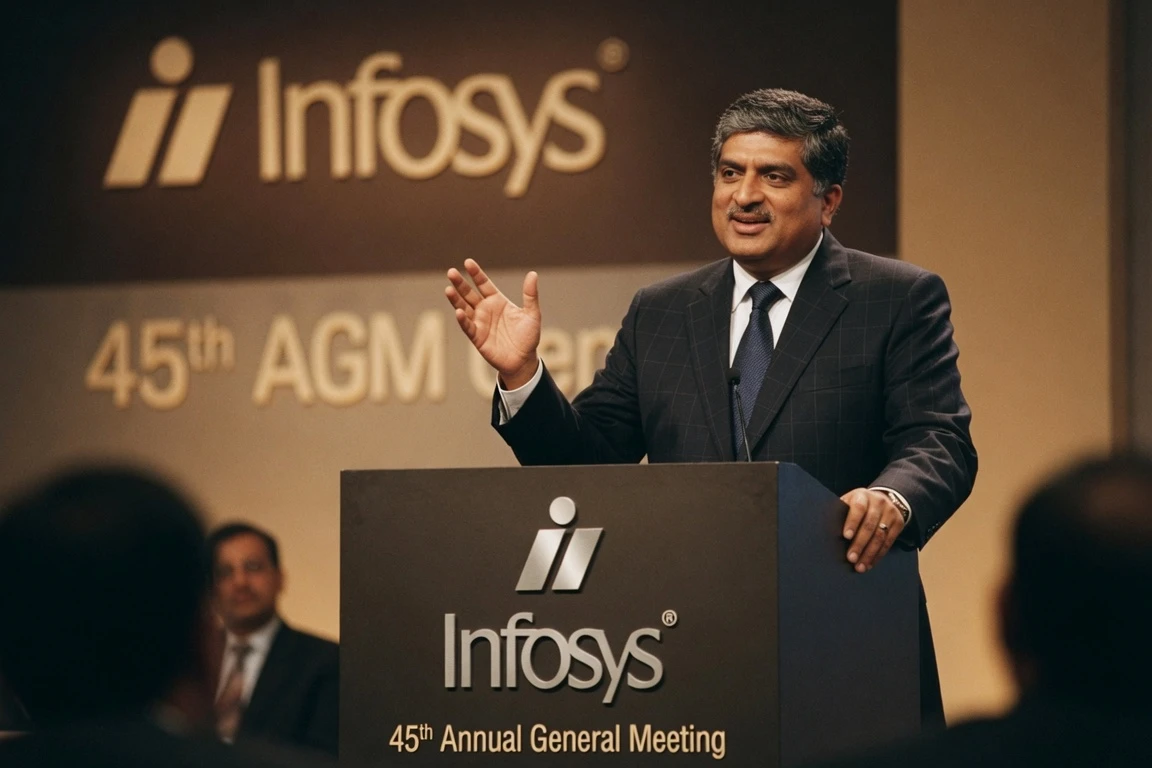
Infosys Chairman Nandan Nilekani told shareholders at the company’s 45th Annual General Meeting on Tuesday that AI will amplify, not replace, Indian IT firms. The pushback, delivered on June 23, 2026, was framed less as denial than as forecast: Infosys now sees a $300-400 billion AI-first services market by 2030 and is positioning the firm to lead it.
The contrarian read misses the company’s bigger move. OpenAI and Anthropic have spent recent months launching their own AI deployment companies, the move widely read as a threat to Indian IT. The 45th AGM produced the counter-evidence. As CLSA’s case that AI is sparing SaaS moats argues, the threat narrative has been running ahead of the facts.
The Numbers Behind the Pushback
The $300-400 billion figure is not Infosys’s own estimate. It comes from a Nasscom-McKinsey report the company cited in April when it unveiled its AI-First Value Framework built around six value pools. Nilekani told shareholders that Infosys is “keen to tap” that range by 2030.
The base business is not collapsing under the AI question. For the year ended March 31, 2026, Infosys posted $20.2 billion in revenue, up 3.1 per cent in constant currency, with large-deal contract value of $14.9 billion and free cash flow of $3.7 billion, according to the firm’s FY26 results press release. Q4 net profit came in at ₹8,501 crore, up 21 per cent year over year. The growth is real, not record-breaking, and FY27 guidance of 1.5 to 3.5 per cent revenue growth sits below where the firm just finished.
The growth that matters now shows up in the AI line. CEO Salil Parekh disclosed at the AGM that Infosys is clocking about annualised $1 billion of AI services revenue, growing at what he called “a very good pace,” per Parekh’s same-day disclosure. That figure is a fraction of total revenue, but it is the line Nilekani and Parekh are now selling.
The Deployment Gap That Justifies the Forecast
The bullish case rests on a single phrase Nilekani used twice in his address: the AI deployment gap. “The AI deployment gap in large enterprise clients is real, and closing that gap is where the work is,” he told shareholders.
The gap is the distance between an AI model that works in a demo and one that runs inside a regulated enterprise, behind its cybersecurity stack, on top of its existing data, and inside its governance frameworks. Indian IT firms have spent decades building exactly those integration skills. Nilekani argued at the AGM that software development “extends far beyond writing code” and requires deep enterprise context, integration with existing technology investments, cybersecurity safeguards, testing, governance, and architecture expertise.
Frontier AI Firms Are Now Knocking on Infosys’s Door
Three months ago the consensus worry was that OpenAI and Anthropic had each launched standalone AI deployment companies, the move widely read as a threat to Indian IT. Satya Nadella’s recent warning that AI could “hollow out” industries gave the worry a Microsoft-shaped endorsement. The 45th AGM produced the counter-evidence in the form of named partnerships. Anthropic, Intel, Cursor and Cognition each signed with Infosys during the last fiscal year.
Infosys spent the last fiscal year signing the frontier AI labs as collaborators, not rivals. The language in the joint releases is unusually direct about who needs whom.
There’s a big gap between an AI model that works in a demo and one that works in a regulated industry, and if you want to close that gap, you need domain expertise. Infosys has exactly that kind of expertise across important industries: telecom, financial services, and manufacturing.
Dario Amodei, co-founder and CEO of Anthropic, made the case in Infosys’s FY26 results press release. Cursor, the AI coding tool maker, said it is enabling over 100,000 software engineers at Infosys with agentic coding platforms. Cognition called Infosys “the first large digital services and consulting firm to deploy agentic tools at this scale.” The pattern is consistent: the firms whose models Nilekani was being asked about are paying Infosys to be their delivery arm, the part of the AI stack they cannot or will not build themselves.
Legacy Modernisation Becomes the AI Battleground
Nilekani singled out one specific area of opportunity at the AGM: legacy systems. “The AI revolution has made legacy modernisation urgent in a way nothing else has,” he told shareholders.
The opportunity is concrete enough that Infosys has named it as a separate value pool within its AI-First framework. The full framework breaks the opportunity into six value pools, each positioned as an active programme with named partnerships and revenue attached. Together they are the structure the $300-400 billion forecast is built on.
- AI Strategy and Engineering
- Data for AI
- Process AI
- Agentic Legacy Modernization
- Physical AI
- AI Trust
The firm said it has more than 4,600 AI projects underway. It has launched over 30 new service offerings across the six pools, with the Topaz Fabric suite sitting on top of the model layer. The build-versus-buy preference shift Nilekani flagged cuts both ways, against traditional SaaS and for firms that can do the building. Parekh framed the same opportunity from the operations side: “Modernisation of technology using agents is one of the largest areas today.”
That is the operating frame for the $300-400 billion bet. If enterprises choose to build rather than buy, the integrator wins, and Indian IT has been that integrator for forty years. If they choose to buy, the model companies with packaged AI products win, and Indian IT is one option among many.
What Investors Are Still Worried About
The bullish framing is not unanimous. Indian IT’s over $300 billion industry has spent the last year absorbing the argument that generative AI could compress demand for software-development and IT-outsourcing work, long the backbone of the sector.
Nilekani himself acknowledged the “existential question” being asked of the industry. The question, as he framed it, is whether companies such as Infosys remain relevant if coding becomes largely automated. The financial guidance does not pretend the question is settled. FY27 revenue growth guidance of 1.5 to 3.5 per cent in constant currency is below the 3.1 per cent Infosys just delivered in FY26, and operating margin guidance of 20 to 22 per cent is roughly in line with where the firm finished.
The full market has been tracking the narrative. Infosys’s market capitalisation stood at ₹4.17 lakh crore as of June 23, 2026, the day of the AGM, and shares are expected to be in focus as investors digest both the AI plan and the conservative FY27 outlook. The bear case has not gone away, and four of its points are now part of the record:
- Whether IT services firms stay relevant if coding becomes largely automated
- The $300-400 billion opportunity is a 2030 forecast, not a current revenue line
- FY27 guidance is conservative, with growth below the FY26 print
- Agentic coding tools may eventually compress the unit economics of services work
The Bottom Line
Nilekani’s “amplify, not replace” line is the headline. The partnerships are the news, and they read like a who-is-who of the frontier AI stack.
Whether the $300-400 billion opportunity lands will turn on how much of the deployment work the frontier AI companies end up doing themselves, and how much they hand to firms like Infosys. The model layer is solved, and the deployment layer is where the open question sits. Per Nilekani’s full address to the 45th AGM, the answer is at least partly already in. The receipts include $1 billion in annualised AI revenue, four named frontier partners, and a 45th AGM that ended with the chairman arguing that he had never been more relevant.
Frequently Asked Questions
What did Infosys’s chairman say about AI at the 45th AGM?
Chairman Nandan Nilekani told shareholders on June 23, 2026, that “AI will not replace a company like ours. It will amplify those who move with purpose and adapt with speed.” He framed AI as an opportunity for IT services firms that adapt quickly, not a threat that replaces them.
What is the $300-400 billion AI-first services opportunity?
It is a 2030 market-size estimate from a Nasscom-McKinsey report that Infosys cited when it unveiled its AI-First Value Framework in April. The company counts six value pools inside that range, including AI Strategy, Data for AI, Process AI, Agentic Legacy Modernization, Physical AI, and AI Trust.
How much AI services revenue is Infosys generating right now?
CEO Salil Parekh said at the AGM that Infosys is clocking about $1 billion in annualised AI services revenue, growing at what he called “a very good pace.” The figure is a small slice of the firm’s $20.2 billion total revenue for the year ended March 31, 2026.
Why are frontier AI companies partnering with Infosys?
Anthropic, Intel, Cursor and Cognition all announced strategic collaborations with Infosys during the last fiscal year. Anthropic CEO Dario Amodei said the gap between an AI demo and a production deployment in a regulated industry requires the domain expertise Infosys already has in telecom, financial services and manufacturing.
What are Indian IT firms’ biggest concerns about AI?
The “existential question” Nilekani named at the AGM is whether IT services firms stay relevant if coding becomes largely automated. Investors have watched shares of Indian IT firms trade on AI anxiety for several quarters. Infosys’s response is to lean into the deployment work the model companies cannot do alone.
Disclaimer: This article is for informational purposes only and does not constitute investment advice. Figures and quotes are accurate as of publication on June 24, 2026, and may change. Consult a qualified financial advisor before making any investment decision related to securities of Infosys or any other company mentioned.


Google Opens Gmail to Voice and Gates Docs Live

Lenovo Prices the IdeaPad Vibe Against Apple’s $699 Neo

Xbox Caps Game Pass Cloud Gaming at 15 Hours

GTA 6 DualSense Controllers Follow Sony’s Usual $84.99 Script

South Korea Retail Investors Face Reckoning After KOSPI AI Rally Collapses

Surrey AI Maps Three Heart Attack Paths and Their Molecular Roots

Germany Locks Neutral Apple ATT Prompts Across Most of Europe

Apple’s 5% EU Fee Quietly Rewrites Alternative App Store Math

Apple’s EU Fee Truce Cuts Complexity but Leaves Rivals Fuming

Pixel 11 Pro Fold Trades Thinness for Durability and Seven-Year Stay

Oracle Cuts 21,000 Jobs in a Year, Cites AI in 10-K Filing

Fable 5 and Mythos 5 Return as US Lifts Anthropic Export Controls

SpaceX’s Google Deal Turns a Rocket Company Into a Cloud Landlord

CD Projekt Red Co-CEO: Redemption Arc Isn’t Done, Witcher 4 in 2027

XPL Rallies 30% Ahead of Plasma One Card Tier Launch

Google Search Profiles Build a Follow Graph Inside Discover

DGO App Brings Rs 549 Mobile Pass for FIFA World Cup 2026 in Nepal

Moonshot AI Targets $30 Billion in China’s Fastest AI Funding Sprint

Oppo’s ColorOS 17 Eligibility List Leaves A-Series Buyers Behind

Microsoft Xbox Layoffs Start in July as Sharma Slams 3% Margin
-
 AI2 months ago
Oracle Cuts 21,000 Jobs in a Year, Cites AI in 10-K Filing
-
 AI2 months ago
Fable 5 and Mythos 5 Return as US Lifts Anthropic Export Controls
-
 AI3 months ago
SpaceX’s Google Deal Turns a Rocket Company Into a Cloud Landlord
-
 GAMING2 months ago
CD Projekt Red Co-CEO: Redemption Arc Isn’t Done, Witcher 4 in 2027
-
 CRYPTO3 months ago
XPL Rallies 30% Ahead of Plasma One Card Tier Launch
-
 NEWS3 months ago
Google Search Profiles Build a Follow Graph Inside Discover
-
 APPS3 months ago
DGO App Brings Rs 549 Mobile Pass for FIFA World Cup 2026 in Nepal
-
 AI3 months ago
Moonshot AI Targets $30 Billion in China’s Fastest AI Funding Sprint