
CRYPTO
The Fear and Greed Index Ran From 17 to 57
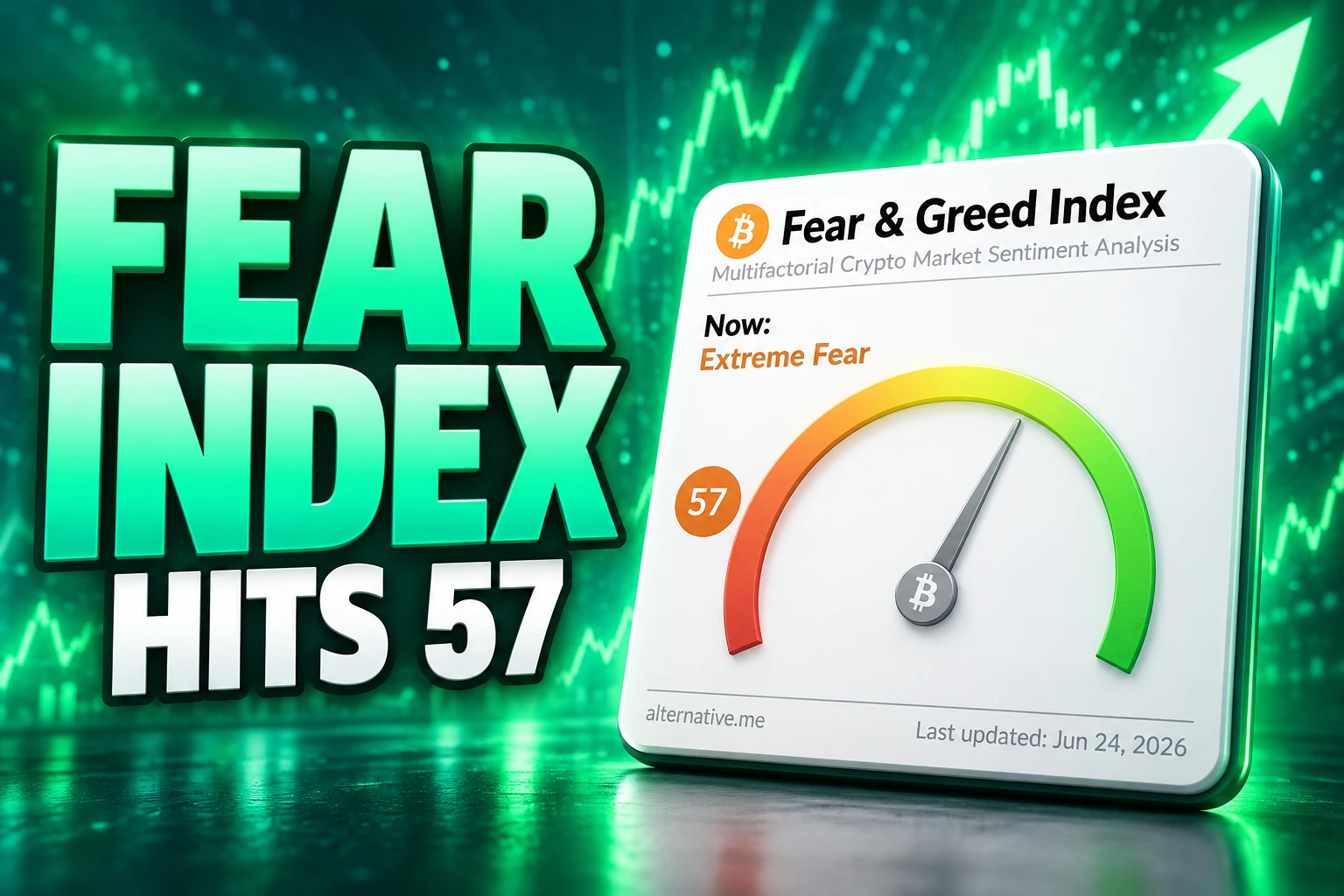
The Crypto Fear and Greed Index printed 17 on June 24, then 11 a week later, and now reads 57 greed as Bitcoin sits 26% above that close.

The Crypto Fear and Greed Index is at 57, in greed, on September 14, 2026, after a June 24 print of 17. Alternative.me, which publishes the gauge, lists 61 for September 13, 71 for a week earlier, and 34 for a month earlier, with Bitcoin at $76,860 on the same dashboard.
That 17 was not the low. The index fell to 11 on July 1, while Bitcoin’s session low that day was $57,747, and the same meter is now on the greed side of the scale after an 82-day climb.
The June 24 Update Caught Fear at 17
A June 24 market update on X said the daily Crypto Fear and Greed Index had dropped further to 17, deep in extreme fear. The post used the classic red-to-green dial that wallet apps and TradingView widgets pull from Alternative.me’s feed.
🚨 UPDATE: The Crypto Fear & Greed Index drops further to 17, deep in Extreme Fear territory. pic.twitter.com/ckLW55vdtj
— Cointelegraph (@Cointelegraph) June 24, 2026
The 17 print did not land as a warning in the replies. Traders treated it as a discount window, the usual “stack while it hurts” read that shows up whenever the dial slides under 25. Fear was not finished. Alternative.me’s series, compiled on Yieldo’s daily table, shows 12 on June 25, 13 on June 26, and 12 again on June 29.
Bitcoin closed at $60,995 on June 24. Anyone who took 17 as a finished capitulation was early by a week on sentiment and still inside a $58,000 handle on price.
July 1 Printed the Real Low at 11
The cluster bottom on the gauge was 11 on July 1, seven days after that 17 update. Bitcoin’s low that session was $57,747, with a close of $60,004. Extreme-fear prints (0-24) then flickered through mid-July: 20 on July 8, 22 on July 14, then 25 on July 15, which is the first step out of the bottom band.
READINGS FROM 17 TO GREED
| Date | Index | Band |
|---|---|---|
| June 24, 2026 | 17 | Extreme fear |
| July 1, 2026 | 11 | Extreme fear |
| August 6, 2026 | 25 | Fear |
| August 19, 2026 | 46 | Neutral |
| August 20, 2026 | 62 | Greed |
| August 25, 2026 | 74 | Greed |
| September 7, 2026 | 71 | Greed |
| September 14, 2026 | 57 | Greed |
The jump that ended the fear stretch was abrupt. The index was 46 on August 19 and 62 the next day, then 74 on August 25, the high of that run. Yieldo’s 366-day window on the series shows a low of 5 and a high of 74, so August’s 74 sat at the top of the past year even though it never crossed into extreme greed.
That path is why the June 17 update reads differently in September than it did on the day. It marked the middle of a fear cluster, not the turn. The site’s earlier note on three weeks of extreme fear sat inside that same June-July block, when the dial spent most sessions under 25.
How the Crypto Fear & Greed Index Is Calculated
Alternative.me built the gauge in February 2018 as a 0 to 100 score for Bitcoin, later reused across crypto dashboards. Zero is extreme fear. 100 is extreme greed. The firm still describes the live index as bitcoin-only, because so much of the math is coin-price volatility.
THE SIX INPUTS AND THEIR WEIGHTS
| Input | Weight | What it compares |
|---|---|---|
| Volatility | 25% | Bitcoin’s current swings and drawdowns versus 30-day and 90-day averages |
| Momentum and volume | 25% | Current volume and thrust versus those same windows |
| Social media | 15% | Bitcoin hashtag posts and interaction speed on X; Reddit is not in the live mix |
| Surveys | 15% | Weekly polls, currently paused |
| Bitcoin dominance | 10% | Bitcoin’s share of total crypto market value |
| Google Trends | 10% | Search volume and related queries around Bitcoin |
Surveys remain listed at 15% and paused, so the five live legs add to 85%. Alternative.me used to run weekly polls on StrawPoll, a platform it owns, and said those votes usually drew 2,000 to 3,000 responses. History back to 2018 is on a public JSON Fear and Greed feed.
THE FIVE BANDS ON THE DIAL
- 0-24: Extreme fear, the zone that held June 24 and July 1.
- 25-44: Fear, where the gauge sat through early August.
- 45-54: Neutral, including the 46 print on August 19, the day before the greed jump.
- 55-74: Greed, including 57 now, 71 on September 7, and 74 on August 25.
- 75-100: Extreme greed, a band the past year did not reach on Yieldo’s chart.
A rise in volatility counts as fear. Heavy buying volume in an up tape counts as greed. Alternative.me also treats a rise in Bitcoin dominance as fear, a flight out of more speculative coins, and a shrinking share as greed as money rotates into alts.
Spot Bitcoin ETFs Lost $4.06 Billion in June
The 17 print did not appear in a vacuum. SoSoValue’s tally of U.S. spot Bitcoin ETFs shows $4.06 billion of net outflows in June 2026, the largest month since those funds launched in January 2024, above the previous record of $3.56 billion in February 2025. May had already taken $2.43 billion.
THE JUNE REDEMPTION WAVE
- June month: $4.06 billion net out of U.S. spot Bitcoin ETFs, per SoSoValue.
- Prior record: $3.56 billion in February 2025.
- May: $2.43 billion of net redemptions before June’s worse month.
- Early-June week: a $1.72 billion weekly ETF outflow from June 1 to June 5, with IBIT the largest drain that week.
That is the plumbing under the red dial. Authorized participants redeem shares by selling the underlying bitcoin, so a record month of ETF exits shows up in spot supply just as volatility and volume, half the index, are already scoring fear. The 17 reading on June 24 sat inside that redemption stretch, not beside it.
The 26% Climb That Followed Extreme Fear
From the $60,995 close on June 24 to $76,860 on Alternative.me’s September 14 dashboard, Bitcoin is up 26%. The move did not start the day the gauge hit 17. Price still tagged $57,747 on July 1, the same date the index printed 11, then spent August grinding through levels that included Bitcoin holding near $63,000 before the late-August sentiment jump.
Ether is at $2,484.89 on that same dashboard, down 1.58% on the day of the 57 print. The fear-to-greed path in the index is a Bitcoin-weighted story; alt tapes can lag while the dial is already in the green.
The sequence matches the old textbook use of the gauge and also shows its lag. Extreme fear can persist for weeks, as it did from mid-June into mid-July, and the first 17 of a cluster is a poor trigger. The 11 on July 1 was the cleaner sentiment low. The 62 on August 20 was the first greed close of the rebound. By August 25 the score was 74, still greed, not extreme greed, with Bitcoin already far above the July low.
Greed at 57 Leaves Buyers on the Other Side
Alternative.me states the two assumptions in plain language. Extreme fear can mean investors are too worried, and that can be a buying window. When investors get too greedy, the market is due for a correction. The June 17 crowd used the first line. The 57 print, and the 71 and 74 that preceded it, is the second line’s territory.
Extreme fear can be a sign that investors are too worried. That could be a buying opportunity.
Alternative.me, Crypto Fear and Greed Index methodology
On September 10, with the index still near 70, the same contrarian read had already flipped: wait for fear again before looking for longs. That is the mechanical use of the tool, and it is why a June 17 update is a completed chapter rather than a live alarm. The people who bought the red dial in late June now hold a green one, 26% higher on Bitcoin, and the signal they trusted is no longer the one that says pile in.
A 57 is mild greed, four points under the prior day and well under the 74 of August 25. It is also 40 points above the June 24 print and 46 points above July 1. The meter that flashed 17 in June now reads 57, and the trade that 17 invited has already been taken.
Frequently Asked Questions
How Often Is the Crypto Fear and Greed Index Updated?
Alternative.me refreshes the score once a day, not intraday, and the public API’s default call returns only the latest value; setting limit to 0 pulls the full daily history back to February 2018, which is why the same number appears on wallets, charting widgets, and research dashboards with a one-day lag.
Is the Crypto Fear and Greed Index Only About Bitcoin?
Yes for the live series. Alternative.me says the current index is for bitcoin only because a large part of the formula is the coin’s own volatility, and public social-media counts are shown for Bitcoin even though the firm has discussed separate alt indices that are not the headline gauge.
Why Does Rising Bitcoin Dominance Count as Fear?
Alternative.me treats a larger Bitcoin share of total crypto market value as investors leaving speculative altcoins for the coin they see as the safer harbor, which scores as fear, while a shrinking Bitcoin share scores as greed because money is rotating into riskier names.
What Happened to the Survey Slice of the Index?
The 15% survey leg used weekly StrawPoll ballots that typically drew 2,000 to 3,000 votes, and Alternative.me still lists that weight while marking the series as paused, so the five remaining inputs are the entire live calculation until polls resume.
Disclaimer: This article is news reporting and analysis of public sentiment data and market figures, and it is for information only. It is not investment advice, trading advice, or a recommendation to buy, sell, or hold bitcoin, ether, spot bitcoin ETFs, or any other digital asset. Readers should consult a licensed financial adviser or investment professional who can consider their own objectives and risk limits before acting on any index reading or price move. Index values, ETF flow totals, and prices reflect the cited sources on the dates named and can change with the next daily print.

Instagram Plus Tests a Read-Only Mode That Cuts Stories

Altman Asks the Public to Accept Some AI Harm

Google Freezes OSS VRP Product Reports After AI Flood

AI Agents Make Payment Rails the Scarce Prize

Turkey’s Crypto Boom Now Runs Through Three Banks

Fable 5 Came Back Under a Commerce On-Off Switch

Google’s SpaceX GPU Lease Has a Sept. 30 Deadline

Plasma One’s XPL Locks Face a 1.81 Billion Cliff

DGO’s Rs 549 World Cup Pass Cost Fans Sleep and Data

Moonshot AI’s $30 Billion Ask Became a $35 Billion Close
-
 AI4 months ago
Fable 5 Came Back Under a Commerce On-Off Switch
-
 AI4 months ago
Google’s SpaceX GPU Lease Has a Sept. 30 Deadline
-
 CRYPTO4 months ago
Plasma One’s XPL Locks Face a 1.81 Billion Cliff
-
 APPS4 months ago
DGO’s Rs 549 World Cup Pass Cost Fans Sleep and Data
-
 AI4 months ago
Moonshot AI’s $30 Billion Ask Became a $35 Billion Close
-

 NEWS4 months ago
ColorOS 17 Device List Spans Oppo, OnePlus and Realme
-

 GAMING4 months ago
Xbox Cuts 3,200 Jobs After Five Years of Thin Returns
-

 GAMING4 months ago
The RTX 4050 Under Rs 70,000 Hides a Wattage Gap