
AI
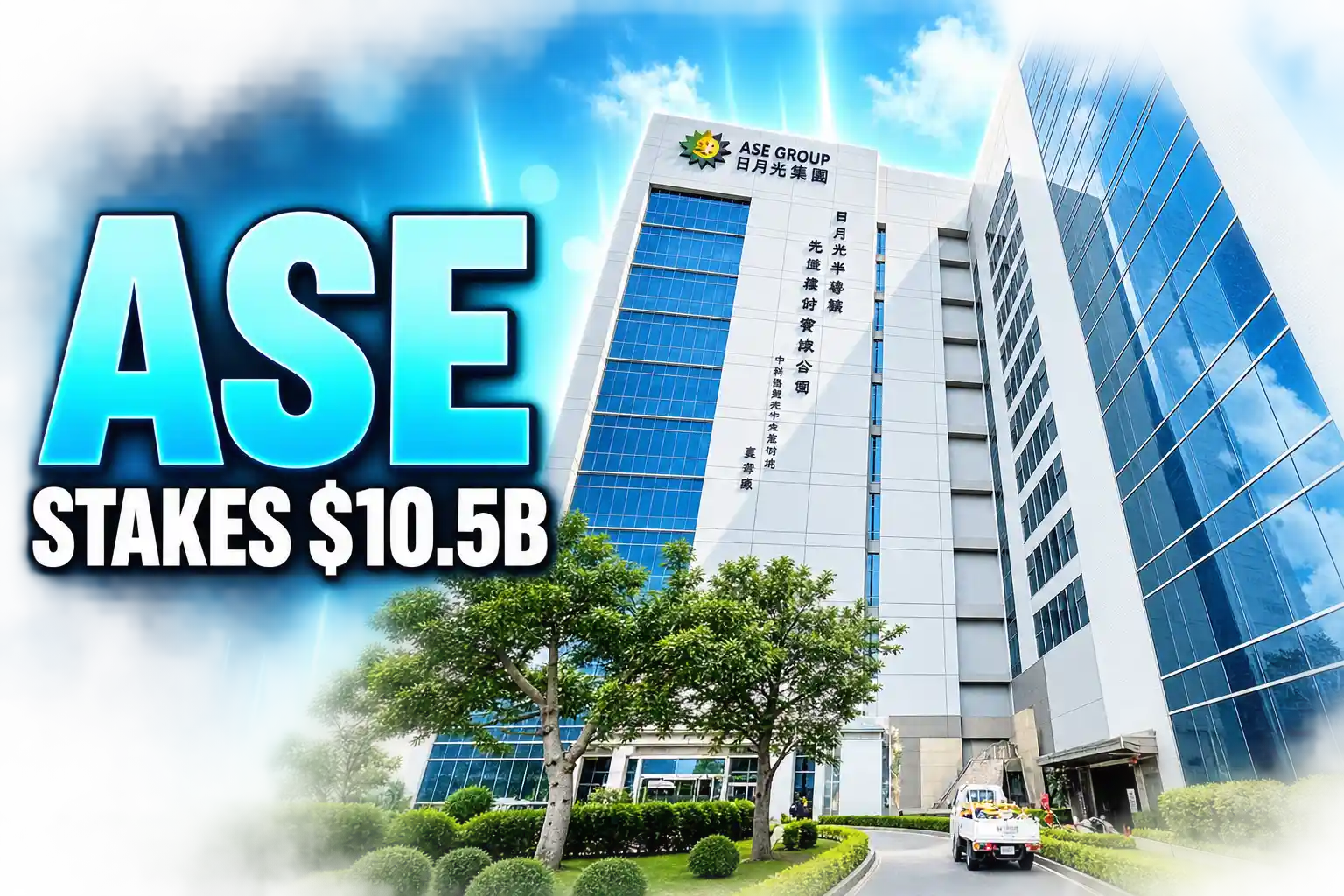
ASE Stakes $10.5 Billion on AI Packaging Through 2029
ASE Technology Holding lifted 2026 spending to $10.5 billion and is adding factories through 2029, a packaging bet that still cannot ship chips this year.

ASE Technology Holding raised 2026 capital spending to $10.5 billion on July 30, a second lift in four months, to add advanced packaging lines for AI chips. Chief operating officer Tien Wu had already told shareholders in Kaohsiung on June 24 that the world’s largest chip packager was adding 15 new sites and building for 2029 and beyond.
The June plan sat at $8.5 billion and already looked large next to a company that used to spend about $2 billion a year. Five weeks later the bill was $2 billion higher, cash flow was set to stay negative, and the plants that will cash the bet were still years from a finished GPU.
ASE Raised 2026 Capex to $10.5 Billion After the Shareholder Meeting
CFO Joseph Tung told analysts on the July 30 call that demand for leading-edge advanced packaging, the unit ASE brands LEAP, forced another $1 billion for buildings and another $1 billion for tools. That took the 2026 budget to about $10.5 billion, of which $4 billion is for new factory buildings and facilities and $6.5 billion is for equipment.
In April the holding company had already added $1.5 billion to reach $8.5 billion after LEAP demand ran hotter than the February plan. Annual spending had surged to more than $5 billion in 2025. Wu told the June 24 meeting the $8.5 billion figure might still be too low. He was right, and the July print made it official.
THE 2026 SPENDING LADDER
| Plan | Capital spending | What changed |
|---|---|---|
| Older baseline | About $2 billion a year | Pre-AI packaging run-rate |
| 2025 actual | More than $5 billion | First big LEAP and test build |
| June 24, 2026 | $8.5 billion | April add of $1.5 billion; Wu said it may rise |
| July 30, 2026 | $10.5 billion | Extra $2 billion; $4 billion buildings, $6.5 billion tools |
Shares fell the session the raise was announced, even as the same call lifted the LEAP outlook. Tung said the extra money is mostly for LEAP, with more mainstream packaging and testing capacity mixed in because the general market is also tight. He also said the negative cash-flow stretch will last for some time, because this year’s spend runs ahead of EBITDA.
15 Sites for 2029, Then 13 Greenfields and 8 Brownfields
Wu’s June 24 list was specific. The holding company would add 15 new sites in 2026: six greenfield plants for ASE, seven greenfield plants for subsidiary Siliconware Precision Industries, and plants bought from Innolux earlier in the year. He framed that wave as supply for 2029 and 2030, not a two-year patch.
The July 30 count used a different cut. Tung said ASE was running 13 greenfield projects and 8 brownfield projects at once. Brownfield, in his words, means buying existing factories and gutting them for packaging and test. Wu, on the same call, said the load was already showing: ASE was building 13 new facilities in 2026, buying plants, and spending capex all at the same time, which he called a tremendous amount of pressure.
Those two tallies should not be added together. The June 15 is a 2026 site list. The July 13-and-8 split is a live construction book that mixes new-builds with renovated shells, including the Innolux floors. Tung said the projects on the books should carry the company into 2028 and into some of 2029.
In April, ASE Semiconductor Manufacturing agreed to buy Innolux’s Fab 5 building and related kit at the Southern Taiwan Science Park in Tainan for NT$14.85 billion (US$460 million), a floor plate of about 184,314 square meters. SPIL separately agreed to buy another Innolux plant in the park for NT$6.33 billion. The holding company is not only pouring concrete. It is converting empty display fabs into packaging space because AI demand will not wait for every greenfield to dry.
Kaohsiung Is Where Most of the Concrete Goes
Southern Taiwan remains the centre of the wager. ASE has more than 40 years in Kaohsiung, and the 2026 starts cluster there: a giant test campus in Renwu, two buildings in Nanzih Technology Industrial Park III, and a joint advanced-packaging hall with board maker WUS Printed Circuit, also in Nanzih, aimed at FOCoS and flip-chip BGA work for AI, cloud, and cars.
THREE KAOHSIUNG BETS ALREADY IN THE GROUND
- Renwu test campus: Ground broken April 10, 2026, as an NT$108.3 billion testing cluster in Renwu with WinWay and Horng Terng, more than 1,000 jobs, Phase I in April 2027 and Phase II in October 2027, and about NT$177.3 billion of yearly output when full.
- Nanzih Park III: Ground broken March 11, 2026, NT$17.8 billion for a smart logistics hall plus a high-end packaging and test building, about 1,470 jobs, finish in the second quarter of 2028, and about NT$4.63 billion of yearly output per hectare.
- WUS joint hall: Announced May 8, 2026, a 113,000-square-meter factory with WUS due in September 2029, more than 2,000 jobs, FOCoS and FC BGA lines, and a 161 kV substation inside the park so the tools have stable power.
Wu, speaking as ASE’s chief executive at the Renwu groundbreaking, said the industry had entered a critical phase of change and that the new plant was meant to drive an upgrade, not a short burst of extra shifts. Mike Hung, ASE’s executive vice president, called the WUS pact a way to use land harder and lift manufacturing capacity. The dates under those quotes are the tell. Renwu’s first wafers-in-test are scheduled for April 2027. The WUS hall is not due until September 2029. A 2026 capex number is buying 2028 and 2029 output.
SPIL’s NT$100 Billion Douliu Plant Is the CoWoS Wager
The subsidiary that sits closest to Nvidia’s packaging queue is SPIL. On August 11 it broke ground on a NT$100 billion (US$3.1 billion) plant on six hectares at Yunlin Technology Industrial Park in Douliu. Vice chairman Chang Yen-chun said the first phase should start in 2028 and that the site will sit with plants SPIL has already pushed in Taichung, Changhua, Yunlin, and Tainan. At full load the Douliu campus is slated to create 2,200 jobs. SPIL’s Huwei plant in the same county, opened in September 2025, is already in commercial production and making money, Chang said.
Economics minister Kung Ming-hsin told the Douliu ceremony that SPIL is one of the Taiwan partners in AMD’s plan, announced in May, to put more than $100 billion into the island’s AI supply chain, a list that also names ASE and Taiwan Semiconductor Manufacturing Co. The day before the groundbreaking, SPIL’s board cleared a cash issue of 809.7 million new shares at NT$20 each to raise NT$16.19 billion for production materials. That is working capital for a CoWoS-class line, not a ribbon-cutting photo.
TSMC still runs the leading CoWoS flow, the 2.5D method that sits a compute die next to high-bandwidth memory on a silicon interposer. What has changed in 2026 is how much of that flow the foundry is willing to hand to OSATs. Wu has been careful not to pitch ASE as a rival to the foundry. On the July 30 call he stressed the pure-play model: no fight with the foundry, no fight with the substrate houses, which he argued is the only way to get the whole chain to move at once.
Hardware infrastructure is a bottleneck. With AI, the hardware requirement is new, insatiable and more complicated and more complex. And today, there are very few manufacturers capable of producing hardware.
Tien Wu, chief operating officer, ASE Technology Holding, Q2 2026 earnings call
JPMorgan managing director Gokul Hariharan said in February that full-process packaging at ASE should start in the second half of 2026, with AMD’s Venice CPUs first, and could reach $300 million to $400 million of revenue in 2026, with Nvidia’s Vera CPU and Amazon’s Trainium3 among the 2027 names in early talks. That is an analyst map, not a customer confirmation. It is also why SPIL is pouring a NT$100 billion CoWoS box in Yunlin instead of waiting for TSMC to free a bay.
Q2 Already Paid a Down Payment on the Bet
The June meeting was not a hope speech sitting on a weak quarter. On July 30 the holding company posted unaudited net revenues of NT$191,064 million for the second quarter, up 26.7% from a year earlier and up 10.0% from the first quarter, or $6,050 million in dollar terms. Net income attributable to the parent was NT$21,068 million, up from NT$7,521 million a year earlier and from NT$14,132 million in the first quarter, a 180% yearly jump. Basic earnings per share were NT$4.80; diluted were NT$4.61.
Q2 2026 AT A GLANCE
- ATM sales: NT$126,148 million, up 36.3% year over year and 12.2% sequentially, the assembly, testing and materials core.
- Mix: Packaging 52% of group sales, testing 13%, electronic manufacturing 34%, other 1%.
- Factory use: Blended 80% to 85%, with many tool lines near full.
- Tools bought: US$1,695 million of equipment in the quarter, including US$840 million for packaging and US$804 million for testing.
LEAP is tracking about $200 million above the earlier $3.5 billion target, or about $3.7 billion for 2026, and management is aiming to double that LEAP revenue in 2027. ATM revenue is expected to grow 35% for the full year. In the first half, machinery capex was $2.7 billion and building, facility and automation spend was $1.4 billion. Net debt to equity sat at 47%, with unused credit lines of NT$396.2 billion and quarterly EBITDA of NT$45.8 billion. In July the company projected third-quarter consolidated revenue to grow 21% to 22% sequentially.
That print is why the $10.5 billion figure is a bet rather than a rescue. The factories are not yet the earnings. The current LEAP lines and test floors are. Wu had already described AI chip demand as the bottleneck earlier in the cycle; the July numbers are the first full-quarter look at that claim after the June site tour.
Why the New Lines Still Cannot Ship This Year
Panel-level packaging is the cost-down path Wu keeps selling, a square 310 by 310 millimetre format that puts more dies on one panel than a round 300 millimetre wafer can. He told the June meeting ASE was preparing what he called the first fully automated, economically viable fan-out panel line. On July 30 he put mass production in the first quarter of 2027. Co-packaged optics, which pulls the optical engine next to the switch or GPU, may start in small volume by the end of 2026. Wu asked for two more quarters before he would talk CPO revenue; he noted ASE has worked on the optical stack for about 20 years. Glass substrates, he said, are not in mass production in the next 12 months.
Counting plants is the easy part of the model. A CoWoS-class package still needs ABF film, a substrate house, a hybrid bonder with a lead time that can run past a year, and inspection gear that can see a bump defect before an HBM stack ruins the whole module. TSMC giving OSATs more of the chip-on-wafer bond, not only the later wafer-on-substrate attach, raises that yield bar. New ASE floors do not erase those queues. They sit on top of them.
HOW THE 2026 WAGER WAS LAID DOWN
- March 11, 2026: Breaks ground on the NT$17.8 billion Nanzih Park III pair, aimed at the second quarter of 2028.
- April 10, 2026: Breaks ground on the NT$108.3 billion Renwu test campus, Phase I due April 2027.
- April 15, 2026: Approves the NT$14.85 billion Innolux Fab 5 buy in Tainan for advanced packaging.
- May 8, 2026: Signs the WUS Nanzih hall, completion dated September 2029.
- June 24, 2026: Wu tells shareholders the 15-site, $8.5 billion plan is for 2029 and beyond.
- July 30, 2026: Tung lifts 2026 capex to $10.5 billion and books 13 greenfield plus 8 brownfield jobs.
- August 11, 2026: SPIL breaks ground on the NT$100 billion Douliu CoWoS plant, first phase 2028.
The United States file is thinner than the Taiwan one. ASE said in June it already has two testing factories in California and plans two more. On Arizona, Wu said a particular customer had asked, and that the company was still weighing what to put on the ground. Nvidia said last year it wanted to build up to $500 billion of AI server infrastructure in the United States with partners that include SPIL. As of that June meeting, SPIL had not announced a U.S. investment of its own. The 2029 capacity Wu is buying is still, overwhelmingly, a Taiwan map.
Cash Flow Stays Negative While the Factories Rise
Wu has been uneasy about the human scale of this for most of 2026. In February he said half of him wanted to spend more and half of him asked whether the company was doing the right thing. ASE had 64,000 people in Taiwan and 100,000 worldwide, he said, and the aim was to stretch that without sending everyone to the hospital. By July he was complaining, in public, that 13 new facilities at once was too many jobs to run in parallel. The $10.5 billion budget is that argument, settled on the spend-more side.
Tung’s warning sits next to Wu’s. Equipment and buildings will run ahead of cash generation for a while. Unused credit of NT$396.2 billion is the buffer. Depreciation from the new lines will lean on margins before those lines are full. The offset, if the bet is right, is mix: ATM already supplied 94% of operating profit in the second quarter on 66% of sales, and Tung said the structural gross-margin ceiling near 30% may need to move up if the fourth quarter clears it.
None of the 2028 doors are open yet. Douliu’s first phase is dated 2028. Nanzih Park III is dated the second quarter of 2028. The WUS hall is dated September 2029. The panel line is dated the first quarter of 2027. Until those dates arrive, ASE is paying 2026 cash for 2029 seats, and the only proof the seats will fill is that LEAP is already ahead of a $3.5 billion target the company raised once this year and is now trying to double.
Disclaimer: This article is news reporting on ASE Technology Holding’s publicly stated capital plans, plant projects and quarterly results, and it is for information only. It is not investment advice, a recommendation to buy or sell ASE shares (TWSE: 3711, NYSE: ASX) or any other security, and it is not a forecast of future earnings or factory yields. Readers who may act on company capex, packaging-capacity or semiconductor-supply facts should consult a licensed financial adviser who can review their own holdings and risk limits. Figures and project dates reflect company statements and primary releases as published on the dates named above and can change with later earnings, board filings or construction updates.

Instagram Plus Tests a Read-Only Mode That Cuts Stories

Altman Asks the Public to Accept Some AI Harm

Google Freezes OSS VRP Product Reports After AI Flood

AI Agents Make Payment Rails the Scarce Prize

Turkey’s Crypto Boom Now Runs Through Three Banks

Fable 5 Came Back Under a Commerce On-Off Switch

Google’s SpaceX GPU Lease Has a Sept. 30 Deadline

Plasma One’s XPL Locks Face a 1.81 Billion Cliff

DGO’s Rs 549 World Cup Pass Cost Fans Sleep and Data

Moonshot AI’s $30 Billion Ask Became a $35 Billion Close
-
 AI4 months ago
Fable 5 Came Back Under a Commerce On-Off Switch
-
 AI4 months ago
Google’s SpaceX GPU Lease Has a Sept. 30 Deadline
-
 CRYPTO4 months ago
Plasma One’s XPL Locks Face a 1.81 Billion Cliff
-
 APPS4 months ago
DGO’s Rs 549 World Cup Pass Cost Fans Sleep and Data
-
 AI4 months ago
Moonshot AI’s $30 Billion Ask Became a $35 Billion Close
-

 NEWS4 months ago
ColorOS 17 Device List Spans Oppo, OnePlus and Realme
-

 GAMING4 months ago
Xbox Cuts 3,200 Jobs After Five Years of Thin Returns
-

 GAMING4 months ago
The RTX 4050 Under Rs 70,000 Hides a Wattage Gap