
AI
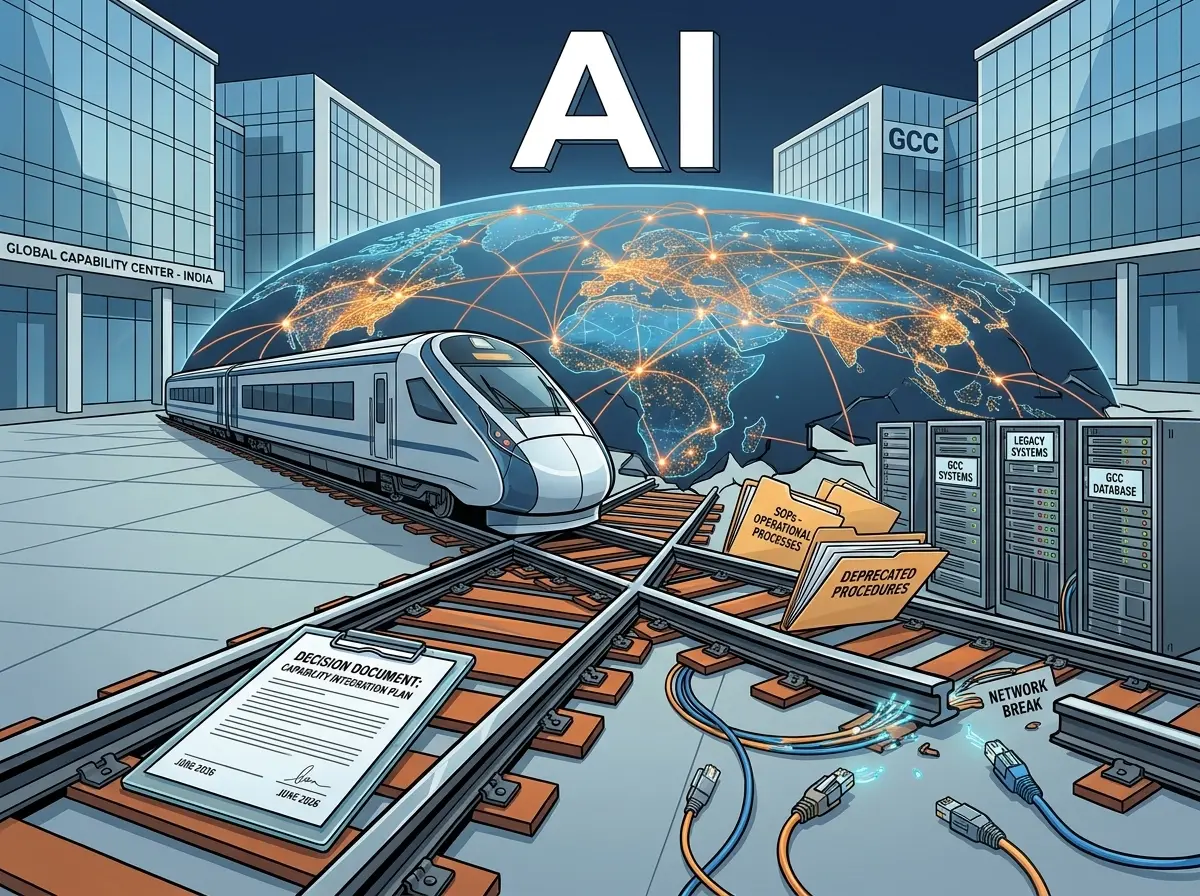
GCCs Build AI Bullet Trains on Incomplete Data Tracks
Near-universal GCC AI use yields real impact for only 27 percent; foundation and knowledge layers decide who owns intelligence arbitrage over cost metrics.

Indian Global Capability Centers treat AI as a finished success story. Pilots fill every deck. Agents and copilots appear in almost every function. Yet the centers that can prove a recurring business decision moved faster, better, or more profitably remain the minority. Adoption is easy to count. Advantage is not.
Vagesha Sinha, AVP for GCC Practice at Polestar Analytics, put the gap in plain terms on the NASSCOM community site this week: GCCs are building bullet trains while the iron tracks underneath (decision-grade data, governed knowledge, reusable pipelines, accountable ownership) stay incomplete. The second-order effect is already visible. Cost-arbitrage scorecards no longer match the operating model parents now expect, and the centers that fail to own intelligence arbitrage will watch the moat slip to whoever engineers the data first.
Near-Universal AI Use Still Leaves Most Without Measurable Impact
The numbers look strong until you ask what they bought. The Infosys survey of 500 Indian GCCs found only 27 percent report significant AI impact, even though nearly every center has deployed AI and 71 percent use generative AI across functions. A typical center now spends 15 percent of its operating budget on AI. On average only 31 percent of tasks inside a process actually get enhanced.
That pattern matches the wider enterprise picture. Publicis Sapient’s 2026 Global Enterprise AI Report, based on 1,550 decision-makers, found 73 percent use AI regularly yet only 10 percent call it core to how the business operates. Deloitte’s State of AI in the Enterprise reported that only 25 percent moved 40 percent or more of pilots into production, though 54 percent expect to hit that mark within months.
- Infosys GCC sample: near-100 percent AI deployment, 27 percent significant business improvement
- Publicis Sapient: 73 percent regular use, 10 percent core to operations, 42 percent say the organization is not set up to capture value
- Deloitte: 25 percent at meaningful production scale today
- Task depth: just 31 percent of process tasks enhanced on average inside GCCs
India’s ecosystem itself is large enough for the gap to matter. Estimates put the country past 1,700 to more than 2,100 centers employing over 2 million professionals and generating tens of billions in revenue, with hundreds already running dedicated AI or ML capabilities. Scale alone has not closed the impact gap.
| Source | Adoption signal | Advantage or scale signal |
|---|---|---|
| Infosys AI-First GCC Index 2026 | Almost all of 500 surveyed GCCs use AI; 71% generative | 27% report significant improvement |
| Publicis Sapient 2026 | 73% regular or most processes | 10% say AI is core to operations |
| Deloitte 2026 State of AI | Broad pilot activity, worker access up 50% | 25% moved ≥40% of pilots to production |
| Gartner (agentic) | Heavy early experimentation | Over 40% of projects projected canceled by end-2027 |
The market is still celebrating activity. Advantage shows up only when data changes a named decision the parent can price.
Data Readiness Is Three Separate Layers With Three Owners
Most roadmaps treat data readiness as one line item. Sinha argues it is three distinct problems, each with different owners, and that almost every center is over-invested in the middle layer while the other two stay thin.
- Foundation layer: Is the data trustworthy, governed, and reachable by a model? Pipeline reliability, lineage, master data, access controls, and movement into a governed lake or warehouse sit here. Unglamorous and expensive, this layer decides whether everything above it holds.
- Decisioning layer: Once the data is sound, is it wired into a named, function-specific decision, or does it stop at a dashboard that reports the past? Decision models, KPI trees, alerting thresholds, and the semantic layer live here. Traditional BI has occupied this space for a decade, mostly in read-only mode.
- Generation layer: Can the organization’s own SOPs, historical context, domain memos, and institutional judgment become structured, queryable context on demand? Document ingestion, chunking, embeddings, knowledge graphs, retrieval pipelines, and RAG or agentic infrastructure belong here. This is where proprietary knowledge becomes usable by models.
Dashboards look mature. Foundations stay patchy. Generation has barely started. That order is backwards for agentic pressure. You cannot skip the foundation to reach reliable agents, and the durable moat sits in the unopened folder of institutional knowledge.
Pilots Usually Fail First on the Data Model
A procurement center can launch a contract agent and still miss margin leakage if clause obligations never link to spend data. A retail center can ship a demand forecast and still overstock the wrong stores if product hierarchy and inventory feeds refuse to reconcile. In BFSI, fraud alerts arrive faster yet lack explainable lineage. In manufacturing, predictive maintenance collapses when sensor streams and maintenance logs live in separate systems. In healthcare, prior-authorization agents stall when policy rules and clinical notes never join a governed retrieval layer.
The model is rarely the weak link. The enterprise is asking it to reason over information that was never made reason-ready. Automating the seven clicks of an old checkout flow without redesigning the underlying data model produces the same theater. Related coverage of the India GCC AI innovation window and pilot problem shows how common this stall remains across the ecosystem.
Industry figures outside the GCC lane track the same failure mode. IDC research has put the share of AI agent proofs of concept that never reach production near 88 percent. Gartner separately projects over 40 percent of agentic AI projects canceled by end of 2027 because of escalating costs, unclear business value, or inadequate risk controls. Governance bolted on after the demo is already too late.
Cost Arbitrage Had a Scorecard. Intelligence Arbitrage Does Not
Cost arbitrage never needed imagination. FTE savings, budget versus actual, tickets processed, and on-time delivery were quantifiable, patterned, and defensible in a quarterly review. Both the center and the parent could see them and plan against them.
Intelligence arbitrage (owning the business outcome and building systems that make a judgment call a competitor cannot cheaply copy) has no equivalent metric yet. The missing number is a symptom, not the cause. Centers stuck in the decisioning layer can run pilots forever and never place an outcome in front of a CEO or CFO that either executive would actually feel.
Advantage shows up when a GCC can prove that its data moved a recurring business decision faster, better, or more profitably than before.
Sinha wrote that line as the practical test. One instruction (“be AI-first, show me adoption”) enters at the top and deforms on the way down. Each level pays only the part it is measured on and passes the rest below. The person at the desk inherits the rework. Fund readiness at the top and the cascade can reverse.
The operating model already depends on the shift. Global process owners who must own outcomes across geographies, thinning functional layers, and generalists moving from execution into product and strategy all lean on data that can be trusted with judgment, not just tasks. A center cannot move from pyramid to diamond on dashboards nobody trusts.
Four Fixes Before the Next Parent Review
Sinha’s checklist is short and concrete.
- Engineer data for a specific recurring decision, not a data domain. “Customer 360” is not a decision. “Which accounts do we not renew next quarter” is.
- Turn experts’ judgment into something the system can use before those experts leave. The counterparty to trust, the disruption that repeats every quarter, the exception that is safe to approve still live in heads. Making that knowledge structured and queryable is the generation-layer problem. Platforms exist for the unstructured-to-structured work; without a tool the risk is simply attrition.
- Build governance and observability in from day one as capabilities, not bolt-ons. The Gartner cancellation forecast sits on top of this gap.
- Name ownership for data readiness at the same seniority as decision ownership. If nobody’s variable compensation moves when the data changes, the data will become unreliable.
In the next review, beyond the cost line, show the parent one decision the center moved and what it was worth. That proof does not wait for HQ to invent a scorecard. It demonstrates mastery of the center’s own data.
The Dual Vantage Only GCCs Hold
Centers sit close enough to the work to see which decisions repeat and close enough to the parent to price them. No consultant and no HQ function holds both vantage points at once. That position is the competitive strength, not a weakness to be managed away.
The winners will convert proprietary data and domain logic into decision systems the parent cannot easily replicate elsewhere. BFSI GCCs driving the AI finance shift already illustrate how specialized domain depth can compound when the foundation and generation layers receive real investment. The same logic applies across manufacturing, healthcare, and retail once the tracks exist.
Crowd conversation among operators keeps returning to the same practical obstacles: missing ROI frameworks for AI work, data readiness as the binding constraint, and the slow recognition that future GCC growth will be more capability-driven and senior-skill-intensive than the old headcount model. Those observations match the second-order picture. Theatre metrics still dominate many internal reviews while the model parents actually need has already moved on.
Tracks First, Then the Trains
GCCs do not have an AI adoption problem. They have a foundation problem wearing an adoption success story as a costume. The centers that convert the current moment into real intelligence arbitrage will be the ones that lay the iron tracks first and that bring the parent a scorecard measuring decisions the way FTE savings once measured cost. The bullet trains will still arrive. They will simply run on tracks that can hold them.


South Korea Retail Investors Face Reckoning After KOSPI AI Rally Collapses

Surrey AI Maps Three Heart Attack Paths and Their Molecular Roots

Germany Locks Neutral Apple ATT Prompts Across Most of Europe

Apple’s 5% EU Fee Quietly Rewrites Alternative App Store Math

Apple’s EU Fee Truce Cuts Complexity but Leaves Rivals Fuming

Pixel 11 Pro Fold Trades Thinness for Durability and Seven-Year Stay

Mayo AI Flags HCM Obstruction From Everyday Ultrasound Videos

Indian Brands Quietly Scale Landmark Screens and Home Tech

Navin Vatsa Turns Grief Into a Lifetime of Quiet Seeing

Google Bets Pixel 11 Agentic AI Will Redefine Phones

Oracle Cuts 21,000 Jobs in a Year, Cites AI in 10-K Filing

Fable 5 and Mythos 5 Return as US Lifts Anthropic Export Controls

SpaceX’s Google Deal Turns a Rocket Company Into a Cloud Landlord

CD Projekt Red Co-CEO: Redemption Arc Isn’t Done, Witcher 4 in 2027

XPL Rallies 30% Ahead of Plasma One Card Tier Launch

Google Search Profiles Build a Follow Graph Inside Discover

DGO App Brings Rs 549 Mobile Pass for FIFA World Cup 2026 in Nepal

Moonshot AI Targets $30 Billion in China’s Fastest AI Funding Sprint

Oppo’s ColorOS 17 Eligibility List Leaves A-Series Buyers Behind

Microsoft Xbox Layoffs Start in July as Sharma Slams 3% Margin
-
 AI2 months ago
Oracle Cuts 21,000 Jobs in a Year, Cites AI in 10-K Filing
-
 AI2 months ago
Fable 5 and Mythos 5 Return as US Lifts Anthropic Export Controls
-
 AI3 months ago
SpaceX’s Google Deal Turns a Rocket Company Into a Cloud Landlord
-
 GAMING2 months ago
CD Projekt Red Co-CEO: Redemption Arc Isn’t Done, Witcher 4 in 2027
-
 CRYPTO3 months ago
XPL Rallies 30% Ahead of Plasma One Card Tier Launch
-
 NEWS3 months ago
Google Search Profiles Build a Follow Graph Inside Discover
-
 APPS3 months ago
DGO App Brings Rs 549 Mobile Pass for FIFA World Cup 2026 in Nepal
-
 AI3 months ago
Moonshot AI Targets $30 Billion in China’s Fastest AI Funding Sprint