
APPS
Whatnot Hits $20 Billion as Live Auctions Fuel Boom and Debt
Whatnot doubles to $20 billion on live shopping that builds seller livelihoods yet draws addiction scrutiny after users report six-figure losses.

Whatnot closed a $545 million Series G that values the live-shopping app at $20 billion, nearly double the $11.5 billion mark set last October. The Los Angeles company said the round, led by ICONIQ, Lightspeed and Avra, is the largest raise in live shopping and will go toward tools, buyer acquisition and trust systems that help its sellers grow.
Buyers have more than doubled in a year. More than 650,000 people join each week. Midway through 2026, platform sellers had already surpassed the full-year 2025 gross merchandise volume.
The Funding Path to Twenty Billion
Whatnot has raised roughly $1.5 billion since its 2019 start. The latest round brought in new names such as Kleiner Perkins and Wellington Management alongside returning backers including Andreessen Horowitz, DST Global, Greycroft, Y Combinator and Alphabet’s CapitalG.
| Round | Date | Amount | Valuation |
|---|---|---|---|
| Series E | Jan 2025 | $265 million | Nearly $5 billion |
| Series F | Oct 2025 | $225 million | $11.5 billion |
| Series G | Aug 2026 | $545 million | $20 billion |
CapitalG managing partner Laela Sturdy noted the jump in complexity: five collectibles categories in the U.S. in 2021 versus hundreds of categories across multiple countries today. Co-founder and CEO Grant LaFontaine said the capital lets the company “build better tools, bring AI to more parts of the selling experience, help sellers reach more buyers, expand into new markets, and continue building the world’s biggest and most trusted marketplace.”
Auctions That Run in Five Seconds
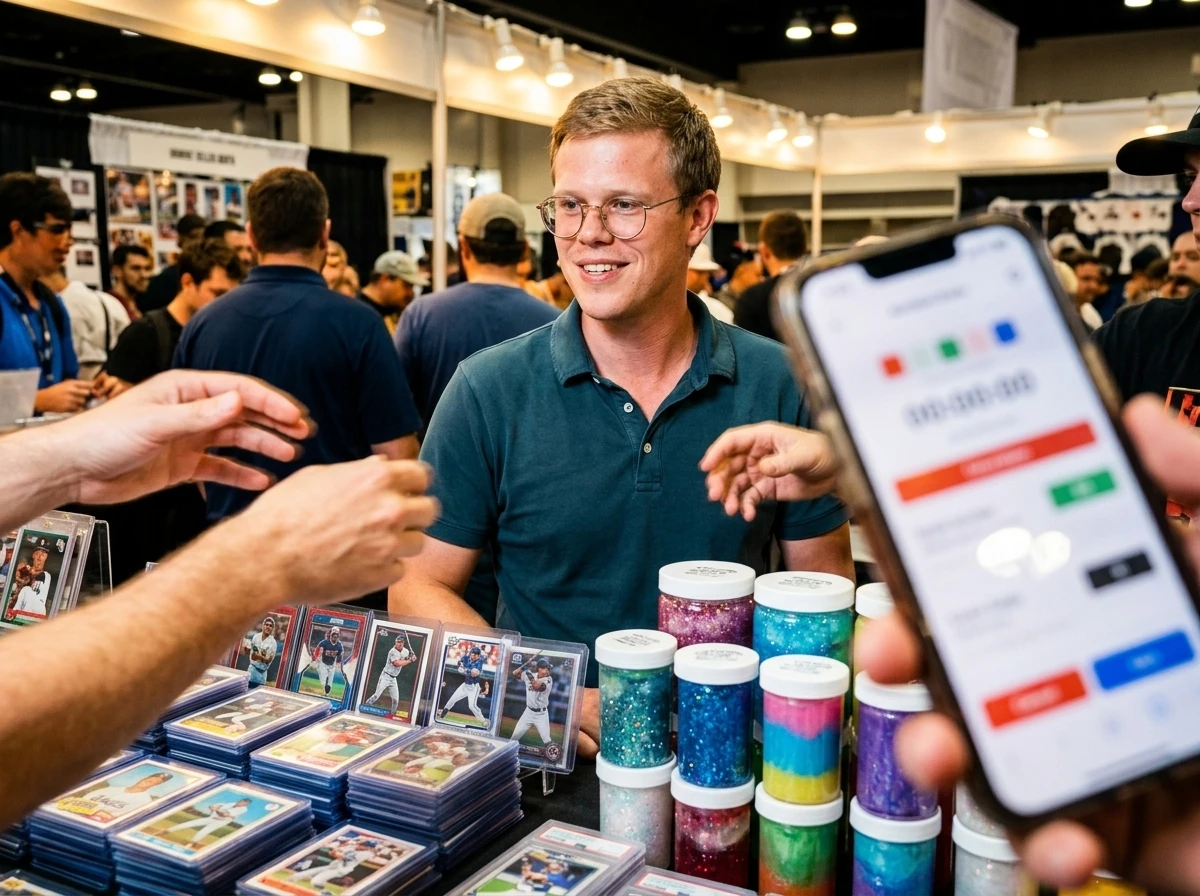
Sellers host live video shows. Viewers bid in real time on sports cards, clothes, slime, designer bags, fresh food, electronics and more. Some lots move in as little as five seconds. The company takes a cut of each completed sale.
- Rapid-fire countdowns keep the pace high and the chat active.
- Swipe or tap mechanics let buyers lock bids without leaving the stream.
- Giveaways and “breaks” of sealed product packs add communal energy.
- Shows run around the clock across time zones.
Users average 95 minutes a day on the app. Month-over-month buyer retention sits above 80 percent, far higher than typical static e-commerce. That engagement is the engine: Whatnot says it holds nearly 60 percent of the estimated $22 billion live shopping market across North America and Europe.
Sellers Turned Side Hustles Into Full-Time Shops
The company’s own framing puts small businesses first. Halfway through 2026 those sellers had already moved more volume than in all of 2025. The number of sellers who crossed $1 million in lifetime sales more than doubled over the prior year. The share earning a full-time living rose 25 percent. One in eight sellers now treats Whatnot as full-time work.
Key seller metrics from the 2026 State of Live Selling report:
- $8 billion live GMV in 2025, more than double the year before
- Over 20 million new accounts created in 2025
- Sellers going live 3-4 times a week average more than $13,000 monthly
- Daily streamers can earn 100-250 times the sales of occasional sellers
- One in four sellers has rented extra space to handle volume
Europe is accelerating too. The seller base there grew 600 percent year over year; France led with an 888 percent jump. In the U.K., daily sellers average £30,000 a month. German sellers report €475 per live hour.
Fees stay simple on the U.S. side: an 8% commission on final sale price for most categories (lower on some high-value or specialty lots) plus a 2.9 percent + $0.30 payment processing fee on the total order. No listing fees apply.
Where the New Capital Goes
LaFontaine and the company blog stress three buckets: more buyers through marketing that introduces live shopping to new audiences, deeper trust systems so first-time purchases become regular ones, and new tools (including AI-assisted ones) that cut busywork so sellers can stay on camera. New categories and international markets round out the plan.
Whatnot already spans Pokémon cards to jewelry to beauty. Fastest-growing global categories recently include beauty (+791 percent), electronics (+444 percent), jewelry (+259 percent) and women’s fashion (+223 percent). The share of women on the platform doubled in a year; fashion alone now drives more than 12 million orders a month.
Earlier this summer the company crossed one billion total orders. It continues to position itself as a community marketplace for collectors and enthusiasts rather than a pure discount or search engine.
The Same Features That Hook Also Draw Fire
The intensity that produces those numbers is also the point of friction. A Wall Street Journal investigation earlier detailed buyers who treated the app like a casino. One accountant, Sean Harding, spent almost $1.4 million in four months after rediscovering baseball cards. He used savings, personal loans, money from a friend and finally a company credit card. His wife filed for divorce after discovering the total.
I just kept telling myself one more time, then I’d sell it all and make all my money back. But it was so easy to just swipe right. You don’t even remember how many times you’ve done it.
Harding told the Journal. Critics point to the high-pressure countdown clocks and social-feed scrolling as design choices that encourage overspending. Whatnot says it bans raffles, lotteries and other gambling-style activity and enforces the rules through seller requirements. It has introduced optional spending limits and watch-time caps and plans further safeguards such as optional passcode steps for purchases.
What we know
- Company bans gambling-style formats and says it polices them.
- Optional buyer limits and caps already exist.
- GMV and user growth remain strong after the scrutiny.
What’s unconfirmed
- Exact scale of problem spending across the full user base.
- Whether new capital will accelerate or moderate the high-velocity formats.
- Any pending regulatory action tied to the addiction reports.
On X, reactions split between celebration of the seller-first raise and sharper notes that investors appear to be pricing extreme engagement intensity as pure upside. That tension sits inside the $20 billion number itself.
Rivals Are Catching the Same Wave
eBay is expanding its own live shopping after a strong quarter. Fanatics and TikTok Shop Live are active in overlapping collectibles and fashion lanes. Whatnot still claims category leadership, yet the field is no longer empty. Sellers who once treated the app as the only live venue now test multiple platforms; some report different economics on eBay Live for certain card volumes.
The broader live-commerce category keeps expanding. Whatnot’s own survey found nearly nine in ten live sellers believe the format drives stronger sales than traditional e-commerce, and more than half now generate the majority of their revenue through live shows. Eighty-eight percent say businesses that skip live selling will struggle to stay competitive.
Still Private, Still Hiring, Still Expanding
LaFontaine has said he would prefer to stay private as long as possible, though the company will be ready if the calculus changes. Hiring is active; one investor note put open roles above 130 shortly after the announcement. Robinhood Ventures participated with a $30 million check, underscoring interest from consumer-finance adjacent capital.
Founders Grant LaFontaine (CEO, earlier stints at Facebook, Google and Kit) and Logan Head (CTO, previously at GOAT) started the company in a Funko Pop-filled rental house after years of selling collectibles themselves. The first livestream moved $5,000 of product in a few hours. That early bet on visible, real-time sellers is now a multi-country operation whose mid-year run-rate already outpaces last year’s full total.
The $545 million simply buys more of the same formula: more shows, more categories, more AI assistance for the people on camera, and more buyers walking into the stream. Whether the high-velocity auctions remain a durable advantage or become a regulatory flashpoint will shape the next stretch of the story.
Frequently Asked Questions
What is Whatnot and how does the live shopping app work?
Whatnot is a marketplace where independent sellers host live video auctions and shows; viewers bid in real time on items ranging from sports cards and collectibles to fashion, beauty, electronics and food, with the company taking a percentage of each completed sale and no upfront listing fees for sellers.
How much does Whatnot charge sellers in fees?
In the United States most categories face an 8 percent commission on the item’s final sale price (with temporary reductions or lower rates on certain high-value or specialty lots) plus a 2.9 percent + $0.30 payment-processing fee on the full order total that includes shipping and taxes; European and other markets use slightly different percentage structures plus local VAT or equivalent.
Who founded Whatnot and when did it start?
Co-founders Grant LaFontaine (CEO) and Logan Head (CTO) launched Whatnot in Los Angeles in 2019 after earlier careers that included product roles at Facebook, Google, Kit and GOAT; the pair added livestreaming in 2020 following Y Combinator’s W20 batch and began with Funko Pops and other collectibles.
How large is the live shopping market that Whatnot leads?
Whatnot’s 2026 State of Live Selling report estimates the live shopping market at $22 billion across North America and Europe, with the company holding nearly 60 percent share after generating $8 billion in live GMV in 2025 alone.


South Korea Retail Investors Face Reckoning After KOSPI AI Rally Collapses

Surrey AI Maps Three Heart Attack Paths and Their Molecular Roots

Germany Locks Neutral Apple ATT Prompts Across Most of Europe

Apple’s 5% EU Fee Quietly Rewrites Alternative App Store Math

Apple’s EU Fee Truce Cuts Complexity but Leaves Rivals Fuming

Pixel 11 Pro Fold Trades Thinness for Durability and Seven-Year Stay

Mayo AI Flags HCM Obstruction From Everyday Ultrasound Videos

Indian Brands Quietly Scale Landmark Screens and Home Tech

Navin Vatsa Turns Grief Into a Lifetime of Quiet Seeing

Google Bets Pixel 11 Agentic AI Will Redefine Phones

Oracle Cuts 21,000 Jobs in a Year, Cites AI in 10-K Filing

Fable 5 and Mythos 5 Return as US Lifts Anthropic Export Controls

SpaceX’s Google Deal Turns a Rocket Company Into a Cloud Landlord

CD Projekt Red Co-CEO: Redemption Arc Isn’t Done, Witcher 4 in 2027

XPL Rallies 30% Ahead of Plasma One Card Tier Launch

Google Search Profiles Build a Follow Graph Inside Discover

DGO App Brings Rs 549 Mobile Pass for FIFA World Cup 2026 in Nepal

Moonshot AI Targets $30 Billion in China’s Fastest AI Funding Sprint

Oppo’s ColorOS 17 Eligibility List Leaves A-Series Buyers Behind

Microsoft Xbox Layoffs Start in July as Sharma Slams 3% Margin
-
 AI2 months ago
Oracle Cuts 21,000 Jobs in a Year, Cites AI in 10-K Filing
-
 AI2 months ago
Fable 5 and Mythos 5 Return as US Lifts Anthropic Export Controls
-
 AI3 months ago
SpaceX’s Google Deal Turns a Rocket Company Into a Cloud Landlord
-
 GAMING2 months ago
CD Projekt Red Co-CEO: Redemption Arc Isn’t Done, Witcher 4 in 2027
-
 CRYPTO3 months ago
XPL Rallies 30% Ahead of Plasma One Card Tier Launch
-
 NEWS3 months ago
Google Search Profiles Build a Follow Graph Inside Discover
-
 APPS3 months ago
DGO App Brings Rs 549 Mobile Pass for FIFA World Cup 2026 in Nepal
-
 AI3 months ago
Moonshot AI Targets $30 Billion in China’s Fastest AI Funding Sprint