
NEWS
CLSA Says AI Spares Core SaaS, Not Seat Licenses
CLSA said SaaS demand is holding, but Agentforce, Headless 360 and Gartner’s $234 billion count show the bill is moving off seats onto agents.

CLSA said on June 1 that a SaaSpocalypse is not showing up in software guidance or earnings yet. Most SaaS vendors had held or raised revenue and margin outlooks and beaten EPS estimates.
The second-order shift is elsewhere. Agents are starting to do the clicking, so the bill is moving off human seats and onto the databases those agents still have to write into.
The Record Layer Is the Part AI Cannot Guess
CLSA, in a note on Indian IT and global software, split vendors into three buckets: systems of record, systems of engagement, and systems of workflows. The brokerage’s point was narrow. A model that can answer the same question two different ways is a poor replacement for a ledger that must post the same entry the same way every time.
AI can sit on top of a record system as another interface. It is a weaker substitute for the record itself. Engagement and workflow tools are the other case, because their product often is the output a model can now draft, route, or complete.
HOW CLSA SORTED THE STACK
| Bucket | AI risk, per CLSA | Names it cited |
|---|---|---|
| Systems of record | Hard to replace; AI more likely to wrap the interface | SAP, Snowflake, Duck Creek, Guidewire, Databricks |
| Systems of engagement | Higher, because AI can stand in for the output | ServiceNow, Adobe, Sitecore |
| Systems of workflows | Higher, same reason | Pega, Mendix, OutSystems, Datadog |
Duck Creek and Guidewire are insurance platforms. Mendix and OutSystems sell low-code tools. Sitecore is a content system. Datadog watches infrastructure. None of that makes them safe if customers stop logging in to finish the job the product used to own.
CLSA still treated the June prints as a rebuttal of the wipeout story. Vendors had not cut the year. Earnings had not rolled over. The brokerage said IT firms with strong SaaS partnerships should keep seeing work in product engineering and implementation.
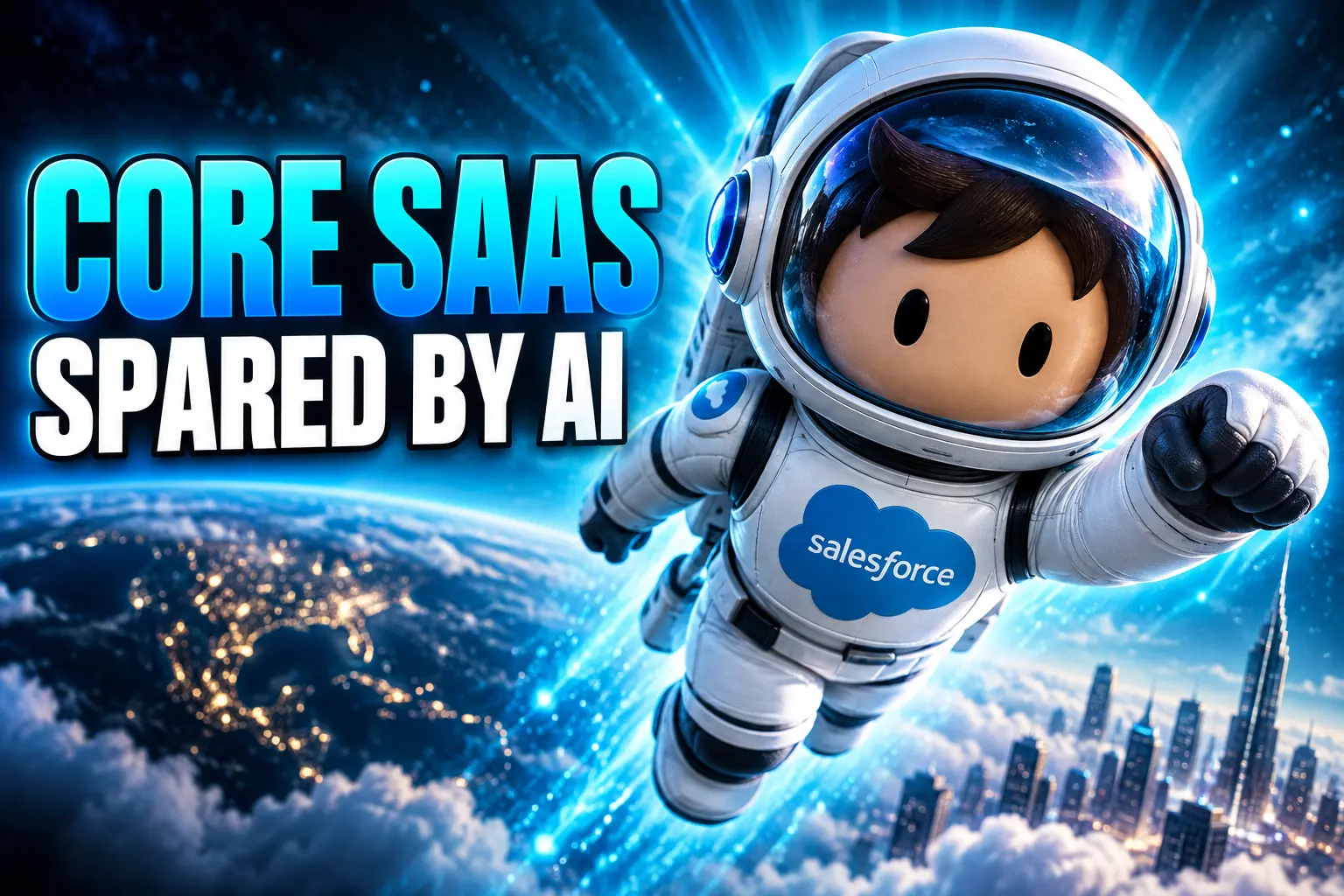
Agentforce ARR Hit $1.5 Billion in the July Quarter
The quarter CLSA was reading was Salesforce’s first quarter of FY27, ended April 30, 2026, and reported on May 27. Revenue was $11.1 billion, up 13 percent year over year and 12 percent in constant currency, including $444 million from Informatica. Agentforce ARR reached $1.2 billion, up 205 percent year over year. Combined Agentforce and Data 360 ARR was nearly $3.4 billion, including $1.1 billion of Informatica Cloud ARR.
Salesforce said it had processed more than 28.6 trillion tokens to date, up 152 percent quarter over quarter, and delivered 3.8 billion Agentic Work Units across Agentforce and Slack, up 111 percent. An AWU is a completed task in production, such as closing a case or updating a record, not a raw token count.
The next print, for the quarter ended July 31, 2026 and reported on August 26, went further. Revenue was $11.3 billion, up 11 percent, including $456 million from Informatica. Subscription and support was $10.8 billion, up 12 percent year over year and 11 percent in constant currency. Agentforce ARR exceeded $1.5 billion, up over 240 percent, after the company folded Slackbot and Headless 360 into that line. Combined Agentforce and Data 360 ARR reached nearly $3.9 billion, up over 210 percent.
AWUs to date reached 7.0 billion, with 3.2 billion in the July quarter, up 97 percent from the prior quarter. Data 360 ingested 104 trillion records, up 355 percent year over year. Robin Washington, Salesforce’s president and chief financial and operating officer, said net-new annual order value growth was the strongest it had been in four years.
SALESFORCE FY27, TWO QUARTERS
| Metric | Q1 ended April 30, 2026 | Q2 ended July 31, 2026 |
|---|---|---|
| Revenue | $11.1 billion | $11.3 billion |
| Subscription and support | $10.6 billion | $10.8 billion |
| Agentforce ARR | $1.2 billion | More than $1.5 billion, including Slackbot and Headless 360 |
| Agentforce and Data 360 ARR | Nearly $3.4 billion | Nearly $3.9 billion |
| AWUs to date | 3.8 billion | 7.0 billion |
| Current remaining performance obligation | $33.6 billion, up 14 percent year over year | $33.5 billion, up 14 percent year over year |
| FY27 revenue guidance | $45.9 billion to $46.2 billion | $46.1 billion to $46.4 billion |
Salesforce raised full-year revenue guidance to $46.1 billion to $46.4 billion, up 11 percent to 12 percent year over year and 11 percent in constant currency. The $200 million raise, $300 million in constant currency, was $100 million of organic growth, $200 million from the pending Contentful and Fin deals, and a $100 million foreign-exchange headwind. GAAP diluted earnings were $4.29 a share, up 119 percent. Non-GAAP diluted earnings were $5.90, up 103 percent.
CLSA had already flagged a quieter tell inside Salesforce. Overall headcount was still growing, mostly in sales, while engineering headcount had stayed broadly flat for two years on AI efficiency. The company had also stopped publishing role-wise certification data for system-integrator partners, which CLSA read as a sign that jobs inside the partner channel were being rewritten even as platform demand held.
What Headless 360 Removes From the Old Login
The product name that makes the seat math uncomfortable is Headless 360. Salesforce now sells the data, business logic, workflows, and governed actions as something an agent can call without a person opening the classic app. In the July quarter that line was folded into Agentforce ARR. At Dreamforce, held September 15 to 17, 2026 in San Francisco, the company pushed the same idea across Sales, Service, Commerce, and Slack, and restated about 30,000 Agentforce customers against the same 7.0 billion work units.
Keep the customer and you can still lose the login. A firm that once bought 200 CRM seats can let an agent update records, log calls, and draft forecasts through the API, while people handle exceptions. The schema, permissions, and audit trail still matter. The renewal question is why 200 humans still need a paid chair.
That is a harder transition than a slogan about AI features. Usage has to become a unit a buyer can budget, a sales team can sell, and a finance team can forecast, without pausing the old subscription number while the new one ramps. Salesforce is already mixing flex credits, premium Agentforce SKUs, and seat licenses. Other vendors are trying per-resolution and per-action fees. The platform can get more valuable at the same time the human seat count gets smaller.
This nonsense of the SaaSpocalypse, I think it’s time for it to stop.
Marc Benioff, Chair and CEO, Salesforce Q2 FY27 earnings call, August 26, 2026
Benioff’s line was aimed at the wipeout thesis, the idea that frontier models would let companies rebuild CRM over a weekend and cancel the vendor. The headless push is a different concession. Salesforce is offering the record without insisting that people live in its screens.
Gartner Counts $234 Billion of Exposed Software Spend
A month after the CLSA note, Gartner put a number on the layer that CLSA had called more at risk. On July 1, 2026, the firm said up to $234 billion of enterprise application spending is exposed to agentic arbitrage between now and 2030, about 20 percent of enterprise application SaaS spending by the end of the decade.
Agentic arbitrage, in Gartner’s wording, is what happens when agents finish tasks across several systems and people stop clicking through each interface. George Brocklehurst, a managing vice president at Gartner, said that breaks the old link between adding users and adding revenue. His research note’s own title is that agentic arbitrage is making enterprise SaaS headless.
Agentic systems deliver outcomes directly, bypassing traditional user experience (UX)-heavy applications and making the software invisible. This breaks the link between user growth and revenue growth for many enterprise software vendors.
George Brocklehurst, Managing Vice President, Gartner, July 1, 2026
Brocklehurst also said the shift is less an apocalypse than a metamorphosis, and that vendors who only defend dashboards and seat licenses face the loss, while firms that sell cross-domain agent workflows can take budget. Buyers, he said, will care less about new tools and more about systems that keep institutional memory over time. That is a record-layer argument in different clothes.
WHERE EXPERTS DISAGREE
- CLSA, June 1: Latest guidance and EPS beats show no visible hit to SaaS demand yet, and record systems are hard for a variable model to replace.
- Gartner, July 1: Up to $234 billion of application spend is exposed through 2030 as agents skip the interface, even if software is not deleted.
- Huang, September 25: The useful models are useful because they call tools, which points to more Adobe and Salesforce use, not a shutdown of those products.
Those three views can all be true on different clocks. A quarter of held guidance does not settle a 2030 mix shift. A 2030 mix shift does not mean this year’s SAP or Salesforce invoice goes to zero.
Indian IT Still Gets Paid to Wire the Platforms
CLSA’s note was also a map of who gets the setup work if the platforms hold. For most system integrators, the brokerage said, the SaaS practice is 10 percent to 25 percent of revenue. That is large enough to matter and small enough that a hit there can hide inside a bland company guide.
WHO CLSA TAGGED ON SAAS SKILLS
- Highest large-cap exposure: Accenture, Capgemini, Wipro, and Cognizant.
- Highest mid-cap exposure: Persistent Systems, which also carried an Outperform rating in the note.
- SAP in the large caps: Infosys, with most mid-caps lacking real SAP depth.
- ServiceNow in the large caps: LTIMindtree.
- Guidewire: Hexaware, with Snowflake, Birlasoft, and Persistent the names it preferred among mid-caps.
SAP delays at HCL Technologies and Wipro were, in CLSA’s view, client-specific rather than a platform problem. HCLTech’s chief executive, C. Vijayakumar, had already said two SAP projects were cancelled in FY26 for client reasons, which fits that reading and still leaves those firms with less work.
The months after the note were less kind to the “healthy implementation demand” half of the call. Infosys later narrowed its FY27 constant-currency growth outlook to 1.5 percent to 3 percent, from a range that topped out at 3.5 percent. Infosys has said AI now contributes more than 8 percent of revenue. Tata Consultancy Services has put annualised AI revenue at almost 9 percent. Those shares have not been enough, on the companies’ own telling, to offset leakage in older application work.
The leftover paid job is less about stacking certified seats and more about the harness around the model: which tools it may call, which data it may see, how it fails, and when a person has to step in. That is still integrator work. It is not the same staffing machine as a decade of ServiceNow and SAP rollouts billed by certified heads.
Consumption Pricing Is Already Replacing the Seat
CLSA said AI had already forced a move from seat-based pricing toward consumption, and that the latest guides still looked fine anyway. The Salesforce year is the working example. Tokens and AWUs are now the usage story management wants investors to watch. Flex credits and premium Agentforce bundles sit next to the old user license. Named agents, including Hunter for outbound sales, with general availability planned for November 2026, are sold as jobs rather than screens.
A vendor that prices only by humans who open the app is exposed the moment the humans stop opening it. A vendor that prices the work, and still owns the record the work writes to, can keep the account after the seat count falls. That is why the CLSA split and the Gartner count are not opposites. One is about whether the invoice exists. The other is about which line on the invoice survives.
THE 2026 SOFTWARE CLOCK
- May 27, 2026: Salesforce reports Q1 FY27 with $1.2 billion of Agentforce ARR, 3.8 billion AWUs to date, and 28.6 trillion tokens to date.
- June 1, 2026: CLSA publishes the note that SaaS guidance and EPS do not yet show an AI demand hit, and ranks Indian IT shops by SaaS exposure.
- July 1, 2026: Gartner says up to $234 billion of enterprise application spend is exposed to agentic arbitrage through 2030, about 20 percent of that SaaS pool.
- August 26, 2026: Salesforce reports Q2 FY27, lifts FY27 revenue guidance to $46.1 billion to $46.4 billion, and puts Agentforce ARR above $1.5 billion on a basis that now includes Headless 360.
- September 15, 2026: Dreamforce opens on the agentic enterprise and headless apps, with about 30,000 Agentforce customers cited on stage.
On September 25, Nvidia chief Jensen Huang said the thing that made models productive was tool use, that the SaaSpocalypse prediction had been the end of software tools, and that there will be more people using Adobe and more using Salesforce tools because agents will be using them too. The record still has to live somewhere those tools can touch.
Disclaimer: This article is news reporting and analysis of brokerage research, company results, and industry comments. It is for information only and is not investment advice, a recommendation to buy or sell any security, or a forecast of returns for Salesforce, Indian IT firms, or any other company named. Readers should consult a licensed financial adviser or other qualified investment professional who can consider their own objectives and risk limits before acting on any figure or view here. Guidance, ARR definitions, and demand comments reflect the cited company reports and research as published on their dates and can change with later quarters.

Instagram Plus Tests a Read-Only Mode That Cuts Stories

Altman Asks the Public to Accept Some AI Harm

Google Freezes OSS VRP Product Reports After AI Flood

AI Agents Make Payment Rails the Scarce Prize

Turkey’s Crypto Boom Now Runs Through Three Banks

Fable 5 Came Back Under a Commerce On-Off Switch

Google’s SpaceX GPU Lease Has a Sept. 30 Deadline

Plasma One’s XPL Locks Face a 1.81 Billion Cliff

DGO’s Rs 549 World Cup Pass Cost Fans Sleep and Data

Moonshot AI’s $30 Billion Ask Became a $35 Billion Close
-
 AI4 months ago
Fable 5 Came Back Under a Commerce On-Off Switch
-
 AI4 months ago
Google’s SpaceX GPU Lease Has a Sept. 30 Deadline
-
 CRYPTO4 months ago
Plasma One’s XPL Locks Face a 1.81 Billion Cliff
-
 APPS4 months ago
DGO’s Rs 549 World Cup Pass Cost Fans Sleep and Data
-
 AI4 months ago
Moonshot AI’s $30 Billion Ask Became a $35 Billion Close
-

 NEWS4 months ago
ColorOS 17 Device List Spans Oppo, OnePlus and Realme
-

 GAMING4 months ago
Xbox Cuts 3,200 Jobs After Five Years of Thin Returns
-

 GAMING4 months ago
The RTX 4050 Under Rs 70,000 Hides a Wattage Gap