
AI
OpenAI Codex Plugins Pull 62 Apps Into One Agent
Codex role plugins now pull 62 workplace apps into OpenAI’s agent and host the result as Sites for non-developer teams.

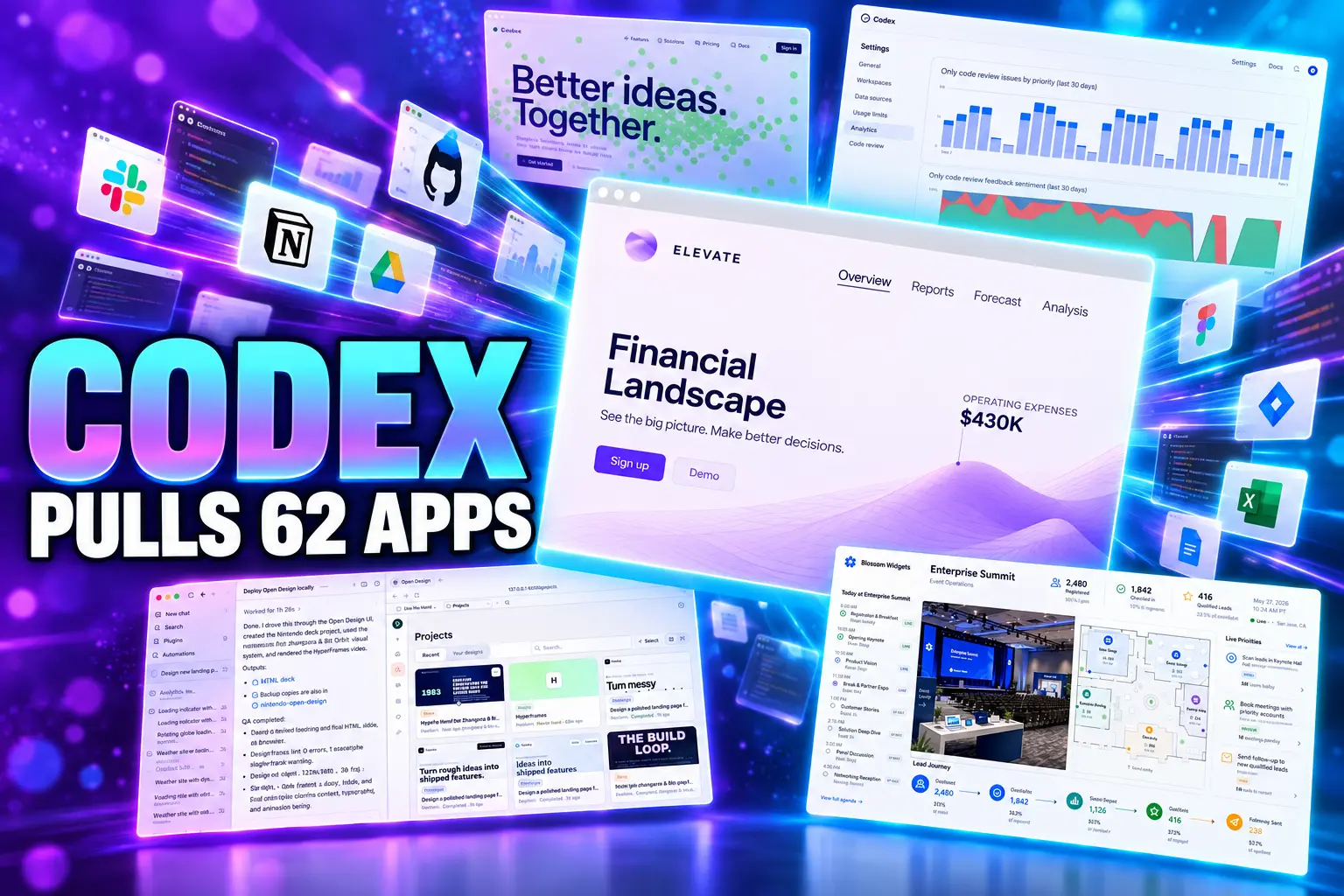
OpenAI’s Codex now ships six role-specific plugins that bundle 62 apps and 110 skills for analysts, sellers, designers, and bankers. More than 5 million people use Codex each week, and knowledge workers are about 20% of that base, growing more than three times as fast as developers.
The June 2, 2026 launch also added Sites, a hosted canvas for dashboards and internal apps, plus annotations that edit one cell, chart, or paragraph without regenerating the rest. The plugins look like a gift to people who never open a terminal. They also pull Salesforce, Snowflake, Figma, and FactSet into an OpenAI agent instead of leaving the AI inside those products.
Non-Developers Are Growing Faster Than Coders
Codex started as a software tool. OpenAI’s June 2 knowledge-work note still says developers are the largest group, while the mix around them is moving faster. Knowledge workers use it for reports, spreadsheets, presentations, contracts, research, data analysis, and small tools that used to wait on an engineer.
Weekly use is up more than 6 times since the desktop app launched in February 2026. Inside OpenAI, non-technical teams already build internal apps, executive packs, dashboards, and creative briefs that follow brand rules. At Zapier, teams pull Slack, Google Docs, and Coda into postmortems, incident plans, and feature tickets. NVIDIA researchers use it to speed experiment work, from hunting ideas to writing machine-learning scripts.
A June 25, 2026 economic research paper from OpenAI pushed that story past marketing copy. Since August 2025, non-developer use rose 137 times among individual users, 189 times among organizational users, and 12 times inside OpenAI. The average OpenAI worker now sends more than 85% of output tokens through Codex. Because heavy users skew the mix, Codex accounts for 99.8% of weekly output tokens generated inside the company.
CODEX ADOPTION INSIDE OPENAI
- Engineers: The average engineer now generates 99% of output tokens on Codex rather than ChatGPT.
- Legal and recruiting: Those teams, with finance, crossed into majority Codex use around April 2026 and now sit above 85% of output tokens.
- Long jobs: By May 2026, 80.6% of sampled individual users made at least one request estimated at more than 30 minutes of human work, 70.2% crossed one hour, and 25.6% crossed eight hours.
- Cross-skilling: More than one-fourth of Codex work from business-function employees was engineering or coding.
Those figures are OpenAI measuring itself, and the paper says the time estimates come from a model judging a 0.1% sample of individual users, so treat the minute marks as directional. The direction is still blunt. People are handing the agent jobs, not just asking it for advice, and non-coders are the fastest new cohort.
What the Six Role Plugins Bundle
OpenAI’s product post framed the launch as six new role-specific plugins that install as a specialist, with no coding required. Each pack bundles apps, skills, instructions, and workflows. Together they cover 62 popular apps and 110 skills. OpenAI says they work out of the box and that teams can still reshape them or ship custom plugins for internal systems.
THE SIX PACKS THAT SHIPPED JUNE 2
| Plugin | Who it is for | What it connects |
|---|---|---|
| Data analytics | Analysts and business teams | Snowflake, Databricks Genie, Hex, Tableau |
| Creative production | Marketing and creative teams | Figma, Canva, Shutterstock, Picsart, Fal |
| Sales | Account and deal teams | Salesforce, HubSpot, Slack, Outreach, Clay, Rox, Actively |
| Product design | Product and design teams | Figma and Canva, including live-URL prototypes |
| Public equity investing | Investors and researchers | Moody’s, Daloopa, Datasite, FactSet, LSEG, S&P, PitchBook, Hebbia |
| Investment banking | Bankers on pitches and diligence | Trusted financial data for comps, pitches, and recommendations |
The sales pack is the clearest picture of the inversion. A rep can hunt priority accounts, prep a meeting, write the follow-up, update the CRM, and flag a deal at risk inside one Codex thread. That work used to bounce between Salesforce, HubSpot, Outreach, and Slack, with each vendor selling its own assistant on top. Here the CRM is a pipe the agent reads and writes.
Creative production does the same to a brief. Teams can build campaign boards, ad variations, lifestyle shots, and ecommerce image sets, then hand the files into Figma or Canva. Product design turns a screenshot or a live URL into something a group can click. Data analytics asks why a metric moved, then drafts the report on warehouse tools the company already pays for.
The Apps Codex Now Speaks For
The public catalog and the installable product are not the same object. OpenAI published public plugin templates with four inspectable folders: data-analytics, sales, product-design, and financial-markets. The README says subject-matter experts built them on internal workflows and alpha partners, and that connector-backed packs may ship with placeholder app and connector IDs that a workspace has to replace.
That gap is the tell. The GitHub repo is a kit for teams that will customize. The ChatGPT plugin directory is the one-click face for people who will not. OpenAI is building toward a partner catalog where outside firms publish plugins in Codex and ChatGPT, which is a store, not a handful of prompts.
STILL LISTED AS COMING SOON
- Corporate Finance: Named on the June 2 product page, not in the public template folders.
- Private Equity Investing: Separate from the public-equity pack that already calls PitchBook and FactSet.
- Marketing Strategy: A planning layer beside the creative-production pack that already makes assets.
- Strategy Consulting: Aimed at decks and synthesis rather than a single SaaS system of record.
- Legal: The function OpenAI says already crossed onto Codex inside the company around April 2026.
Engineering teams still argue over coding agents, which is why a Claude Code versus Codex comparison remains the live fight for repositories. The plugin work is a different contest. It is about which agent sits above Salesforce, Snowflake, and Figma, and whether Microsoft 365 Copilot’s pitch (AI inside the apps you already open) still holds when those apps answer to Codex instead.
Practitioners have already treated the plugin format as plumbing. The same bundle of skills, apps, and MCP servers that OpenAI wrapped for bankers is being dropped into other agents so work can move across tools and token pools. That is not a marketer story. It is what a platform looks like when the install unit is a role pack, not a chat window.
Codex Now Hosts the App It Used to Export
Sites is the piece that makes the plugins more than a nicer export. In June it launched in preview for Business and Enterprise customers through the Codex app, with Enterprise admins gating it in role-based access control. Codex can turn analysis, plans, and launch materials into dashboards, planners, review workspaces, project boards, galleries, and light tools, then share them inside a workspace by URL.
OpenAI’s examples are specific. Ask for a customer-review page and it builds an interactive site with product updates, open questions, usage trends, and next steps. Ask for a scenario planner from a financial model and leaders compare assumptions instead of hunting tabs. Ask it to keep a launch hub current as messaging and owners change. Early partners named on the product page are Vercel, Wix, Base44, Replit, Lovable, Figma, Webflow, and Emergent.
Software creation was always about more than writing code. Sites in Codex fundamentally gives the power of end-to-end software creation to every user, no matter their technical fluency.
Rohan Varma, Codex, OpenAI, on X
Varma’s June 2 post said the sites deploy to a URL, stay private to workspaces, include authentication, and can hold static files plus database-backed data. Official Sites hosting and access modes now describe a later, wider beta: Plus, Pro, Business, Enterprise, and Edu, with plan limits on creates, storage, and high-use public sites. A new site starts limited to its owner and workspace admins. Every deployment URL is production, so the docs tell you to save a version first if you need a review copy that is not live.
Durable data uses D1 for structured records and R2 for files. Visitor access is not edit access. Enterprise workspaces keep public publishing off until an admin turns it on. That is a hosted app platform with ChatGPT identity on the door, not a slide you email.
Fix One Chart Without Rewriting the Deck
Annotations were already in Codex for code, Markdown, and sites the agent created. The June 2 expansion pointed the same gesture at documents, spreadsheets, and slides. You mark the bit that is wrong and say what should change. Codex updates that selection and leaves the rest.
OpenAI’s own examples are small on purpose. Change the font on a navigation bar. Ask where a claim in an investment thesis came from. Relabel a chart on a slide. Knowledge work dies in revision, not in the first draft, and a full regenerate is how earlier chat tools wrecked a page someone had already approved.
Tied to Sites, the same click can edit a live internal app. Tied to the equity plugin, it can interrogate one sentence in a thesis without rebuilding the book. The feature is quiet. It is also how a non-developer stays in control after the agent has dumped 12 pages on the table.
ChatGPT Sites Crossed 5 Million Apps
The June preview did not stay a Business-tier demo. On September 11, 2026, the official ChatGPT account said people had created over 5 million sites since launch, a count that must not be confused with the more than 5 million weekly Codex users reported in June. The same post listed collab editing, private invites that do not require a public link, faster prompt-to-deploy, database inspect for editors, and custom domains.
Three months ago, we launched ChatGPT Sites – an easy way for anyone to build and host fully functional, interactive web apps. Since then, people have created over 5M sites.
We’ve been listening to your feedback and ICYMI, we’ve launched a few Sites updates:
🫂 Build together:…
— ChatGPT (@ChatGPT) September 11, 2026
Tibo Sottiaux, who works on Codex and ChatGPT at OpenAI, called it a large upgrade to creating, sharing, and hosting sites directly through ChatGPT. The crowd that actually ships on this stack is less lyrical. One recurring objection is concentration: if the model, the connectors, and the live dashboard all sit on one login, an account freeze takes down the internal app along with the chat history. That is a fair reading of a product that now wants to host production URLs, not just files.
FROM CODING AGENT TO HOSTED WORK LAYER
- February 2026: OpenAI launches the Codex desktop app, the baseline for the later “more than 6 times” weekly-user claim.
- June 2, 2026: Role plugins, Sites preview, and annotations ship, with knowledge workers at about 20% of weekly users.
- June 25, 2026: OpenAI’s agent paper reports 137-times non-developer growth among individuals and Codex at 99.8% of internal output tokens.
- September 10, 2026: OpenAI introduces a ChatGPT Work experience for financial firms with indexed market data hosted by OpenAI.
- September 11, 2026: ChatGPT says Sites have passed 5 million apps and adds collab editing, private invites, and custom domains.
Median token use inside OpenAI’s own research group was 56 times higher in June 2026 than in November 2025, with customer support at 32 times, engineering at 27 times, and legal at 13 times. Parallel agents are part of that load. By June, OpenAI said its 99th-percentile internal users were generating more than 60 hours of agent turns in a day across multiple runs. Sites gives those runs a URL to live on after the thread closes.
Finance Data Now Lives on OpenAI’s Servers
The public-equity and investment-banking plugins were the first finance door. They help review earnings, compare companies, test a thesis, build pitch materials, and turn diligence into a recommendation. On September 10, 2026, OpenAI went further with ChatGPT for Financial Services, a ChatGPT Work setup that pairs GPT-6 Astra with built-in premium data.
OpenAI said indexed feeds from Daloopa, PitchBook, LSEG News, and Crunchbase are hosted by OpenAI so firms are not stuck wrangling MCP connectors for core research. Bankers get granular citations back to source. A broader connector set, OpenAI said, includes Datasite, Box, Preqin, FactSet, and Intapp. That is the same pattern as the June plugins, taken one step inward: first the agent calls your vendor, then OpenAI keeps a copy of the data the agent needs to reason.
Corporate Finance, Private Equity Investing, Marketing Strategy, Strategy Consulting, and Legal remain listed as coming soon on the June 2 product page. The finance product that actually appeared in September was this hosted-data ChatGPT experience, not those five named packs. Admins on Business and Enterprise workspaces can already control the app permissions under the plugins that did ship.
The June launch read, in most write-ups, as Codex learning manners for people who do not write code. The three months after it show a different machine. Role packs route 62 workplace apps through one agent, Sites keeps the output on an OpenAI URL, and the finance stack now indexes market data on OpenAI’s side of the wall. The five missing plugins can wait. The layer they were meant to feed is already up.
Frequently Asked Questions
How Do You Invoke a Codex Role Plugin During a Task?
After you install a pack from the Codex plugin directory, a new thread can let Codex pick among installed tools, or you can type @ to call a plugin or one of its bundled skills by name. OpenAI’s plugin docs describe that @ path as the way to force a specific workflow when several packs are installed, which matters once sales, analytics, and Sites are all present in the same workspace.
Why Does GitHub Show Four Codex Plugin Templates?
The public repository is a template set, not a mirror of the ChatGPT directory. It currently exposes data-analytics, sales, product-design, and a combined financial-markets folder, and the README warns that connector IDs in those files are placeholders for a target workspace. Creative production and the split public-equity and investment-banking directory listings live in the product catalog rather than as matching public folders.
Is a New Codex Site Public as Soon as It Has a URL?
No. A new Site starts limited to its owner and workspace admins, and visitor access does not grant editing rights. Enterprise workspaces leave public publishing off until an admin enables it, and the docs treat every deployment URL as production, so the safe path is to save a version without deploying while you review data handling.
Which Extra Codex Role Plugins Has OpenAI Listed but Not Shipped?
The June 2 product page, which still carried the same roster when retrieved for this piece, names Corporate Finance, Private Equity Investing, Marketing Strategy, Strategy Consulting, and Legal as coming soon. September’s finance launch was a separate ChatGPT Work product with hosted market data, not those five plugin packs.
Disclaimer: This article is news reporting on OpenAI product launches and related company research. It is informational only and is not investment, financial, legal, or professional advice. Nothing here is a recommendation to buy, sell, or hold any security, or to rely on Codex, ChatGPT Sites, or ChatGPT for Financial Services for client work, diligence, or trading. Speak with a licensed financial adviser, compliance officer, or attorney before using these tools on live deals or regulated data. Features, plugin rosters, data feeds, and access rules follow the cited OpenAI pages and posts and can change.

Instagram Plus Tests a Read-Only Mode That Cuts Stories

Altman Asks the Public to Accept Some AI Harm

Google Freezes OSS VRP Product Reports After AI Flood

AI Agents Make Payment Rails the Scarce Prize

Turkey’s Crypto Boom Now Runs Through Three Banks

Fable 5 Came Back Under a Commerce On-Off Switch

Google’s SpaceX GPU Lease Has a Sept. 30 Deadline

Plasma One’s XPL Locks Face a 1.81 Billion Cliff

DGO’s Rs 549 World Cup Pass Cost Fans Sleep and Data

Moonshot AI’s $30 Billion Ask Became a $35 Billion Close
-
 AI4 months ago
Fable 5 Came Back Under a Commerce On-Off Switch
-
 AI4 months ago
Google’s SpaceX GPU Lease Has a Sept. 30 Deadline
-
 CRYPTO4 months ago
Plasma One’s XPL Locks Face a 1.81 Billion Cliff
-
 APPS4 months ago
DGO’s Rs 549 World Cup Pass Cost Fans Sleep and Data
-
 AI4 months ago
Moonshot AI’s $30 Billion Ask Became a $35 Billion Close
-

 NEWS4 months ago
ColorOS 17 Device List Spans Oppo, OnePlus and Realme
-

 GAMING4 months ago
Xbox Cuts 3,200 Jobs After Five Years of Thin Returns
-

 GAMING4 months ago
The RTX 4050 Under Rs 70,000 Hides a Wattage Gap