
COMPUTERS
Microsoft’s 2029 Quantum Bet Rests on a 20-Second Hold
Microsoft cut its scalable quantum date to 2029 after a 20-second Majorana 2 parity hold, while physicists still dispute the qubit and Atom Computing ran the.

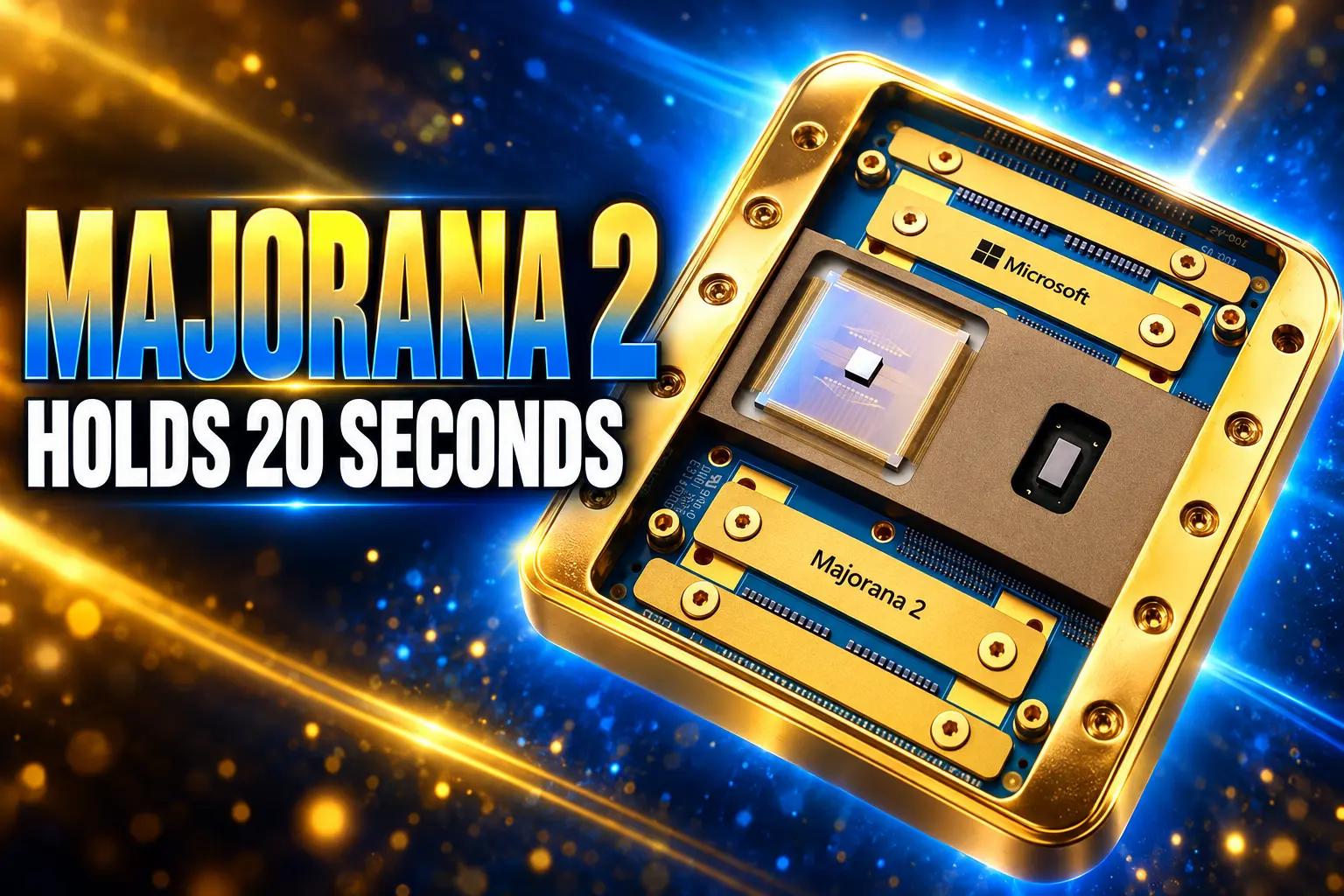
Microsoft said on June 2, 2026 that Majorana 2 holds a quantum state for a mean of 20 seconds. Some holds lasted as long as one minute. The company also pulled its target for a scalable quantum computer forward to 2029.
That date is a wager, not a shipping notice. The result behind it is a long-lived parity signal on a new materials stack, and the error-corrected machine in the same week was built by a partner that does not use this chip.
Microsoft Cuts Its Useful Quantum Date to 2029
The announcement came at Build in San Francisco. Microsoft described Majorana 2 as its next topological chip and credited a new materials stack, plus its Discovery agentic-AI research tools, for a mean qubit lifetime of 20 seconds. The company called that a 1,000-fold gain over the prior generation and said some instances lasted as long as one minute.
Chetan Nayak, Microsoft technical fellow and corporate vice president of quantum hardware, put the year-on-year claim in one line. “We’re 1,000 times better,” he said. The same briefing set one-microsecond operations and a qubit about 1/100th of a millimeter across as the other two figures Microsoft wants judged beside the lifetime.
Microsoft had talked about a scalable topological machine on a 2033 timetable. With Majorana 2, it said it had cut that timetable in half and now aims at 2029. Nayak’s test for the program is still delivery. “We need to make improvements each year that will get us closer to delivering a computer that we believe will have massive commercial and societal value,” he said.
Announced today at #MSBuild: Microsoft unveiled Majorana 2, a next-generation topological quantum chip developed with the help of Microsoft Discovery’s agentic AI. https://t.co/esVcmeWdgh pic.twitter.com/vZBu4UmMQs
— Microsoft (@Microsoft) June 2, 2026
The same 20-second figure was quickly read as a shorter clock for wallet cryptography, a jump that treats a parity hold as if it were a machine that can run Shor’s algorithm. The hardware underneath that reading is still the chip Microsoft showed at Build, and the paper that came with it.
MAJORANA 1 VS. MAJORANA 2
| Measure | Majorana 1 | Majorana 2 |
|---|---|---|
| Reported lifetime | 1 to 12 milliseconds | Mean 20 seconds; some holds 1 minute |
| Superconductor | Aluminum | Lead |
| Semiconductor stack | Indium arsenide hybrid | Indium arsenide and indium arsenide antimonide |
| Stated operation time | Not given in the June briefing | 1 microsecond |
| Stated qubit size | Not given in the June briefing | 1/100th of a millimeter |
| Target for a scalable machine | 2033 | 2029 |
Those rows are Microsoft’s own comparisons. They do not, by themselves, show a logic gate or a full two-axis qubit measurement.
What a 20-Second Parity Signal Measures
Nayak’s lifetime range for the aluminum devices was 1 to 12 milliseconds. Majorana 2, he said, replaces that aluminum superconductor with lead and updates the active semiconductor region to indium arsenide and indium arsenide antimonide. Lead has a larger superconducting gap, which Microsoft says makes it harder for stray energy, including cosmic radiation, to kick the device out of its protected state.
The accompanying technical write-up is titled “20 Second Parity Lifetime in an InAs-Pb Tetron Device.” Parity here is a count of even versus odd electrons on a superconducting wire, read through quantum dots. A long quiet stretch of that even-odd signal is the number Microsoft is selling as qubit lifetime. The June manuscript had not been peer reviewed when the chip was unveiled.
Independent write-ups of the same paper noted a narrower setup than the keynote language. The long-lived parity was measured on a single wire of one device inside a small four-qubit tetron array, and the public figures were Z-direction measurements. Complementary X measurements, the ones needed before a two-level system is treated as a controllable qubit, were not part of the result Microsoft put on stage.
Microsoft’s 1,000 times figure is the company’s own factor, not a fresh ratio of 20 seconds to 12 milliseconds. Other common qubit hardware still quotes lifetimes in microseconds, which is the comparison Microsoft used when it reached for a phone-battery analogy: a charge that used to die in a day now lasting nearly three years. That analogy travels well. It still describes a hold, not a program running.
Henry Legg Says the Physics Is Not There
Three weeks after Build, Nature published a peer-reviewed challenge to the 2025 data that Microsoft used to introduce Majorana 1. Henry Legg, a condensed-matter physicist at the University of St Andrews, argued that the transport signals attributed to a topological gap can be read as noise or as trivial device effects, and that software choices in the tune-up hid other operating regions.
The comment is aimed at the February 2025 Nature paper on single-shot parity readout in an indium arsenide-aluminum nanowire, not at a refereed Majorana 2 qubit paper, because that paper did not exist in June. Legg’s point is that the stack under both chips has not shown the basic object the 2029 date assumes.
WHERE EXPERTS DISAGREE
- Microsoft’s case: Nayak’s team says radio-frequency capacitance traces show a flux-periodic two-state signal that would wash out in a gapless device, and that this is the evidence for a topological origin.
- Legg’s case: The 2025 protocol does not demonstrate a topological qubit, and a 2029 public roadmap cannot rest on physics he says is not there.
- Frolov’s case: Sergey Frolov, a physicist at the University of Pittsburgh who was not an author on either Nature piece, said the Matters Arising made it apparent that the 2025 paper has no scientific value.
Nature ran Microsoft Quantum’s reply the same day, with Nayak as corresponding author. The reply says the group’s radio-frequency interferometric measurements “strongly indicate a topological origin” and “very strongly constrain non-topological explanations.” Nayak also pointed to a government process the company treats as an outside check: DARPA moved Microsoft into the final phase of its Quantum Benchmarking Initiative after reviewing public and proprietary results.
They simply cannot sell the 2029 roadmap as credible to the public when the underlying physics is not there.
Henry Legg, physicist, University of St Andrews
Nayak’s short answer to that line is unchanged. “We stand by our results and our roadmap,” he said. “At the end of the day, success is the delivery of a scalable quantum computer.” The louder argument after Build was not the 20-second figure. It was whether a long-lived parity signal on a tetron is a qubit, and whether agentic tools on a materials stack can stand in for that demonstration.
Atom Computing Held a Logical Memory for 90 Rounds
On June 3, 2026, Atom Computing published a different kind of result. The Boulder and Berkeley company traps neutral atoms with lasers and, with Microsoft Quantum listed among the collaborators on the paper, ran a toric-code quantum memory that kept working through up to 90 rounds of error correction. Dr. Jonathan King, co-founder and chief scientist, wrote the company note.
Neutral atoms vanish. A collision in the vacuum chamber, or heat from the operations themselves, can delete a qubit. King listed four jobs any complete demonstration has to finish at once: find the missing atom in real time with a mid-circuit measurement, put a fresh atom in its place, refill the reservoir from a source that does not run out, and do all of that without wrecking the logical qubit that is still holding the information.
THE FOUR STEPS ATOM HAD TO CLEAR
- Find the loss: Mid-circuit measurement flags an atom that has left the trap without destroying the qubits that were not measured.
- Swap a spare: A pre-cooled atom from a standby pool takes the empty site so the logical qubit can keep running.
- Refill the pool: After about 10 rounds the array has to reload from the atom source, or the machine simply runs out of qubits.
- Hold the logical state: The memory has to keep a usable logical error rate while those swaps and reloads are happening.
The toric code needs connections that a flat superconducting chip cannot draw. King’s point is that movable atoms can make those links. In the first 10 rounds, a distance-6 encoding showed a lower logical error rate than a distance-4 encoding, the sub-threshold pattern error correction is supposed to produce. Past 10 rounds, once continuous reloading was in the loop, the two distances looked similar, which King read as operation near the threshold rather than comfortably under it.
Errors still piled up. Some faults could not be recovered once too many atoms flipped at once. Mark Saffman at the University of Wisconsin-Madison called the 90 rounds another step toward a machine that can stay on, and noted that extra errors did accumulate across the run. King still placed the work on the same footing as Google’s superconducting memories as a deep, repeated quantum-memory demonstration on a commercial-style platform, and said Atom is the first company to have sold a logical-qubit quantum computer.
Laser-trapped arrays are no longer a side bet in one lab. Japan’s first atom-array quantum computer already runs on another company’s processor, which is the backdrop for Atom’s claim that this hardware class is moving from papers into rooms that have to stay up.
Electrons on Helium Make a Seventh Qubit Platform
EeroQ, a Chicago company founded in 2017, spent the same stretch of June on a third physical object. On June 16, 2026 it said it had shown the first strong coupling of a microwave photon to the charge state of an electron floating on liquid helium, in a result peer-reviewed and published in Nature Physics. That is a readout building block, not a Microsoft chip, and no contract tying EeroQ to Majorana 2 turned up in the company’s own account of the work.
Nick Farina, co-founder and chief executive, treated the coupling as the moment the platform left theory. “For over 25 years, electrons on helium have been identified as a uniquely promising qubit platform, but until now, no one had demonstrated the ability to couple to an actual electron qubit state in this system,” he said. The idea dates to 1999 work from Bell Labs and Michigan State. Stephen Lyon, EeroQ’s chief technology officer and a Princeton professor, later expanded it. The charge qubit is a readout path; the long-term bet is the electron’s spin.
For over 25 years, electrons on helium have been identified as a uniquely promising qubit platform, but until now, no one had demonstrated the ability to couple to an actual electron qubit state in this system.
Nick Farina, co-founder and CEO, EeroQ
On July 9, 2026, EeroQ followed with a Physical Review Applied paper on its Wonder Lake chip, made at SkyWater Technology on a standard 130-nm CMOS line. Fourteen control lines addressed 128 channels. Electrons were clocked through helium-filled microchannels, and in the published runs they collectively traveled tens of kilometers with no detectable charge loss. That is a routing result on a foundry process, which is the scaling story EeroQ wants standing next to Microsoft’s exotic stack and Atom’s laser tables.
The 24 Logical Qubits Were Already on the Books
Microsoft and Atom Computing did not meet in June. On November 19, 2024, the Azure Quantum team said it had applied its qubit-virtualization software to Atom’s ytterbium atoms and entangled 24 logical qubits in a cat, or GHZ, state, then the record. The same campaign ran the Bernstein-Vazirani algorithm on 28 logical qubits encoded from 112 physical qubits.
Error rates told the partnership’s working method. After error and loss detection, the logical error rate was 10.2%, 4.1 times better than the 42% physical baseline. When losses were detected and corrected, the rate was 26.6%, 1.6 times better than physical. Entanglement was claimed because those rates sat below the 50% threshold. Atom also quoted 99.6% two-qubit gate fidelity in a commercial neutral-atom system. The companies put a combined machine, with Azure Elements, up for order with 2025 delivery.
THE DATES ON MICROSOFT’S WAGER
- November 19, 2024: Microsoft and Atom Computing report 24 entangled logical qubits and computation on 28 logical qubits from 112 physical atoms.
- February 2025: Microsoft’s Nature paper on single-shot parity readout underpins the Majorana 1 launch and, later, Legg’s critique.
- June 2, 2026: Majorana 2 is unveiled at Build, with a mean 20-second hold and a 2029 scalable-machine target.
- June 3, 2026: Atom Computing reports a toric-code memory that runs through 90 error-correction rounds with atom replacement and reload.
- June 16, 2026: EeroQ publishes strong photon-to-electron coupling on helium in Nature Physics.
- June 24, 2026: Nature prints Legg’s Matters Arising and Microsoft’s reply on the 2025 topological-gap data.
- July 9, 2026: EeroQ’s Wonder Lake shuttling paper appears in Physical Review Applied.
Two hardware programs now sit on Microsoft’s public clock. One is the topological chip whose lifetime jumped after a lead swap, whose 2029 date is the line Nayak will be held to, and whose underlying qubit claim is still contested in Nature. The other is a laser-trapped atom machine that has already sold a logical-qubit system, entangled 24 logical qubits, and kept a memory alive for 90 rounds. DARPA’s final benchmarking phase is the outside calendar Microsoft keeps citing. 2029 is the date it set for itself.

Instagram Plus Tests a Read-Only Mode That Cuts Stories

Altman Asks the Public to Accept Some AI Harm

Google Freezes OSS VRP Product Reports After AI Flood

AI Agents Make Payment Rails the Scarce Prize

Turkey’s Crypto Boom Now Runs Through Three Banks

Fable 5 Came Back Under a Commerce On-Off Switch

Google’s SpaceX GPU Lease Has a Sept. 30 Deadline

Plasma One’s XPL Locks Face a 1.81 Billion Cliff

DGO’s Rs 549 World Cup Pass Cost Fans Sleep and Data

Moonshot AI’s $30 Billion Ask Became a $35 Billion Close
-
 AI4 months ago
Fable 5 Came Back Under a Commerce On-Off Switch
-
 AI4 months ago
Google’s SpaceX GPU Lease Has a Sept. 30 Deadline
-
 CRYPTO4 months ago
Plasma One’s XPL Locks Face a 1.81 Billion Cliff
-
 APPS4 months ago
DGO’s Rs 549 World Cup Pass Cost Fans Sleep and Data
-
 AI4 months ago
Moonshot AI’s $30 Billion Ask Became a $35 Billion Close
-
 NEWS4 months ago
ColorOS 17 Device List Spans Oppo, OnePlus and Realme
-
 GAMING4 months ago
Xbox Cuts 3,200 Jobs After Five Years of Thin Returns
-
 GAMING4 months ago
The RTX 4050 Under Rs 70,000 Hides a Wattage Gap