
NEWS
VinRobotics Bets the VR-H3 on VinFast Factory Lines
VinRobotics showed the VR-H3 in Vienna as a factory humanoid, but a headset still drives it while two VinFast contracts and a 2026 production target carry the wager.

VinRobotics put its VR-H3 industrial humanoid in front of the global robotics crowd in Vienna in June, and the job it is chasing sits on a VinFast line.
The Hanoi company, founded in November 2024 inside Vingroup, rates the machine at 6 to 8 kilograms of lift and showed it being driven through a VR headset. Two robot-and-AI contracts with VinFast, worth about 52 billion dong, are due for acceptance in 2026.
VinRobotics Took the VR-H3 From Hanoi to Vienna
On June 3, 2026, VinRobotics said it had spent late May and early June running the VR-H3 through a string of public rooms: ICRA 2026 in Vienna, Austria, the outdoor Festival der Roboter that opened that conference, a Vietnam Robot Tech Day with the Vietnamese embassy, and COMPUTEX Taipei.
ICRA ran June 1 to 5 at the VIECON Convention Center under the theme “Robots for All,” with more than 5,000 registrations. COMPUTEX ran June 2 to 5 with more than 1,500 exhibitors and a crowd the organizers put above 40,000 people from more than 150 countries.
The company called the VR-H3 a third-generation humanoid built in Hanoi, with the mechanical structure, real-time electrical architecture, power platform, battery, and full-body AI control developed by Vietnamese engineers. It packs more than 31 actuators and two onboard edge computers.
Vietnam’s ambassador to Austria, Vu Le Thai Hoang, walked the outdoor stand. Company talks sat in the same forums as Google DeepMind, NVIDIA, and Boston Dynamics. CEO Ngo Quoc Hung treated the tour as a shakedown, not a trophy lap.
Bringing VR-H3 to international technology forums is not only an opportunity for VinRobotics to showcase the capabilities of Vietnamese engineers, but also a real-world testing process to further refine humanoid robot platforms designed for practical applications and real-life operating environments.
Ngo Quoc Hung, Chief Executive Officer, VinRobotics, June 3, 2026 statement
Sister firm VinDynamics put a service humanoid named Dyno on the same ICRA floor as a guide. That split is the point. One body is meant for a plant. The other is meant for a lobby.
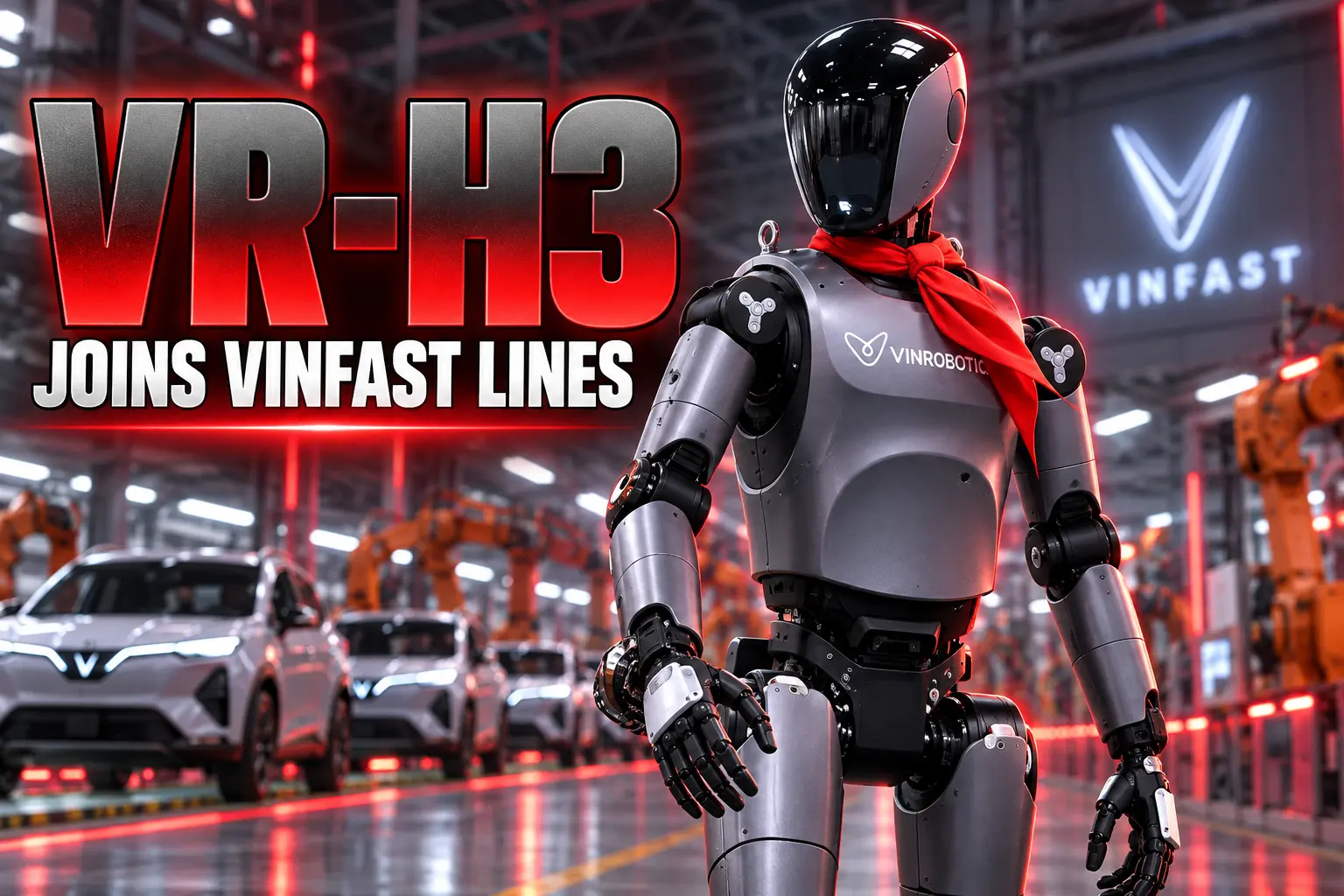
What the VR-H3 Can Lift and Carry
VinRobotics’ own walking-speed note puts the VR-H3 at 178 cm tall and weighing 85 kg. The June brief says it can sense a room, talk to people, move parts, and help with assembly, with a rated payload of 6 to 8 kilograms.
VR-H3 FIGURES VINROBOTICS HAS PUT ON PAPER
| Item | Company figure |
|---|---|
| Height | 178 cm |
| Weight | 85 kg |
| Actuators | More than 31 |
| Onboard computers | Two edge units |
| Rated payload | 6 to 8 kg |
| Vienna control demo | VR headset teleoperation, no extra trackers |
Those numbers describe a light industrial helper, not a press or a weld cell. A fixed arm on a VinFast body line still moves heavier steel. The pitch for a humanoid is that the same pair of legs can walk between stations built for people.
On February 9, 2026, VinRobotics and VinFast ran a Demo Day with a unit labelled VR-H3.1. The company’s factory-trial video says the robot lifted and carried a 5.5 kg automotive door frame, a specific part from a body-shop sequence, while averaging 0.6 meters per second and peaking at 1 meter per second. That 5.5 kg lift is a trial load, not a new rating.
Hung’s team has also said it trains walking with reinforcement learning, including gait rewards, domain randomization, and curriculum learning so a heavy platform stays up when the floor is not a lab mat. The June rooms were crowded and open. That is a lower bar than a live takt-time cell, and it is a higher bar than a taped demo bay.
52 Billion Dong Tied to VinFast Lines
The June tour sat on paid work that was already in the group. Vingroup’s 2025 annual report said VinRobotics signed two turnkey robot and AI jobs for VinFast plants in 2025, together about 52 billion dong (about $2 million), with acceptance expected in 2026.
Those VinFast factory contracts for the VR-H3 are small next to a car plant. They are the first invoice in a closed loop. VinFast’s 2025 annual filing says it works with VinRobotics on factory output, quality checks, and running costs as volumes rise, and that VinFast expects to build robots for VinRobotics, VinMotion, and VinDynamics.
Anne Pham, VinFast’s deputy CEO of investments, said on an earnings call that humanoid trials were planned for the second half of 2026 across two Vietnam plants for certain operational tasks. The report also named VinMetal and VinCons as later automation targets inside the same group.
THE CLOCK ON THE FACTORY WAGER
- November 2024: VinRobotics is founded with charter capital of 1 trillion dong ($39.35 million), Vingroup holding 51 percent, chairman Pham Nhat Vuong 39 percent, and his sons Pham Nhat Quan Anh and Pham Nhat Minh Hoang 5 percent each. Ngo Quoc Hung is named CEO.
- First eight months: The company rolls five industrial prototypes, H1, H2, H3, and two M2 units, and later says headcount grew 8.5-fold by a January 31, 2026 staff party.
- 2025: Two VinFast turnkey contracts, about 52 billion dong, are signed. Vingroup says design and supply-chain work cut the bill of materials by more than 50%, and it sets industrial-scale production and use for the end of 2026.
- February 9, 2026: Demo Day with VinFast. VR-H3.1 moves body-shop parts, including a 5.5 kg door frame.
- April 22, 2026: A strategic memo is signed with MobiFone Solutions at VinRobotics headquarters.
- May 2026: An Infineon memo is signed, then published on June 9, for a Hanoi competency center.
- June 1 to 5, 2026: VR-H3 walks ICRA, the outdoor robot festival, and COMPUTEX as a “Make in Vietnam” industrial platform.
A 52 billion dong pair of jobs will not automate Hai Phong. It will force the robot through a real acceptance test on someone else’s takt. That is the cheap, harsh dataset most humanoid startups have to beg BMW or Mercedes to share.
The Headset Still Drives the Hands
The clip that VinRobotics chose to highlight on ICRA’s opening day was not a fully unsupervised cell. It was remote driving. A person wore a VR headset with motion capture built in, and the robot copied the motion with no extra trackers in the hall.
That is a product, not a footnote. A headset that does not need a motion-capture cage can go into a plant without a new room full of cameras. It also means a person is still in the loop. The June language mixed “real-time autonomous control” with a demo that was, on the floor, a puppet.
Hung’s engineers list the stack they say they own. The list is the bet that Vietnam can stop buying the whole robot from China or the United States and still service a VinFast line.
WHAT VINROBOTICS SAYS IT BUILT IN HOUSE
- Mechanical structure: Body, limbs, and industrial shell designed in Vietnam rather than imported as a finished humanoid kit.
- Electrical architecture: Real-time computing and communication, including the two edge computers that sit on the robot.
- Power and battery: Distribution platform and pack, the parts that decide how long a shift can run before a swap.
- Hands and actuators: Robotic hands and high-performance motors presented as a local supply set around the VR-H3, not a single showpiece joint.
- Full-body AI control: Walking, balance, and task software trained with reinforcement learning and, in Vienna, driven by the headset when a person takes over.
Vingroup has said the company already masters more than 90 percent of that core stack. Mastery on a slide is not a three-shift body shop. The February trial is the more useful artifact: a door frame, a stop point the robot had to pick, and a walking speed that would lose a footrace to a line worker.
The company’s site has since put a later commercial platform in the window, pairing a high-end VR-H5 and a mid-range VR-M3 with open-source tools on ROS 2, MuJoCo, Isaac Lab, and LeRobot, plus a first runtime called vla.cpp. That does not retire the H3 story. It shows the industrial mule is already being succeeded while the 2026 factory clock is still running.
Infineon’s Hanoi Competency Center
On June 9, 2026, Infineon Technologies said it had signed a memorandum with VinRobotics, dated May, to work on humanoid robots. The concrete item is a joint competency center at VinRobotics’ Hanoi office, branded VRICC, where Infineon says it will join projects from the early design stage and help train VinRobotics staff.
Infineon put a number on its own slice of the machine: an average semiconductor bill of materials of around $500 per robot, covering sensing, compute, motor control, power, links, safety, and security in silicon, silicon carbide, and gallium nitride. That $500 is the chip kit, not VinRobotics’ full parts cost, and it sits beside the group’s claim that it already cut the overall bill of materials by more than 50 percent.
Philipp von Schiersteadt, Infineon’s chief sales officer for compute, consumer, and communication, said the work would aim at “next-generation humanoid robots for deployment in various sectors, from industry to services and the home.” Hung, in the same release, kept the order of markets the other way around: Vietnam first, then abroad.
As VinRobotics continues to build core technology capabilities through engagement with a diverse range of world-class technology partners, we believe initiatives such as this one will help lay the foundation for a new generation of robotics solutions developed in Vietnam, serving both the domestic market and gradually expanding into international markets.
Ngo Quoc Hung, Chief Executive Officer, VinRobotics, Infineon memorandum, June 9, 2026
Forty million dollars of charter capital does not buy a Figure-class research campus. A German chipmaker’s lab inside the Hanoi office is how a young company borrows a power-electronics bench it cannot staff at that price. It is also how Infineon plants a flag in a Southeast Asian factory base that already welds cars.
Vingroup Split the Robot Bet Three Ways
VinRobotics is not the only humanoid shop Pham Nhat Vuong stood up. In January 2025 the group formed VinMotion with another 1 trillion dong in charter capital and a 51 percent Vingroup stake, aimed at general-purpose machines. In September 2025 it added VinDynamics with 500 billion dong, the unit that brought Dyno to Vienna as a guide.
VINGROUP’S THREE HUMANOID COMPANIES
| Company | Formed | Charter capital | Public job so far |
|---|---|---|---|
| VinRobotics | November 2024 | 1 trillion dong ($39.35 million) | Industrial VR-H3, VinFast contracts, Infineon lab |
| VinMotion | January 2025 | 1 trillion dong | General-purpose line, including a Motion series |
| VinDynamics | September 2025 | 500 billion dong | Dyno service robot at ICRA and Vinpearl Safari |
Three logos do not make a robotics industry. They do show the group is not hanging the whole wager on one waist joint. VinRobotics takes the plant. VinDynamics takes the public-facing body. VinMotion sits in the middle as a multi-use platform. VinFast, in its filing, offers itself as the contract manufacturer for all three.
The charter on VinRobotics is 1 trillion dong, about $39.35 million at the November 2024 conversion the company used when it launched. That is real money in Hanoi and a rounding error next to U.S. humanoid rounds that clear a billion. Vingroup has also shut consumer-electronics pushes before. A phone or a television that has to win a retail shelf is a different animal from a robot whose first customer owns the next building.
The closed loop is the whole strategy. Stamp, weld, paint, and final assembly at VinFast are four rooms that already chew through labor. If a humanoid can haul a door frame in one of those rooms without stopping the line, VinRobotics gets data and an invoice. If it cannot, the group still has the car plant, and the robot program becomes another expensive prototype wall.
Second-Half Trials at Two Vietnam Plants
By mid-September 2026 the public record still shows a plan, not a signed-off cell. Pham said trials were booked for the second half of the year at two Vietnam plants. Vingroup told shareholders industrial-scale production and use should start by the end of 2026. The 52 billion dong VinFast jobs are due for acceptance in that same year. None of those three items has been posted as finished work.
WHAT WE KNOW
- The machine: VR-H3 is a 178 cm, 85 kg third-generation humanoid with more than 31 actuators, two edge computers, and a 6 to 8 kg rated lift.
- The customer: VinFast already signed two 2025 turnkey jobs worth about 52 billion dong and described humanoid trials at two Vietnam plants in the second half of 2026.
- The control: The ICRA opener that VinRobotics chose to feature was VR-headset teleoperation with no external trackers, even as the brief also talked about onboard autonomous control.
- The supply bet: Infineon is putting a competency center in Hanoi, and Vingroup says it cut the full parts bill by more than 50 percent and owns more than 90 percent of the core stack.
WHAT IS UNCONFIRMED
- Live line duty: No public log yet shows VR-H3 or H3.1 clearing a full shift on a VinFast body line after the February 9 Demo Day.
- Year-end output: The end-2026 industrial production target in the 2025 annual report has not been updated with a unit count or a ship date.
- Which body ships: The commercial site now leads with VR-H5 and VR-M3, so the robot that takes the 2026 plant trial may not wear the H3 badge that went to Vienna.
A headset can put a Vietnamese humanoid on a factory floor this year. A two-plant trial can decide whether that is a stunt or a shift. The invoice that matters is still the 52 billion dong VinFast already agreed to pay, and the clock on that acceptance runs to the end of 2026.

Instagram Plus Tests a Read-Only Mode That Cuts Stories

Altman Asks the Public to Accept Some AI Harm

Google Freezes OSS VRP Product Reports After AI Flood

AI Agents Make Payment Rails the Scarce Prize

Turkey’s Crypto Boom Now Runs Through Three Banks

Fable 5 Came Back Under a Commerce On-Off Switch

Google’s SpaceX GPU Lease Has a Sept. 30 Deadline

Plasma One’s XPL Locks Face a 1.81 Billion Cliff

DGO’s Rs 549 World Cup Pass Cost Fans Sleep and Data

Moonshot AI’s $30 Billion Ask Became a $35 Billion Close
-
 AI4 months ago
Fable 5 Came Back Under a Commerce On-Off Switch
-
 AI4 months ago
Google’s SpaceX GPU Lease Has a Sept. 30 Deadline
-
 CRYPTO4 months ago
Plasma One’s XPL Locks Face a 1.81 Billion Cliff
-
 APPS4 months ago
DGO’s Rs 549 World Cup Pass Cost Fans Sleep and Data
-
 AI4 months ago
Moonshot AI’s $30 Billion Ask Became a $35 Billion Close
-

 NEWS4 months ago
ColorOS 17 Device List Spans Oppo, OnePlus and Realme
-

 GAMING4 months ago
Xbox Cuts 3,200 Jobs After Five Years of Thin Returns
-

 GAMING4 months ago
The RTX 4050 Under Rs 70,000 Hides a Wattage Gap