
NEWS
Cathie Wood Doubled Down After the SpaceX IPO Pop
Cathie Wood flagged voracious SpaceX IPO demand, then ARK bought the listing and the slide as SPCX swung from $225.64 to $104.83.

Cathie Wood, chief executive of ARK Invest, said in early May that a SpaceX listing would meet voracious demand and a volatile open. SpaceX priced $75 billion of stock at $135 a share on June 11 and listed the next morning on Nasdaq as SPCX, where the shares opened at $150.
ARK then bought millions of shares on the first session and again on the way down. SPCX closed at $151.21 on September 11, 12% above the IPO price, after trading as high as $225.64 and as low as $104.83.
Wood Called the Demand Before SpaceX Filed Terms
On May 6, weeks before SpaceX set a public price, Wood told listeners the order book was already there. “There is so much demand out there,” she said. SpaceX was already the largest line in ARK Venture Fund, at 13.76% of the portfolio as of April 30, and she said investors who wanted a look at the company had been finding that fund.
She described IPO demand as voracious even while calling $75 billion a large sale. “So, the demand is voracious out there,” Wood said. “Only $75 billion… yes, it’s a big IPO, but just think about how SpaceX has reawakened the dream of space exploration.” She also said the first days would be messy because supply would not match that demand, and she labeled the deal a “volatile” IPO.
That was the wager in plain language. She was not waiting to see whether the roadshow cleared. She was telling clients the shortage of stock would be the story, and that ARK already owned a private stake other buyers could not get.
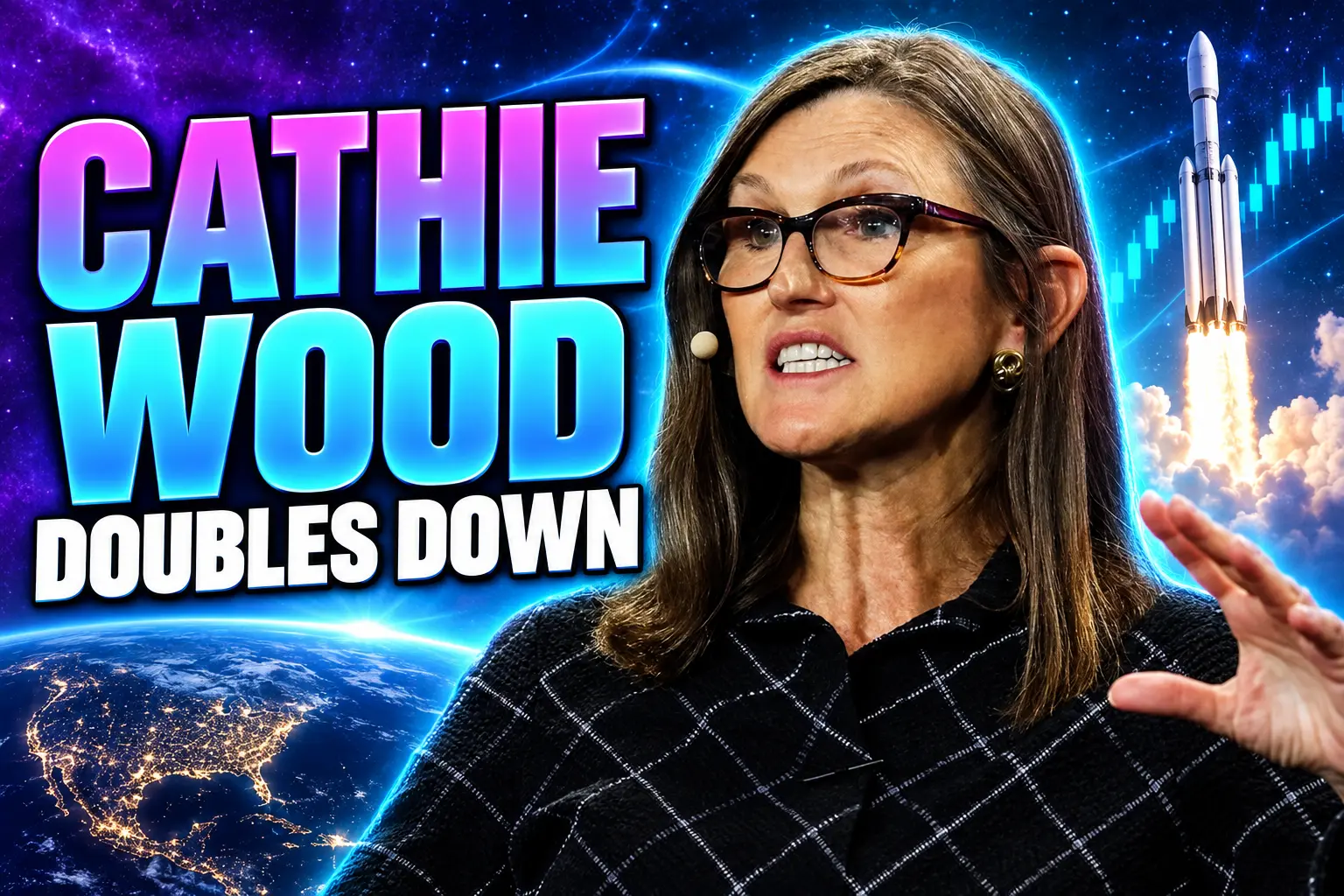
$75 Billion Priced at $135 and Opened at $150
SpaceX sold 555.6 million Class A shares at a fixed $135, with Goldman Sachs and Morgan Stanley running the books after a one-week market. At that price the company was valued at $1.77 trillion, about 95 times 2025 revenue of $18.67 billion. Saudi Aramco’s 2019 listing, the previous high-water mark, raised $29.4 billion including its greenshoe, so SpaceX more than doubled the old record on proceeds alone.
THE JUNE LISTING
| Item | Figure |
|---|---|
| Offer price | $135 |
| Shares sold | 555.6 million |
| Gross proceeds | $75 billion |
| Implied equity value | $1.77 trillion |
| First print | $150, then $160 |
| Ticker | SPCX |
Bankers on the deal said the book was covered at least three times and that a lot of accounts would be unhappy with their allotments. Retail received 20% to 25% of the offering, or $15 billion to $18.75 billion, through Schwab, Fidelity, Robinhood, SoFi, and E*Trade, plus dedicated programmes in Europe, Japan, and the UK. Underwriters held an option on another 83.3 million shares that could lift proceeds to about $86.25 billion.
The stock opened at $150, 11% above the IPO price, and quickly traded up to $160. For a sale that size, that is a contained first print, not a meme melt-up. The float was only 4.2% before the greenshoe, Elon Musk kept 84.4% of the votes through Class B shares, and his 6.4 billion shares were locked for 366 days. Index rules that now let huge new listings enter major benchmarks within days added another bid against that thin public supply.
ARK Bought 3.3 Million Shares on Day One
Wood did not treat listing day as an exit from a private winner. Four ARK exchange-traded funds bought 3,291,184 SPCX shares on June 12, about $444 million if those tickets were filled at $135. The split put SpaceX into the flagship innovation fund and into the robotics, internet, and space products on the first session.
ARK’S JUNE 12 TICKETS
- ARK Innovation: 1,690,839 shares, a 3.2% weight in that fund.
- ARK Autonomous Technology: 736,442 shares, a 4.5% weight.
- ARK Next Generation Internet: 325,562 shares, a 2.6% weight.
- ARK Space and Defense: 538,341 shares, a 6.8% weight.
On June 22, after the first fade from the post-listing high, the same four funds added 210,121 shares. Later daily reports showed more buying in July, including tickets sized around $18 million after a scrubbed Starship test and further adds as the stock dropped below the IPO price. The pattern is the point. Wood had warned that the opening would swing. When it did, ARK treated the swing as inventory.
A High of $225.64 and a Low of $104.83
The tape did the volatile thing she flagged, just not on the opening print. SPCX ran to $225.64 on June 16, four sessions after the debut, then gave those gains back in a hurry. By August 3 the 52-week low sat at $104.83, a break of the $135 offer with the lockup calendar still in view.
THE FIRST 90 DAYS ON THE TAPE
- May 6, 2026: Wood says demand is voracious and the IPO will be volatile.
- June 11, 2026: SpaceX prices 555.6 million shares at $135 for $75 billion.
- June 12, 2026: SPCX opens at $150 and ARK buys 3.29 million shares.
- June 16, 2026: Shares trade as high as $225.64.
- June 22, 2026: ARK adds 210,121 shares on the first fade.
- July 22, 2026: Wood calls SpaceX a candidate for the most important company in global history.
- August 3, 2026: The stock prints a low of $104.83.
- September 11, 2026: SPCX closes at $151.21, 12% above the IPO price.
A move from $135 to $225.64 and back through $104.83 is the supply-demand imbalance in public form. Fast-track index buying against a 4.2% free float can force that kind of spike when insiders are locked up, and the reverse flow shows up just as fast when the first mechanical bid is done. Fundamentals at Starlink and the launch pad did not change on that schedule. The float did.
Why ARK Treats SpaceX as an AI Landlord
Wood’s May comments sat next to a simpler claim that is now the listed story: Musk had already said xAI would be dissolved as a standalone company so the AI products would come from SpaceX. The S-1 was not a pure rocket prospectus. Connectivity, launch, and AI sit in one reporting pile, and the AI stack was still losing money while soaking up capex.
At the IPO, SpaceX’s three lines generated $6.58 billion of adjusted EBITDA on $18.67 billion of revenue. Starlink produced $7.17 billion of adjusted EBITDA on $11.4 billion of sales, which is the cash engine. The AI line lost $1.24 billion and spent $12.73 billion of capex in 2025, then another $7.72 billion in the first quarter of 2026. Anthropic agreed to pay $1.25 billion a month for Colossus compute through May 2029. Alphabet’s contract is $920 million a month from October through June 2029.
We think this could become the most important company in history, and I mean in global history.
Cathie Wood, CEO of ARK Invest, on Mornings with Maria, July 22, 2026
She said that after the stock had already rolled over from the June high. ARK chief futurist Brett Winton had put orbital data-center revenue as high as $300 billion a year by the late 2020s if SpaceX can rent tens of gigawatts from orbit. The firm’s later research argues that orbital satellite compute costs can fall to about half of terrestrial data-center builds once the early AI satellites are flying. That is the second half of Wood’s bet, and it is why a 95-times-sales listing was sold as infrastructure rather than as a launch vendor.
The Venture Fund’s SpaceX Weight Fell to 7.54%
The private fund that held SpaceX before the ticker existed also had a good quarter because of it. ARK Venture Fund returned 20.21% in the quarter, against 15.20% for the S&P 500 and 13.76% for the MSCI World Index, and SpaceX and Anthropic were the top contributors. Assets rose from $711 million to $1.3 billion, including $400 million of net inflows. Starlink crossed 12 million active customers in more than 160 countries, and SpaceX sold $25 billion of unsecured notes to refinance a bridge loan, a step ARK said should cut interest costs by about $300 million a year.
ARK’S SPACEX STAKE IN THE VENTURE FUND
- April 30, 2026: SpaceX is 13.76% of ARK Venture Fund, the largest holding.
- June 30, 2026: The position moves from the private book into the public book after the IPO, still under lockup.
- August 31, 2026: SpaceX is still first, at 7.54% of ARK Venture Fund.
- September 4, 2026: ARK Space and Defense shows 543,251 SPCX shares, a 10.60% weight worth $81.3 million.
The weight drop from 13.76% to 7.54% is not a dump. The fund roughly doubled in size during the quarter, and new private names such as Stripe, Cellares, and Hydra Host took capital. SpaceX remained line one. ARK’s open-source 2030 valuation model, built with Mach33, still centers on an expected enterprise value of about $2.5 trillion that year. At $151.21 on September 11, the public tape is close to a $2 trillion company and 12% above the IPO, which is a long way from that 2030 mark and a long way from the June spike.
Wood called the demand correctly. The $75 billion sale cleared, the book was more than full, and retail still wanted a larger slice than it got. She also called the volatility, even if the first print was orderly. The violent part arrived in the next two months, and ARK kept buying it. As of August 31, SpaceX was still the largest holding in ARK Venture Fund, at 7.54%. The shares closed at $151.21 on September 11.
Frequently Asked Questions
When Did SpaceX Go Public and Under What Ticker?
SpaceX priced the deal on June 11, 2026, and started trading on June 12 on Nasdaq and Nasdaq Texas under the ticker SPCX. The Class A shares were a 4.2% float before the underwriters’ option, with the rest still in insider hands.
How Did the SpaceX IPO Compare With Saudi Aramco’s Listing?
Aramco’s 2019 debut raised $29.4 billion including the greenshoe. SpaceX’s $75 billion sale was more than twice that, and a full exercise of the 83.3 million-share option would have taken proceeds to about $86.25 billion, still the largest IPO on record by a wide margin.
Does Elon Musk Still Control SpaceX After the IPO?
Yes. Musk holds 84.4% of voting power through 10-vote Class B shares, and SpaceX listed as a controlled company with no requirement for an independent board. Because it is a Texas corporation, derivative claims need a 3% voting bloc held for six months, a stake worth $53 billion at the $135 IPO price.
What Is the ARK Venture Fund If It Is Not an ETF?
ARK Venture Fund (ARKVX) is an actively managed closed-end interval fund that can hold private and public shares of companies ARK files under its disruption theme. Interval funds redeem on a set calendar rather than trading all day like an ETF, which is how it carried SpaceX before SPCX existed and kept the stock after the lockup clock started.
Disclaimer: This article is news reporting and analysis of public filings, fund holdings, and market prices, and it is for information only. It is not investment advice, a recommendation to buy or sell SpaceX, Tesla, ARK Venture Fund, or any ARK ETF, and it is not a forecast of future returns. Readers should consult a registered investment adviser or licensed financial planner who can review their own time horizon, liquidity needs, and risk limits before acting. Share prices, fund weights, lockup dates, and contract figures reflect the sources cited as of their stated dates and can change with new filings, trading, and corporate actions.

Instagram Plus Tests a Read-Only Mode That Cuts Stories

Altman Asks the Public to Accept Some AI Harm

Google Freezes OSS VRP Product Reports After AI Flood

AI Agents Make Payment Rails the Scarce Prize

Turkey’s Crypto Boom Now Runs Through Three Banks

Fable 5 Came Back Under a Commerce On-Off Switch

Google’s SpaceX GPU Lease Has a Sept. 30 Deadline

Plasma One’s XPL Locks Face a 1.81 Billion Cliff

DGO’s Rs 549 World Cup Pass Cost Fans Sleep and Data

Moonshot AI’s $30 Billion Ask Became a $35 Billion Close
-
 AI4 months ago
Fable 5 Came Back Under a Commerce On-Off Switch
-
 AI4 months ago
Google’s SpaceX GPU Lease Has a Sept. 30 Deadline
-
 CRYPTO4 months ago
Plasma One’s XPL Locks Face a 1.81 Billion Cliff
-
 APPS4 months ago
DGO’s Rs 549 World Cup Pass Cost Fans Sleep and Data
-
 AI4 months ago
Moonshot AI’s $30 Billion Ask Became a $35 Billion Close
-

 NEWS4 months ago
ColorOS 17 Device List Spans Oppo, OnePlus and Realme
-

 GAMING4 months ago
Xbox Cuts 3,200 Jobs After Five Years of Thin Returns
-
 GAMING4 months ago
The RTX 4050 Under Rs 70,000 Hides a Wattage Gap