
NEWS
Smartphones Are Quietly Building Invisible Walls in Vietnamese Homes
Vietnamese parents spend 7 hours a day on the internet but only 47 minutes with their children. Surveys show what that gap is doing at the dinner table.

At 8 PM in an apartment on Nhan Hoa Street in Hanoi, the L.T. family runs through what has become an ordinary Vietnamese evening. The father scrolls TikTok on the sofa, the mother works through a Shopee cart, the 9-year-old son is locked into a game, the 15-year-old daughter texts nonstop, and the 3-year-old whines for a different YouTube channel. Five people, five phones, five separate worlds under one roof, a single vignette that captures where the smartphone era has quietly landed.
Vietnamese adults spend roughly seven hours a day online, and only about 47 minutes with their own children, according to the Vietnamese family portrait behind the data. The country is not alone in the pattern. Sweden’s health agency has told parents to keep smartphones away from children under 13, and Britain is moving toward a ban on under-16s joining social media. The same device that promises to connect anyone, anywhere has become the one families eat, argue, and fall asleep next to. The numbers behind that shift now look less like a lifestyle change and more like the start of a slow public health story.
The Numbers Behind the Quiet Drift
The headline figures come from a stack of recent surveys, and together they give the Vietnamese dinner table its exact dimensions. The Digital 2024 series published by We Are Social and Meltwater, drawn from Vietnam’s full Digital 2024 dataset, puts the average Vietnamese user online for seven hours a day and on social media for three hours and 30 minutes of that. A separate Q&Me survey found 65% of Vietnamese users reaching for their phone within five minutes of waking, and 58% reaching for it again as the last thing they do before sleep.
Put the seven-hour figure against the 47 minutes a day urban Vietnamese parents spend talking or playing with their children, and the gap stops looking like a scheduling problem. It looks like a budget.
Decision Lab’s 2023 survey of city households documented the dinner-table picture, and a UNICEF Vietnam report from the same period documented the cost for the youngest children. The full set of figures, side by side:
- 7 hours per day online, the Vietnamese average in early 2024
- 71% of city households with at least one phone user at the dinner table
- 62% of children aged 6-15 who feel unheard at dinner
- 2.5 hours per day on devices for city children aged 3 to 5
- 30% rise in speech delays and attention deficit diagnoses from 2020 to 2024
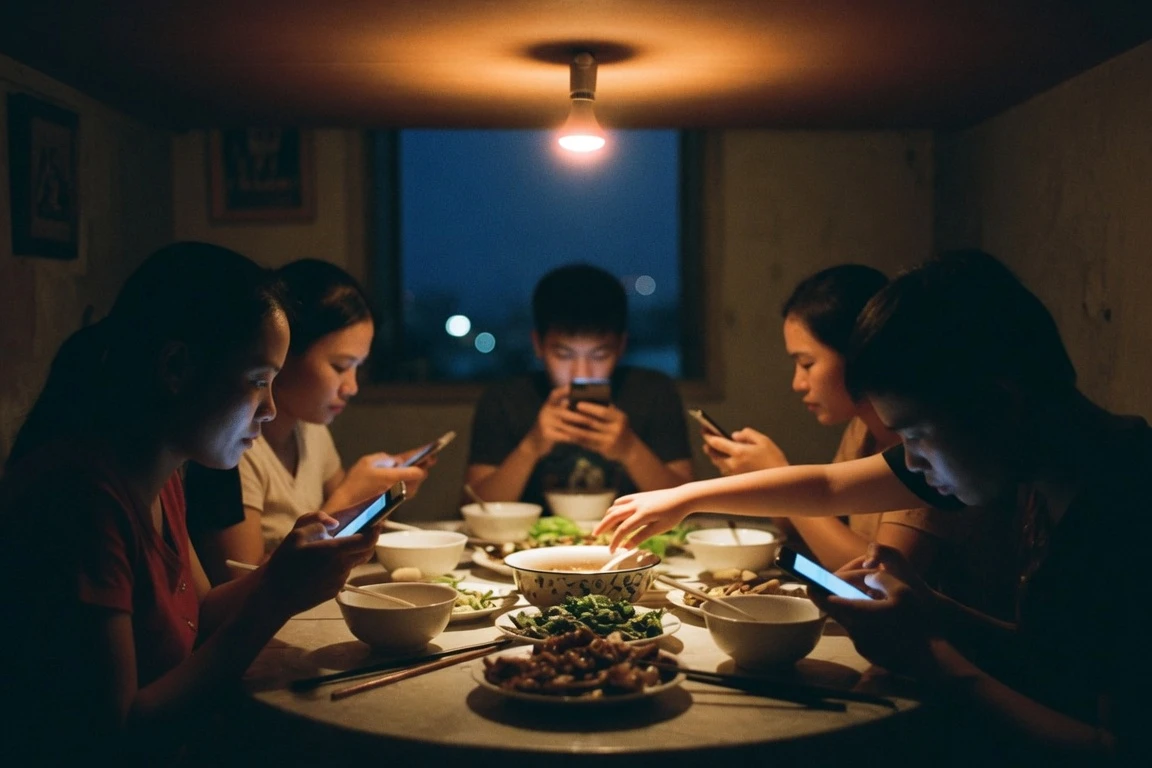
What Happens When Dinner Comes With a Side of TikTok
The statistics translate into very specific evenings. A Hanoi woman identified as N.M.T told VietnamPlus that her husband keeps his phone in his hand even at the table, sometimes streaming YouTube, sometimes scrolling news, sometimes playing games between bites. She has tried gentle reminders and outright confrontation. His habit, she said, has not changed. The pattern is no longer an exception to the family dinner in urban Vietnam. It is the family dinner.
Another Hanoi parent, N.A.M from Thanh Xuan district, gave a rarer and more self-aware version of the same scene:
I had scolded my third-grade daughter several times during dinner because she kept talking about one classmate after another. At the time I thought it was nonsense, because my mind was preoccupied with listening to commentary on the gold market and real estate investment on YouTube. I have a habit of listening to YouTubers during dinner to catch up on current events, because I’m too busy all day to do it. Many times I regret scolding her, but then I quickly get caught up in the news and forget to ask her how her day was.
N.A.M told VietnamPlus that even when she does ask, she now senses her daughter answering just to get through the moment, not to share. The cost of the screen has shifted from a missed conversation to a chilled one.
The Youngest Pay the Highest Price
A UNICEF Vietnam report cited in the same piece found that children aged 3 to 5 in Vietnamese cities now spend an average of 2.5 hours a day on digital devices, more than double the one-hour daily cap the World Health Organization recommends for that age group. Between 2020 and 2024, the rate of speech delays and attention deficit disorders in the same age band rose by 30%.
When children are first soothed with YouTube at age 2, the report warned, they learn to interact with screens before they learn to interact with their mothers.
The damage does not stop with the children. Researchers have a name for the adult version of the same behavior: phubbing, a portmanteau of phone and snubbing for the act of looking at a phone while ignoring the person across the table. The research on phubbing’s family effects now points in the same direction across studies, with effects ranging from lower relationship satisfaction in couples to higher loneliness scores in adults who report being regularly phubbed.
The same pattern reaches couples. For partners who admit to being on the receiving end of regular phubbing, marital intimacy has fallen noticeably since both partners picked up the habit. The separation-in-bed phenomenon VietnamPlus describes is the same dynamic running in slow motion. What the research keeps finding:
- Lower overall relationship satisfaction between adult partners who phub each other
- Reduced perceived intimacy in couples after sustained phone use at home
- A measurable drop in how listened-to children feel during shared meals
- A learned default in which the screen outranks the human in front of you
- Erosion of the verbal back-and-forth that builds vocabulary and empathy in young children
Why the Algorithm Keeps Winning
The mechanism is older than any app. Scrolling TikTok for thirty seconds delivers a laugh on demand, and the brain learns to chase that immediate reward. Sitting through a 30-minute story from a nine-year-old delivers no laugh, no score, and no notification, and the parent has to regulate their own emotions while doing it. The choice the brain keeps making, given those two menus, is not a moral one. It is a dopamine one.
So many parents have, without meaning to, trained themselves to swipe rather than listen. The result is a generation of children who have watched 500 Facebook friends stream past while feeling alone, who confuse Likes with hugs and Comments with the words Mom and Dad understand you. The mistake is not in owning the technology. It is in confusing virtual connection with the deeper kind.
A 20-Minute Window That Changes the Math
There is a counter-finding worth knowing. A Harvard study on Digital Family Rituals found that just 20 minutes a day without phones increased family bonding by 37% after eight weeks. The intervention was not a tech detox or a new app. It was a 20-minute gap the family agreed to protect.
Sweden’s no-smartphone guidance for kids under 13 and Britain’s plan to ban under-16s from social media are national-scale versions of the same instinct. The version VietnamPlus proposes is built around the dinner table itself. The practical steps, drawn from the same piece:
- Make the dinner table a no-phone zone, even for 20 minutes, and start small
- Ask one real question each night: how was today, what was fun, do you need help tomorrow
- Reflect weekly on whether the bonding felt real or performative, and adjust
- Replace solo screen time with shared screen time: a movie, a Kahoot round, a YouTube cooking tutorial done together
- Sign a digital contract with children over 10: one hour of screen time after chores, parents agree not to check work email after 8 PM
The piece’s framing line is worth keeping: a house does not need more Wi-Fi bars. It needs more we-feeling bars. Whether the dinner table can hold that weight, in a country where the average household now runs five devices in parallel, is the open question every Vietnamese family is already answering, one meal at a time.
Frequently Asked Questions
What does phubbing actually mean?
The word is a portmanteau of phone and snubbing. Researchers use it for the act of looking at a mobile phone while ignoring the person physically present. The same body of work has linked the behavior to lower relationship satisfaction in couples and weaker face-to-face interaction in families, including at the dinner table.
How much screen time does the WHO recommend for young children?
The World Health Organization’s screen-time guidance for children aged 3 to 4 caps sedentary screen use at one hour per day, with less being better. VietnamPlus cites UNICEF data showing Vietnamese city children in the 3 to 5 age band actually average 2.5 hours a day on devices, a gap that puts the country well outside the WHO recommendation.
Why are governments moving to ban or limit smartphones for kids?
Sweden’s health agency has told parents to keep smartphones away from children under 13, citing harmful content exposure, sleep loss, and addiction-like use. Britain is moving toward a social media ban for under-16s scheduled for spring 2027. Both moves reflect the same evidence base that links early, heavy screen exposure to attention and language problems in children.
Does turning off the Wi-Fi actually help?
A Harvard study on Digital Family Rituals found that 20 minutes a day of phone-free time increased family bonding by 37% after eight weeks. The intervention worked because it was small, repeated, and protected. The phone is the tool. The attention is the resource.
What is the 30-minute phone-free mealtime rule?
It is the practical version of the Harvard finding: phones go away for the length of one family meal, with no exceptions for adults or children. The VietnamPlus piece positions it as a low-cost daily ritual for any household that already runs multiple devices in parallel, and a way to recover the kind of attention that does not show up in a notification.


South Korea Retail Investors Face Reckoning After KOSPI AI Rally Collapses

Surrey AI Maps Three Heart Attack Paths and Their Molecular Roots

Germany Locks Neutral Apple ATT Prompts Across Most of Europe

Apple’s 5% EU Fee Quietly Rewrites Alternative App Store Math

Apple’s EU Fee Truce Cuts Complexity but Leaves Rivals Fuming

Pixel 11 Pro Fold Trades Thinness for Durability and Seven-Year Stay

Mayo AI Flags HCM Obstruction From Everyday Ultrasound Videos

Indian Brands Quietly Scale Landmark Screens and Home Tech

Navin Vatsa Turns Grief Into a Lifetime of Quiet Seeing

Google Bets Pixel 11 Agentic AI Will Redefine Phones

Oracle Cuts 21,000 Jobs in a Year, Cites AI in 10-K Filing

Fable 5 and Mythos 5 Return as US Lifts Anthropic Export Controls

SpaceX’s Google Deal Turns a Rocket Company Into a Cloud Landlord

CD Projekt Red Co-CEO: Redemption Arc Isn’t Done, Witcher 4 in 2027

XPL Rallies 30% Ahead of Plasma One Card Tier Launch

Google Search Profiles Build a Follow Graph Inside Discover

DGO App Brings Rs 549 Mobile Pass for FIFA World Cup 2026 in Nepal

Moonshot AI Targets $30 Billion in China’s Fastest AI Funding Sprint

Oppo’s ColorOS 17 Eligibility List Leaves A-Series Buyers Behind

Microsoft Xbox Layoffs Start in July as Sharma Slams 3% Margin
-
 AI2 months ago
Oracle Cuts 21,000 Jobs in a Year, Cites AI in 10-K Filing
-
 AI2 months ago
Fable 5 and Mythos 5 Return as US Lifts Anthropic Export Controls
-
 AI3 months ago
SpaceX’s Google Deal Turns a Rocket Company Into a Cloud Landlord
-
 GAMING2 months ago
CD Projekt Red Co-CEO: Redemption Arc Isn’t Done, Witcher 4 in 2027
-
 CRYPTO3 months ago
XPL Rallies 30% Ahead of Plasma One Card Tier Launch
-
 NEWS3 months ago
Google Search Profiles Build a Follow Graph Inside Discover
-
 APPS3 months ago
DGO App Brings Rs 549 Mobile Pass for FIFA World Cup 2026 in Nepal
-
 AI3 months ago
Moonshot AI Targets $30 Billion in China’s Fastest AI Funding Sprint