
NEWS
Samsung and SK Hynix Pledged Trillions, Then Refused the Grid Bill
Samsung and SK hynix pledged 800 trillion won for four fabs, then refused KEPCO’s 25 trillion won grid prepay with Gwangju still aimed at 2030.

Samsung Electronics and SK hynix rejected a 25 trillion won request from Korea Electric Power Corp. to prepay five years of electricity bills. The cash would have helped fund the grid for four new memory plants pledged on June 29. Those plants still have no opening date.
The refusal, confirmed in a KEPCO letter to a National Assembly lawmaker on Sept. 14, is the first hard no after a summer of trillion-won maps. Memory is still scarce. Power is the item that has to be paid for now.
Four New Memory Fabs Without an Opening Date
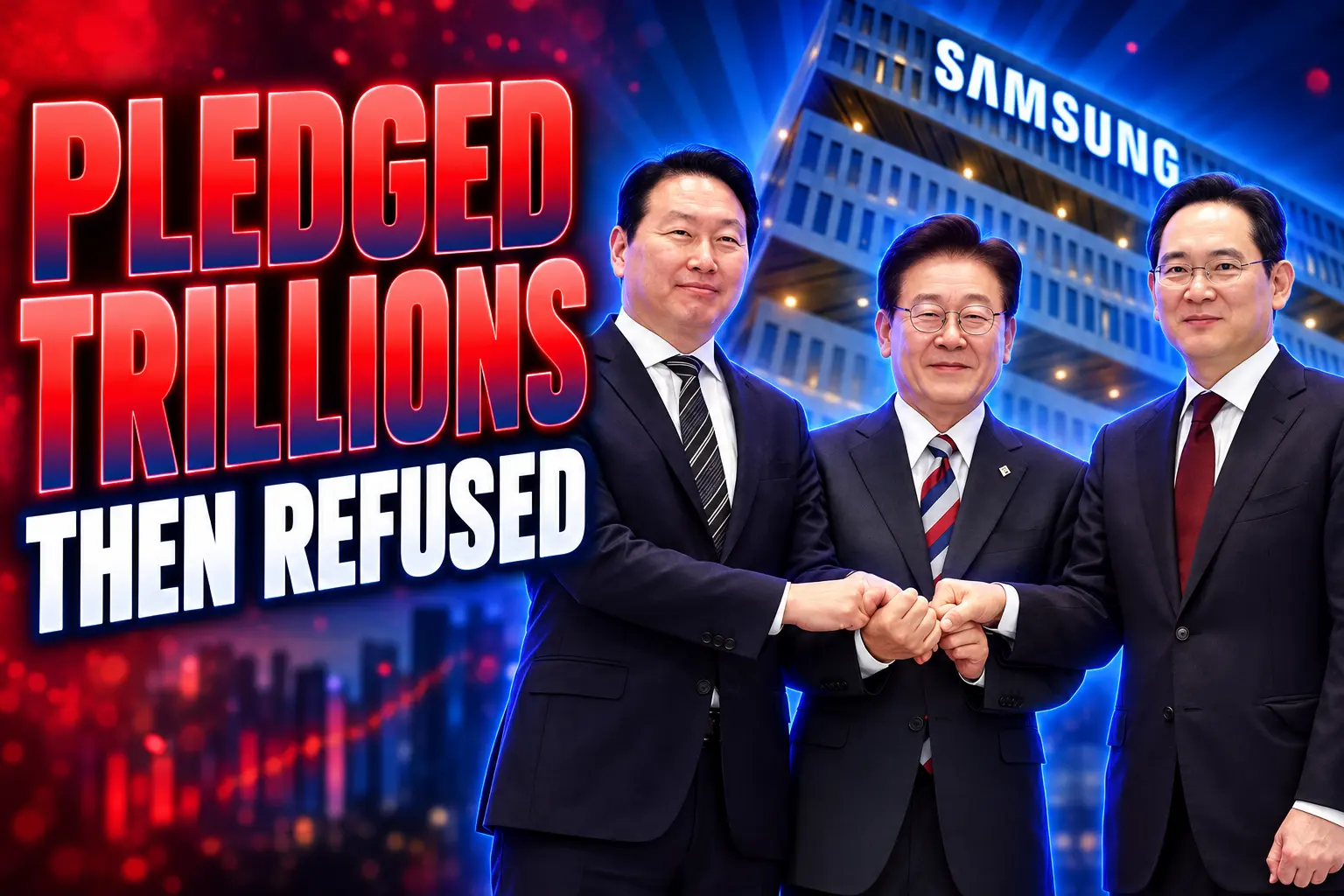
At a Blue House briefing on June 29, President Lee Jae Myung stood with Samsung Electronics Executive Chairman Lee Jae-yong and SK Group Chairman Chey Tae-won and rolled out three megaprojects: semiconductors, physical AI, and AI data centers. Industry Minister Kim Jung-kwan said the two chipmakers would each build two memory plants in the southwest, four in all, for a combined 800 trillion won ($520 billion).
Samsung’s 400 trillion won slice is two factories in Gwangju. SK hynix matched that 400 trillion won for two plants in the same region, without naming a city that day. Lee Jae-yong called Gwangju a candidate, not a closed deal, and said the draw was expected help on power, water, workers, and other infrastructure. Site maps and construction calendars were not published.
Samsung also put a much larger domestic number on the table. The company said it would invest 2,655 trillion won at home, 2,030 trillion won of that on the Pyeongtaek campus and the Yongin National Industrial Complex, and 625 trillion won on Honam, Chungcheong, and Yeongnam. Combined with SK hynix’s parallel decade map, the two groups talked past 4,755 trillion won. Samsung shares still closed that Monday at 323,000 won, down 4.86 percent. SK hynix finished just under 2.63 million won, down 1.68 percent.
THE JUNE 29 PLEDGE SHEET
| Pledge | Amount | What it covers |
|---|---|---|
| Four Honam memory plants | 800 trillion won | Two Samsung plants in Gwangju, two SK hynix plants in the southwest |
| Samsung domestic total | 2,655 trillion won | 2,030 trillion won for Pyeongtaek-Yongin, 625 trillion won for Honam, Chungcheong, and Yeongnam |
| SK hynix named master plan | 700 trillion won | 600 trillion won for the Yongin cluster, 100 trillion won to expand Cheongju |
| KEPCO prepay (rejected) | 25 trillion won | Samsung 20 trillion won, SK hynix 5 trillion won, about five years of bills |
Lee Jae-yong told the briefing the market view was that even aggressive chip spending could not meet demand as AI moved faster than the plants already on the books. Yongin’s timetable, he said, had already been pulled forward after Giheung, Hwaseong, and Pyeongtaek, so a new complex had to be prepared sooner.
The global AI race has become both an all-out war and a highly localized battle for strategic advantage. The southwestern coast is rich in water resources and, in particular, renewable energy. We must develop regions with abundant power, water supplies and stable access to affordable land into new strategic sites.
Lee Jae Myung, President of South Korea, Blue House briefing, June 29, 2026
He promised a dedicated Blue House task force to push the work through. Presidential chief of staff Kang Hoon-sik said the government wanted the new plants finished within the current administration. That is a political clock, not a fab clock.
The First Board Check Was 54 Trillion Won
The first money that actually cleared a board was not Honam money. On Aug. 7, SK hynix said directors had approved about 54 trillion won for two plants already on its Gyeonggi and Chungcheong map: 35.2 trillion won for the Y2 DRAM plant in Yongin and 19.1 trillion won for the M17 NAND plant in Cheongju.
That vote, the company said, executes the June master plan of 600 trillion won for Yongin and 100 trillion won for Cheongju. Y1, the first Yongin plant, is still aimed at a first cleanroom in February 2027. The Yongin Y2 cleanroom opening in June 2029 follows a groundbreaking in July 2027, with spending running through October 2031. M17 is scheduled to break ground in February 2027 and open a cleanroom in December 2028.
SK hynix also said it had pulled the full four-plant Yongin cluster forward by 12 years, from 2045 to 2033. Phase 1 power and water up through Y2, it added, was 99 percent done. That is the difference between a cluster that already has pipes and a southwest map that still needs a grid.
Omdia, cited in the same release, puts DRAM and NAND demand on a 19 percent compound annual growth rate from 2025 through 2030. The company framed memory as core AI infrastructure, not a cycle to ride and exit. An official said technological edge is no longer enough, and that shipping the volume on the day the customer needs it is the advantage that counts.
KEPCO Asked for Five Years of Power Bills Upfront
KEPCO’s ask sat in a different ledger. The utility wanted Samsung to prepay about 20 trillion won and SK hynix about 5 trillion won, 25 trillion won together, sized off last year’s bills of 4.1 trillion won at Samsung and 900 billion won at SK hynix. KEPCO would have drawn down the balance against monthly charges and paid interest above the two-year Treasury yield, credited every six months. The cash was meant for the national backbone grid, including Yongin and Honam.
Samsung sent a vice president-level no on Sept. 9. SK hynix reached the same decision. KEPCO confirmed both answers in a written reply to the National Assembly. The firms told the utility a five-year lock-up was hard to justify while the memory cycle’s next five years are not a contract. Both declined to comment in public.
KEPCO’s debt stood at 210.7 trillion won at the end of June, with daily interest of about 11.5 billion won. The utility has put the grid expansion bill at about 100 trillion won. Rate rises are politically ugly. Bond sales add to a stack that already compounds every day. A five-year prepay from the two biggest industrial loads would have been a substitute for that borrowing.
The chipmakers are not short of cash this year. Samsung’s first-quarter operating profit was 57.23 trillion won, more than seven times the year-earlier period, and larger than its whole 2025 operating profit in three months. SK hynix posted 37.61 trillion won, up 405.5 percent. They will spend on tools, cleanrooms, and HBM lines they control. They will not park five years of power bills on KEPCO’s books while DRAM still resets.
Gwangju Production Is Still Aimed at 2030
On Sept. 13, Jeonnam-Gwangju Mayor Min Hyung-bae told a local semiconductor forum the city wants first-phase construction in 2027, completion by the end of 2029, and first production in 2030. “Our goal is clear,” he said. “We are working with the determination that the administration must never fall behind corporate investment.”
Han Sang-won, chair of the Gwangju Chamber of Commerce and Industry, said land and announcements would not be enough. Power, water, permits, roads, and skilled workers have to move together, along with housing, hospitals, schools, and culture if engineers are going to stay. Gwangju is still a candidate geography. Three names have circulated: the Gwangju military airport, Advanced District 3 in Oryong-dong, and Solaseado in Haenam. None is a poured slab.
The one Gwangju line that already has a date is not a memory fab. Samsung said it will spend about 240 billion won on a 21,500 square meter Gwangju HVAC line for AI data centers, due to run by 2028, using FläktGroup kit it bought last year. Cooling units can land in an existing industrial city. Four memory plants cannot.
THE DATES THAT ACTUALLY MOVED
- June 29, 2026: Lee Jae Myung, Lee Jae-yong, and Chey Tae-won unveil the 800 trillion won four-plant southwest plan at the Blue House, with Samsung’s 2,655 trillion won domestic total beside it.
- August 7, 2026: SK hynix directors approve about 54 trillion won for Yongin Y2 and Cheongju M17, the first board-level cash from the June map.
- September 9, 2026: Samsung tells KEPCO at vice president level that the 20 trillion won prepay is a no.
- September 14, 2026: KEPCO’s letter to a lawmaker records that both chipmakers have rejected the 25 trillion won package.
Seventy-seven days separate the handshake from the letter. In that span, Honam did not gain an opening year from either company. The mayor supplied 2030. That is a city target, and it sits years after Y1’s 2027 cleanroom.
Four Fabs Would Need 6.3 Gigawatts
The government has said the southwest plants would need 6.3 gigawatts of power and about 650,000 tons of water a day. Kang Hoon-sik, on June 29, listed spare dam water, unused allocations, and wastewater recycling as the answer to shortage claims. Climate minister Kim Sung-hwan said seven dams on the Yeongsan and Seomjin rivers can move 3.37 million tons a day and hold about 1.5 billion tons, and that more than 1 million tons a day could be arranged. Chip plants drink ultrapure water, not river water on a good day.
Lee Soon-hyung, an energy professor at Dongshin University, told the Sept. 13 forum that semiconductors do not only need a lot of electricity. They need electricity that does not fluctuate. Grid reinforcement and clean delivery matter as much as generating capacity. A region that now exports power would become a 6.3 gigawatt sink if four plants actually start.
THE HONAM BUILD LIST
- Power: 6.3 gigawatts of firm, stable supply, on the order of several large nuclear units, before four plants can run at once.
- Water: about 650,000 tons a day of industrial supply, with ultrapure treatment on top, still argued over in June and not built in September.
- Sites: Gwangju as Samsung’s candidate, SK hynix still on “the southwest,” and three local plots in play without a final pick.
- People: a workforce that may not come from Honam even if the plants do, plus housing and schools if it is supposed to stay.
KEPCO has talked about a 345 kV path into the region in phases through 2034, with an early block around 4 gigawatts in 2031. That calendar already trails the mayor’s 2030 production aim, and it assumed money. The prepay was one way to raise it. That way is closed.
Yongin Already Has Power and Water
Yongin is the cluster that does not need a speech about dams. SK hynix said Phase 1 power and water through Y2 is essentially finished, which is why Y2 can be scheduled at all. Samsung’s 2,030 trillion won Pyeongtaek-Yongin line is the heavy end of its 2,655 trillion won total, not the 400 trillion won Gwangju headline. Chungcheong gets 140 trillion won in Samsung’s split, including about 56 trillion won to turn Cheonan and Onyang into HBM plants, on top of Samsung Display’s 67 trillion won OLED plan in Asan.
Process kit is moving on a nearer clock than Honam concrete. Samsung said on Sept. 8 that it will put High NA EUV for DRAM by 2028, joining a 12-inch mask effort with ASML. That is a line-level bet inside plants that already exist. It does not wire Gwangju.
On the day of the Blue House event, Samsung held 38 percent of DRAM, SK hynix 29 percent, and Micron 22 percent, with SK hynix at 58 percent of HBM. Those shares are why the June numbers could be so large without an immediate glut. HBM still displaces two to three conventional DRAM wafers per HBM wafer in the same cleanroom. New southwest floors would eventually loosen that bind. Eventually is 2030 in the only public calendar on offer.
Memory Makers Will Not Finance KEPCO’s Grid
The bottleneck has moved. Wafers for 2026 and 2027 were already spoken for before the June briefing. The argument now is who pays for the wires, substations, and transformers that have to exist before a new Honam cleanroom is worth a tool order. KEPCO tried to pull that bill forward as a customer prepay. Samsung and SK hynix treated it as a five-year call on a cycle they will not underwrite for the utility.
That does not cancel 800 trillion won of southwest plants, and it does not cancel 54 trillion won of Yongin and Cheongju work that already has dates. It does mean the headline spending increase from June is still a map. The grid is the item that has to be financed in cash, this year, by someone other than a prepaid power bill.
Mayor Min still wants construction in 2027 and first production in 2030. The floors those dates describe are not prepaid, and KEPCO still has to build the line.

Instagram Plus Tests a Read-Only Mode That Cuts Stories

Altman Asks the Public to Accept Some AI Harm

Google Freezes OSS VRP Product Reports After AI Flood

AI Agents Make Payment Rails the Scarce Prize

Turkey’s Crypto Boom Now Runs Through Three Banks

Fable 5 Came Back Under a Commerce On-Off Switch

Google’s SpaceX GPU Lease Has a Sept. 30 Deadline

Plasma One’s XPL Locks Face a 1.81 Billion Cliff

DGO’s Rs 549 World Cup Pass Cost Fans Sleep and Data

Moonshot AI’s $30 Billion Ask Became a $35 Billion Close
-
 AI4 months ago
Fable 5 Came Back Under a Commerce On-Off Switch
-
 AI4 months ago
Google’s SpaceX GPU Lease Has a Sept. 30 Deadline
-
 CRYPTO4 months ago
Plasma One’s XPL Locks Face a 1.81 Billion Cliff
-
 APPS4 months ago
DGO’s Rs 549 World Cup Pass Cost Fans Sleep and Data
-
 AI4 months ago
Moonshot AI’s $30 Billion Ask Became a $35 Billion Close
-

 NEWS4 months ago
ColorOS 17 Device List Spans Oppo, OnePlus and Realme
-

 GAMING4 months ago
Xbox Cuts 3,200 Jobs After Five Years of Thin Returns
-

 GAMING4 months ago
The RTX 4050 Under Rs 70,000 Hides a Wattage Gap