
AI
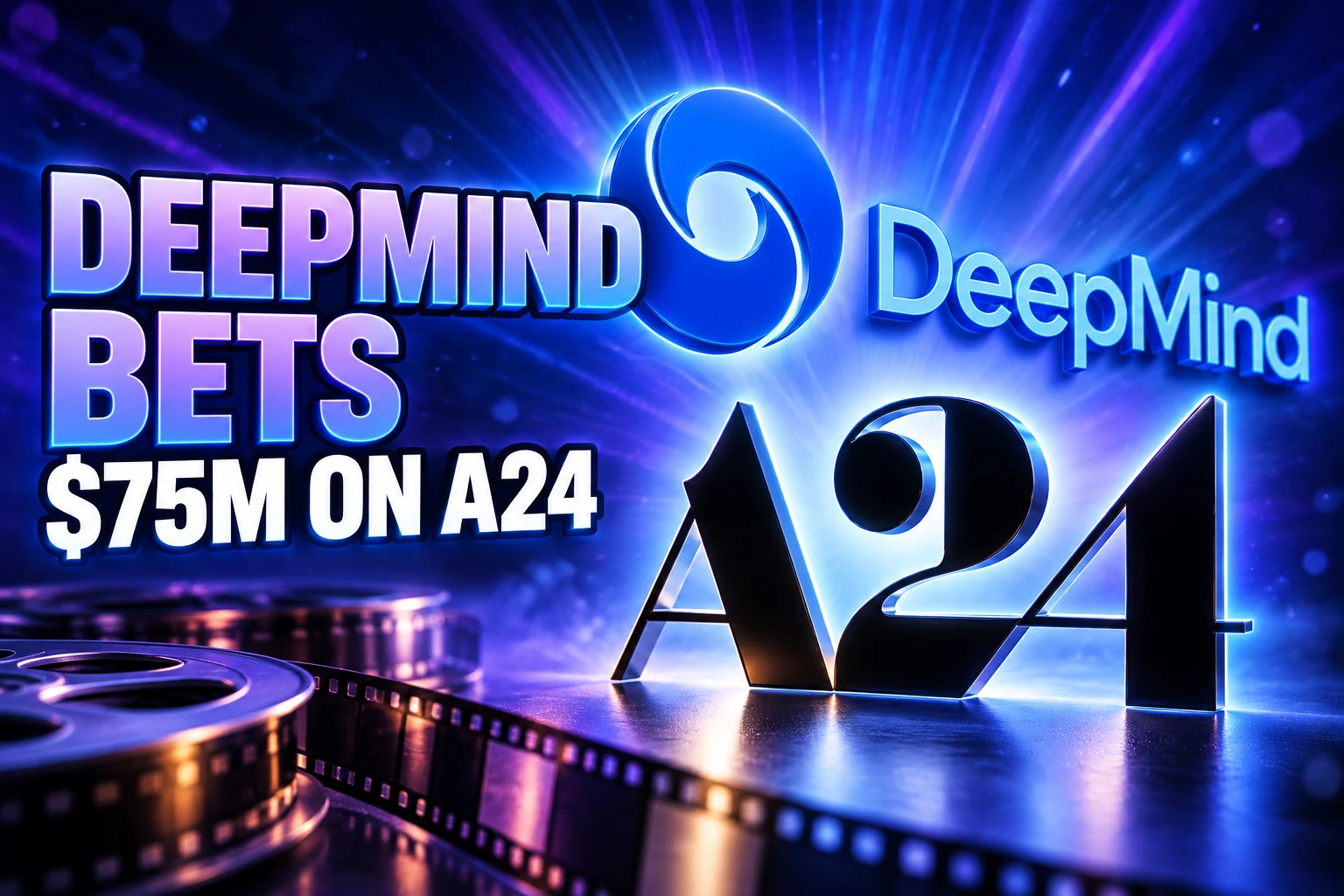
Google Bets $75 Million That A24 Can Sell Hollywood on AI
Google’s first film-studio stake is about $75 million into A24 for DeepMind research tools, a cheap bet on indie prestige rather than a library grab.

Google DeepMind put about $75 million into A24 on June 22, 2026, taking the company’s first stake in a film studio and calling the work a research pact. Demis Hassabis, DeepMind’s co-founder and CEO, said the lab wants artists in the room from the start. The check is small next to other Hollywood AI bills, and it buys A24’s name on the tools.
Google’s First Studio Stake Comes Without the Library
Eli Collins, vice president of product at Google DeepMind, wrote that the companies were announcing a first-of-its-kind research partnership pairing a lab with “the industry’s most filmmaker-forward studio.” The official post said Google had made an investment. It did not name a dollar figure. People familiar with the matter put the check at about $75 million, and DeepMind declined to confirm that number.
Hassabis said the lab believes “the best way to develop tools that empower artists is to work directly with them.” He has made a similar case in public, including when he framed creativity as the AGI bottleneck rather than a solved engineering trick. The A24 pact is that idea with a studio logo attached.
Google DeepMind 🤝 @A24
We’re launching a research partnership with A24 to ensure the tools of the future are shaped by the creators who use them. Find out more → https://t.co/KN3HdGVjGS pic.twitter.com/IUD7rkcRQS
— Google DeepMind (@GoogleDeepMind) June 22, 2026
A person familiar with the agreement said A24 keeps full creative control and that the arrangement is not an intellectual property or data-training deal. Google does not get A24’s film and television library. The pact is multiyear and non-exclusive, so either side can still work with other partners. Filmmakers are not required to use whatever ships.
THE TERMS GOOGLE ACTUALLY BOUGHT
- The cash: About $75 million from Google, described as tied to the research pact rather than a standalone capital raise.
- The access: A24 gets DeepMind research and compute; DeepMind gets artists in the workflow, not the catalog.
- The duration: Multiple projects over time, with goals that Collins said will change as the two sides build.
- The limit: No library scrape, no mandate on set, and no exclusive lock on either company.
Sophia Shin, who handles communications at A24, called it a research partnership in which the studio works “side-by-side with DeepMind’s researchers to learn, iterate, and build.” She said A24 would rather “have a seat at the table than on the sidelines,” and that the studio does not take its audience for granted. That last clause was the tell. The audience had already started shouting.
$75 Million Beside Hollywood’s Larger AI Checks
A24 was valued at $3.5 billion in June 2024 after a round led by Thrive Capital, whose own check was $75 million, the same size as Google’s later stake. The 2024 price was up 40 percent from a 2022 round of $225 million that valued the studio at $2.5 billion. Google is not buying the company. It is matching a venture check to get inside the building.
Other recent Hollywood AI bills dwarf that number. Netflix said on March 5, 2026, that it was taking InterPositive, the company Ben Affleck founded for AI-powered tools built by and for filmmakers. A later securities filing put the cash price at $587 million and moved a 16-person team onto the streamer’s payroll, with Affleck joining as a senior advisor. In December 2025, Disney announced a $1 billion equity investment in OpenAI and a three-year license that lets Sora draw on more than 200 Disney, Marvel, Pixar, and Star Wars characters. That license does not cover actors’ likenesses or voices.
FOUR HOLLYWOOD AI CHECKS
| Deal | Date | Money | What it buys |
|---|---|---|---|
| Google stake in A24 | June 22, 2026 | About $75 million | Research pact, no library access |
| Thrive Capital into A24 | June 2024 | $75 million | Board seat at a $3.5 billion valuation |
| Netflix buys InterPositive | March 2026 | $587 million cash | A 16-person post-production tools team |
| Disney into OpenAI | December 2025 | $1 billion equity | Sora license for 200-plus characters |
Affleck wrote that InterPositive trained on a closed soundstage so the model would learn “visual logic and editorial consistency” under problems like missing shots, background replacements, or bad lighting. That is a post-production company sold at almost eight times Google’s A24 check. Disney paid more than thirteen times as much for a character license and a slice of OpenAI. Google is paying indie-studio prices for something those deals do not include: a prestige brand willing to say the tools were shaped by filmmakers.
Kane Parsons Already Called Generative AI Cultural Rot
The studio’s latest smash made the timing worse. Backrooms, directed by Kane Parsons and starring Renate Reinsve, had passed $300 million at the global box office by the week of the announcement, the biggest hit yet for the New York company behind Everything Everywhere All at Once and Marty Supreme. People briefed on the pact said Google and A24 hoped to bring the studio’s own artists into the work, Parsons among them.
Parsons had just said the opposite.
generative AI feels less like innovation than a symptom of a broader cultural and economic rot
Kane Parsons, director of Backrooms, June 2026 interview
He also said he gets “no enjoyment” from using the technology on any project. The highest-grossing A24 film of that run was sold as handmade unease, and its director had already described the tool Google wants to refine. That is the wager’s hard edge. The lab is paying for a roster of filmmakers. The filmmaker who just printed money does not want the toy.
The louder problem is brand math. A24 sold tickets on stubborn human taste. Taking the lab’s money, even for research, spends that pitch in public. Comments on the studio’s own posts accused it of walking away from the audience that made the label matter. Some of that noise was purity theater. Some of it was a customer telling the company which part of the product it actually bought.
The Contract Bar on Synthetic Performers
The labor calendar made the same week less friendly. SAG-AFTRA told members to vote on its 2026 TV and Theatrical deal by 5 p.m. Pacific on Thursday, June 4, eighteen days before Google and A24 went public. The union used the studios’ demand for a four-year term to tighten AI rules that began in 2023.
Producers agreed to a principle that favors human performances. A producer may not use a synthetic in a role that would otherwise be performed by a human unless the synthetic provides significant additional value to the motion picture beyond a human performer or a digital replica. Violations carry uncapped damages. Producers need an articulable business reason to scan someone. Self-tapes cannot be reused for AI. Replicas cannot cross a picket line during a strike. The union’s own summary is blunt about why the companies accepted a high bar: a synthetic performance cannot be copyrighted, and the studios are in the copyright business.
That contract does not ban a storyboard generator. It does fence off the thing audiences fear when they hear “AI movie,” which is a face and a voice that never showed up to work. DeepMind still employs DeepMind’s in-house AI philosopher on questions of how these systems should treat people. The A24 pact is the product version of that argument, aimed at a union town that just wrote “human first” into the deal.
The Writers Guild of America’s 2026 agreement, closed in April, takes a narrower cut. The guild’s terms treat AI as a tool, not a writer, and they require notice if literary material is licensed to train a public model. They do not require payment for that training. The gap between those two guilds is the gap Google is trying to occupy: software in the pipeline, humans on the call sheet.
Why the First Tool Is a Storyboard Generator
Early accounts of the workbench start with an AI storyboard generator, the rough frames a crew uses before cameras roll, not a text-to-video engine and not a synthetic actor. Scott Belsky, an A24 partner who previously served as Adobe’s chief strategy officer and oversees A24 Labs, told people familiar with the work that the tools “won’t look anything like the prompted generation type of AI that people feel uncomfortable with.” He said there are “better uses that preserve creative control and support risk-taking.”
Storyboards are a smart first target if the bet is permission. They sit in pre-production, where a missed drawing costs time rather than a performer’s residual. They also produce a training signal DeepMind cannot buy from a library clause it does not have: working directors marking which generated frame is useful and which one is junk. Collins wrote that the hands-on work gives DeepMind “invaluable feedback and guidance from leading artists.” That sentence is the product plan. A24’s sets become a test bench. The tools, once they exist, can move back into Google’s own video stack, including Veo, while A24’s filmmakers decide whether to touch them.
A24 Labs was already poking at storyboards before the Google check. The investment puts DeepMind researchers beside that unit and, if the briefing holds, inside live productions. The risk for Google is that the first tool looks so modest that rival labs shrug. The risk for A24 is that “storyboard” is a word fans do not trust once the other party is DeepMind.
A Short Film at Tribeca Came First
DeepMind did not arrive in Hollywood cold. On May 20, 2025, it announced a pact with Primordial Soup, the venture founded by Darren Aronofsky, to put Veo in the hands of filmmakers for three shorts. The first, Eliza McNitt’s Ancestra, premiered at the Tribeca Festival on June 13, 2025, combining Veo with live-action filmmaking and a crew of more than 200 people. McNitt used the model for images a live unit cannot easily shoot, including cosmic and microscopic scenes, around a cast working under SAG-AFTRA rules.
That was a director-level experiment. The A24 pact is the studio-level sequel: a slate, a brand, and a check, still without a named feature.
THE PATH FROM SHORTS TO A STUDIO STAKE
- June 26, 2024: Thrive Capital leads a round that values A24 at $3.5 billion, with Thrive’s own check at $75 million and Josh Kushner joining the board.
- May 20, 2025: DeepMind and Aronofsky’s Primordial Soup announce three Veo-assisted shorts.
- June 13, 2025: Ancestra premieres at Tribeca as a live-action and Veo hybrid.
- December 11, 2025: Disney takes a $1 billion stake in OpenAI and licenses more than 200 characters to Sora.
- March 5, 2026: Netflix says it is buying InterPositive; a later filing prices the cash at $587 million.
- June 4, 2026: SAG-AFTRA’s voting window on the four-year TV and Theatrical deal closes.
- June 22, 2026: Google and A24 announce the research pact, with people familiar putting Google’s stake at about $75 million.
Read in order, the A24 check is the cheap, high-status move after a year of much larger bills. Disney paid for characters. Netflix paid for a post house. Google paid for a taste-maker that can tell other directors the tools were built with them, not at them.
Filmmakers Still Have a Veto
Shin is right that a seat at the table beats a finished model dropped on a set. She is also asking A24’s audience to treat a Google stake as craft, not capture. By late September 2026, neither company had named a first film or shipped a public tool. Parsons had not recanted. The comments had not cooled.
The veto that matters now is quieter than a boycott. A24’s directors can simply stay out of the room. If they do, Google has a $75 million press release and a storyboard prototype with no filmmaker fingerprints on it. If they walk in, DeepMind gets the thing it could not scrape from a catalog: notes from the people whose names sell the tickets.
Hassabis can keep saying artists should shape the tools. A24 can keep saying this is research. The bet only pays if someone with an A24 credit actually marks up a frame, and if the audience that made Backrooms a hit still lines up after they do.

Instagram Plus Tests a Read-Only Mode That Cuts Stories

Altman Asks the Public to Accept Some AI Harm

Google Freezes OSS VRP Product Reports After AI Flood

AI Agents Make Payment Rails the Scarce Prize

Turkey’s Crypto Boom Now Runs Through Three Banks

Fable 5 Came Back Under a Commerce On-Off Switch

Google’s SpaceX GPU Lease Has a Sept. 30 Deadline

Plasma One’s XPL Locks Face a 1.81 Billion Cliff

DGO’s Rs 549 World Cup Pass Cost Fans Sleep and Data

Moonshot AI’s $30 Billion Ask Became a $35 Billion Close
-
 AI3 months ago
Fable 5 Came Back Under a Commerce On-Off Switch
-
 AI4 months ago
Google’s SpaceX GPU Lease Has a Sept. 30 Deadline
-
 CRYPTO4 months ago
Plasma One’s XPL Locks Face a 1.81 Billion Cliff
-
 APPS4 months ago
DGO’s Rs 549 World Cup Pass Cost Fans Sleep and Data
-
 AI4 months ago
Moonshot AI’s $30 Billion Ask Became a $35 Billion Close
-

 NEWS4 months ago
ColorOS 17 Device List Spans Oppo, OnePlus and Realme
-
 GAMING4 months ago
Xbox Cuts 3,200 Jobs After Five Years of Thin Returns
-
 GAMING4 months ago
The RTX 4050 Under Rs 70,000 Hides a Wattage Gap