
APPS
Microdramas Beat Netflix on Phones, Then Spend 90% on Ads
Omdia says ReelShort tops Netflix on U.S. phone minutes, with a $14 billion 2026 forecast, while platform bosses put up to 90% of spend into ads.

U.S. phones now spend more daily time in microdrama apps than in Netflix, Disney+ or Prime Video, according to Omdia’s Q4 2025 Sensor Tower cut. The research firm put global microdrama revenue at $11 billion in 2025 and $14 billion by the end of 2026. At MIP London in February, platform bosses said ads can take up to 90% of the budget.
ReelShort Logs 35.7 Daily Minutes on 1.1 Million Users
Omdia’s analysis of Sensor Tower data shows higher daily mobile viewing time than Netflix on ReelShort in the United States. The gap is per user, not per population, and that is the number Hollywood keeps quoting.
U.S. MOBILE MINUTES, Q4 2025
| App | Daily minutes per user | Monthly mobile users |
|---|---|---|
| ReelShort | 35.7 | 1.1 million |
| Amazon Prime Video | 26.9 | Not published |
| Netflix | 24.8 | Around 12 million |
| Disney+ | 23.0 | Not published |
Netflix still had around 12 million monthly active mobile users in the United States, against 1.1 million for ReelShort. Maria Rua Aguete, Omdia’s head of media and entertainment, put the comparison in those terms at MIP London: the format is winning attention, not scale, “at least for now.”
Microdramas are no longer a niche experiment. They are becoming a core driver of mobile video engagement. On mobile, microdrama apps are generating more daily viewing time than the world’s biggest streaming platforms.
Maria Rua Aguete, Head of Media and Entertainment, Omdia, at MIP London
The same pattern showed up in smaller markets. In the United Kingdom, Omdia recorded FlickReels at 22.39 minutes a day against 21.47 for Amazon Prime Video. In Mexico, DramaBox hit 27.9 minutes, ahead of Prime Video at 23.8 and Disney+ at 22.5. Discovery, Omdia said, still runs through YouTube, Instagram and TikTok, where daily use is approaching 80 minutes. The shows are largely aimed at women aged 25 to 45, with producers now pushing into new genres.
Ninety Percent of the Budget Buys the Audience
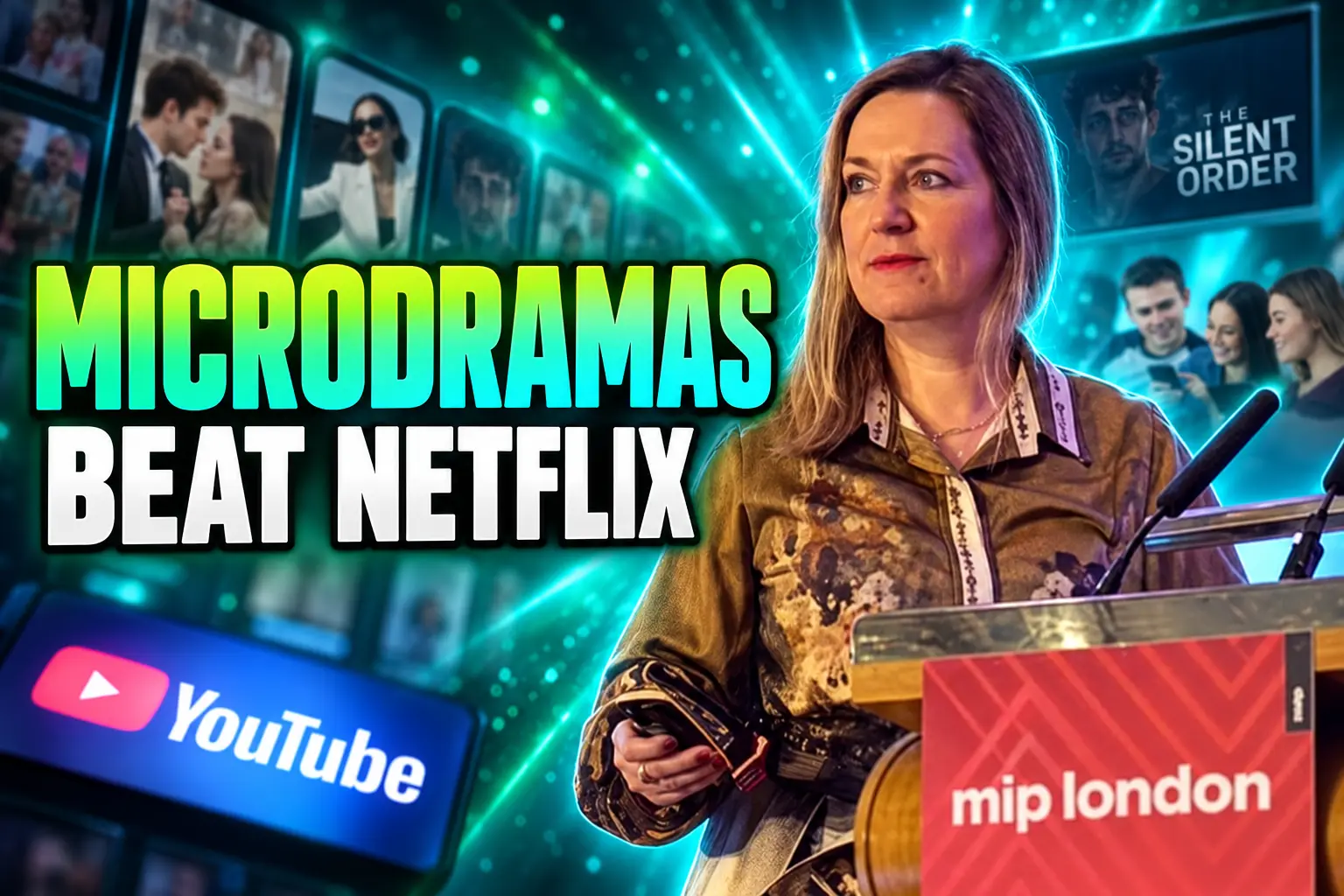
The minutes look like a content story until the people who run the apps describe the P&L. At the packed “MicroDrama 2026: The Global Breakout” session during MIP London, held February 22 to 24, 2026, Timothy Oh, general manager of COL Group International, said the working split would shock a studio line producer.
Ninety percent of the budget goes to marketing. Promoting short drama is the same as promoting any games.
Timothy Oh, General Manager, COL Group International, MIP London
Oh said teams test thousands of trailer cuts on social platforms to force a download, then keep testing. Anatolii Kasianov, co-founder and co-CEO of Holywater, told the same room that acquisition can run $20 to $30 per install, which is why the shops lean on data tools and AI to grind the cost down. That is a mobile-game loop with a soap on the poster. The script is the landing page. The product is a retained payer.
Trailer mills in adjacent short-story apps already treat a 0.25-point lift in click-through as a 30% drop in user cost, and they generate thousands of ads a month with a hook every few seconds and a cliffhanger that interrupts the scroll. Microdrama platforms are running the same machine. Hollywood’s “pivot” is a decision to compete inside that machine, not a decision to make shorter prestige pilots.
The Paywall Starts After the Free Episodes
Episodes last about one to two minutes, shot vertical for a phone held in one hand. The first run is free. Then the app wants coins, a weekly pass, or both. Omdia said in October 2025 that more than 60% of global sales already came from subscription or transactional payments, often after a free intro, with average revenue per user able to hit $20 a week or $80 a month.
HOW A TAP TURNS INTO CASH
- The tease: A social trailer or the first episodes play free, then stop on a cliffhanger.
- The coins: Viewers buy packs to unlock the next minute, a model copied from game currencies.
- The pass: A weekly or monthly plan is sold as the cheaper way to binge, which is how ARPU reaches $20 a week.
- The ad buy: Those trailers are the real production line, because a $20 to $30 install has to earn out fast.
A weekly habit at $20 is $80 in a 4-week month, which is the top of Omdia’s range. Finish a short season that way and the tab can rival a night at the movies for less running time than a feature. Viewers who bounce at the paywall describe the same sting: two minutes of story after a free tease, then a price that can match what other apps charge for a year. The session length in Omdia’s table is what that loop is built to produce.
China Still Accounts for Most of the Money
The $14 billion 2026 figure is a global number, and most of it is still Chinese. Omdia’s October 2025 cut put China at 83% of 2025 revenue. By 2026 it expects about $3 billion to be made outside China, with the United States taking 50% of that slice, or $1.5 billion. That U.S. line is why MIP was full. It is also why a U.S. minutes chart can move capital without matching Netflix’s user base.
THE 2026 MONEY SPLIT
- Global 2025: $11 billion in microdrama revenue, almost twice Omdia’s $5.8 billion FAST forecast for the same year.
- Global 2026: $14 billion by year end, still a forecast with a quarter of the year left.
- Outside China: $3 billion in 2026, with the U.S. at $1.5 billion.
- China’s 2025 share: 83% of the $11 billion, a mix that has not flipped just because U.S. minutes look loud.
Those four figures are why a ReelShort session can beat Netflix on a phone and still be a sideshow next to the domestic Chinese market. The international rush is a fight over the smaller pile, and the U.S. is the prize inside that pile.
FROM $11 BILLION TO SHORTS SERIES
- October 14, 2025: Omdia projects $11 billion in global 2025 microdrama revenue and flags ARPU as high as $80 a month.
- October 2025: GammaTime raises a $14 million seed round as Hollywood names start backing a dedicated app.
- Q4 2025: Sensor Tower records ReelShort at 35.7 U.S. daily minutes, ahead of Prime Video, Netflix and Disney+.
- February 23, 2026: Omdia, speaking at MIP London, puts 2026 revenue at $14 billion and the U.S. at $1.5 billion outside China.
- February 27, 2026: Holywater’s My Drama premieres Wild Silence with Maksim Chmerkovskiy.
- September 23, 2026: YouTube rolls out Shorts Series after counting 6.5 billion microdrama views in the first half of the year.
The through-line is not a sudden love of one-minute acts. It is a cash register that already works in China, a U.S. minutes chart that finally looks board-ready, and a social feed that will sell the next episode if someone pays for the click.
Bill Block and Maksim Chmerkovskiy Walk In
Once the minutes and the $1.5 billion U.S. line were on the same slide, legacy names stopped treating vertical soaps as a dare. Traditional distributors began asking how a vertical library sits in a sales bundle. Broadcasters already in short-form, including TelevisaUnivision’s ViX and Globo’s GloboPlay, have been folding serial bites into ad-supported and freemium tiers to lift time spent. The talent market followed the money.
Five Spanish Series From GammaTime and Idilio
GammaTime, the app founded by former Miramax chief Bill Block, struck a co-financing and production deal with Latin American studio Idilio for five original Spanish-language vertical series aimed at global distribution. The slate is being written natively in Spanish in romance, telenovela and crime. Idilio, launched in September 2025 by television personality Gabriela Tafur with backing from Andreessen Horowitz, gets a U.S. pipe. GammaTime, which raised $14 million in October 2025 from backers including vgames, Pitango, Alexis Ohanian and Kris Jenner, gets Spanish-language volume without building that bench from zero.
“There is a huge opportunity for Spanish-language content in the micro-drama space,” Block said. Tafur said Latin American stories have “always dominated the dramatic narrative” and called it time they had “a global stage in the format that is taking over the world.” Native Spanish soaps are also a user-acquisition play: the same trailer tests Oh described, pointed at a bilingual U.S. audience and at Latin America, where DramaBox already beats Prime Video on daily minutes in Mexico.
Wild Silence Puts a Reality Star in the Frame
Holywater used the same MIP week to put a known face on the format. My Drama cast Dancing with the Stars pro Maksim Chmerkovskiy in Wild Silence, which premiered on the app on February 27, 2026. Holywater billed it as the first TV celebrity turn in a vertical series in the United States, with Alexandria Watts as Camilla, direction by Mila Pohrebynska, and production with Alexander Kane of Skyframe Films. Chmerkovskiy plays Jack, a recluse who pulls Camilla into a remote cabin after a crisis; Holywater’s own logline is a wilderness romance with a dark past, cut for a phone.
“Wild Silence was an opportunity to step into a completely different kind of storytelling that is intimate, emotionally raw, and built for the way the majority of audiences are watching shows today,” Chmerkovskiy said. A reality-TV name in the lead is also a trailer that already has search demand, which is what a $20 to $30 install budget wants. The prestige is a targeting variable.
YouTube Counted 6.5 Billion Microdrama Views
Omdia already listed YouTube as a discovery pipe. On September 23, 2026, at Made on YouTube, the company decided it would rather keep the binge. Kurt Wilms, YouTube’s senior director of product management for TV, said Shorts Series lets creators pack Shorts into seasons and episodes with custom thumbnails and sequential playback, rolling out on web, mobile and TV. Creators such as Kinigra Deon and GOKKO CLUB were already building multi-part Shorts. Microdramas on YouTube passed 6.5 billion views in the first half of 2026, with watch time up more than 50% year over year. Views of that material on TV rose more than 90% even though the form was built for a vertical phone.
That is a different 90% from Oh’s ad share, and it points at a split in the business. Dedicated apps convert a cliffhanger into coins. YouTube converts the same itch into another Short, then a living-room autoplay. More than half of YouTube’s top 100 creators already see TV as their most-watched screen, Wilms said. If sequential Shorts hold viewers without a coin gate, the $20-a-week ARPU story gets a rival that does not need an app-store cut. If they do not, Shorts Series is another billboard for ReelShort and DramaBox.
What Streamers Lose on the Phone
Aguete said the minutes chart is “the metric streamers care about most” as they try to grow mobile use against social video. They still win the user count. They lose the session. A Netflix mobile user in Omdia’s cut gave the app 24.8 minutes; a ReelShort user gave 35.7. Multiply that by how cheaply a vertical episode can be shot, then by how many trailer variants a performance team can ship in a week, and the comparison that hurts is not runtime. It is cost per retained minute.
Legacy stacks can license vertical libraries, drop Bravo-style shorts into an existing app, or ignore the format and keep paying for hour-long shows that a tired thumb will not open. The shops that already buy users at $20 to $30 a download will keep feeding TikTok, Instagram and YouTube until the next episode is a reflex. Streamers still have the bigger mobile audiences. The apps that sell the minute after the tease have the longer sessions, the $14 billion forecast, and the ad bills that come with both.

Instagram Plus Tests a Read-Only Mode That Cuts Stories

Altman Asks the Public to Accept Some AI Harm

Google Freezes OSS VRP Product Reports After AI Flood

AI Agents Make Payment Rails the Scarce Prize

Turkey’s Crypto Boom Now Runs Through Three Banks

Fable 5 Came Back Under a Commerce On-Off Switch

Google’s SpaceX GPU Lease Has a Sept. 30 Deadline

Plasma One’s XPL Locks Face a 1.81 Billion Cliff

DGO’s Rs 549 World Cup Pass Cost Fans Sleep and Data

Moonshot AI’s $30 Billion Ask Became a $35 Billion Close
-
 AI4 months ago
Fable 5 Came Back Under a Commerce On-Off Switch
-
 AI4 months ago
Google’s SpaceX GPU Lease Has a Sept. 30 Deadline
-
 CRYPTO4 months ago
Plasma One’s XPL Locks Face a 1.81 Billion Cliff
-
 APPS4 months ago
DGO’s Rs 549 World Cup Pass Cost Fans Sleep and Data
-
 AI4 months ago
Moonshot AI’s $30 Billion Ask Became a $35 Billion Close
-

 NEWS4 months ago
ColorOS 17 Device List Spans Oppo, OnePlus and Realme
-

 GAMING4 months ago
Xbox Cuts 3,200 Jobs After Five Years of Thin Returns
-

 GAMING4 months ago
The RTX 4050 Under Rs 70,000 Hides a Wattage Gap