
CRYPTO
Pi Network Token Hovers Near All-Time Low With $0.20 in Sight
Pi Network’s PI token trades near $0.13 after a 95% drop from peak, with 1.21 billion tokens set to unlock in 2026. Can Pi2Day 2026 on June 28 change that?

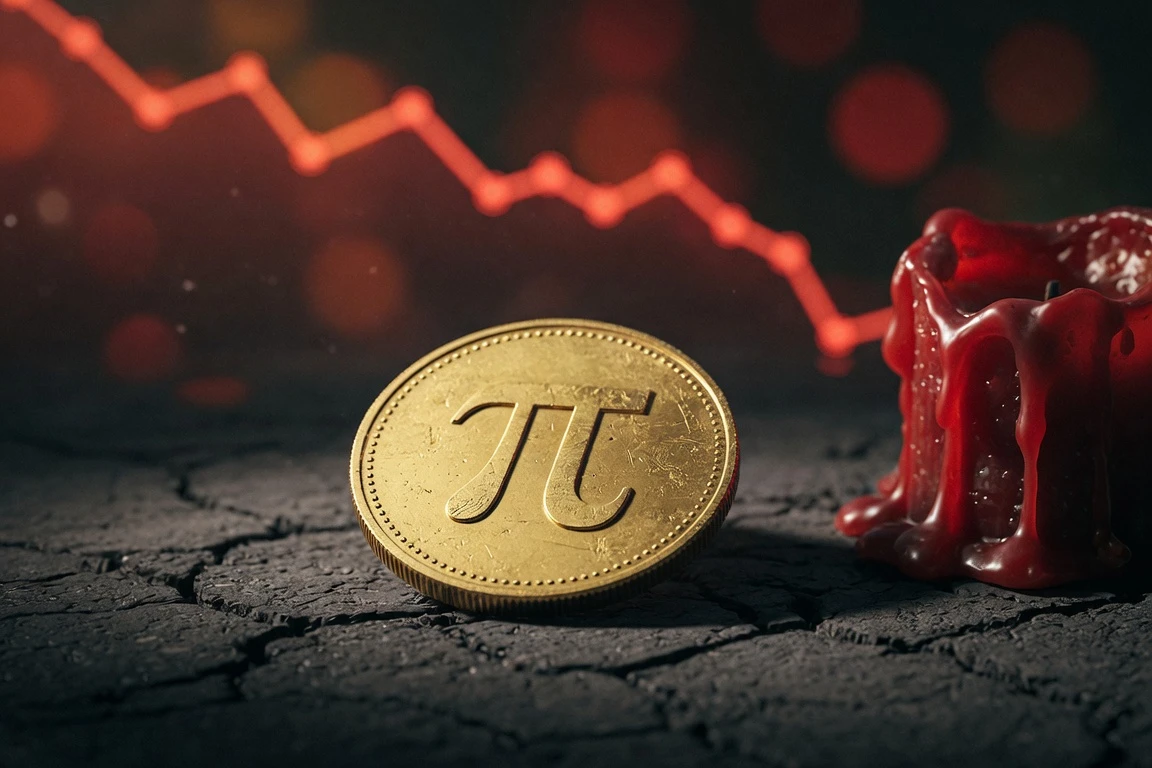
Pi Network’s PI token has spent June trading within a hair of its all-time low, hovering around $0.13 as of late in the month and roughly 95.7% below the $2.99 peak it set shortly after its open mainnet launch in February 2025. The token sits at the intersection of a fixed unlock schedule, thin exchange liquidity, and a near-term catalyst in Pi2Day 2026 on June 28, the project’s annual community event. None of those forces has shifted in a way that would break the floor.
CoinGecko’s live PI price page places PI’s all-time low at $0.1189, set on June 5, and its circulating market capitalization at roughly $1.38 billion, ranking it around #55 among tokens. The number that does not show up on either chart is the daily supply drip: roughly 6.5 million PI tokens enter circulation every day through 2026, on a published schedule, regardless of price action. Crypto.news’ supply analysis puts the year’s scheduled unlocks at roughly 1.21 billion PI, a figure that has come to define the price action. Demand has not yet materialized at a scale that would absorb the float.
What the PI Chart Shows Right Now
Pi Network’s token has been rangebound near the floor since early June. A PI price check on June 25 put the token at roughly $0.1267, down about 1.56% over 24 hours and 3.01% over seven days, with a deeper 13.86% slide over the trailing month.
The Relative Strength Index sat near 37.49, below its moving average at 41.79, a setup that signals weak momentum without yet flashing oversold. The MACD line ticked slightly above its signal line at -0.0038 versus -0.0043, with a marginally positive histogram.
Selling pressure has eased but no one has stepped in to push the other way. Crypto analyst Crypto With Gopal pointed to a head-and-shoulders pattern forming on the daily chart, with buyers still defending the neckline near $0.13. The broader backdrop has not helped. CoinMarketCap’s Fear and Greed reading remains parked in Extreme Fear territory, and small-cap tokens like PI usually need stronger Bitcoin and altcoin demand before local catalysts land.
The Unlock Math Behind the Slide
The structural issue is the unlock calendar. A year-long supply schedule analysis puts the year’s new supply at roughly 1.21 billion PI tokens, working out to about 6.5 million coins entering circulation every day. That is a pace the market has to absorb regardless of price action.
At a token price hovering around $0.13, that daily trickle translates into somewhere near $30 million of new supply each month. The market has to absorb every dollar of it just to keep price flat.
That is not a one-time event the market can mark through and move past. It is a continuous addition to float, arriving regardless of news, sentiment, or chart pattern. A token can shrug off a single large release; a perpetual stream is harder to clear, especially when the market is already pinned near its lows. The schedule does not ease with the calendar.
Crypto.news poses the supply question bluntly: roughly 1.21 billion new coins need buyers, and “the honest answer is not comforting.” The figures from the analysis underscore the imbalance, with PI’s circulating float and $1.38 billion market cap sitting well below the $2.10 billion fully diluted valuation. Token unlocks at $0.13 price land on a market already trading near its floor.
Demand has not yet materialized at a scale that would absorb the float. The price keeps grinding sideways as supply continues to arrive.
Why a Larger Float Keeps the Lid On
Part of what makes the math painful is where the new coins come from. Pi’s total supply sits at 100 billion tokens, with only about 11 billion currently in circulation, per CoinGecko. The fully diluted valuation lands near $2.10 billion against a market cap of roughly $1.38 billion, leaving a wide gap of coins that will, in time, become sellable. Until they are, the daily release schedule keeps adding to the supply that markets must clear.
A large share of those future coins is locked into voluntary commitments Pioneers, as Pi users are called, made in exchange for higher mining rates. Tens of billions of PI reportedly sit in those lockups. While the locks are in place, they remove real supply from the immediate float, which is part of why PI’s daily volume, around $10.89 million as of June 25, is thin in absolute terms.
The wildcard is what those lockups look like when they expire. A commitment made when PI was effectively untradeable is a very different commitment once the token is worth real money on exchanges. Add migration on top of that. For years, Pi balances lived inside a mobile mining app and were not transferable tokens, and the migration process has converted a vast pile of in-app IOUs into real, sellable PI. Every migration adds a potential seller to the float.
Pi2Day 2026 Lands June 28 With Two Test Campaigns
Pi Network has set Pi2Day 2026 for Sunday, June 28, per the official Pi2Day 2026 announcement post. The Core Team is telegraphing four specific initiatives, none of them a price announcement.
The updates lean into app creation, Launchpad testing, and broader participation rather than a token event. The wider vibecoding push targeting AI-assisted builders runs underneath both campaigns. Pi has explicitly said one of the new pieces will never go onto Mainnet, a deliberate signal that the test does not add new PI market supply.
The Launchpad test connects to a working Pi-integrated game, Slice of Pi, so engagement data is real rather than synthetic. The updated flow removes some steps from the first test launch and adds a fair-access hold designed to limit whale control. Pi App Studio pitches outside developers access to a 60M+ engaged user base with built-in payments, identity, and ad infrastructure. None of those structural features adds new PI market supply on its own.
As Pi2Day 2026 approaches on Sunday, June 28, Pioneers have four days left to participate in the Vibe Coder campaign with a raffle and the Pi Launchpad Testnet Token SLICE.
The Pi Core Team posted this on its official X account on June 25, framing Pi2Day 2026 as a focus on app creation, Launchpad testing, and user participation, with no price-related announcement expected. What the event is positioned around:
- Vibe Coder campaign: AI-assisted app builders, raffle for Pi merchandise, runs until Pi2Day.
- SLICE Launchpad Testnet token: second test launch, Slice of Pi game integration, no mainnet listing.
- Pi App Studio pitch: 60M+ engaged users and built-in payments, identity, and ad infrastructure for outside developers.
- Updated Launchpad flow: fair-access hold meant to limit whale concentration during launches.
Bears will note that none of those announcements, on their face, introduces a buy-side catalyst. The price will need to find demand somewhere else.
Where PI Trades and How Thin the Float Is
The exchange footprint is wide but shallow. CoinGecko lists Gate as the most active venue for PI trading, with the PI/USDT pair logging $822,611 in 24-hour volume. OKX and Bitget are the next-largest venues by activity.
Kraken added Pi for spot trading in March 2026, the project’s first major U.S.-regulated listing. OKX opened PI access to U.S. customers in May 2026. Binance and Coinbase have not listed PI as of late June 2026. The liquidity profile tells the story: roughly $10.89 million in 24-hour volume against a $1.38 billion market cap is a thin float for any token, and thinner still for one absorbing 6.5 million new coins a day.
The exchange footprint looks like this:
| Exchange | Status | Notes |
|---|---|---|
| Gate | Most active pair PI/USDT | $822,611 24h volume |
| OKX | Active, U.S. access since May 2026 | EUR pairs and Convert |
| Bitget | Active | Listed alongside other venues |
| Kraken | Spot trading since March 13, 2026 | First major U.S. venue |
| Binance | Not listed | Pi2Day 2026 speculation ongoing |
The Path Back to $0.20
Getting PI back to $0.20 requires something the project has not yet produced at scale: net demand that exceeds the daily unlock flow. The candidates on the table are real, but each carries a weight of its own. None of the catalysts is in place yet.
A major exchange listing, particularly on Binance or Coinbase, would broaden the buyer base and reduce the friction around U.S. access. Pi Network has not confirmed either listing. Pi2Day 2026 could move that needle if a top-tier venue announcement lands on June 28, but speculation has run ahead of confirmation for months. The structural candidates that bulls point to:
- Major exchange listing (Binance or Coinbase), with the buyer base and liquidity that come with tier-one access.
- Real consumer app traction, with Testnet hobby apps converting to genuine everyday use cases for the token.
- Broader crypto risk-on rotation, with macro tailwinds lifting small caps alongside Bitcoin and major alts.
PI’s chart setup is fragile but not broken: the neckline at $0.13 is being defended, RSI is not yet oversold, and the MACD has just crossed positive. The roughly 470 apps hosted on Pi’s Testnet show real builder interest, but that conversion rate is what would translate the user base into actual demand.
None of those catalysts is a sure thing. The unlock schedule does not pause for any of them.
Frequently Asked Questions
What is Pi Network’s all-time low?
CoinGecko lists PI’s all-time low at $0.1189, set on June 5, 2026. The token has held within a few cents of that floor through the second half of June. A late-June price check put PI near $0.1267 as the Pi2Day 2026 catalyst approached.
How many Pi tokens unlock in 2026?
Crypto.news’ supply analysis puts the year’s scheduled unlocks at roughly 1.21 billion PI tokens. That works out to about 6.5 million tokens per day, on average, across 2026. The pace is fixed on a published schedule that does not pause for price action. Until those unlocks are absorbed, the supply pressure remains structural.
When is Pi2Day 2026?
Pi Network has set Pi2Day 2026 for Sunday, June 28. The Core Team previewed the Vibe Coder campaign and the SLICE Launchpad Testnet token via its official channels on June 25. Neither campaign adds a buy-side catalyst; SLICE is a Testnet token that will not move to Mainnet.
Where can PI be traded?
PI is most active on Gate, with OKX and Bitget close behind by volume. Kraken added Pi for spot trading in March 2026, its first major U.S.-regulated listing. OKX opened PI access to U.S. customers in May 2026. Binance and Coinbase have not listed PI as of late June 2026.
What would push PI to $0.20?
A climb from late-June prices to $0.20 requires a major exchange listing, real consumer app traction that creates buy-side demand, or a broader crypto risk-on rotation. Pi2Day 2026 could move the first two if a listing or app breakthrough lands, but no confirmation has emerged. None of those is in place as of late June 2026.
Disclaimer: This article is for informational purposes only and does not constitute investment, financial, or trading advice. Cryptocurrency assets are highly volatile and carry substantial risk of loss, including total loss of capital. Figures cited are accurate as of publication; readers should consult a qualified financial professional before making investment decisions and verify current market data independently.


Sony’s 10 Percent Disc Drop Leaves the 2028 Cutoff Intact

Chip Allocation Sidelines the Base iPhone 18 This Fall

Miami-Dade Fights the Vice City Brand It Already Wears

IFA 2026 Awards Put Tecno Ahead of Flagship Phones

USB-C Gadgets Made the Junk Drawer Rechargeable

Pixel 11 Pro Asks $1,099 for a Light Google Locked

The iPhone Ultra Sells Two Retired Minis as One Foldable

Google Opens Gmail to Voice and Gates Docs Live

Lenovo Prices the IdeaPad Vibe Against Apple’s $699 Neo

Xbox Caps Game Pass Cloud Gaming at 15 Hours

Oracle Cuts 21,000 Jobs in a Year, Cites AI in 10-K Filing

Fable 5 and Mythos 5 Return as US Lifts Anthropic Export Controls

SpaceX’s Google Deal Turns a Rocket Company Into a Cloud Landlord

CD Projekt Red Co-CEO: Redemption Arc Isn’t Done, Witcher 4 in 2027

XPL Rallies 30% Ahead of Plasma One Card Tier Launch

Google Search Profiles Build a Follow Graph Inside Discover

DGO App Brings Rs 549 Mobile Pass for FIFA World Cup 2026 in Nepal

Moonshot AI Targets $30 Billion in China’s Fastest AI Funding Sprint

Oppo’s ColorOS 17 Eligibility List Leaves A-Series Buyers Behind

Microsoft Xbox Layoffs Start in July as Sharma Slams 3% Margin
-
 AI3 months ago
Oracle Cuts 21,000 Jobs in a Year, Cites AI in 10-K Filing
-
 AI2 months ago
Fable 5 and Mythos 5 Return as US Lifts Anthropic Export Controls
-
 AI3 months ago
SpaceX’s Google Deal Turns a Rocket Company Into a Cloud Landlord
-
 GAMING3 months ago
CD Projekt Red Co-CEO: Redemption Arc Isn’t Done, Witcher 4 in 2027
-
 CRYPTO3 months ago
XPL Rallies 30% Ahead of Plasma One Card Tier Launch
-
 NEWS3 months ago
Google Search Profiles Build a Follow Graph Inside Discover
-
 APPS3 months ago
DGO App Brings Rs 549 Mobile Pass for FIFA World Cup 2026 in Nepal
-
 AI3 months ago
Moonshot AI Targets $30 Billion in China’s Fastest AI Funding Sprint