
CRYPTO
Pi Network Invites Vibe Coders, Then Bills Unused Apps
Pi App Studio let vibe-coded apps chase 60 million users, then ended the 0.25 Pi subsidy for apps without distinct users.

Pi Network told vibe-coding creators on May 13, 2026 that they could plug AI-built apps into more than 60 million Engaged Pioneers through Pi App Studio. The Core Team’s pitch was blunt: AI makes software cheap to ship, so the scarce pieces are users, payments, and identity, which Pi says it already has.
Community posts in early June treated that product as a freshly “activated” phase of bringing apps in from outside. The official record is older, and the bill arrived later. On August 24, 2026, Pi ended the flat 0.25 Pi create-and-edit subsidy for most App Studio work and kept the cheap rate only for apps with distinct users.
Pi Told Vibe Coders the Users Were Already Waiting
The May 13 blog, restated the next day on the @PiCoreTeam account, asked technical developers and non-technical product people to build in Codex, Claude Code, Replit, Cursor, Lovable, or similar tools, then use App Studio to bring AI-created apps into Pi. Copy-and-paste prompts were meant to drop in the Pi SDK, check the setup, and add Pi payments without a manual rebuild.
The demo was a Connect 4 game made on an external AI coding platform. Pi said the tailored prompts had been iterated across those tools so the app would follow its developer rules from the first pass, which it argued could also shorten the path to Mainnet approval. The whole hook-up, it said, can finish in as soon as 2 minutes, depending on the outside platform and the size of the codebase.
Founders Dr. Chengdiao Fan and Dr. Nicolas Kokkalis had just spoken at Consensus 2026 on May 6 and 7 about blockchain, KYC, business models, and utility in the AI era. App Studio was already the in-house AI builder for Pioneers. The May change opened the same door to people who were not in the Pi community yet and were already shipping with outside models.
The public page still sells that path as “Deploy Vibe Coded Apps to 60 Million Engaged Users,” with a three-step flow: ship in an AI tool, convert in App Studio, then chase users through Pi’s discovery and staking features.
Vibe coders and creators can now tap into Pi Network’s massive user base of over 60 million Engaged Pioneers by easily bringing their external AI-created apps to Pi’s real distribution network and utility ecosystem through Pi App Studio!
Creators, who may be technical developers… pic.twitter.com/7Nlg1OOMZU
— Pi Network (@PiCoreTeam) May 14, 2026
A community observer wrote on June 5 that the update had been activated and that Pi would promote it externally to vibe-coding creators, then said applications began entering on June 6. That language is what later recaps treated as a new phase. It was the May product, restated after the first outside apps showed up.
A Flat 0.25 Pi Fee Built a Long Tail of Experiments
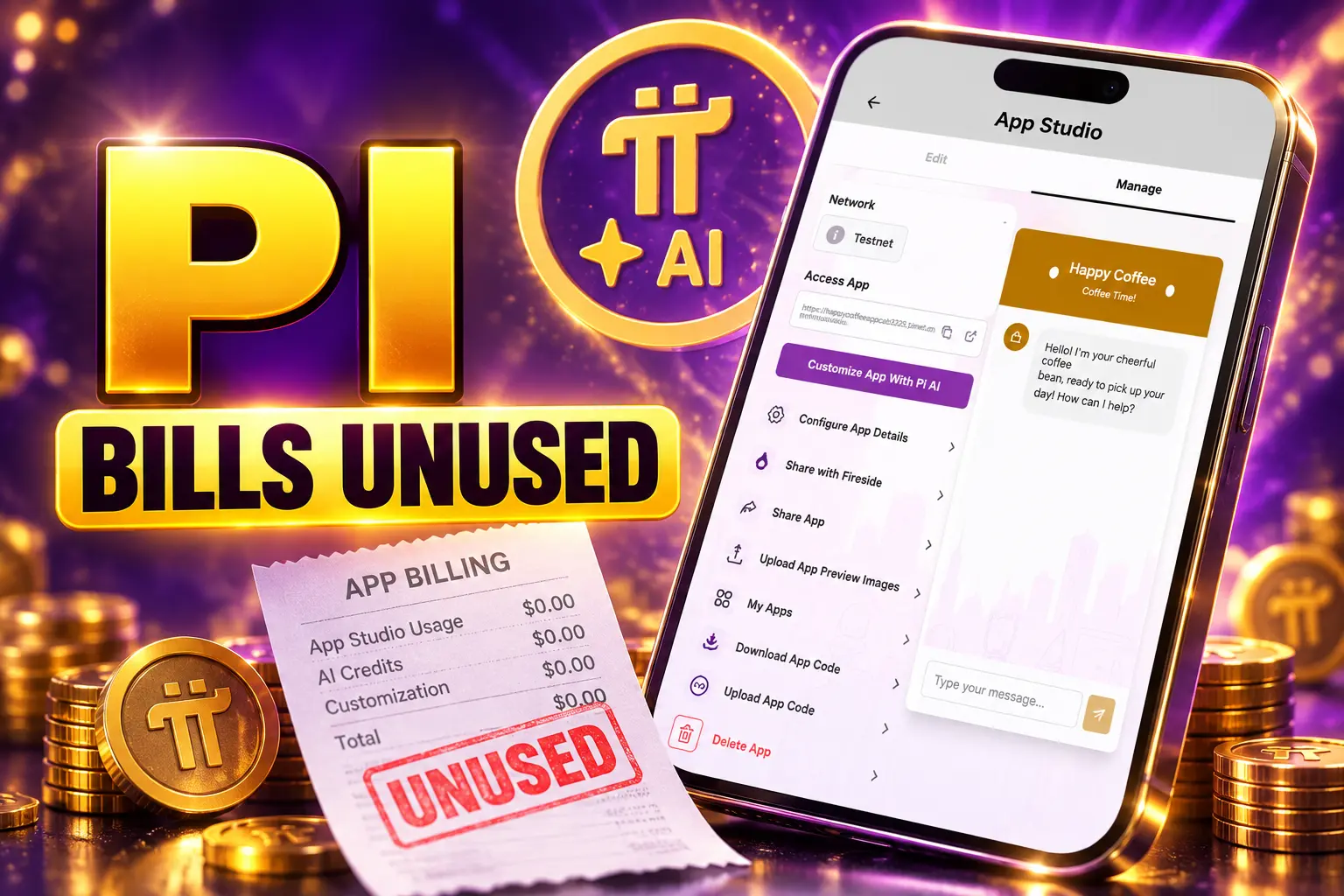
Until August 24, every App Studio create and every edit cost 0.25 Pi, no matter how much AI compute sat behind the job. Pi said it had been covering the gap between that fee and the real model bill so people would try the tool. After watching how creators used it, and which apps drew other people, the Core Team said it had enough data to stop paying for the whole long tail.
Continuing to subsidize all creation equally would mean a substantial amount of resource waste, including funding a long-tail of apps that may only be created for testing, experimentation, or spamming.
Pi Network, App Studio pricing blog, August 17, 2026
The replacement is a standard create-and-edit price that “more closely reflects the actual cost of the AI services used to generate an app,” with no markup on those underlying costs, and a rate that can change with the resources each job burns. Creators whose apps show real utility and usage from distinct users, other than the creator, keep the old 0.25 Pi rate. Eligibility is not a one-time stamp; Pi said it will review the list as new usage data comes in, so an app that later finds users can still win the cheap tier.
That is the subsidy only for apps with users rule, written as an incentive. It is also an admission that the open on-ramp did what cheap generative tools do: it produced a lot of apps that other Pioneers never opened. The June celebration of “apps entering the ecosystem” and the August price change are the same pipeline, scored.
APP STUDIO BY THE CORE TEAM’S OWN FIGURES
- Distribution hook: Pi cites more than 60 million Engaged Pioneers as the reason outside builders should convert an AI app instead of finding users from scratch.
- Old create fee: 0.25 Pi per new App Studio app, with Pi covering the rest of the model bill.
- Old edit fee: 0.25 Pi per edit, same subsidy, same flat rate for every change.
- Claimed hook-up time: as soon as 2 minutes to add the Pi SDK, check the setup, and add payments.
Replies under official App Studio posts still skip the feature list and go back to token supply, abandoned community apps, and a working-app test people feel was never met. The pricing note is the first time the Core Team has said in public that a large share of App Studio output was tests, experiments, or spam.
What Karpathy Meant by Forgetting the Code
Pi did not invent the method it is recruiting. Andrej Karpathy, the former Tesla AI director and OpenAI cofounder, named it on February 2, 2025, as a way of building where you forget that the code even exists, accept the model’s diffs, and paste error messages back until the thing runs.
It’s not too bad for throwaway weekend projects, but still quite amusing. I’m building a project or webapp, but it’s not really coding – I just see stuff, say stuff, run stuff, and copy paste stuff, and it mostly works.
Andrej Karpathy, February 2, 2025 post on X
Collins Dictionary later made “vibe coding” its Word of the Year for 2025. A year after the first post, Karpathy wrote that agent workflows were becoming a default for professionals, “except with more oversight and scrutiny,” and that the aim was to keep the speed without giving up software quality. Pi’s May invite still points at the first version: describe an app, convert it, reach 60 million people.
That gap is the product risk. App Studio’s own July 7 backend note said new apps had been largely frontend-only, single-session toys whose scores, lists, and notes vanished when the user left. Persistent storage, added that day for newly created apps, was the first fix that made a high score or a to-do list survive a second visit. Three days later the Core Team added an App Planning Phase so the model would ask about idea, goal, design, and user experience before it generated anything. Those are quality rails on a pipe that was sold as two minutes and a paste.
Mainnet Payments Still Require a Utility Test
Getting an AI app into Pi Browser is not the same as taking real Pi. The May 13 post put a hard line under the 2-minute demo: Mainnet payment access is granted for apps that demonstrate real utility, safe behavior, stable operation, and a legitimate Pi-denominated use case. The directory can fill with converted web apps while spend stays gated.
Pi listed working apps among the conditions for opening the network, and it dropped the Enclosed Mainnet firewall at 8:00 AM UTC on February 20, 2025, after the enclosed period that began on December 28, 2021. The May 2026 move was an attempt to manufacture that working-app layer at AI speed, using a user base collected over years of mobile mining. Payments on those apps still settle on Pi’s chain, where the Protocol 23 smart contract switch has been the other half of the same utility push.
App builders writing under official feature posts say community projects have been dropped because operating costs outlasted any support they could find. The August pricing change does not fund those builders. It stops paying the model bill for apps that never find a second user.
The 404 That Survives an AI Rebuild
The quality problem is no longer only a fee table. Creators posting on September 12, 2026 said multiple published App Studio apps were opening to a 404 page even while the listing, ratings, and staking stayed live. An AI rebuild restored the home route, then the 404 came back, and some said the rebuild stripped design and features while “fixing” the break.
That pattern matches the method Karpathy described when a model cannot clear a bug: ask for random changes until the error goes away, and accept that you may not know what else moved. On a weekend demo, the cost is time. On a published Pi app, the cost is a Pioneer who taps a ranked listing and hits a missing home page, then a creator who burns another paid edit after August 24 to chase a break the last edit may have caused.
Pi has not published a post that confirms the 404s. The complaint is still the clearest on-the-ground note since the subsidy ended: the conversion flow can put an app in the directory faster than the generated app can keep a stable route.
A Directory Ranked by Staked Pi
Discovery is not a neutral shelf. Ecosystem Directory Staking, launched in June 2025 and restyled on June 18, 2026, lets Pioneers and businesses lock Pi on Mainnet to boost an app’s rank in the Pi Browser interface, which lists Mainnet apps, App Studio apps, and services such as centralized exchanges. There are no protocol-level Pi rewards for that stake. Rank is the prize.
Pi’s own staking post used CiDi Games as the proof case: less than a week after that app’s beta, rank was lifted by 3.19 million staked Pi and the game logged more than 1.2 million plays. That is the specimen the vibe-code pitch is aiming at, a title people actually open, with Pi locked behind it as a popularity weight. It is also a reminder that stake can buy attention for an app that may or may not survive a 404.
THE APP STUDIO CALENDAR
| Date | What shipped |
|---|---|
| May 13, 2026 | App Studio adds an external-AI flow for vibe-coded apps |
| June 6, 2026 | Community observers said outside apps had started entering |
| July 7, 2026 | Persistent storage for newly created App Studio apps |
| July 10, 2026 | App Planning Phase asks for idea, goal, design, and UX first |
| August 24, 2026 | 0.25 Pi subsidy ends except for apps with distinct users |
| September 4, 2026 | Local storage, staking API, Pi.shareFile, and docs.minepi.com |
Read top to bottom, the year is a funnel: open the door, watch what walks in, tax the unused work, then ship the missing product tools to whoever is left.
Three New Tools, Still Behind a Whitelist
On September 4, 2026, Pi added three developer capabilities and put technical docs on a single site at docs.minepi.com, folding material that had lived in SDK pages, a Community Developer Guide, and a GitHub repo. The new path runs from account and app registration through sandbox work, SDK hooks, authentication, payments, and Mainnet launch, with AI-assisted notes for auth and payments. Two of the three new tools are gated.
WHAT SHIPPED ON SEPTEMBER 4
- Local storage: Whitelisted Pi Browser apps can keep preferences and session state on the Pioneer’s device instead of a backend, in a shared pool that can drop stale data when it fills, and the data does not follow the user across devices.
- Staking data API: Also whitelist-only at first, it returns a user’s effective stake for that specific app, mixing amount locked with a boost for how long it has been locked.
- Pi.shareFile: Broader than the first two, it hands files and video to the phone’s native share sheet so a market app can send a receipt image or a game can send a clip without a custom share flow.
Local storage is the honest twin of the July 7 persistence note: many App Studio apps still need somewhere to put a setting that is not a full server. The whitelist is the honest twin of the August fee. Pi is no longer giving every generated app the same support.
The public vibe-code page still asks creators to convert a web app in minutes and apply to a vibe-coding community form. The tools that would make those apps feel like products sit behind a whitelist, and the cheap 0.25 Pi on-ramp is gone for anyone who cannot show distinct users.
Disclaimer: This article is news reporting and analysis of Pi Network product posts, developer tools, and public creator complaints. It is informational only and is not investment advice, trading advice, or a recommendation to buy, sell, hold, or use PI, Pi App Studio, or any application in the Pi Browser. Readers who are considering holding PI, building an app, or spending Pi inside an app should consult a qualified financial adviser and, where relevant, a software or security professional who can review the specific product. Figures, fees, eligibility rules, and app statuses reflect the cited Pi posts and public reports as of the dates named above and can change without notice.

Instagram Plus Tests a Read-Only Mode That Cuts Stories

Altman Asks the Public to Accept Some AI Harm

Google Freezes OSS VRP Product Reports After AI Flood

AI Agents Make Payment Rails the Scarce Prize

Turkey’s Crypto Boom Now Runs Through Three Banks

Fable 5 Came Back Under a Commerce On-Off Switch

Google’s SpaceX GPU Lease Has a Sept. 30 Deadline

Plasma One’s XPL Locks Face a 1.81 Billion Cliff

DGO’s Rs 549 World Cup Pass Cost Fans Sleep and Data

Moonshot AI’s $30 Billion Ask Became a $35 Billion Close
-
 AI4 months ago
Fable 5 Came Back Under a Commerce On-Off Switch
-
 AI4 months ago
Google’s SpaceX GPU Lease Has a Sept. 30 Deadline
-
 CRYPTO4 months ago
Plasma One’s XPL Locks Face a 1.81 Billion Cliff
-
 APPS4 months ago
DGO’s Rs 549 World Cup Pass Cost Fans Sleep and Data
-
 AI4 months ago
Moonshot AI’s $30 Billion Ask Became a $35 Billion Close
-

 NEWS4 months ago
ColorOS 17 Device List Spans Oppo, OnePlus and Realme
-

 GAMING4 months ago
Xbox Cuts 3,200 Jobs After Five Years of Thin Returns
-

 GAMING4 months ago
The RTX 4050 Under Rs 70,000 Hides a Wattage Gap