
GAMING
Steam Machine vs Xbox Series X: The 2026 Living Room Gaming Showdown
Steam Machine vs Xbox Series X compared on specs, real-world gaming, and price. The Steam Machine launches June 30 at $1,049; Xbox prices rise August 1, 2026.

Valve’s Steam Machine is launching at the end of June 2026, with reviews published on June 25, a randomized reservation queue that closed the same day, and first shipments going out Monday June 29. The compact 6-inch cube runs SteamOS 3 and starts at $1,049 for the 512GB model, with a 2TB model at $1,349. Three days after those reviews went live, Microsoft confirmed its third Xbox console price hike since late 2025.
From August 1, 2026, the Xbox Series X 1TB moves from $649.99 to $799.99, the digital-only edition rises from $599.99 to $749.99, and the 2TB model is being discontinued entirely. Both moves trace to the same cause: an AI-driven memory and storage crunch that has pushed component costs higher across the consumer electronics industry. The Steam Machine vs Xbox Series X comparison is no longer a clean spec race. It is a snapshot of what that shortage has done to two very different boxes in the same week.
The Component Crisis That Built These Prices
Valve first showed off the Steam Machine in November 2025 with price targets under $750. Those targets are gone. The company’s own statement on the new pricing is direct: “Our initial goal for the price of the Steam Machine is no longer viable. The prices we’re sharing today reflect the current state of manufacturing, or more precisely, the cost of the components we’ve secured over the past six months.”
Microsoft walked the same road in the same week. Its June 25, 2026 Xbox Wire post blamed the same dynamic for the August 1 hike, saying console storage and memory prices have “increased by more than 2.5x and we expect another doubling by the fall of 2027.” The 2TB Xbox Series X is being discontinued alongside the price move. Apple has been raising prices on iPhones and Macs for the same reason, and the broader squeeze is documented in detail on how AI data centers are driving hardware prices. The Steam Machine and Xbox Series X are now both products of a memory market reshaped by hyperscale AI buyers, not just gaming competition.
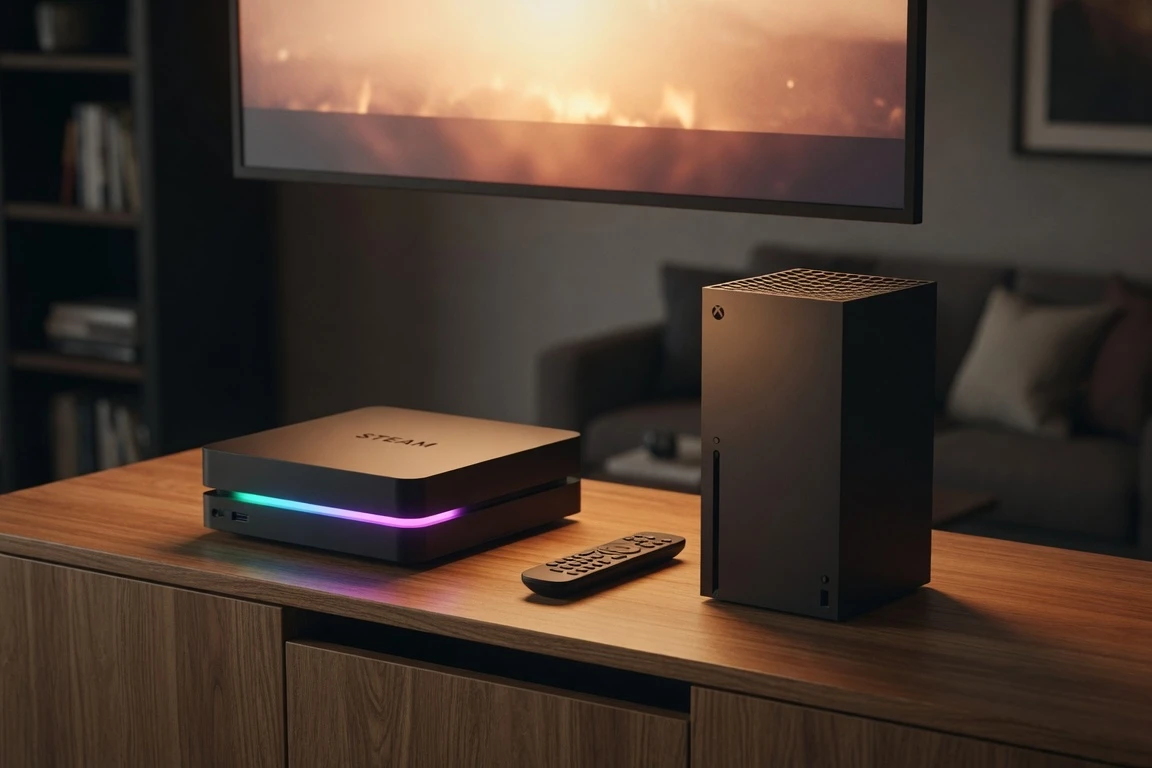
The Hardware, Side by Side
Both systems target 4K HDR gaming on a living room TV, but the silicon paths diverge sharply. The Steam Machine pairs a semi-custom AMD Zen 4 CPU with 6 cores and 12 threads at up to 4.8 GHz against a semi-custom AMD RDNA 3 GPU with 28 compute units and 8GB of GDDR6 VRAM. The Xbox Series X uses an older AMD Zen 2 CPU with 8 cores and 16 threads at 3.8 GHz, paired with a much larger RDNA 2 GPU at 52 compute units and 12 TFLOPS. Full hardware details on the Steam Machine are laid out in Valve’s partner-published launch coverage, summarized at Steam Machine launch specs, pricing, and reservation details.
Memory and storage split the two systems in different ways. The Steam Machine ships with a single 16GB DDR5-5600 stick plus 8GB of GDDR6 VRAM, with a second SODIMM slot left empty in every shipping unit, a visible scar of the memory shortage. The Xbox Series X uses 16GB of GDDR6 across a 320-bit bus, with 10GB running at 560 GB/s and 6GB at 336 GB/s. Steam Machine storage is a 512GB or 2TB NVMe SSD, expandable via microSD. Xbox Series X storage is a 1TB custom NVMe SSD, expandable only via Microsoft’s proprietary Storage Expansion Cards.
On connectivity, the Steam Machine offers DisplayPort 1.4, HDMI 2.0, two USB-A 2.0 ports, a USB-C 3.2 Gen 2 port, gigabit Ethernet, Wi-Fi 6E, and Bluetooth 5.3. The Xbox Series X ships with HDMI 2.1, three USB-A 3.1 ports, Ethernet, Wi-Fi, and a 4K UHD Blu-ray drive the Steam Machine does not have. The Steam Machine adds HDMI CEC for one-touch TV wake, a feature usually missing from desktop graphics cards.
| Spec | Steam Machine (2026) | Xbox Series X |
|---|---|---|
| CPU | Semi-custom AMD Zen 4, 6 cores / 12 threads, up to 4.8 GHz, 30W TDP | Custom AMD Zen 2, 8 cores / 16 threads, 3.8 GHz (3.6 GHz w/ SMT) |
| GPU | Semi-custom RDNA 3, 28 CUs, up to 2.45 GHz, 110W TDP, 8GB GDDR6 | Custom RDNA 2, 52 CUs at 1.825 GHz, 12 TFLOPS |
| Memory | 16GB DDR5-5600 (single SODIMM) + 8GB GDDR6 VRAM | 16GB GDDR6, 320-bit bus, 10GB @ 560 GB/s, 6GB @ 336 GB/s |
| Storage | 512GB or 2TB NVMe SSD + microSD slot | 1TB custom NVMe SSD + Storage Expansion Card slot |
| Video output | HDMI 2.0, DisplayPort 1.4 | HDMI 2.1 with VRR and FreeSync, 4K UHD Blu-ray drive |
| Networking | Wi-Fi 6E, Bluetooth 5.3, gigabit Ethernet | Wi-Fi, Ethernet |
| Form factor | ~152mm cube (~6 inches), 2.6 kg | Vertical tower |
What the First Wave of Reviews Measured
Independent Steam Machine reviews went live on June 25, and the benchmark numbers line up across outlets. An IGN review put the Steam Machine through Forza Horizon 6, Cyberpunk 2077, and Total War: Warhammer III at native 4K. Eurogamer’s separate review covers the same silicon against consoles and is collected at Steam Machine review: specs, value, and Quick Resume gap.
At native 4K, the Steam Machine falls well short of console-class frame rates in current AAA titles. IGN recorded Forza Horizon 6 at the Extreme preset with FSR Performance at 30 fps. Cyberpunk 2077 with the Ray Tracing Ultra preset and FSR Performance hit just 14 fps. Total War: Warhammer III on Ultra at 4K averaged 23 fps. None of those numbers look like the 4K 60 fps Valve originally promised.
Drop the presets to Medium and the picture shifts. IGN measured Forza Horizon 6 at 4K Medium with FSR Performance at 57 fps, and Cyberpunk 2077 at the same settings up to 64 fps. Rock Paper Shotgun’s review recorded Forza Horizon 6 on the Steam Machine’s High+RT preset averaging 48 fps at native 1080p, rising to 56 fps with FSR 3.1.5 in Quality mode.
The reviewers’ overall verdict placed the Steam Machine somewhere between the Xbox Series S and the base PS5 in raw frame rates, with the Xbox Series X clearly ahead on GPU-bound 4K work. Eurogamer noted that a similarly priced RTX 5050 build typically outperforms the Steam Machine, especially at 4K. The compact size, low noise, and SteamOS simplicity still earn the box praise, even when raw frame rates do not.
- Forza Horizon 6, 4K Extreme + FSR Performance: 30 fps (IGN review)
- Forza Horizon 6, 4K Medium + FSR Performance: 57 fps (IGN review)
- Cyberpunk 2077, 4K Medium + FSR Performance, ray tracing off: 64 fps (IGN review)
- Cyberpunk 2077, 4K RT Ultra + FSR Performance: 14 fps (IGN review)
- Forza Horizon 6, 1080p High + RT native: 48 fps (Rock Paper Shotgun review)
Real-World Gaming at 4K, With Caveats
The Steam Machine can play games at 4K, just not always at the settings most players expect. Forza Horizon 6 at 4K Medium with FSR Performance ran at 57 fps in IGN’s testing, and Cyberpunk 2077 at 4K Medium reached 64 fps. Rock Paper Shotgun found even tougher games like STALKER 2 averaging 42 fps at 4K Low with FSR on Performance mode. Easier-to-run titles like Counter-Strike 2 hit 100 to 120 fps at 4K with High settings and FSR Quality, and Hollow Knight: Silksong clears 200 fps at the box’s native output.
Ray tracing remains the Steam Machine’s weak spot. IGN recorded Hitman: World of Assassination dropping from 161 fps at native 1080p to 33 fps with ray-traced reflections enabled. Cyberpunk 2077 with both Quality FSR 3 and RT reflections held 58 fps, but adding sun shadows and Medium RT lighting sunk it to 37 fps.
Valve’s marketing has caught up to these limits. The Steam Machine store page used to advertise “4K gaming at 60 fps.” A June 25 report on the change is collected at how Steam Machine’s 4K marketing changed after reviews, noting the page now reads “up to 4K gaming with FSR 4.1.” The new phrasing reflects what reviewers are actually measuring: less demanding or older titles may run at 4K without major drops, while 1080p to 1440p is the more realistic target for current AAA releases.
How SteamOS Stacks Up Against the Xbox Dashboard
The Steam Machine runs SteamOS 3, with full access to Steam’s PC library, mods, emulators, and the option to install Windows. The Xbox Series X runs Microsoft’s Xbox dashboard, with Quick Resume, native 4K Blu-ray playback, and the Game Pass subscription library. The two experiences differ in ways that matter beyond raw frame rates.
Day-to-day, the Steam Machine behaves more like a stripped-down PC than a console. You boot into Steam’s Big Picture interface, sign in with a QR code via the Steam Mobile app, and start downloading games from your existing library. Settings tweaks live in a few layered menus accessed by the Steam Button on the new Steam Controller, and users comfortable with Linux can drop into a full desktop mode. The Xbox Series X, by contrast, opens straight into the Xbox home screen with the games you own, your Game Pass library, and a small set of streaming apps.
Hardware features split the two boxes in different directions. The Xbox Series X includes Quick Resume, which lets multiple suspended games switch in seconds; the Steam Machine does not have an equivalent, and SteamOS warns against launching a second game while one is already running. The Steam Machine counters with HDMI CEC support for one-touch TV wake, an empty SODIMM slot for a second 16GB DDR5 stick (covered at Valve’s single-stick DDR5 explanation and impact), and access to mods and emulators that Xbox policy prohibits. The Xbox Series X still ships with a 4K UHD Blu-ray drive. The Steam Machine does not.
Steam Machine Strengths
- Full Steam library with the rest of your PC storefronts optional
- Mods and emulators plus the option to install Windows
- Upgradeable storage and RAM via NVMe SSD swap and the empty SODIMM slot
- Compact 6-inch cube that fits unobtrusively under a TV
- HDMI CEC one-touch TV wake from a paired Steam Controller
Xbox Series X Strengths
- Quick Resume across multiple suspended games
- Game Pass library with day-one first-party releases
- Native 4K UHD Blu-ray drive for physical media
- Plug-and-play console experience with minimal settings tweaking
- Lower entry price at $649.99 today, ahead of the August 1 hike
Pricing Reality Check for Late June 2026
The two systems live in very different price brackets, and both have moved since their original announcements. The Steam Machine reservation queue opened at $1,049 for the 512GB model and $1,349 for the 2TB model, with Steam Controller bundles pushing those figures to $1,128 and $1,428. Valve’s first batch of shipments goes out Monday June 29, and general sales open June 30, 2026.
The Xbox Series X 1TB sits at $649.99 today. On August 1, 2026, it rises to $799.99, the digital-only 1TB edition moves from $599.99 to $749.99, and both Xbox Series S models climb by $100. The 2TB Xbox Series X is being discontinued. Microsoft’s primary announcement on the price move is at Microsoft’s third Xbox console price hike announcement.
Microsoft’s own statement frames the cause in plain terms. “Last October, we increased Xbox console price by $20-$70 in the U.S.,” the Xbox Wire post reads. “We hoped another price increase would not be necessary, and we have spent the last several months working with suppliers on options. Unfortunately, console storage and memory prices have increased by more than 2.5x and we expect another doubling by the fall of 2027.” The entire post is worth reading; the quote captures the squeeze in one paragraph.
Last October, we increased Xbox console price by $20-$70 in the U.S. We hoped another price increase would not be necessary, and we have spent the last several months working with suppliers on options. Unfortunately, console storage and memory prices have increased by more than 2.5x and we expect another doubling by the fall of 2027.
The statement came from a Microsoft Xbox Wire post on June 25, 2026, attributed to the company’s Xbox hardware team.
| System | Price | Notes |
|---|---|---|
| Steam Machine 512GB | $1,049 | Reservations closed June 25; first shipments June 29 |
| Steam Machine 2TB | $1,349 | Reservations closed June 25; first shipments June 29 |
| Steam Machine 512GB + Steam Controller | $1,128 | Bundle |
| Steam Machine 2TB + Steam Controller | $1,428 | Bundle |
| Xbox Series X 1TB | $649.99 today, $799.99 from August 1 | Microsoft raising price |
| Xbox Series X 1TB Digital | $599.99 today, $749.99 from August 1 | No disc drive |
| Xbox Series S 512GB | $399.99 today, $499.99 from August 1 | Lower tier |
Which Should You Buy, and Why
This is not a comparison with a single winner. The Steam Machine is a compact PC that runs SteamOS. The Xbox Series X is a console that runs the Xbox dashboard. They serve different buyers, and the price gap is now $400 to $450 at launch, which IGN flagged as “likely to disqualify Valve’s new mini gaming PC in the eyes of many console faithfuls.”
The Steam Machine is for PC-curious living room players. It rewards anyone who already has a Steam library, wants mod support, or plans to install other PC storefronts later. It is also the right pick for buyers who care about upgradeable storage and an empty RAM slot for future expansion. It is the wrong pick for anyone who wants plug-and-play 4K console gaming without ever opening a settings menu.
The Xbox Series X is for plug-and-play simplicity. It rewards anyone who values a mature console ecosystem with Quick Resume, Game Pass day-one first-party releases, and a native 4K Blu-ray drive. It is the wrong pick for buyers who want to play games with kernel-level anti-cheat (Fortnite, GTA Online, Apex Legends), which the Steam Machine also cannot run on SteamOS, or for anyone set on mods and emulators.
Real-world, the right pick depends on what you already own. If you have hundreds of Steam games and want them on the living room TV, the Steam Machine becomes a compelling alternative to dragging a desktop tower into the lounge. If you want a console that boots straight into games and ships with a 4K disc drive, the Xbox Series X still earns the easier recommendation. Eurogamer’s verdict landed bluntly: on a cost-to-performance basis, the Steam Machine is “nowhere near competitive” as a console, and the PS5 Pro at $699 outperforms it for less money. The detailed price comparison that frames the August 1 move is collected at Xbox Series X 1TB rising from $649.99 to $799.99.
Get the Steam Machine if…
- You already own a large Steam library you want on the living room TV
- You want mod support, emulators, or access to multiple PC storefronts
- You care about upgradeable storage and an empty RAM slot for future expansion
- You’re comfortable tweaking graphics settings for higher frame rates
- A compact, quiet box matters more than native 4K performance
Get the Xbox Series X if…
- You want plug-and-play 4K gaming with no settings menus
- Xbox Game Pass with day-one first-party releases is a key reason to buy
- Quick Resume across multiple games matters to your routine
- You want a native 4K UHD Blu-ray drive
- You prefer the lower entry price at $649.99 today, before the August 1 hike
Frequently Asked Questions
When does the Steam Machine launch, and what does it cost?
The Steam Machine launches June 30, 2026, with a randomized reservation queue that opened June 22 and closed June 25. The 512GB model costs $1,049 and the 2TB model costs $1,349 without a Steam Controller. Bundles with the new Steam Controller raise those prices to $1,128 and $1,428, respectively. The first batch of shipments goes out Monday June 29.
Does the Steam Machine play games at 4K?
Yes, but with caveats. The Steam Machine store page now advertises “up to 4K gaming with FSR 4.1” rather than the original “4K gaming at 60 fps” claim. Less demanding and older games run at 4K without major frame drops. Newer AAA releases are better at 1080p or 1440p, often with AMD FSR upscaling. Ray tracing at meaningful presets remains out of reach on the box’s current GPU.
Is the Xbox Series X getting a price hike?
Yes. From August 1, 2026, the Xbox Series X 1TB rises from $649.99 to $799.99, the Xbox Series X 1TB Digital rises from $599.99 to $749.99, and both Xbox Series S models rise by $100. The 2TB Xbox Series X is being discontinued entirely. The full breakdown of the announcement is on Microsoft’s Xbox Wire post from June 25, 2026.
Is the Steam Machine a true Xbox Series X replacement?
No. Eurogamer’s review concluded that a base PS5 with disc drive costs £569.99 direct from Sony and outperforms the Steam Machine for the same money, and that the 2TB PS5 Pro at £789.99 also beats it. The Xbox Series X delivers stronger 4K performance per dollar, and Eurogamer called the Steam Machine’s value “nowhere near competitive” on a console-like basis. It is closer to a compact PC that happens to run SteamOS than to a true console competitor.
Can you install Windows on the Steam Machine?
Yes. The Steam Machine is a compact PC with an x86 AMD chip, and IGN’s review confirmed that Windows can be installed on it. The empty second SODIMM slot also lets users add a second 16GB DDR5 stick for 32GB of dual-channel memory, though replacing the RAM takes more disassembly than swapping the user-replaceable M.2 SSD.
Both boxes will keep moving on the same component market. SK Hynix’s CEO has said the memory shortage will last until 2030, and Microsoft has flagged another doubling of storage and memory prices by fall 2027.


Sony’s 10 Percent Disc Drop Leaves the 2028 Cutoff Intact

Chip Allocation Sidelines the Base iPhone 18 This Fall

Miami-Dade Fights the Vice City Brand It Already Wears

IFA 2026 Awards Put Tecno Ahead of Flagship Phones

USB-C Gadgets Made the Junk Drawer Rechargeable

Pixel 11 Pro Asks $1,099 for a Light Google Locked

The iPhone Ultra Sells Two Retired Minis as One Foldable

Google Opens Gmail to Voice and Gates Docs Live

Lenovo Prices the IdeaPad Vibe Against Apple’s $699 Neo

Xbox Caps Game Pass Cloud Gaming at 15 Hours

Oracle Cuts 21,000 Jobs in a Year, Cites AI in 10-K Filing

Fable 5 and Mythos 5 Return as US Lifts Anthropic Export Controls

SpaceX’s Google Deal Turns a Rocket Company Into a Cloud Landlord

CD Projekt Red Co-CEO: Redemption Arc Isn’t Done, Witcher 4 in 2027

XPL Rallies 30% Ahead of Plasma One Card Tier Launch

Google Search Profiles Build a Follow Graph Inside Discover

DGO App Brings Rs 549 Mobile Pass for FIFA World Cup 2026 in Nepal

Moonshot AI Targets $30 Billion in China’s Fastest AI Funding Sprint

Oppo’s ColorOS 17 Eligibility List Leaves A-Series Buyers Behind

Microsoft Xbox Layoffs Start in July as Sharma Slams 3% Margin
-
 AI3 months ago
Oracle Cuts 21,000 Jobs in a Year, Cites AI in 10-K Filing
-
 AI2 months ago
Fable 5 and Mythos 5 Return as US Lifts Anthropic Export Controls
-
 AI3 months ago
SpaceX’s Google Deal Turns a Rocket Company Into a Cloud Landlord
-
 GAMING3 months ago
CD Projekt Red Co-CEO: Redemption Arc Isn’t Done, Witcher 4 in 2027
-
 CRYPTO3 months ago
XPL Rallies 30% Ahead of Plasma One Card Tier Launch
-
 NEWS3 months ago
Google Search Profiles Build a Follow Graph Inside Discover
-
 APPS3 months ago
DGO App Brings Rs 549 Mobile Pass for FIFA World Cup 2026 in Nepal
-
 AI3 months ago
Moonshot AI Targets $30 Billion in China’s Fastest AI Funding Sprint