
AI
Nvidia Caps Its OpenAI Ohio Guarantee at $105 Billion
Nvidia signed $105 billion residual-value guaranties for OpenAI’s Ohio campus, locking exclusive chips after investors pushed back on a larger backstop.

Nvidia capped credit support for OpenAI’s Ohio campus at $105 billion on August 17, 2026, in residual-value guaranties filed the same day. The cap covers finished land, power and shell at PORTS-Pike in Pike County, not OpenAI’s rent bill.
One week earlier, Nvidia had recruited six Wall Street firms to raise over $500 billion for AI factories. Its own residual support on those platforms is limited to 25% of a deal.
Nvidia Signed a $105 Billion Residual-Value Cap
The papers are now public. Nvidia, SB Energy and OpenAI announced that Nvidia is the exclusive AI compute infrastructure provider at PORTS-Pike, a campus on private land and the former Portsmouth Gaseous Diffusion Plant. SB Energy, the SoftBank Group unit that develops data centers and power plants, will build, own and operate the site. OpenAI is the tenant under a 20-year lease.
Nvidia’s initial credit support covers 4.25 IT-gigawatts. It holds an option, at its sole discretion, on the remaining 3.75 IT-gigawatts. OpenAI is the customer for 8 IT-gigawatts. Nvidia is also putting $1.5 billion into SB Energy, joining SoftBank Group and OpenAI on the developer’s cap table.
Jensen Huang, Nvidia’s founder and chief executive, tied the money to repeat chip cycles rather than to a single build.
We are securing long-lived infrastructure for NVIDIA compute so OpenAI can deploy the most productive AI factories that can be upgraded repeatedly with each new generation delivering more intelligence and better economics.
Jensen Huang, founder and CEO, Nvidia newsroom
Goldman Sachs and JP Morgan advised SB Energy. Morgan Stanley advised Nvidia.
THE SIGNED OHIO PACKAGE
- The cap: Nvidia’s aggregate payment obligation on the initial guaranties is cumulatively capped at $105 billion.
- The load: Those guaranties cover about 4.25 gigawatts of IT load, with an option on 3.75 gigawatts more.
- The tenant: An OpenAI affiliate leases the premises for 20 years; SB Energy is the lessor.
- The equity: Nvidia is investing $1.5 billion in SB Energy now.
The $105 billion figure is a ceiling on a shortfall, not a cheque Nvidia is writing this year. Payment is conditioned on SB Energy meeting ready-for-service tests, expected to begin in 2028, and it steps down as OpenAI pays rent.
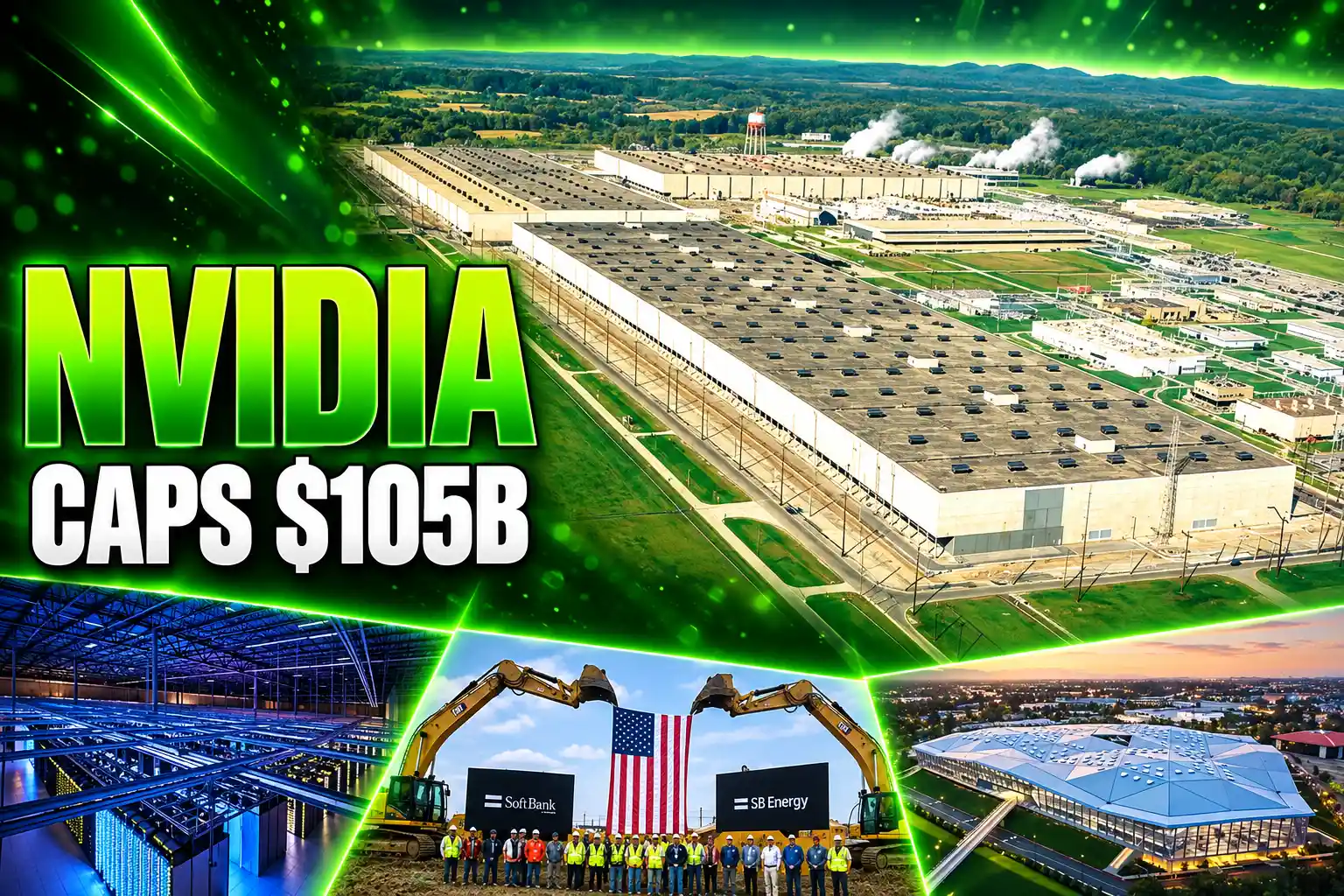
The Guarantee Attaches to Finished Buildings, Not the Rent
Earlier talks had described a backstop of about $250 billion standing behind OpenAI’s full Ohio commitment. Investors pushed on how much risk that would park on Nvidia. What closed on August 17 is a different instrument, and a smaller one.
Huang’s own note is blunt about the limit. Nvidia is supporting land, power and shell for about 4 gigawatts over a 20-year term. That support is confined to defined slices of lease and power payments plus a specified residual-value commitment. It is not the full cost of the site and not all of the tenant’s obligations.
EARLIER TALKS VERSUS THE AUGUST 17 FILING
| Term | Earlier talks | Signed August 17, 2026 |
|---|---|---|
| Headline backstop | About $250 billion | $105 billion cumulative cap |
| What Nvidia backs | A financing guarantee on the Ohio commitment | Residual value of finished land, power and shell |
| IT load covered now | The full campus as discussed | 4.25 IT-GW, option on 3.75 IT-GW |
| When it can pay | Not set in those talks | As halls are placed in service, 2028 to 2030 |
A residual-value guaranty is a promise about the building after a default, not a monthly rent cheque. Nvidia’s August 17 filing says a trigger is OpenAI’s insolvency that causes a lease default, or OpenAI missing payments. Nvidia then covers the gap between a guaranteed minimum value and whatever SB Energy recovers by re-leasing or selling the premises. Nvidia can assume a lease, force a relet, start a sale, or allow a termination.
OpenAI has agreed to reimburse Nvidia for amounts Nvidia actually pays. That indemnity is only as strong as OpenAI is on the day a claim is made.
Wall Street’s $500 Billion Platforms Came First
On August 10 and 11, Nvidia said it had signed memorandums with Apollo, BlackRock, Blackstone, Brookfield, Goldman Sachs and KKR. The firms are building separate compute-financing platforms designed to mobilize over $500 billion of third-party capital for AI factories over time. Nvidia was careful to say that figure is not its revenue, not one fund, and not a pledge to one customer.
The banks are supposed to underwrite each deal on their own, including the customer, demand, use, cash flow and residual value. Nvidia supplies the factory platform. In some cases it may add residual-value support for up to 25% of an opportunity, judged project by project. That is the template Nvidia spent a week selling as the answer to circular-finance questions.
THE SIX FIRMS ON THE PLATFORMS
- Apollo: Long-term credit for AI factory kit and sites.
- BlackRock: Large asset pools aimed at infrastructure that produces cash.
- Blackstone: Private capital for data-center and power assets.
- Brookfield: Operator-investor in long-lived power and campus deals.
- Goldman Sachs: Bank structuring and distribution into those platforms.
- KKR: Long-duration capital with infrastructure underwriting.
PORTS-Pike is not a 25% slice of a bank platform. It is a bilateral residual-value stack with SB Energy, capped at $105 billion on the first 4.25 gigawatts, plus a $1.5 billion equity cheque. Nvidia’s other land-power-and-shell guaranties for AI cloud partners were already disclosed at $3.5 billion. Add the Ohio cap and the gross figure in Nvidia’s subsequent quarterly filing is $108.5 billion.
Who Pays if OpenAI Walks Away?
If OpenAI defaults once a hall is in service, SB Energy has to try to replace the tenant or sell. Nvidia’s cheque is the leftover gap, up to the $105 billion cap, and only after those steps. The guarantee does not attach to dirt still being graded. Huang wrote that exposure falls as OpenAI pays and as capacity comes online, and that it can expire if OpenAI earns a satisfactory credit rating, if OpenAI ends a lease on agreed terms, or 20 years after each lease starts.
THE ORDER OF LOSS
- OpenAI: Pays rent as completed capacity is delivered; reimburses Nvidia if a guaranty is drawn.
- SB Energy: Must relet or sell before Nvidia’s shortfall maths begin.
- Nvidia: Pays any remaining gap to the guaranteed minimum, capped at $105 billion on the initial 4.25 IT-GW.
- The 3.75 IT-GW option: Stays off Nvidia’s cap unless Nvidia chooses to extend credit support.
That waterfall is why the structure is smaller than the $250 billion talks and still heavy. Nvidia is the exclusive chip vendor, a $1.5 billion investor in the landlord, and the residual guarantor on the tenant’s finished shells. Those three roles move together if OpenAI stumbles. Huang’s reply is that the capacity can be sold to another qualified tenant because Nvidia compute is widely used and can be redeployed.
He posted the same argument the morning the deal went out.
— Jensen Huang (@JensenHuang) August 17, 2026
“Is this circular financing? No. OpenAI will pay the lease,” Huang wrote. He compared the Ohio move to supply-chain work: lock a scarce input when demand is visible. Critics still read exclusive supply, landlord equity and a nine-figure residual put as one loop. The filing does not settle that fight. It does show Nvidia will not pay first, will not pay for empty dirt, and will not, on today’s papers, backstop the second half of the campus.
Pike County Gets the Campus and the Power Bill
PORTS-Pike sits in southern Ohio, on remediated federal ground at the old Portsmouth plant and on nearby private land. SB Energy and SoftBank plan at least 10 gigawatts of new energy generation, which they say yields 8 IT-gigawatts of factory capacity. They also plan at least $4.2 billion of regional grid work with AEP Ohio, framed as a way to keep those costs off other ratepayers.
OpenAI says the first 800 megawatts should come up in 2028 largely on existing AEP kit. Later phases need new plants, including natural gas, plus new transmission. The lab says it will start paying only as completed capacity is ready to lease, and that it will fund those bills from revenue, cash flow and capital raised from investors. Permits, environmental reviews and financing still have to land.
THE CAMPUS, AS THE COMPANIES DESCRIBE IT
- Jobs: About 35,000 construction jobs through 2032 and 2,500 long-term operating jobs.
- Community funds: $40 million from OpenAI on top of SB Energy’s existing $40 million, an $80 million pair, plus $84 million in Codex credits for Ohio college students.
- Cooling: Closed-loop, air-cooled systems that recirculate water rather than running cooling towers.
- Reporting: An annual public report on local hiring, community spend, water use and project energy use.
Sam Altman, OpenAI’s chief executive, put the pitch in local terms.
This is going to be a huge site, with enough computing power to help millions of people use AI to do things we can only start to imagine today, from finding new medicines to starting businesses and solving hard problems.
Sam Altman, CEO, OpenAI, Nvidia-SB Energy announcement
OpenAI also says it is contracting the capacity against long-term training needs and product demand, and that Nvidia will provide credit support only on the first 4.25 IT-gigawatts. The remaining halls still need a guarantor if Nvidia does not exercise its option.
Exclusive Chips for 4.25 Gigawatts, With an Option on the Rest
The industrial logic is the chip lock. Each generation of Nvidia factory systems at PORTS-Pike could mean about 1.5 million GPUs, or about $150 billion to $200 billion in Nvidia revenue, Huang wrote. Over 20 years the site can take more than one upgrade cycle. OpenAI’s existing and planned Nvidia deployments come to about 12 gigawatts, with room to about 16 gigawatts if Nvidia extends PORTS-Pike past 4.25 gigawatts. At those levels Huang put the opportunity at roughly $600 billion of Nvidia compute through 2030.
That is the trade investors are being asked to accept. Nvidia gave up a rumored $250 billion wrap on the whole Ohio idea. It kept exclusive silicon on the first 4.25 gigawatts, a path to $150 billion to $200 billion per generation, a $1.5 billion stake in the landlord, and a residual put that only pays after a default and a failed relet or sale. The 3.75 gigawatts still sitting on the option, and the separate bank platforms aimed at more than $500 billion of other people’s money, are where the rest of the risk was supposed to go.
Whether those platforms actually fund halls at this scale is a later story. The August 17 filing already did the nearer job. It showed Wall Street what a capped, residual-value Ohio deal looks like after a $250 billion rumour, and it showed OpenAI that the second half of PORTS-Pike is not on Nvidia’s cap unless Nvidia says so.
Frequently Asked Questions
What Is a Residual-Value Guarantee in the Ohio Deal?
It is a contract with SB Energy, the landlord, about the minimum value of finished leased premises after a default, not a promise to cut OpenAI a monthly rent cheque. Nvidia’s filing names two triggers: an OpenAI insolvency that causes a lease default, and OpenAI missing lease payments. Nvidia then pays the shortfall against a guaranteed minimum after a replacement lease or a sale, and it can choose to assume, relet, sell or terminate.
When Does Nvidia’s Ohio Guarantee Start?
Each guaranty generally becomes effective when the matching lease starts, and only after SB Energy meets ready-for-service conditions on that hall. Huang said those phases run as data centers are placed in service between 2028 and 2030. OpenAI says the first 800 megawatts are due in 2028, largely on existing AEP infrastructure, which is the earliest window in which a guaranty could attach.
Who Owns the PORTS-Pike Data Center?
SB Energy will build, own and operate it. OpenAI holds the 20-year customer lease and will run the compute. Nvidia is the exclusive AI compute vendor and a $1.5 billion equity investor in SB Energy, not the landlord. The campus spans private land and remediated Department of Energy ground at the former Portsmouth Gaseous Diffusion Plant.
How Does OpenAI Say It Will Pay for the Lease?
OpenAI says it pays only as completed capacity becomes available, and that it will fund those bills from business revenue and cash flow plus capital raised from investors. Separately it is putting $40 million into a community grant fund, making up to $84 million in Codex credits available to about 844,000 eligible Ohio college students at $100 per student for the 2026-2027 academic year, and publishing a yearly report on hiring, water and energy.
Disclaimer: This article is news reporting and analysis of company announcements and securities filings. It is for information only and is not investment, legal or financial advice, and it is not a recommendation to buy, sell or hold Nvidia, SoftBank, SB Energy, OpenAI or any related security. Readers who may act on financing, credit or equity questions should consult a licensed financial adviser or securities attorney who can review the actual guaranty, lease and offering documents. Figures and project statuses are taken from the August 2026 statements and filings cited above and can change as construction, permits, option exercises and later disclosures arrive.

Instagram Plus Tests a Read-Only Mode That Cuts Stories

Altman Asks the Public to Accept Some AI Harm

Google Freezes OSS VRP Product Reports After AI Flood

AI Agents Make Payment Rails the Scarce Prize

Turkey’s Crypto Boom Now Runs Through Three Banks

Fable 5 Came Back Under a Commerce On-Off Switch

Google’s SpaceX GPU Lease Has a Sept. 30 Deadline

Plasma One’s XPL Locks Face a 1.81 Billion Cliff

DGO’s Rs 549 World Cup Pass Cost Fans Sleep and Data

Moonshot AI’s $30 Billion Ask Became a $35 Billion Close
-
 AI4 months ago
Fable 5 Came Back Under a Commerce On-Off Switch
-
 AI4 months ago
Google’s SpaceX GPU Lease Has a Sept. 30 Deadline
-
 CRYPTO4 months ago
Plasma One’s XPL Locks Face a 1.81 Billion Cliff
-
 APPS4 months ago
DGO’s Rs 549 World Cup Pass Cost Fans Sleep and Data
-
 AI4 months ago
Moonshot AI’s $30 Billion Ask Became a $35 Billion Close
-

 NEWS4 months ago
ColorOS 17 Device List Spans Oppo, OnePlus and Realme
-

 GAMING4 months ago
Xbox Cuts 3,200 Jobs After Five Years of Thin Returns
-
 GAMING4 months ago
The RTX 4050 Under Rs 70,000 Hides a Wattage Gap