
AI
Idaho’s $6 Million Bet Puts Stalk Sensors on Combines
University of Idaho NSF funding will put stalk-strength sensors on combines so cereal breeders can match field data to DNA.

The University of Idaho has $6 million from the National Science Foundation to build harvest sensors and AI models that score cereal stalks for lodging risk. The four-year EPSCoR award began in August 2026 and funds work through 2030 on wheat, corn and sorghum.
Daniel Robertson, an associate professor of mechanical engineering and the project’s lead investigator, already runs field tests that bend stalks by hand. The new money is for sensors that could ride the machines that cut every plant.
The $6 Million Sensor Bet
NSF recorded the grant as award 2614822 to the Regents of the University of Idaho under the Established Program to Stimulate Competitive Research. That program steers agency money to states that win less of it in open competition, and Idaho is one of them. Clemson University and the University of Nebraska Medical Center are the research partners.
Stalk lodging is the bending or breaking of stems before harvest. Down plants pick up pests and disease, and a combine cannot always lift the grain. Robertson put the food-system stake in one line: “Two-thirds of the world’s calories come from wheat, corn and rice, all crops that suffer from stalk lodging.” This project’s breeding targets are wheat, corn and sorghum, not rice.
Bayer Crop Science, writing for U.S. growers, puts annual corn yield losses from severe lodging at 5 to 25 percent in the United States. A 2025 open dataset Robertson coauthored goes further on maize worldwide, putting global stalk-lodging losses above $6 billion a year and estimating that a 1 percent drop in lodged plants could feed about 5 million more people.
THE GRANT IN BRIEF
- The money: $6 million from NSF EPSCoR, award 2614822, to the University of Idaho.
- The window: Four years, beginning in August 2026 and running through 2030.
- The crops: Wheat, corn and sorghum selected for stalk strength and yield.
- The partners: Idaho engineers, Clemson plant scientists, and AI researchers at the University of Nebraska Medical Center.
The public language is predictive breeding. Robertson said the aim is for breeders to know which genetic combinations will hold up in wind, rather than crossing lines and waiting to see what falls over. The hardware problem underneath that sentence is older than the grant.
210 Stalks an Hour Is the Current Ceiling
Most breeding programs still score lodging by walking plots after a storm and counting plants on the ground. Wind speed, soil moisture and pests all move that count, so a weak hybrid in a calm year can look as strong as a stiff one. Rind penetrometers add a number, but they have a hard time separating elite hybrids that already sit close together on strength.
Robertson’s group answered that with DARLING, short for Device for Assessing Resistance to Lodging IN Grains. An operator sets a hinged footplate beside a stalk, lines up a load cell, and pushes until the stem folds. The rig records force and rotation, then reports flexural stiffness and bending strength. In field use it produces the same crease, or Brazier buckle, seen when wind takes a plant down.
A 2019 methods paper on the device found that, across about 5,000 tests, the crew averaged 210 stalks an hour. That is a real gain on plot counts. It is still a person in a row with a tool. At 210 stalks an hour, a diversity panel of tens of thousands of stems is a season of labor, not a pass with the harvester.
HOW STALK STRENGTH GETS SCORED NOW
| Method | What it records | Working rate | Main limit |
|---|---|---|---|
| Late-season lodging counts | Plants down at harvest | Plot by plot | Weather and pests swamp the genetics |
| Rind penetrometer | Resistance of the stalk wall | Faster than a full break test | Struggles to split close elite hybrids |
| DARLING handheld rig | Bending strength and flexural stiffness | 210 stalks an hour | Still walk-the-row labor |
| Combine-mounted sensors (this grant) | Physical traits at harvest | Harvest scale, if the designs work | Still being modeled, not in the field |
The 2025 maize dataset used DARLING in that middle row. Across 98 environments, four years and 41 locations, bending strength from the handheld rig was the strongest predictor of which plots actually lodged, beating rind puncture and cell-wall chemistry. The measurement works. The bottleneck is how many plants you can afford to touch.
Idaho’s 2025 Patent Already Names Combines
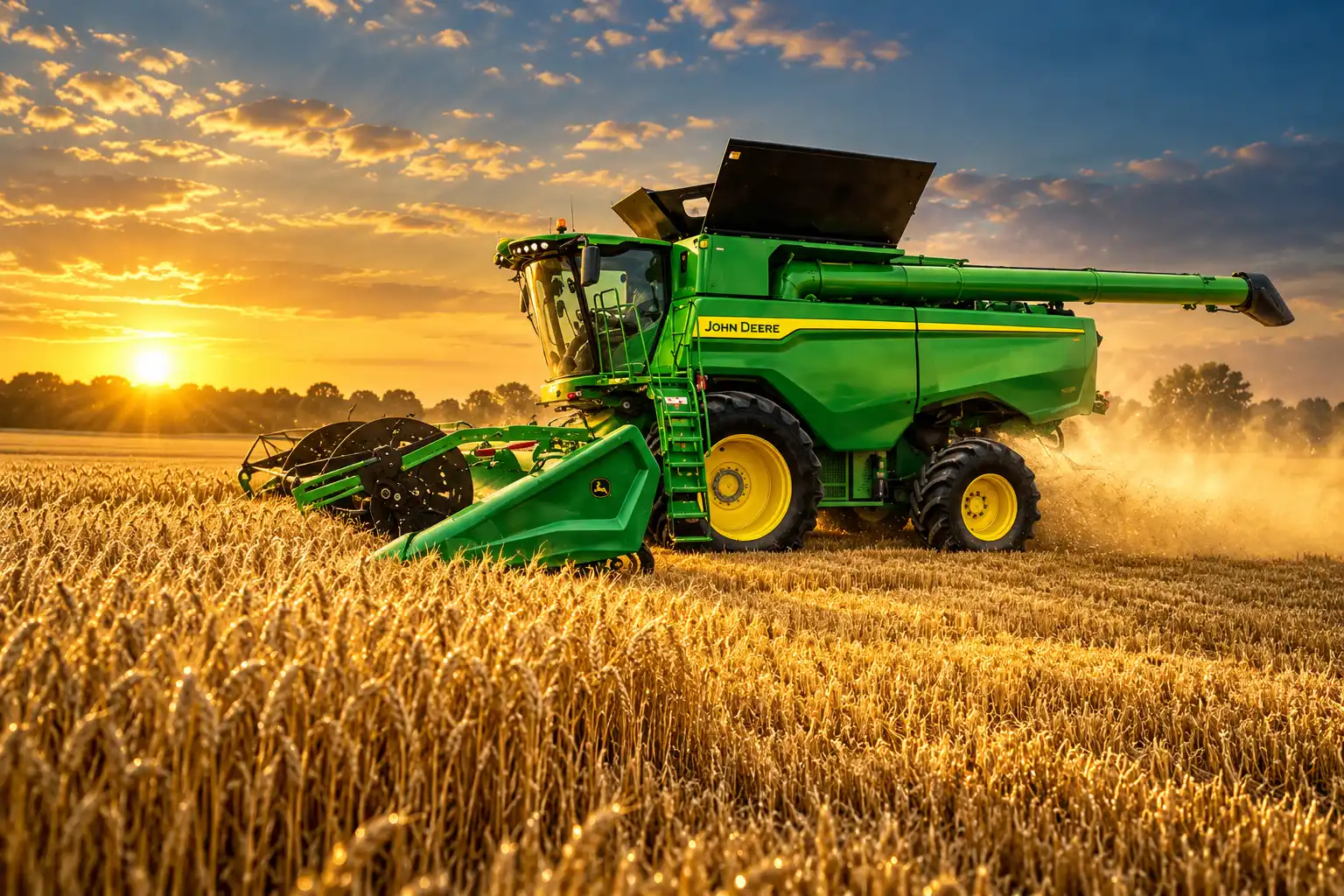
That is why the NSF language about “harvest-integrated sensing” matters more than the AI headline. Robertson and graduate students are modeling sensor packages that could later sit on commercial combines. Collecting a reading while grain is already coming in would multiply the physical data breeders can pair with DNA, and it would cut the cost of sending crews out with a breaker.
The combine idea is not a sketch from this award. In May 2025 the U.S. Patent and Trademark Office granted the University of Idaho patent US12314897B2, “Apparatus and method for high throughput measurement of lodging resistance in crops.” The inventors are Robertson, Austin R. Bebee, George Clayton Bennett and Christopher J. Stubbs. The filing dates to September 2, 2021, with a September 10, 2020 priority date.
The claims describe a height-adjustable force bar and a force sensor moved through a plot of stems. A processor turns those signals, plus stem density and height, into flexural-stiffness estimates. One embodiment is a walk-behind wheeled frame. Another, written into the patent, is a force bar that can ride a combine, with a displacement sensor tracking the vehicle.
WHAT THE 2025 PATENT ALLOWS
- The bar: A height-adjustable force bar that moves through standing stems and logs the load on a sensor.
- The extras: Optional cameras, LiDAR, ultrasonic sensors, GPS, and height sensors to estimate stem count and length.
- The models: Interacting and non-interacting stiffness models whose outputs can be averaged for a plot.
- The mount: Manual wheels or an automated vehicle, including a combine, as the movement mechanism.
The grant does not say the patented bar will ship on a production header by 2030. It funds the next designs and the software that will consume whatever those designs return. Robertson has been blunt about which discipline is in front.
This is fundamentally an engineering problem as much as a genetics problem. Plant scientists have made tremendous advances in understanding crop genetics, but mechanics can tell us why plants fail.
Daniel Robertson, associate professor of mechanical engineering, University of Idaho
Why Breeders Still Cannot Match DNA With Stalks
Lab sequencing now returns millions of genetic markers from a crop’s DNA. Linking a marker to a trait such as stalk strength still means growing the plant and measuring it under field loads. Breeders call that mismatch the genome-to-phenome bottleneck: the genome file is huge, the phenome file is thin.
The Idaho team’s answer is to train AI models on DNA sequences using the physical measurements as labels, then narrow the search to genetic regions tied to lodging resistance. That only works if the labels are both mechanical and numerous. A handful of plot scores cannot supervise a model that is supposed to rank thousands of crosses.
Even a “large” stalk study shows the gap. In October 2025 Robertson, Clemson geneticist Rajandeep S. Sekhon, Kentucky horticulturist Seth DeBolt and colleagues released measurements on 31,260 maize stalks from 566 inbred lines. They scored 11 intermediate phenotypes, including geometry and DARLING bending traits, in four environments in South Carolina and Kentucky in 2020 and 2021. They kept each plant’s identity instead of averaging a plot, which is the kind of table an AI model can actually use.
31,260 stalks is a heavy lift for handheld gear. It is a rounding error next to a single county’s harvest. The grant is a bet that harvest-time sensors can turn that special dataset into a routine byproduct of cutting grain.
Nebraska Medical Center’s role sits on that same gap. Its researchers are to take methods built on the human genome and recast them for plant DNA, hunting signatures of stronger stems. Clemson’s job is the biology in between, tying those signatures to cells and molecules that make a stalk fail or hold.
Short Corn Already Cuts Wind Damage
Seed companies are not waiting for a combine sensor. One commercial path is to shorten the plant so wind has less lever arm. Short-stature maize, which cuts height about 25 to 30 percent by shrinking internodes, is already in trials across the Midwest.
A 2026 Crop Science analysis of that germplasm found wind damage in 10.6 percent of tall hybrid plots and 3.8 percent of short-stature plots, a 64% reduction, across 444 site-years. Forty-seven tall locations crossed a 5 percent damage threshold or were abandoned; 17 short-stature locations did. During the 2020 Midwest derecho, earlier work on the same idea found about 50 percent fewer damaged plants and 13 percent higher yield where short corn stood.
That path has a catch the 2025 Idaho-Clemson dataset spells out. Breeding for grain has already shifted dry matter into the ear and away from the stem, which made modern hybrids easier to lodge. Packing short plants at high density then changes light and competition in the canopy, which can weaken stalks again. Height is one control. The failure load of the stem is another. Robertson is funding the second dial, not a replacement for the first.
Sorghum and wheat do not have a short-stature product with that same trial trail. A sensor that scores bending strength at harvest would apply across all three cereals in the grant, including lines that breeders still want tall for forage or biomass.
Human-Genome Methods Come to Cereal DNA
The award is built as a three-lab split, with two Idaho colleges on the teaching side. Each piece maps onto a different layer of the same bottleneck: measure the stalk, read the DNA, explain the tissue that failed.
HOW THE LABS DIVIDE THE WORK
- University of Idaho: Lead on harvest-integrated sensors, mechanical models of why stems buckle, and AI training data from those measurements.
- University of Nebraska Medical Center: Recast human-genome analysis methods as models that scan plant DNA for signatures of stronger stalks.
- Clemson University: Connect those genetic hits to cellular and molecular processes that set stalk strength in the field.
- North Idaho College: Build transfer routes so two-year students can move into Idaho engineering degrees tied to the project.
- Brigham Young University-Idaho: Open graduate research on-ramps in the state for engineering students who want field work on the sensors.
Sekhon’s Clemson group is already in the paper trail. The 31,260-stalk release grew the diversity panel at Clemson’s Simpson center and at Kentucky’s Spindletop farm, the same Kentucky collaboration that ran earlier DARLING trials with DeBolt. The new NSF text does not name those faculty as the 2026 co-investigators, and the university announcement does not list a Nebraska Medical Center principal investigator. The institutional split is what NSF is paying for.
Robertson has framed the student layer as a workforce project at the meeting point of agriculture, engineering and artificial intelligence. The sensor designs are the thing those students would actually build.
North Idaho College Joins the Training Pipeline
Idaho is using the award to keep the talent local as well as to instrument a header. North Idaho College is the transfer partner for engineering undergraduates. BYU-Idaho is the partner for exposing more engineering students in the state to graduate-level field research. Those clauses are typical EPSCoR language, but they match the lab’s actual tool path: a device that started as a hinged pole in a row and is now a patent that names a combine.
FROM HANDHELD RIGS TO THIS AWARD
- September 2019: The DARLING methods paper reports about 5,000 field tests at 210 stalks an hour and the Brazier-buckle failure mode.
- 2020 to 2021: The maize diversity panel is grown in South Carolina and Kentucky; the force-bar patent is filed in September 2021.
- May 27, 2025: Patent US12314897B2 issues to the University of Idaho, including a combine-mounted embodiment.
- October 30, 2025: The 11-trait, 31,260-stalk maize dataset is published as a public phenotyping resource.
- August 2026: NSF award 2614822 begins, with support through 2030 for harvest sensors and DNA models on wheat, corn and sorghum.
The sensors are not on a dealer lot. Robertson’s group is still modeling several designs that might later be built into commercial combines. The AI models have no public accuracy numbers because the harvest-scale labels do not exist yet. Short-stature maize is already cutting wind damage in Midwest trials while this instrument work runs.
What the award does buy is a four-year attempt to take a measurement that already predicts lodging at 210 stalks an hour and attach it to the one machine that handles every stem. If that attachment holds, breeders get a phenome file that can sit next to the genome file they already own. The clock on that attempt runs through 2030.

Instagram Plus Tests a Read-Only Mode That Cuts Stories

Altman Asks the Public to Accept Some AI Harm

Google Freezes OSS VRP Product Reports After AI Flood

AI Agents Make Payment Rails the Scarce Prize

Turkey’s Crypto Boom Now Runs Through Three Banks

Fable 5 Came Back Under a Commerce On-Off Switch

Google’s SpaceX GPU Lease Has a Sept. 30 Deadline

Plasma One’s XPL Locks Face a 1.81 Billion Cliff

DGO’s Rs 549 World Cup Pass Cost Fans Sleep and Data

Moonshot AI’s $30 Billion Ask Became a $35 Billion Close
-
 AI4 months ago
Fable 5 Came Back Under a Commerce On-Off Switch
-
 AI5 months ago
Google’s SpaceX GPU Lease Has a Sept. 30 Deadline
-
 CRYPTO4 months ago
Plasma One’s XPL Locks Face a 1.81 Billion Cliff
-
 APPS4 months ago
DGO’s Rs 549 World Cup Pass Cost Fans Sleep and Data
-
 AI5 months ago
Moonshot AI’s $30 Billion Ask Became a $35 Billion Close
-

 NEWS5 months ago
ColorOS 17 Device List Spans Oppo, OnePlus and Realme
-

 GAMING4 months ago
Xbox Cuts 3,200 Jobs After Five Years of Thin Returns
-

 GAMING4 months ago
The RTX 4050 Under Rs 70,000 Hides a Wattage Gap