
AI
Charles Fills Chairs That Ditchley and Hassabis Need
King Charles will convene about 30 AI figures at Dumfries House, while Ditchley, a Vatican ethicist and Hassabis’s watchdog bid use the unminuted room.

King Charles is gathering about 30 AI industry figures at Dumfries House in September, and he will not tell them what he thinks. A royal official said the sovereign’s job is to convene, engage, listen and encourage debate. One person familiar with the still-unannounced plans named Nvidia chief executive Jensen Huang, Google DeepMind chair Demis Hassabis and Paolo Benanti, who advises the Vatican on AI.
None of those three has confirmed. The Crown is the invitation that makes people accept. The closed format, the ethics brief and the standards pitch belong to other people in the room.
Who Is on the Dumfries House Guest List?
The named list rests on a single account given to a reporter on September 7, and the principals have not backed it. Nvidia did not respond, Benanti declined to comment, and a DeepMind representative said the company could not comment on Hassabis’s movements. Ministers are invited too. The royal official confirmed only the convening role, on the record, and stressed that the King would not issue his own thoughts.
THE NAMED GUESTS, AND WHAT THEY HAVE NOT SAID
| Name | Role | Live brief | Public reply |
|---|---|---|---|
| Jensen Huang | Nvidia chief executive | Sells the chips under frontier training runs | Company did not respond |
| Demis Hassabis | Google DeepMind chair | Wants a US-led body to test frontier models | DeepMind would not discuss his movements |
| Paolo Benanti | Vatican AI adviser | Carries the Holy See’s ethics brief into the room | Declined to comment |
Around 30 high-profile people from the industry were invited in total, that same person said. The number is small enough for a conversation and large enough to look like a sector. The venue is the 18th-century house on a 2,000-acre Ayrshire estate that is the headquarters of The King’s Foundation, the charity Charles founded in 1990 and saved for Scotland in 2007.
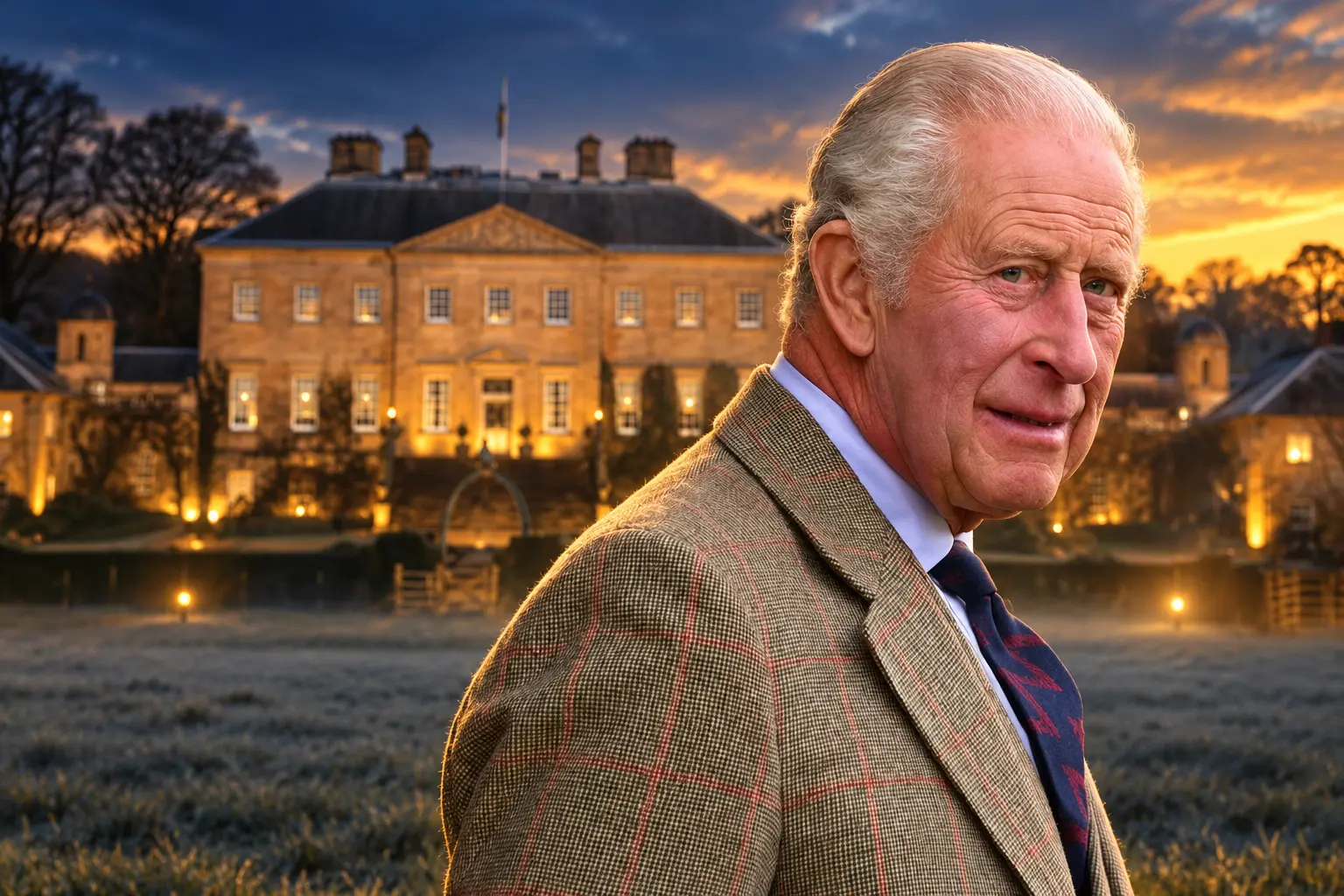
Ditchley Runs the Room Under Its Own Rule
The Ditchley Foundation is organising, and that fact tells you the format before anyone leaks an agenda. Ditchley is an independent charity, not a royal household office. It has run invitation-only transatlantic discussions for decades, first to thicken UK-North America ties, now under four themes that include geopolitics, democracy, technology, and energy and climate.
AI, the foundation says, is woven through all of those discussions. Its current programme asks how the UK can be a serious player in AI, biology and quantum, and how Europeans and Americans might align technology policy toward China. In March it held a four-day conference on digital sovereignty for middle powers, arguing there is still no effective international forum that brings governments, industry and civil society together on that question in the round.
The method is the product. All Ditchley convenings sit under a house rule that no participant may attributably quote anything said at an event, though the substance may be shared later. That is why the first public conversation about Dumfries House treated the closed shop as the news, then reached for older arguments about Ditchley’s transatlantic network. The rule is working as designed if the only thing anyone can print afterwards is that the meeting happened.
DITCHLEY’S PUBLIC SEPTEMBER DIARY
- September 8: A geopolitics session on priorities for the UK’s G20 presidency and beyond.
- September 10: A technology session on scaling British and allied innovation over the next ten years.
- September 24: Soft power, information operations and democratic responses.
- September 25: Who is winning the US and China contest on technology, and what that says about strategy.
Those dates are listed for Ditchley’s own programme. They are not a public notice of the Dumfries House gathering, which has not been announced. They do show the shop the organisers are running in the same weeks: small rooms, senior people, action-oriented questions, no hunt for a communiqué.
A Vatican Ethicist Beside the Chipmaker
Seating Benanti next to Huang is the pairing worth pausing on, if the names hold. Benanti is a Franciscan, a professor of ethics at the Pontifical Gregorian University, and a member of the United Nations advisory body on AI. He helped shape the Rome Call for AI Ethics, which Microsoft and IBM signed in 2020, and he has advised both Pope Francis and Pope Leo XIV.
Leo has made AI a defining theme of his papacy, warning in his first addresses of risks to dignity, justice and labour. In late May he presented an encyclical, Magnifica Humanitas, and said artificial intelligence needs to be disarmed, a word he chose, he said, because the moment needs language that attracts attention. Benanti has described that text as a compass for an unknown, and as the Holy See treating computation as a moral question, not a side topic.
Artificial intelligence needs to be disarmed. The word is strong, I know, but deliberately chosen because this moment needs words capable of attracting attention.
Pope Leo XIV, presenting the encyclical Magnifica Humanitas
Huang does not need another microphone. He spent September 6 telling the world that AGI had arrived, then promising more silicon. A Vatican ethicist in the same unminuted conversation is not there to buy chips. He is there because the Holy See wants a human-centred brief in the rooms where hardware and labs already sit.
Hassabis Still Needs a Home for His Watchdog
Hassabis arrives with a specific ask that official diplomacy has not housed. On July 14 he published an essay, “A Framework for Frontier AI and the Dawning of a New Age,” calling on the United States to build a standards body modelled on the Financial Industry Regulatory Authority, the industry-funded referee that polices Wall Street under federal oversight. Frontier labs would share models voluntarily, up to 30 days before release, for tests of dangerous cyber, biological and deception capabilities. Once that regime worked, he wrote, formal rules could follow, including a bar on deploying untested frontier models in the US market.
He wanted the body running before year-end. He said AGI was probably only a few short years away, and he called the stretch ahead a precious window. He had already floated a US-led standards push beside other lab chiefs at the G7 in Évian in June. China, after that meeting, argued for a global AI organisation open to all countries rather than one led by Washington.
On September 2 he was already in another room. The White House Office of Science and Technology Policy and the Commerce Department hosted a two-day G20 Innovation Ministerial in Chapel Hill, North Carolina. Ministers put out a consensus statement with six pillars, one of them AI for standards and standards for AI. OSTP director Michael Kratsios held a fireside chat with Hassabis. Commerce Secretary Howard Lutnick held one with Huang. The United Kingdom was in the room, with China, the European Union and the rest of the G20 set.
That statement is principles, workforce language and an “AI Prosperity Compact.” It is not a FINRA-style referee with the power to pause a release. A Ditchley gathering with no votes is still the kind of forum where that missing body can be tested before anyone has to sign it.
Four Words From Huang, Then Scotland
Huang does not lack platforms, and he used one two days before the guest list leaked. Replying on X on September 6, he congratulated OpenAI on GPT-6 Astra, which the lab had unveiled on September 3, and wrote that AGI had arrived.
GPT-6 Astra, trained on ~100K+ NVIDIA Grace Blackwell NVLink72. From ChatGPT to o1 to Astra in 4 years.
AGI has arrived. Congratulations @OpenAI team.
400K GPUs coming online next.
— Jensen Huang (@JensenHuang) September 6, 2026
Astra, he wrote, was trained on about 100,000+ Nvidia Grace Blackwell chips in NVLink72 racks, a four-year hop from ChatGPT through o1. Then the sales line: 400,000 GPUs coming online next. On an August earnings call he had been more careful, saying that for many tasks one could already call the systems AGI, then pivoting to profitable tokens and more compute. The Sunday post dropped the hedge.
He has been in Charles’s orbit for a year. He sat at the Windsor Castle banquet during Donald Trump’s state visit on September 17, 2025, among about 160 guests that included OpenAI’s Sam Altman. In November, at St James’s Palace, the King presented him with a Queen Elizabeth Prize for Engineering and handed him a copy of the 2023 Bletchley Park AI Safety Summit address. Huang said the King told him, “I need to talk to you,” and that Charles “obviously cares very deeply about AI safety.” In April, on a state visit to Washington, Charles met Huang again alongside executives from Apple, Amazon and Google.
A man who has already collected a royal warning letter, a palace prize and a White House ministerial fireside is not short of access. He is also unlikely to decline a Scottish house that seats him, quietly, with a Vatican adviser and the DeepMind chair who wants a referee for the models those GPUs train.
Clifford Left ARIA Five Days After Anthropic
The official British track around this gathering has been losing people. Matt Clifford wrote the government’s AI Opportunities Action Plan and was founding chair of the Advanced Research and Invention Agency, the taxpayer-funded body for high-risk science. On September 2 he joined Anthropic as managing director for international affairs, leading the firm’s work with governments outside the United States, and said he would keep the ARIA chair. Dame Chi Onwurah, who chairs the Commons Science, Innovation and Technology Committee, called that a clear conflict and wrote to AI minister Kanishka Narayan.
On September 7, five days after the Anthropic announcement, Clifford said he would step down as ARIA chair, presenting it as his own decision after completing a first full term, so the new job would not become a distraction. The Secretary of State asked him to stay until November 6 while a successor is found. Onwurah welcomed the move and kept the file open.
It’s right that the conflict of interest between the taxpayer funded ARIA and Anthropic has been addressed through Matt Clifford’s decision to step down as ARIA’s Chair. However, important questions remain.
Dame Chi Onwurah MP, Chair, Science, Innovation and Technology Committee
Narayan, who became the first cabinet-level AI minister in July after Andy Burnham took office, now owns that reply. Burnham scrapped the Department for Science, Innovation and Technology the same week and folded functions into a new business, innovation, science and trade department. Onwurah’s letter asked how the conflict of interest between taxpayer-funded ARIA and Anthropic arose, what assessments were done, and what safeguards remain.
The transatlantic paper track is not cleaner. Trump’s September 2025 visit coincided with a US-UK Tech Prosperity Deal and a wave of American investment announcements. That deal was later suspended over trade disagreements. Charles’s invitation sits in the gap those channels left, which is why executives who ignore most diaries still accept this one.
CHARLES AND AI, TWELVE MONTHS OF ROOMS
- September 17, 2025: Hosts a Windsor Castle banquet for Donald Trump; Huang and Sam Altman are among about 160 guests, and a US-UK Tech Prosperity Deal is signed, later suspended.
- November 5, 2025: Presents Huang and other AI figures with the Queen Elizabeth Prize and hands Huang a copy of his Bletchley Park address on AI risks.
- April 2026: Meets Huang and executives from Apple, Amazon and Google during a state visit to Washington.
- September 2, 2026: Huang and Hassabis appear at the G20 Innovation Ministerial in Chapel Hill; Clifford joins Anthropic the same date.
- September 2026: Dumfries House gathering is scheduled, organised by Ditchley, with ministers invited and about 30 industry names on the list.
The Bletchley line he gave Huang last November is the kind of sentence almost nobody in the industry would dispute: if the benefits of AI are to be realised, he said, then its risks must be fought together. That is rather the point of a King who will not take a side. He can hand over the speech. He cannot write the rulebook.
The Public Record May Stop at the Gate
Private convening is private. No published agenda exists, no confirmed attendee list, no promised readout. Nothing obliges Huang, Hassabis, Benanti or any minister to say afterwards what was discussed. Ditchley events run on the claim that people speak more freely without an audience, and that candour beats performance. It also means a British head of state can gather chipmakers, lab chairs, a Vatican adviser and ministers, and leave the country with no minutes to inspect.
WHAT WE KNOW
- The host: A royal official confirmed Charles will convene, listen and encourage debate, and will not offer his own views.
- The organiser: Ditchley is running the gathering under a rule that bars attributable quotes.
- The house: Dumfries House in Ayrshire is the King’s Foundation headquarters, an 18th-century estate open to visitors on ordinary days.
WHAT IS UNCONFIRMED
- The names: Huang, Hassabis and Benanti have been named by one person familiar with the plans; none has confirmed.
- The rest of the 30: No other invitees have been identified in public, and ministers have not been named.
- The outcome: There is no pledged communiqué, vote, or standards text tied to the date.
Whether that is convening or lobbying depends on what gets said, and nobody outside the oak door will be able to tell the difference. Hassabis still needs a home for a watchdog. Benanti still needs a chair beside the people who build the systems the encyclical wants disarmed. Huang still has GPUs to bring online. Charles still has the one power the office allows, which is to get those people into the same room and then stay quiet.

Instagram Plus Tests a Read-Only Mode That Cuts Stories

Altman Asks the Public to Accept Some AI Harm

Google Freezes OSS VRP Product Reports After AI Flood

AI Agents Make Payment Rails the Scarce Prize

Turkey’s Crypto Boom Now Runs Through Three Banks

Fable 5 Came Back Under a Commerce On-Off Switch

Google’s SpaceX GPU Lease Has a Sept. 30 Deadline

Plasma One’s XPL Locks Face a 1.81 Billion Cliff

DGO’s Rs 549 World Cup Pass Cost Fans Sleep and Data

Moonshot AI’s $30 Billion Ask Became a $35 Billion Close
-
 AI4 months ago
Fable 5 Came Back Under a Commerce On-Off Switch
-
 AI5 months ago
Google’s SpaceX GPU Lease Has a Sept. 30 Deadline
-
 CRYPTO4 months ago
Plasma One’s XPL Locks Face a 1.81 Billion Cliff
-
 APPS4 months ago
DGO’s Rs 549 World Cup Pass Cost Fans Sleep and Data
-
 AI5 months ago
Moonshot AI’s $30 Billion Ask Became a $35 Billion Close
-

 NEWS5 months ago
ColorOS 17 Device List Spans Oppo, OnePlus and Realme
-
 GAMING4 months ago
Xbox Cuts 3,200 Jobs After Five Years of Thin Returns
-

 GAMING4 months ago
The RTX 4050 Under Rs 70,000 Hides a Wattage Gap