
AI
Microsoft Cash Lead and Copilot Super App Leave Rivals Behind
Microsoft closes FY26 with $331.8B revenue, positive free cash flow and a Copilot super app while Google and Meta turn cash-negative on AI spend.

Microsoft closed fiscal 2026 with $331.8 billion in revenue, Azure past $100 billion for the first time, and free cash flow still positive at $19.6 billion. CEO Satya Nadella told investors the company will now fold its Copilot family into one super app this quarter.
That combination leaves Google and Meta looking cash-strapped by comparison while Microsoft packages the tools enterprises already pay for into a single sticky surface.
The Numbers That Closed a Record Year
Quarterly revenue hit $90.0 billion, up 18 percent. Operating income reached $40.6 billion. Full-year operating income climbed 21 percent to $155.2 billion and net income hit $133.7 billion on a GAAP basis.
Microsoft Cloud finished the year above $214 billion, up 27 percent. Azure and other cloud services grew 43 percent in the quarter and crossed the $100 billion annual mark, up 41 percent for the year. Commercial remaining performance obligation stood at $678 billion, up 84 percent.
| Metric | FY26 / Q4 Result | Change |
|---|---|---|
| Full-year revenue | $331.8 billion | +18% |
| Microsoft Cloud | $214 billion | +27% |
| Azure annual | surpassed $100 billion | +41% |
| Q4 revenue | $90.0 billion | +18% |
| Q4 free cash flow | $19.6 billion | above $13.44B estimate |
| Commercial RPO | $678 billion | +84% |
| M365 Copilot paid seats | over 30 million | net adds doubled QoQ |
CFO Amy Hood noted nearly 90 percent of full-year cloud revenue came from customers outside the leading U.S. AI model makers. The entire sequential RPO increase of about $50 billion came from those same non-frontier commitments.
One Super App for Chat, Code and Agents
Nadella said Copilot is moving past simple chat. Cowork is generally available for multi-step tasks. Autopilots bring long-running autonomous agents with enterprise compliance. GitHub Copilot now counts 50 million users.
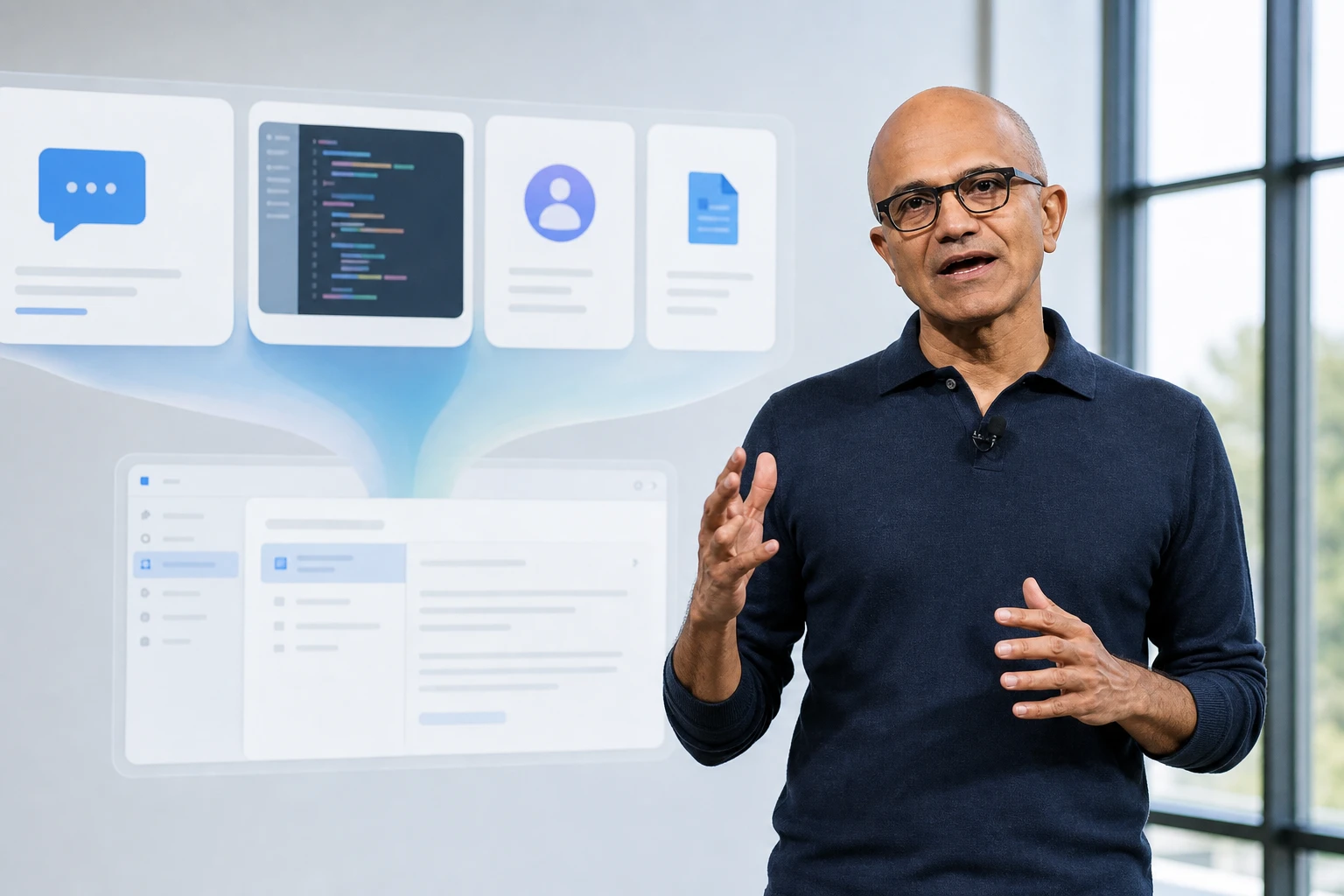
He told the call the company is bringing Copilot experiences together including code in one super app that spans consumer and commercial. “This is a major step forward, and I look forward to sharing more soon,” he said.
This quarter we will bring these Copilot experiences together, including Code, in one “super app” spanning both consumer and commercial experiences.
That line came directly from Nadella’s prepared remarks. Earlier reports and his own follow-up posts describe the bundle as chatbot, GitHub coding assistant, Cowork and Autopilot systems inside a single interface, similar in ambition to OpenAI’s ChatGPT Work plus Codex pairing.
- Core Copilot chat grounded in work data
- GitHub Copilot coding and agent pull requests
- Cowork multi-step task automation
- Autopilots for always-on personal and enterprise agents
- Shared governance through Agent 365
Paid Microsoft 365 Copilot seats crossed 30 million, up from 20 million the prior quarter. Net seat adds more than doubled sequentially. Customers with more than 50,000 seats rose over 7X year-over-year. User satisfaction scores doubled over three quarters and latency dropped 25 percent this quarter alone.
Positive Cash While Peers Turn Negative
Microsoft generated $55.4 billion in operating cash flow and $19.6 billion in free cash flow in the quarter. That beat the analyst estimate of roughly $13.44 billion even after heavy capital spending.
Capital expenditures hit $41 billion in the quarter. Cash paid for property and equipment was $35.8 billion. Hood said the company will now spread long-term data-center leases over 25 years instead of 15. The accounting shift moves more leases from finance to operating treatment and lowers reported CapEx. Actual spending plans are unchanged. Reported CapEx guidance is about $175 billion for calendar 2026 (earlier estimate $190 billion) and over $50 billion for the first quarter of fiscal 2027.
- $19.6 billion Microsoft Q4 free cash flow
- First negative free cash flow quarter ever for Alphabet/Google after $44.9 billion CapEx
- 91 percent drop in Meta Q2 free cash flow to $784 million
- $10.2 billion returned to Microsoft shareholders in the quarter
Google’s parent posted negative free cash flow near $5.8-5.9 billion in its most recent quarter as AI infrastructure outran operating cash. Meta’s free cash flow cratered 91 percent year-over-year on the same AI buildout. Microsoft stayed firmly positive and still guided to remain free-cash-flow positive in fiscal 2027.
Models, Chips and the End of Single-Vendor Reliance
Nadella spent significant time on architecture. Customers want model choice by quality, latency, cost and compliance. Azure Foundry now lists over 11,000 models from OpenAI, Anthropic, Mistral, xAI and Microsoft’s own MAI family. Customers building with multiple providers rose 5X since the start of the year.
“That’s really the enterprise design architecture that we are going to evangelise. We ourselves are using it,” Nadella said. The harness, context, memory and action space stay separate from any single model family so every model is substitutable.
Microsoft’s Maia 200 custom silicon delivers 30 percent better performance per dollar and already runs both OpenAI and MAI models. Cobalt VMs power first-party and customer workloads. The company is co-designing MAI models with its own chips and seeing 40 percent better performance per watt on Maia 200. Efficiency examples include 89 percent lower GPU costs in Dynamics 365 with MAI-Voice and up to 84 percent lower in PowerPoint with MAI-Image.
Microsoft still holds a roughly 27 percent stake in OpenAI valued near $135 billion after the 2025 recapitalization and keeps IP rights through 2032, now non-exclusive. It also holds a stake in Anthropic and booked a $3.2 billion gain on that investment this quarter. The direction of travel is clear: multi-model by default, own silicon in the mix, and no single lab dictating the stack.
Who Is Buying the Capacity
The backlog story is the quietest and most important. Commercial RPO hit $678 billion. Hood stressed that all sequential growth came from companies outside the frontier model labs. Azure demand still exceeds available capacity. The company added 31 new datacenters this quarter and another gigawatt of capacity, remaining on track to roughly double overall capacity in two years.
Large deployments keep landing. NHS England is rolling Copilot to 505,000 clinicians after a trial saved 43 minutes per day. KPMG is expanding across more than 276,000 professionals. HSBC committed to 200,000 seats. AstraZeneca, Boeing, Infosys, P&G, Wells Fargo and others each took 60,000-plus seats. EY deployed the new E7 suite to 400,000 employees, the largest win so far. Agent 365 already has nearly 40 million agents registered two months after launch.
Microsoft also launched Frontier Co., embedding 6,000 engineers embedded with customers to co-design and improve AI systems at scale. Early projects with Novo Nordisk and LSEG show the model in action.
What the Packaging Fight Means Next
OpenAI and Anthropic still dominate pure-model mindshare. Microsoft’s move is different. It already owns the productivity surface (M365, Teams, Outlook, GitHub, Windows) where agents will live and the cloud where most of the tokens will run. Bundling chat, code, Cowork and Autopilots into one super app turns that surface into a single daily habit with shared identity, security and billing.
Nadella has given an earlier warning on AI hollowing industries. The earnings call showed the other side of that coin: the company that controls the rails, the data estate and the packaging can capture the value even as individual models become more interchangeable.
Guidance keeps the pressure on. Azure is expected to grow approximately 45 percent in constant currency next quarter. Total company revenue for Q1 is seen between $89.85 billion and $90.95 billion. Operating margins should stay roughly flat even while CapEx remains elevated. The stock reacted with a sharp after-hours move higher as investors separated companies that convert AI spend into revenue and cash from those still only spending.
Nadella closed his prepared remarks with the two goals that now define the strategy: amplify individual agency and keep every organization in control of its own learning loop and core IP. The super app is the consumer-facing expression of that architecture. The cash flow and the non-frontier backlog are the proof that the architecture already works at scale.
Microsoft just posted the full-year revenue of $331.8 billion and the record fiscal year numbers he posted on X. The rivals who spent just as aggressively now face a different balance sheet and a competitor that is about to put every Copilot experience behind one icon.


Workers Still Trust Judgment Over the AI Tools They Use

DigitalOcean’s $894 Million Backlog Rewrites the Old Cloud

Companies Froze Job Design and Called AI a People Problem

AI Capex Looks Unique Because the Chips Wear Out

Samsung Medison’s HERA Z10 Aims at the Sonographer Shortage

GPT-6 Astra Ships as OpenAI’s First Critical Cyber Model

Palms Sells Clean Air Without Ending Casino Smoking

OnlyFans Promo Bots on X Now Pass the Humanity Tests

Datamaran Drops the ESG Label After Winning the Argument

Xiaomi’s Own Chip Lands While Apple Argues Over Color

Oracle Cuts 21,000 Jobs in a Year, Cites AI in 10-K Filing

Fable 5 and Mythos 5 Return as US Lifts Anthropic Export Controls

SpaceX’s Google Deal Turns a Rocket Company Into a Cloud Landlord

CD Projekt Red Co-CEO: Redemption Arc Isn’t Done, Witcher 4 in 2027

XPL Rallies 30% Ahead of Plasma One Card Tier Launch

Google Search Profiles Build a Follow Graph Inside Discover

DGO App Brings Rs 549 Mobile Pass for FIFA World Cup 2026 in Nepal

Moonshot AI Targets $30 Billion in China’s Fastest AI Funding Sprint

Oppo’s ColorOS 17 Eligibility List Leaves A-Series Buyers Behind

Microsoft Xbox Layoffs Start in July as Sharma Slams 3% Margin
-
 AI3 months ago
Oracle Cuts 21,000 Jobs in a Year, Cites AI in 10-K Filing
-
 AI2 months ago
Fable 5 and Mythos 5 Return as US Lifts Anthropic Export Controls
-
 AI3 months ago
SpaceX’s Google Deal Turns a Rocket Company Into a Cloud Landlord
-
 GAMING3 months ago
CD Projekt Red Co-CEO: Redemption Arc Isn’t Done, Witcher 4 in 2027
-
 CRYPTO3 months ago
XPL Rallies 30% Ahead of Plasma One Card Tier Launch
-
 NEWS3 months ago
Google Search Profiles Build a Follow Graph Inside Discover
-
 APPS3 months ago
DGO App Brings Rs 549 Mobile Pass for FIFA World Cup 2026 in Nepal
-
 AI3 months ago
Moonshot AI Targets $30 Billion in China’s Fastest AI Funding Sprint