
APPS
The Play Store Will Warn You When Apps Vanish
Play Store code will flag apps already pulled from the catalog, just as unregistered packages face a September 30, 2026 removal from Google Play.

Google hid three notice templates in Play Store version 51.4.19 that tell you an installed app “was removed from Google Play and will no longer receive updates.” Researcher Aamir Siddiqui, who publishes teardowns as AssembleDebug, pulled those strings on May 26, 2026. Google has not switched the alerts on.
The wording is already past tense. This is not a countdown before an app leaves. It is a label after the listing is gone, aimed at leftover copies that still sit on phones.
The Death Notice Is Already in Play Store Code
The templates change with the count. One named app. Two named apps. One named app plus a number of others. Each line ends the same way: the software on the device will not get another Play update.
THE THREE NOTICES
- One app: “%1$s was removed from Google Play and will no longer receive updates.”
- One plus a count: “%1$s and %2$d other apps were removed from Google Play and will no longer receive updates.”
- Two named apps: “%1$s and %2$s were removed from Google Play and will no longer receive updates.”
Those placeholders are the same family of strings as the original Play Store teardown strings. An APK teardown is unfinished work. Siddiqui’s own later Play Store dives, including pause-and-resume downloads and a paid-games layout dated September 7, 2026, never showed this warning live.
So the useful question is not whether a toast would be nice. It is which removals would fire it, and what people should do when one lands.
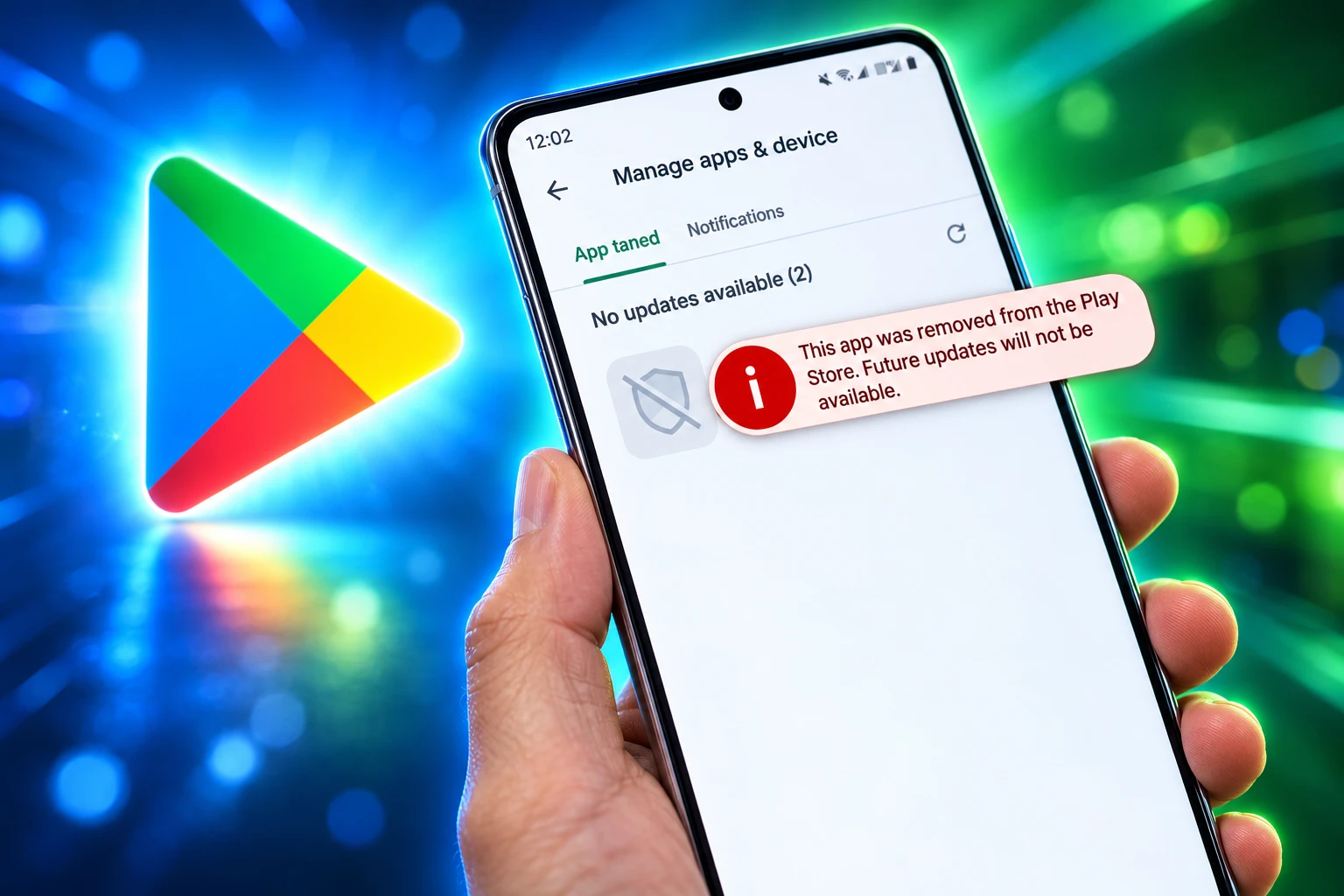
Play Protect Speaks Only When Google Calls an App Harmful
Play already has a narrower channel. Google Play Protect scans for potentially harmful apps, including titles that have been removed or suspended. If Protect fires, Google’s developer Help page says users may get a push notice and an option to keep the app, or a one-tap uninstall.
Routine delistings sit outside that path. A developer who unpublishes a tool, a policy strike that is not treated as malware, or a regional takedown can erase the store page while the icon stays on the home screen. You find out when you buy a new phone, factory-reset, or tap Update and nothing happens.
PLAY PROTECT VERSUS THE NEW ALERT
| Channel | What triggers it | What you can do |
|---|---|---|
| Play Protect today | Harmful app, or a removal/suspension Play treats as a security case | Uninstall, or keep the copy |
| New Play Store strings | An installed app is gone from Play and cut off from updates | Unknown; the code only states the fact |
| No notice today | Voluntary unpublish, many policy pulls, regional store exits | Nothing until you try to reinstall or update |
The gap is the leftover install. Taking a title off Play does not wipe it from devices that already have it. Updates stop. The icon does not.
1.75 Million Apps Never Reached the Store
The notice would arrive after years of Play raising the bar at the door. In its 2025 safety recap, Google said it prevented over 1.75 million policy-violating apps from being published and banned more than 80,000 developer accounts that tried to ship harmful titles. Play Protect, Google said, now scans over 350 billion Android apps a day.
GOOGLE PLAY SAFETY IN 2025
- Blocked at publish: Over 1.75 million policy-violating apps never made it onto Play.
- Accounts cut: More than 80,000 developer accounts were banned.
- Daily scans: Play Protect inspects over 350 billion Android apps each day.
- Still on the phone: A block or a later removal does not uninstall copies people already have.
Those 1.75 million never reached a home screen. The dead-app strings target a different pile: titles that did ship, then left, while the APK stayed behind. A phone that collected utilities, regional banks, and one-off tools through 2024 and 2025 can carry that pile without a single badge on the icon.
Unregistered Apps Get Pulled on September 30
The date that makes the unfinished code bite is September 30, 2026. Google’s Play Console Help says that from that day, every Play package must be registered for Android developer verification. Apps that are not registered “will be removed from Play.”
Matthew Forsythe, director of product management for Android app safety, put the same deadline on developers in a July 15, 2026 update. He said Play had auto-registered over 99 percent of apps, and that owners should still check Console Home and register what is left to avoid global removal from Google Play.
While 99% of apps on Play have been registered automatically, you should check your Play Console Home page to register any remaining apps by September 30, 2026 to avoid global removal from Google Play and ensure a seamless user installation experience.
Matthew Forsythe, Director of Product Management, Android App Safety, Android Developers Blog
Manual work is the long tail: old package names, shared signing keys, white-label builds, a personal account that still holds a tool nobody has opened in Console for a year. Help staff walk through how to register remaining Play package names, including a signed snippet upload when auto-registration misses.
THE 2026 PLAY REMOVAL CALENDAR
- March 2026: Android developer verification opens; Google later says millions of apps are registered after that launch.
- May 26, 2026: Dead-app notice strings appear in Play Store version 51.4.19.
- July 15, 2026: Forsythe warns that leftover unregistered Play apps face global removal if they miss September 30.
- August 2026: Limited-distribution accounts and an advanced sideload flow launch; hobbyists can share to up to 20 devices with no government ID and no fee.
- September 30, 2026: Unregistered Play packages are removed. Separate developer verification starting September 30 begins for installs from seven participating stores in Brazil, Indonesia, Singapore, and Thailand, on certified devices running Android 7 and up.
- 2027: Google says it will expand verification to all apps on certified Android devices.
The four-country rule and the Play Console purge are related and not identical. Verification first limits new installs from seven storefronts (Google Play, HONOR App Market, OPPO App Market, Galaxy Store, Palm Store, V-Appstore, and GetApps) in those four countries. The Console rule is broader: an unregistered Play package is supposed to leave the catalog worldwide.
If the 51.4.19 strings ever ship, that worldwide drop is exactly the event they describe. People who still have those APKs would get a store notice that updates are over, not a Protect malware scare.
Keep the Icon, Lose the Updates
Google’s standing target-API rule already draws a similar line without a toast. Existing Play apps that are not updated, and that miss an API level within two years of the latest major Android release, stop being offered to new users on newer Android versions. People who already installed the app can still find it, reinstall it, and run it on versions the binary supports.
A September 30 package removal is harsher for new devices and for anyone who wipes a phone. The listing is gone. The old install can keep opening until a server dies, a certificate expires, or the OS refuses it. The new notice would finally name that split: live icon, dead store page.
It would not, on the strings we have, uninstall anything. It would not export your data. It would not point to a replacement. It would not say whether the developer walked away, failed a privacy form, missed a target API, or skipped package registration.
When No More Updates Is the Wrong Advice
A blunt “removed, no more updates” line treats every exit as the same end of life. Recent store exits show why that can be the wrong move.
In August 2026, Ozon Bank left Google Play under sanctions pressure. The bank told customers the installed copy would keep working and asked them not to delete it, while pointing new users at other stores and a website file. Crypto exchange apps were also pulled from Play in South Korea the same month. In both kinds of case, the binary on the phone is the only official client some people still have.
A Protect-style keep-or-uninstall choice at least admits that fork. The 51.4.19 copy does not. Power users who sideload, and anyone holding a bank or wallet that lost its listing, can read “will no longer receive updates” as “throw this away” when the publisher wants the opposite.
WHAT WE KNOW
- The copy: Three templates in version 51.4.19 say an installed app was removed from Play and will not get updates.
- Protect already: Harmful or suspended apps can already trigger a keep-or-remove push.
- The deadline: Unregistered Play packages are set for removal on September 30, 2026.
WHAT IS UNCONFIRMED
- Ship date: Google has not confirmed a rollout, and later Play teardowns have not shown the alert live.
- The button: The strings do not prove a one-tap uninstall or a keep option.
- The trigger list: It is unclear whether voluntary unpublish, API-floor hiding, and package-registration drops all fire the same toast.
- Sideloads: There is no public sign the check extends past Play’s own install records.
Until those four points are public, the honest user move is still the dull one. If an app holds money, identity, or a lock you cannot replace, export what you can before the listing dies. If it is a flashlight you have not opened since 2024, delete it without waiting for Google to write you a note.
Will Sideloaded Apps Get the Same Ping?
Probably not, on the evidence we have. The templates live in the Play Store client and talk about removal from Google Play. Apps installed from a browser, a USB package, or another storefront are not in that ledger unless Play also signed the same package for that user.
That split is getting louder, not quieter. Google has started putting third-party stores listed on Play in the United States, and AssembleDebug flagged Aptoide Games as a US Play listing in August 2026. At the same time, unverified packages in Brazil, Indonesia, Singapore, and Thailand will need ADB or Google’s advanced flow after September 30. Play is becoming both more open to rival catalogs and more strict about who may put a package on a certified phone.
A death notice that only knows Play’s database will miss the copies that never came from Play. It will also over-warn on titles that left Play and still get patches somewhere else. The people who need the ping most, the ones who never check a store page, will see it only for the apps Play itself used to own.
Siddiqui is still opening new Play Store builds. Pause and resume for downloads. A denser shelf for paid games. The removal warning remains three sentences in version 51.4.19, waiting on a switch Google has not flipped, while September 30, 2026 does the quieter job of taking unregistered packages off the shelf.

Instagram Plus Tests a Read-Only Mode That Cuts Stories

Altman Asks the Public to Accept Some AI Harm

Google Freezes OSS VRP Product Reports After AI Flood

AI Agents Make Payment Rails the Scarce Prize

Turkey’s Crypto Boom Now Runs Through Three Banks

Fable 5 Came Back Under a Commerce On-Off Switch

Google’s SpaceX GPU Lease Has a Sept. 30 Deadline

Plasma One’s XPL Locks Face a 1.81 Billion Cliff

DGO’s Rs 549 World Cup Pass Cost Fans Sleep and Data

Moonshot AI’s $30 Billion Ask Became a $35 Billion Close
-
 AI4 months ago
Fable 5 Came Back Under a Commerce On-Off Switch
-
 AI5 months ago
Google’s SpaceX GPU Lease Has a Sept. 30 Deadline
-
 CRYPTO4 months ago
Plasma One’s XPL Locks Face a 1.81 Billion Cliff
-
 APPS4 months ago
DGO’s Rs 549 World Cup Pass Cost Fans Sleep and Data
-
 AI5 months ago
Moonshot AI’s $30 Billion Ask Became a $35 Billion Close
-
 NEWS5 months ago
ColorOS 17 Device List Spans Oppo, OnePlus and Realme
-

 GAMING4 months ago
Xbox Cuts 3,200 Jobs After Five Years of Thin Returns
-

 GAMING4 months ago
The RTX 4050 Under Rs 70,000 Hides a Wattage Gap