
AI
Stak Energy’s Off-Grid Arctic AI Campus Is Stuck on a Lease
Stak Energy wants a 50-year North Slope lease for off-grid AI power, yet turbines, fiber, and a final state yes remain open.

Stak Energy wants a 50-year state lease on 715.4 acres of North Slope tundra for a gas-fired AI campus that would never touch Alaska’s public grid. The Alaska Division of Oil and Gas issued a preliminary decision to offer a 50-year lease on May 12, 2026, after no rival bidder stepped forward. A final finding has not been posted.
The pitch is distance. Cold air would cut cooling water. Stranded gas would feed on-site turbines. Neighbors, in the company’s telling, would be a non-issue. The same distance now sits on the other side of the ledger: turbine queues that run into 2031, an Arctic fiber line that ice has already cut twice, and no named customer for a plant John Boyle, Stak’s chief strategy officer, has put at more than $10 billion.
A Square Mile of Gravel on Continuous Permafrost
STAK Energy Corporation applied on November 21, 2025, then filed a revised package on March 12, 2026. The site sits about one mile west of the Dalton Highway at Milepost 390, and about 26 miles south of Deadhorse, west of the Trans-Alaska Pipeline System and the Alaska Gasline Development Corporation right-of-way. The state holds both the surface and the mineral estate. The North Slope Borough is the local government; Arctic Slope Regional Corporation is the regional Native corporation. No village corporation land is in the tract.
THE CAMPUS ON PAPER
| Piece | Figure |
|---|---|
| Lease area | 715.4 acres |
| Main gravel pad | 640 acres (one square mile) |
| Access road | 1.8 miles |
| Gravel fill | 7.1 million cubic yards, about 8 feet thick on average and at least 5 feet |
| On-site power | 1 to 3 gigawatts, used behind the meter |
| Lease term | 50 years, with a possible renewal |
| Site work Stak put at | $500 million for studies, engineering, gravel, and an initial camp |
| Full build, per Boyle | more than $10 billion |
| Gas at full simple-cycle | 350 to 500 million cubic feet a day (about 128 to 183 billion cubic feet a year) |
| Cooling water vs a typical plant | 10% or less, Stak says, at a 12 F yearly average |
The pad would be a thermally stable working surface over continuous permafrost, with gravel from the state-permitted mine at Milepost 390. Backup power would sit on about 4,500 gallons of diesel in nine 500-gallon double-walled tanks. Wastewater would be hauled to Deadhorse. The revised application raised the construction workforce from up to 500 people to up to 1,500, swapped modular data halls for high-performance computing units, and added the option of a gas treatment and compression system. DNR wrote that the lease would support the first data center project in Alaska.
HOW THE LEASE GOT THIS FAR
- November 21, 2025: Stak files for a 50-year state land lease under AS 38.05.070.
- December 23, 2025: The company gives DNR a letter of non-objection from Great Bear Pantheon, the oil and gas lessee on adjoining tracts.
- March 12, 2026: A revised application lands, and state agencies get a two-week review.
- May 12, 2026: The division posts its preliminary best-interest finding. No competing interest was filed, so the state moved to a negotiated lease.
- June 15, 2026: The first public comment deadline arrives, then slips.
- July 17, 2026: The extended comment window closes. DNR has not posted a Final Finding and Decision.
Rent would mix a base rate with a cut of annual gross receipts from the lessee and any sublessees. The public file does not list the base rent, the percentage, or a minimum payment. A five-year entry authorization would run inside the 50-year clock, not on top of it. The state keeps the mineral estate.
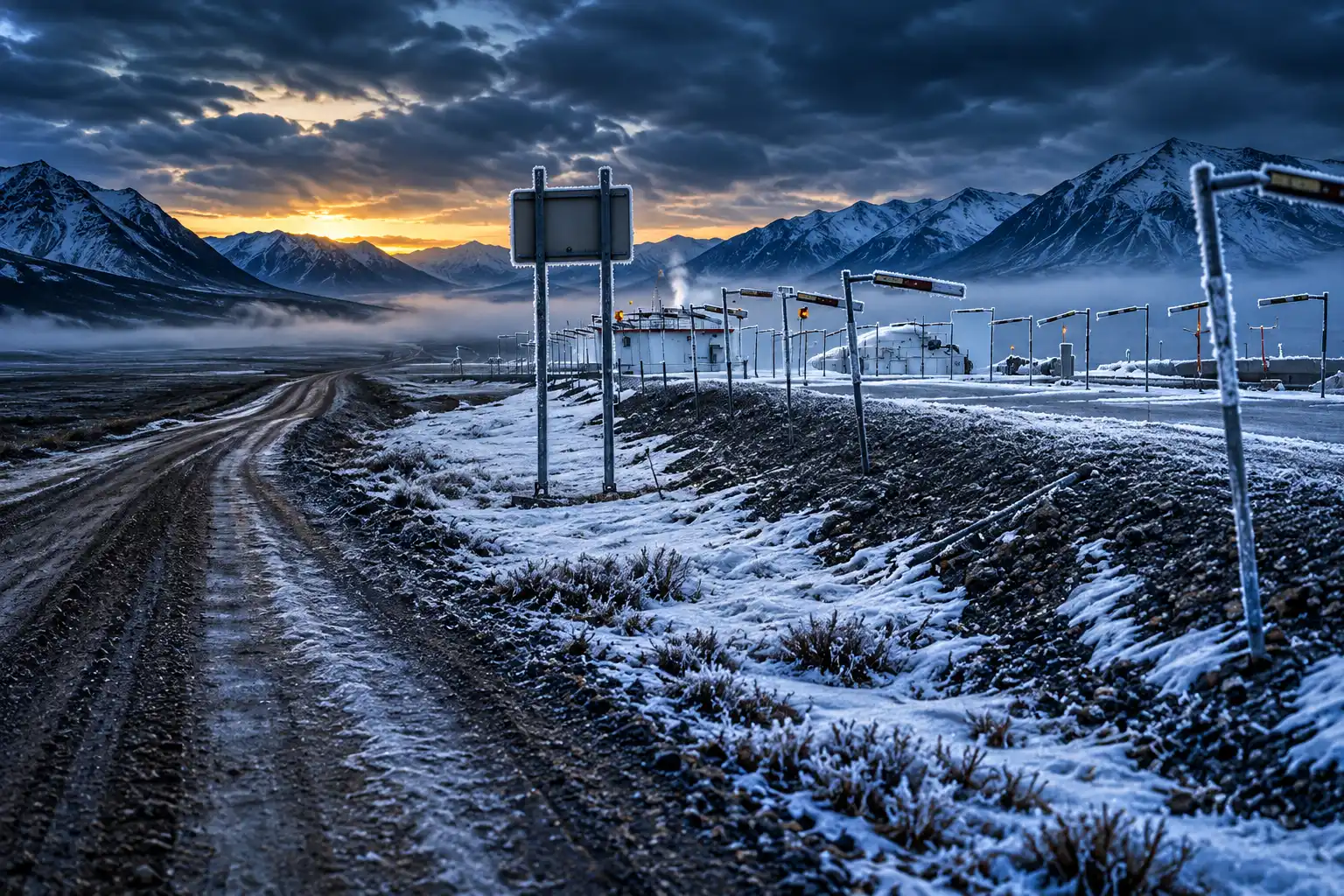
Isolation Was the Whole Pitch
Lower 48 campuses have walked into fights over power bills and data center water use in host cities. Stak’s answer is to stay off the Railbelt and to cool with dry Arctic air. The plant would not sell electricity into urban Alaska’s grid. Gas would move on dedicated lines from fields the company puts 25 to 90 miles away. Those pipelines are not part of this lease and would need their own reviews.
Stak’s site calls the project an off-grid answer built on stranded North Slope gas. Boyle has said average yearly temperatures at the site are 12 F, so the campus should need 10% or less of the water a typical data center uses for cooling. He has also said there are no cities or villages within 50 miles except Deadhorse, a work-camp hub for oil crews who fly in and out. The Northern Alaska Environmental Center, reading the same state file, noted that dry cooling cuts one water problem and does not erase gravel fill, drainage, dust control, or domestic water on a 715.4-acre pad.
Carbon capture is not in the first design. Stak has said it could be studied later. North Slope CO2 lines and storage are not in place. Greenhouse gas from 1 to 3 gigawatts of simple-cycle gas is a direct product of the power model, not a side effect.
John Boyle Left the Department That Must Decide
Sparrow Mahoney, Stak’s founder and chief executive, grew up in Alaska and went to Wasilla High School. She has worked in startups and in cryptocurrency, including the Iditarod’s crypto push. The company has not laid out a full ownership chart. Jim Shine, a former special assistant at the Department of Natural Resources, is the applicant contact on the lease form.
Boyle is the hire that changes the temperature in the room. Gov. Mike Dunleavy made him natural resources commissioner in 2023. He left that post on October 24, 2025. By July 2026 he was Stak’s chief strategy officer, arguing for a lease from the department he used to run. He is also on the November 3, 2026, general-election ballot for Alaska House District 9. Shine and Boyle are the sort of people who know how a North Slope land file moves. Paying a small senior bench is not the same as raising the money Boyle now attaches to the full campus.
Stak has not named banks or hyperscalers for this build. It previously said it was raising money from McKinley Alaska Private Investment in Anchorage. In July, Boyle recast the business itself. Stak, he said, would generate power and sell it to large computing firms. It would not operate the data halls.
And while we anticipate hyperscalers providing the commercial foundation for our power plant build, Stak will be able to provide power to any entity interested in purchasing it.
John Boyle, chief strategy officer, Stak Energy, in an emailed statement
That line quietly moves the bet. The company is asking the state for a 50-year computing campus, then describing itself as a remote power vendor waiting on a tenant.
More Than 500 Comments, and Almost None in Favor
Going far from towns was supposed to drain the politics out of the file. It did not. DNR released more than 500 public comments filed before the first deadline. Fewer than a dozen backed the project. Sean Clifton, a department spokesman, said the agency extended the window an extra month, to July 17, because of “the volume of comments received, public interest and requests for extension.”
THE FIRST WAVE OF COMMENTS
- The count: More than 500 messages reached the division before the original close, with the docket then held open through July 17.
- The split: Fewer than a dozen comments endorsed the lease; the rest were opposed, including form letters and unique notes from Kodiak, Kotzebue, Seward, Valdez, and Nuiqsut.
- The groups: Formal concern also came from the Northern Alaska Environmental Center, the Alaska Public Interest Research Group, and the Alaska chapter of Backcountry Hunters and Anglers.
- The company’s read: Boyle called the bulk of it form letters “lacking substance other than reflecting an individual’s point of view,” and said more substantive notes would be answered in due course.
Stak said it is “committed to being a responsible steward of the land entrusted to us” and that the site is “far removed from any local communities.” A few supporters made the same point in blunter language, that the location takes NIMBY off the table. The docket shows that remoteness did not stop a statewide argument about gravel, climate, and whether a 50-year industrial pad belongs on that stretch of tundra. Some writers wrongly claimed the plant would lift Railbelt power prices; the North Slope is not tied to that grid, so a gas sale there would not set Anchorage rates. Other objections sat on firmer ground, including the gravel demand and the carbon from a large new burner.
Turbine Queues Now Run Into 2031
A campus in the 1 to 3 gigawatt band is a power plant first. Boyle has said the generators could make a gigawatt or more, which he put at some 30% above the peak load of urban Alaska’s entire grid. Getting the machines is the part isolation does not fix. GE Vernova’s gas equipment backlog and slot reservations reached 116 GW at the end of the second quarter of 2026, up from 100 GW three months earlier. The company has been taking reservations for 2031. About 20% of that gas-power book is going to data-center and AI loads. Annual output is running near 20 GW, with higher targets later in the decade.
Large-frame waits of about five years are common in the trade press, and some frames are quoted as far as seven years. Prices have jumped with the queue. That is the same hardware every other off-grid AI campus is chasing, which is why warnings about gas-fired AI campuses lasting a decade land on this file as well as on plants in Texas or the Plains. Stak’s application listed a construction start in summer 2026 and first operations in late 2028. Summer 2026 closed without a final lease. A 2028 switch-on now has to clear a turbine line that is already selling the early 2030s.
Great Bear Pantheon, the neighbor that sent the December 23, 2025, letter of non-objection, is also among North Slope producers that have been lining up gas for the long-running Alaska LNG effort. The lease before DNR does not award Stak a gas contract. It only puts a computing pad next to someone else’s subsurface rights and a pipeline corridor that has other suitors.
Two Ice Breaks on the Only Arctic Cable
Boosters like to say training clusters do not care whether the hall sits in Loudoun County or above the Arctic Circle, as long as fiber is in the ground. The North Slope already has a path south. Quintillion built the first Arctic subsea and terrestrial fiber network, with landings that include Prudhoe Bay and Deadhorse and a terrestrial run to Fairbanks, then on toward Seattle and Portland. On April 22, 2026, GCI announced an agreement to acquire Quintillion’s fiber and fold more than 1,800 miles of existing cable, plus planned miles, into a statewide ring.
The line has not been boring. Sea ice cut the subsea segment in June 2023 and again in January 2025. The second break sat in winter ice. Quintillion said on October 22, 2025, that crews on the CanPac Valkyrie had finished repair and deeper burial near Oliktok Point, restoring service after 9 months. A 171-mile overland Land Bridge is meant to give Utqiagvik and the Slope a path that does not depend on that beach. For a hyperscaler that sells five-nines cloud, an eight- or nine-month wait on a ship is not an outage plan. For batch training that can pause, it is a different product. Stak has not said which one it is selling.
Latency is the other untested claim. A Fairbanks hop is not Ashburn. Inference that has to answer a user in milliseconds may never belong at Milepost 390. Training that can sit on cheap gas and cold air might. Until a tenant signs, that split is marketing.
Who Would Buy a Gigawatt of Isolated Power?
The application invited the public to comment on the proposed state lease, and the commenters who did so keep appeal rights on a final finding. Wetland delineation for a Clean Water Act Section 404 permit is still listed as future work. So are nesting-bird surveys, air-quality modeling, and thermal modeling of permafrost under waste heat and a warming climate. DOT flagged overweight gravel hauls on the Dalton Highway. Reclamation security is required; the dollar amount is not in the file.
WHAT WE KNOW
- The land action: DNR has made a preliminary finding that a 50-year negotiated lease may be in the state’s interest, on 715.4 acres, after a solicitation that drew no competing bid.
- The power model: Stak wants 1 to 3 gigawatts of behind-the-meter gas generation and, per Boyle, would sell that power to hyperscalers rather than run the computers.
- The docket: More than 500 comments came in before the first deadline, fewer than a dozen in favor, and the close moved to July 17, 2026.
WHAT IS UNCONFIRMED
- The final lease: No Final Finding and Decision has been posted, and the base rent plus gross-receipts share are still blank.
- The customer: No hyperscaler, offtake contract, or full financing package is in the public file.
- The machines and the gas: Turbine slots, the 25-to-90-mile pipeline authorizations, and a priced gas supply sit outside this lease.
WHAT THE LEASE STILL DOES NOT SETTLE
- A tenant: Boyle’s hyperscaler foundation is an expectation, not a signed hall.
- A turbine: A late-2028 start collides with a global queue already selling 2031.
- A fuel line: Gas gathering from 25 to 90 miles away needs a separate stack of permits.
- A bond: The performance guaranty amount waits on an estimate Stak has not put in the notice file.
- A cable story: Fiber exists to Deadhorse, and ice has already taken it down twice.
The isolation that was supposed to make this easy is the product Stak is selling, and it is also the constraint. Cheap gas and 12 F air do not order a turbine, bury a fiber line deeper than ice, or put a hyperscaler’s name on a pad that is still, on the state’s own paper, only a preliminary yes.

Instagram Plus Tests a Read-Only Mode That Cuts Stories

Altman Asks the Public to Accept Some AI Harm

Google Freezes OSS VRP Product Reports After AI Flood

AI Agents Make Payment Rails the Scarce Prize

Turkey’s Crypto Boom Now Runs Through Three Banks

Fable 5 Came Back Under a Commerce On-Off Switch

Google’s SpaceX GPU Lease Has a Sept. 30 Deadline

Plasma One’s XPL Locks Face a 1.81 Billion Cliff

DGO’s Rs 549 World Cup Pass Cost Fans Sleep and Data

Moonshot AI’s $30 Billion Ask Became a $35 Billion Close
-
 AI4 months ago
Fable 5 Came Back Under a Commerce On-Off Switch
-
 AI5 months ago
Google’s SpaceX GPU Lease Has a Sept. 30 Deadline
-
 CRYPTO4 months ago
Plasma One’s XPL Locks Face a 1.81 Billion Cliff
-
 APPS4 months ago
DGO’s Rs 549 World Cup Pass Cost Fans Sleep and Data
-
 AI5 months ago
Moonshot AI’s $30 Billion Ask Became a $35 Billion Close
-

 NEWS5 months ago
ColorOS 17 Device List Spans Oppo, OnePlus and Realme
-

 GAMING4 months ago
Xbox Cuts 3,200 Jobs After Five Years of Thin Returns
-

 GAMING4 months ago
The RTX 4050 Under Rs 70,000 Hides a Wattage Gap