
APPS
Massachusetts Certifies First Ride-Hailing Union, But Antitrust Risk Looms

Massachusetts certified the first state-level ride-hailing drivers’ union in U.S. history on Friday, a milestone labor organizers are calling the largest private-sector organizing win since Ford autoworkers unionized in 1941. Nearly 70,000 Uber and Lyft drivers across the state now have collective bargaining rights while remaining classified as independent contractors, a framework made possible by a 2024 ballot measure but one that legal scholars warn could face federal antitrust scrutiny.
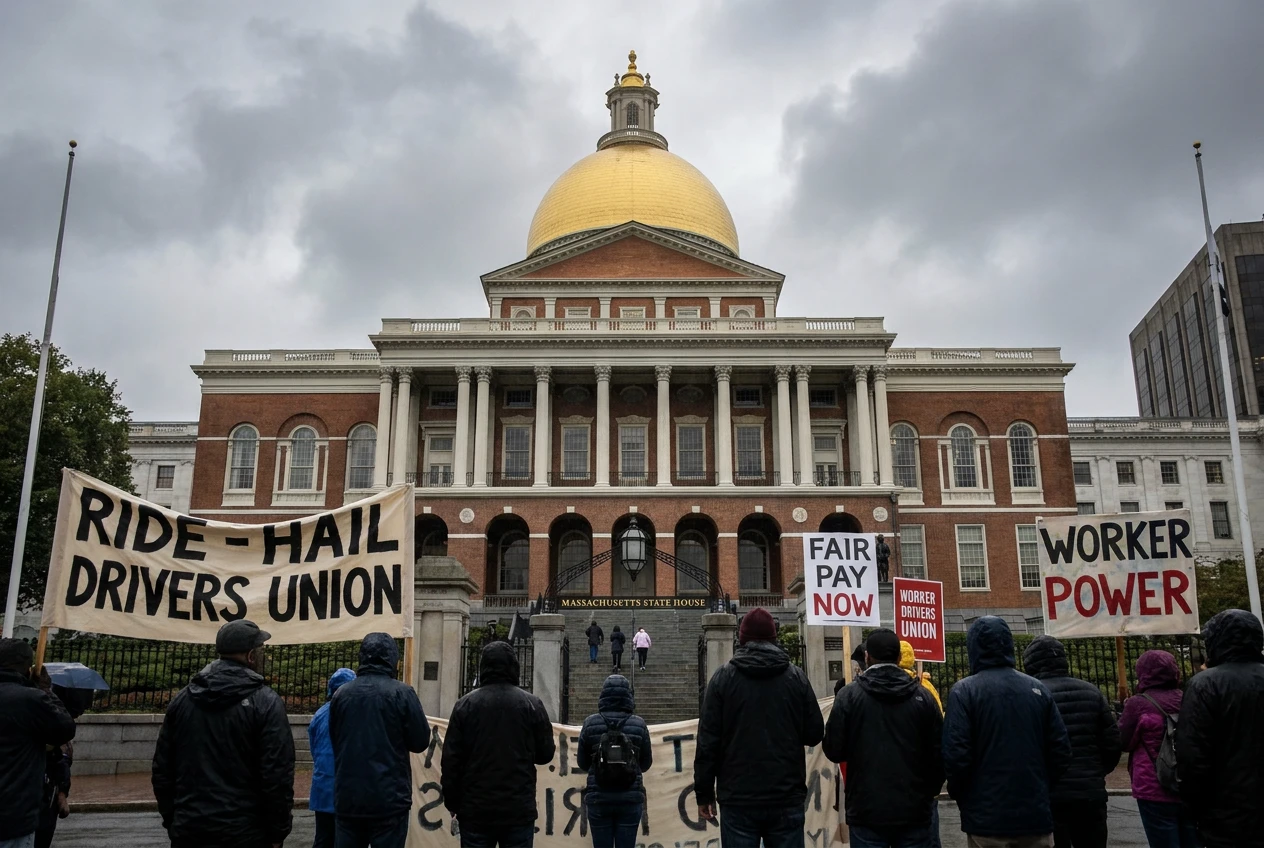
Jean Fredo, who has driven for Uber for more than seven years, stood outside the Massachusetts State House on Tuesday and described the stress of working longer hours for shrinking pay as gas and maintenance costs climbed. “I live with stress, always scared to lose my app. This is not a way to live,” he said in French through a translator, holding up a photo of his four children. Drivers hope the union will bring relief on wages, sudden deactivations, and the opacity of app algorithms that determine their earnings.
What the 2024 Ballot Measure Changed
The certification became possible after Massachusetts voters approved a 2024 ballot measure creating a first-in-the-nation framework allowing ride-hailing drivers to unionize and bargain collectively while remaining independent contractors. The model sidesteps federal labor law, which generally excludes independent contractors from collective bargaining protections under the National Labor Relations Act (NLRA, the 1935 statute governing private-sector union rights).
Under the Massachusetts framework, drivers retain the flexibility to set their own schedules and use their own vehicles, but gain the ability to negotiate collectively over pay rates, deactivation policies, and other terms. The ballot measure passed with 53.9% support in November 2024, overcoming opposition from business groups that argued the hybrid model could expose companies to antitrust liability under the Sherman Act, which prohibits agreements among independent businesses that restrain trade.
Victoria Acosta, a mother who drives for both Uber and Lyft, said in Spanish through a translator that she hopes the victory inspires drivers in other states. “Without the support of the drivers, we wouldn’t be here,” she said. Labor organizers are already targeting similar campaigns in California and Illinois, where app-based gig workers face the same classification dilemma.
Why Independent Contractors Cannot Unionize Under Federal Law
Ride-hailing drivers are generally classified as independent contractors rather than employees, a distinction that excludes them from many traditional labor protections. The NLRA covers only employees, not independent contractors, meaning drivers cannot form unions recognized under federal law. Independent contractors are also excluded from minimum wage and overtime protections under the Fair Labor Standards Act (FLSA, the 1938 federal wage law).
The classification turns on control. Employees work under an employer’s direction and control; independent contractors operate their own businesses and set their own terms. Uber and Lyft have long argued that drivers fit the latter category because they choose when and how long to work, use their own vehicles, and pay their own expenses. Courts and regulators have split on the question, with some states and agencies finding drivers are misclassified employees, while others have upheld the contractor designation.
Massachusetts’ ballot measure does not reclassify drivers as employees. Instead, it creates a state-level carve-out allowing independent contractors in the ride-hailing industry to bargain collectively, a structure that exists nowhere else in the U.S. The legal risk is that collective bargaining among independent contractors could be construed as price-fixing or market allocation under federal antitrust law, which treats independent businesses negotiating together as potential cartels.
The Antitrust Challenge Looming Over the Model
Business groups and some legal scholars have warned that the Massachusetts framework could violate the Sherman Act, the 1890 federal antitrust statute that prohibits agreements among competitors that restrain trade. When independent contractors negotiate collectively over prices or terms, they are technically competitors agreeing to set rates, a practice the Federal Trade Commission (FTC, the federal antitrust enforcement agency) and the Department of Justice have historically treated as per se illegal.
The concern is not hypothetical. In 2015, the FTC blocked a proposed rule in Seattle that would have allowed ride-hailing drivers to unionize, arguing that collective bargaining among independent contractors would constitute illegal price-fixing. The Seattle rule was never implemented. Massachusetts’ ballot measure attempts to avoid that outcome by framing the bargaining framework as a state labor regulation rather than a private agreement among competitors, but whether that distinction will survive federal scrutiny remains untested.
Autumn Weintraub, executive director of the App Drivers Union, said drivers across the country regularly communicate with one another about changing conditions in the industry. “Drivers now have an official organization and can speak with one voice about what’s happening in this industry,” she said. “We cannot let billions of dollars leave Massachusetts and go to Silicon Valley. That money feeds people’s families, that money pays the rent.”
How Other States Are Watching
California and Illinois labor organizers are closely tracking the Massachusetts certification. California’s Proposition 22, approved by voters in 2020, classified app-based drivers as independent contractors and provided limited benefits but did not grant collective bargaining rights. Illinois lawmakers introduced a bill in early 2025 that would create a similar framework to Massachusetts, allowing drivers to unionize while remaining contractors. The bill has not yet advanced out of committee.
What Uber and Lyft Said
Uber said in a statement that it would work with the union and regulators while preserving “driver flexibility and hard-won benefits.” Lyft said it was committed to “engaging in good faith” and “helping drivers succeed while keeping rideshare affordable and dependable for everyone who counts on it.” Neither company indicated it would challenge the certification in court, though both have historically opposed efforts to reclassify drivers as employees or impose collective bargaining frameworks.
What Drivers Hope the Union Will Deliver
Drivers who signed union cards cited three primary grievances: declining pay, sudden deactivations, and the opacity of app algorithms that determine earnings. Fredo said when he started driving for Uber he appreciated the flexibility and the ability to make his own schedule while still being present for his family. But over time, he found himself working longer hours while earning less as gas and maintenance costs climbed.
Deactivations are a particular source of anxiety. Drivers can lose access to the apps with little warning, often after a customer complaint or a drop in their rating below a platform-set threshold. The apps do not disclose the specific algorithms that calculate ratings or determine which drivers receive which ride requests, leaving drivers with limited visibility into how their earnings are set.
The union’s first bargaining priorities are expected to include minimum per-mile and per-minute rates, a transparent appeals process for deactivations, and disclosure of the factors that determine ride assignments. Massachusetts regulators are separately considering new ride-hailing rules involving safety standards and driver oversight. Days before the union certification, Uber warned in a blog post that some of the proposals could raise costs and reduce flexibility for drivers, while supporters said the changes are intended to strengthen safety and accountability.
The Autonomous Vehicle Shadow Over the Victory
The organizing effort has unfolded alongside the rapid expansion of autonomous vehicle technology. Waymo, the self-driving subsidiary of Alphabet, has expanded driverless taxi operations in cities including San Francisco, Los Angeles, and Phoenix, heightening anxiety among some ride-hailing drivers about the future of their jobs. Massachusetts still requires a licensed human operator inside autonomous vehicles tested on public roads, but that rule could change as the technology matures.
Weintraub said drivers regularly communicate about the expansion of autonomous vehicles and the threat they pose to driver livelihoods. “Drivers now have an official organization and can speak with one voice about what’s happening in this industry,” she said. The union has not yet announced a formal position on autonomous vehicles, but labor organizers in other states have called for policies that would require human drivers in autonomous taxis or impose fees on driverless operations to fund retraining programs for displaced workers.
Fredo said his dream is to save and send his four children to college. “I’m fighting for a better life for them, just like everyone else is fighting for their families,” he said. “I believe we will get there.”
How the Model Compares to Traditional Union Structures
| Attribute | Traditional Employee Union (NLRA) | Massachusetts Ride-Hailing Union |
|---|---|---|
| Worker classification | Employees | Independent contractors |
| Bargaining scope | Wages, hours, working conditions | Pay rates, deactivation policies, algorithm transparency |
| Federal protection | NLRA coverage, NLRB enforcement | State-level framework, no NLRA coverage |
| Antitrust risk | None (employees exempt from Sherman Act) | Potential Sherman Act liability (contractors negotiating collectively) |
| Flexibility | Employer sets schedule | Driver sets own schedule |
| Benefits | Employer-provided health, retirement, unemployment | Driver pays own expenses, limited benefits |
What Comes Next for the 70,000 Drivers
The union will now begin the bargaining process with Uber and Lyft. Massachusetts law does not set a timeline for reaching a first contract, and neither company has indicated how long negotiations might take. The union has not yet disclosed its full bargaining team or the specific proposals it will bring to the table, though organizers have said minimum pay rates and deactivation appeals will be early priorities.
The certification also sets up a test case for whether the Massachusetts model can survive federal legal challenges. If the FTC or the Department of Justice concludes that the framework violates the Sherman Act, the union could be dissolved or forced to restructure its bargaining approach. No federal agency has yet announced an investigation, but business groups have signaled they may file complaints or lawsuits challenging the ballot measure’s constitutionality.
For now, drivers are celebrating. Fredo said he hopes the union will bring better pay, stronger protections against sudden deactivations, and more stability. “With the union, it will not feel like we’re working for nothing,” he said. “Now the money will not only stay in the billionaire’s pockets. The money will actually come to the workers who work very hard.”
Frequently Asked Questions
Are Uber and Lyft drivers in Massachusetts now employees?
No. The Massachusetts ballot measure allows drivers to unionize and bargain collectively while remaining classified as independent contractors. Drivers still use their own vehicles, pay their own expenses, and set their own schedules.
Can drivers in other states form similar unions?
Not yet. Massachusetts is the only state with a legal framework allowing independent contractors in the ride-hailing industry to unionize. California and Illinois labor organizers are pursuing similar campaigns, but no other state has passed enabling legislation.
What will the union negotiate over?
The union is expected to bargain over minimum pay rates, deactivation policies, algorithm transparency, and other terms that affect driver earnings and job security. The scope of bargaining is defined by the 2024 ballot measure and Massachusetts state law.
Could the union be challenged in court?
Yes. Business groups and legal scholars have warned that collective bargaining among independent contractors could violate federal antitrust law, which prohibits agreements among competitors that restrain trade. No federal agency has yet announced an investigation, but challenges are possible.
How many drivers does the union represent?
The union will ultimately represent nearly 70,000 Uber and Lyft drivers across Massachusetts, according to organizers. The certification was completed on Friday, May 23, 2026.
Will the union affect ride prices?
Uber and Lyft have not said whether they will raise prices in response to the union. The companies have historically argued that higher driver costs could lead to higher fares, but the union has countered that the companies can afford to pay drivers more without raising prices.
What happens if autonomous vehicles replace human drivers?
The union has not yet announced a formal position on autonomous vehicles. Labor organizers in other states have called for policies that would require human drivers in autonomous taxis or impose fees on driverless operations to fund retraining programs for displaced workers.


Google Opens Gmail to Voice and Gates Docs Live

Lenovo Prices the IdeaPad Vibe Against Apple’s $699 Neo

Xbox Caps Game Pass Cloud Gaming at 15 Hours

GTA 6 DualSense Controllers Follow Sony’s Usual $84.99 Script

South Korea Retail Investors Face Reckoning After KOSPI AI Rally Collapses

Surrey AI Maps Three Heart Attack Paths and Their Molecular Roots

Germany Locks Neutral Apple ATT Prompts Across Most of Europe

Apple’s 5% EU Fee Quietly Rewrites Alternative App Store Math

Apple’s EU Fee Truce Cuts Complexity but Leaves Rivals Fuming

Pixel 11 Pro Fold Trades Thinness for Durability and Seven-Year Stay

Oracle Cuts 21,000 Jobs in a Year, Cites AI in 10-K Filing

Fable 5 and Mythos 5 Return as US Lifts Anthropic Export Controls

SpaceX’s Google Deal Turns a Rocket Company Into a Cloud Landlord

CD Projekt Red Co-CEO: Redemption Arc Isn’t Done, Witcher 4 in 2027

XPL Rallies 30% Ahead of Plasma One Card Tier Launch

Google Search Profiles Build a Follow Graph Inside Discover

DGO App Brings Rs 549 Mobile Pass for FIFA World Cup 2026 in Nepal

Moonshot AI Targets $30 Billion in China’s Fastest AI Funding Sprint

Oppo’s ColorOS 17 Eligibility List Leaves A-Series Buyers Behind

Microsoft Xbox Layoffs Start in July as Sharma Slams 3% Margin
-
 AI2 months ago
Oracle Cuts 21,000 Jobs in a Year, Cites AI in 10-K Filing
-
 AI2 months ago
Fable 5 and Mythos 5 Return as US Lifts Anthropic Export Controls
-
 AI3 months ago
SpaceX’s Google Deal Turns a Rocket Company Into a Cloud Landlord
-
 GAMING2 months ago
CD Projekt Red Co-CEO: Redemption Arc Isn’t Done, Witcher 4 in 2027
-
 CRYPTO3 months ago
XPL Rallies 30% Ahead of Plasma One Card Tier Launch
-
 NEWS3 months ago
Google Search Profiles Build a Follow Graph Inside Discover
-
 APPS3 months ago
DGO App Brings Rs 549 Mobile Pass for FIFA World Cup 2026 in Nepal
-
 AI3 months ago
Moonshot AI Targets $30 Billion in China’s Fastest AI Funding Sprint