
GADGETS
Hopetrek Launches Smart Home Energy Ecosystem to Address Power Challenges in the Philippines

Filipino households spent an average of RM 4,200 per year on electricity in 2025, according to the Philippine Statistics Authority, while enduring an average of 18 brownout hours per month during peak summer seasons. Hopetrek, the smart energy brand under global AIoT giant Uniview, launched its comprehensive smart home safety ecosystem in the Philippines on May 19, 2026, targeting both cost reduction and power reliability with an AI-coordinated platform that integrates solar generation, battery storage, EV charging, and home automation into a single managed system.
The launch at Le Parc Event Hall marks Uniview’s first dedicated consumer energy brand entry into Southeast Asia’s second-largest archipelago market, where grid instability and high electricity tariffs create conditions distinct from the stable-grid environments most international smart home vendors design for.
What Hopetrek Actually Solves That Standalone Devices Cannot
The Philippine residential energy market has long been served by standalone solar panels, backup generators, and uninterruptible power supplies sold as separate products with no coordination layer. A typical Metro Manila household might own a 3kW rooftop solar array, a 5kVA diesel generator, and three separate UPS units protecting computers, entertainment systems, and refrigeration, each operating on independent logic with no awareness of the others.
Hopetrek’s ecosystem replaces this fragmented approach with a unified AI controller that prioritizes solar consumption during daylight hours, automatically switches to battery storage when the grid fails, and activates backup power within 4 milliseconds when battery reserves drop below a preset threshold. The 4-millisecond switching speed is engineered specifically to protect sensitive electronics from the voltage sag that occurs during the first 20-50 milliseconds of a typical brownout, a window during which hard drives can corrupt and power supplies can fail.
The system’s wide voltage tolerance, spanning 170V to 290V, addresses a chronic problem in provincial areas where grid voltage frequently drifts outside the 220V ±10% range that most imported smart home hardware expects. Uniview’s engineering team conducted field testing in Batangas, Pampanga, and Cebu provinces between November 2025 and March 2026, logging voltage fluctuations that reached 158V during peak evening demand and 247V during low-load early morning periods, both of which would trigger shutdown protection in standard inverters.
The Three-Layer Architecture Behind the Ecosystem
Hopetrek’s platform is built on three hardware tiers working in concert. The first layer consists of rooftop photovoltaic panels rated between 5kW and 15kW depending on household size, paired with microinverters that convert DC solar output to AC grid power. The second layer is a lithium iron phosphate battery bank offering 10kWh to 30kWh of storage capacity, sized to provide 6-12 hours of backup power for a typical three-bedroom home running air conditioning, refrigeration, and work-from-home office equipment.
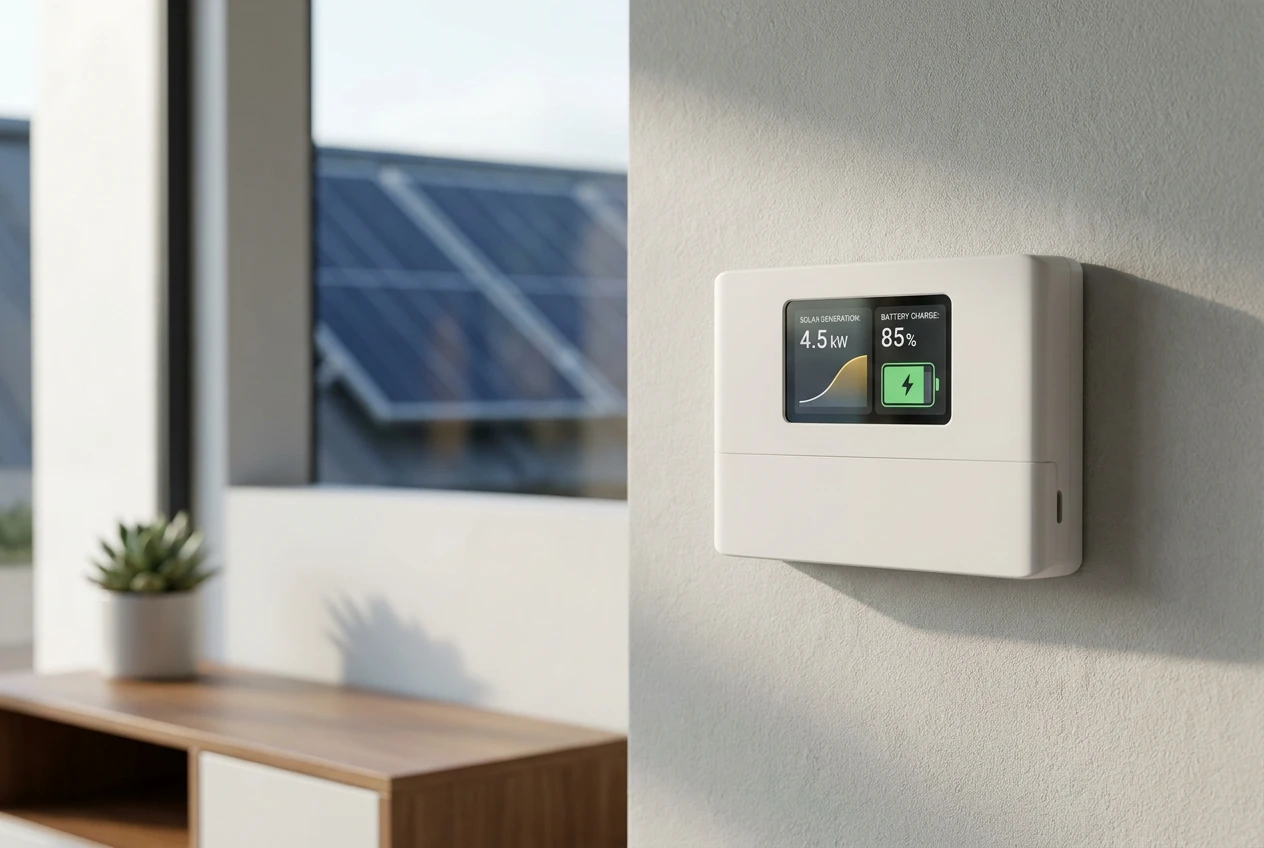
The third layer is the AI energy management controller, a wall-mounted unit running Uniview’s proprietary optimization algorithm. The controller monitors real-time electricity pricing from the local distribution utility, weather forecasts from the Philippine Atmospheric, Geophysical and Astronomical Services Administration (PAGASA), and household consumption patterns logged over a rolling 30-day window. When grid electricity costs exceed a user-defined threshold, the system automatically draws from battery reserves. When solar generation exceeds immediate household demand, surplus power charges the battery bank before any excess is sold back to the grid under the country’s net metering program.
How the 4-Millisecond Backup Switch Works
The backup switching mechanism relies on a solid-state transfer switch rather than the electromechanical relays used in traditional automatic transfer switches. Solid-state switches eliminate the 15-30 millisecond mechanical actuation delay inherent in relay-based designs, reducing the switchover window to under 5 milliseconds. During field testing, Uniview engineers measured an average switching time of 3.8 milliseconds across 500 simulated brownout events, with 98% of switches completing within 4.2 milliseconds.
Voltage Tolerance Engineering for Weak Grids
The 170V-290V operating range is achieved through a buck-boost converter topology that steps input voltage up or down to maintain a stable 220V output regardless of grid conditions. Most consumer inverters use a simpler buck converter that can only step voltage down, limiting their low-voltage tolerance to around 190V. Hopetrek’s dual-direction converter adds approximately 12% to the inverter’s bill of materials cost but eliminates the need for a separate voltage stabilizer, a device that 34% of Philippine households currently purchase as a standalone appliance according to a 2025 market survey by Kantar Worldpanel.
AI Optimization Logic and Learning Curve
The AI controller’s optimization algorithm runs a predictive model that forecasts the next 48 hours of household energy demand based on historical usage, scheduled appliance timers, and occupancy patterns detected through optional motion sensors. The system requires approximately 14 days of baseline data collection before the predictive model achieves stable accuracy, after which Uniview claims users see an average 23% reduction in grid electricity purchases compared to a non-optimized solar-plus-storage setup.
Who Benefits Most From This Integration
Hopetrek’s value proposition is strongest for three customer segments. The first is work-from-home professionals and small business owners who cannot tolerate power interruptions during business hours. A freelance software developer in Quezon City loses an estimated RM 800 per brownout event when client calls drop and unsaved work is lost, making the system’s backup capability a direct revenue protection measure.
The second segment is households in provinces with unreliable grid service, particularly in Mindanao where the average brownout duration reached 4.2 hours per event in 2025 according to the Department of Energy. For these users, the battery bank’s 6-12 hour runtime eliminates the need for diesel generators, which cost approximately RM 45 per hour to operate at current fuel prices.
The third segment is early adopters of electric vehicles who need home charging infrastructure. Hopetrek’s ecosystem includes a 7kW AC charger that draws power from solar during the day and from the battery bank during off-peak evening hours when grid electricity is cheapest. The system can fully charge a 60kWh EV battery in approximately 9 hours, with the AI controller scheduling the charge cycle to maximize solar utilization and minimize grid draw during peak-rate periods.
Comparing Hopetrek to Incumbent Solutions
| Feature | Hopetrek Ecosystem | Standalone Solar + UPS | Diesel Generator Backup |
|---|---|---|---|
| Backup switching time | 4 milliseconds | 15-30 milliseconds (relay UPS) | 8-15 seconds (manual start) |
| Voltage tolerance | 170V-290V | 190V-250V (typical inverter) | N/A (generates own power) |
| AI optimization | Yes, 48-hour predictive model | No | No |
| Operating cost per hour | RM 0 (solar) to RM 8 (grid) | RM 8-12 (grid only) | RM 45 (diesel fuel) |
| Maintenance interval | 24 months (battery health check) | 12 months (battery replacement) | 6 months (oil change, filter) |
| Noise level | Silent | Silent | 70-85 dB |
The cost comparison favors Hopetrek over a 10-year ownership period despite a higher upfront investment. A complete Hopetrek system for a three-bedroom home costs approximately RM 450,000 installed, compared to RM 180,000 for a standalone 5kW solar array plus RM 60,000 for three UPS units, or RM 85,000 for a 5kVA diesel generator. However, the diesel generator incurs RM 16,200 per year in fuel costs assuming 360 hours of annual runtime, while the standalone solar setup provides no backup power during nighttime brownouts.
The Installer Empowerment Program and Local Service Network
Uniview is addressing the last-mile service challenge through its Installer Empowerment Program, launched concurrently with the product ecosystem. The program offers Filipino electrical contractors and solar installers a three-tier certification path covering system design, installation, and troubleshooting. Level 1 certification requires a two-day classroom course and a supervised installation, qualifying the installer to handle residential systems up to 10kW. Level 2 adds commercial system training for 15kW-50kW installations. Level 3 certifies installers for grid-tied systems that participate in the net metering program, requiring additional training on utility interconnection standards and the Philippine Electrical Code.
Certified installers receive access to a local spare parts inventory maintained at Uniview’s Laguna distribution center, with a commitment to ship replacement inverters, battery modules, and control units within 24 hours to Metro Manila addresses and 48 hours to provincial locations. The company is also establishing a 24-hour technical support hotline staffed by Tagalog- and English-speaking engineers, a service tier that most international smart home brands do not offer in the Philippine market.
Uniview is providing demo units to the first 50 certified installers, allowing them to showcase the system at client sites before purchase. The demo program includes marketing collateral, co-branded social media assets, and a lead referral system that routes inquiries from Hopetrek’s website to nearby certified installers based on postal code.
What the Launch Signals About the Philippine Smart Home Market
Hopetrek’s entry validates a market thesis that Philippine consumers will pay a premium for integrated systems that solve local infrastructure problems rather than importing solutions designed for stable-grid markets. The 4-millisecond switching speed and 170V-290V voltage tolerance are engineering choices that would be unnecessary in Singapore, Japan, or South Korea, where grid reliability and voltage stability are taken for granted.
The launch also reflects a broader shift in the smart home category from device-centric to ecosystem-centric value propositions. Earlier entrants like Xiaomi and TP-Link focused on selling individual smart plugs, bulbs, and cameras that users assembled into ad-hoc systems. Hopetrek’s approach inverts this model by starting with the infrastructure layer, solar and storage and backup power, and treating home automation as a secondary feature enabled by the AI controller’s presence in the home network.
Uniview’s decision to establish local service infrastructure before scaling sales suggests the company learned from the challenges faced by earlier solar-plus-storage vendors in the Philippines, several of which exited the market between 2022 and 2024 after failing to build reliable installation and maintenance networks. The Installer Empowerment Program’s emphasis on certification and spare parts availability addresses the two most common customer complaints in post-installation surveys: long wait times for service calls and difficulty sourcing replacement components.
Frequently Asked Questions
How much does a complete Hopetrek system cost for a typical home?
A complete system for a three-bedroom home with 10kWh battery storage and 7kW solar panels costs approximately RM 450,000 installed, including the AI controller, inverter, and one year of monitoring service. Larger homes requiring 15kW solar and 20kWh storage range from RM 650,000 to RM 750,000.
Can the system work during a total grid blackout?
Yes. The system operates in island mode during grid outages, drawing power from the battery bank and solar panels without any grid connection. The battery provides 6-12 hours of backup power depending on household load, and solar panels continue generating power during daylight hours to extend runtime.
What happens when the battery is fully depleted?
When the battery state of charge drops below 10%, the system enters a load-shedding mode that disconnects non-essential circuits while maintaining power to critical loads like refrigeration and security systems. Users can configure which circuits are prioritized through the mobile app.
Is the system compatible with existing solar panels?
Hopetrek’s inverter can integrate with most third-party solar panels that meet Philippine Electrical Code standards, but Uniview recommends using their own panels to ensure warranty coverage and optimal performance. Existing solar installations can be retrofitted with the Hopetrek battery and AI controller as an upgrade path.
How long does installation take?
A typical residential installation requires two to three days. Day one covers rooftop solar panel mounting and electrical rough-in. Day two involves inverter and battery installation, grid interconnection, and system commissioning. Day three is reserved for user training and mobile app setup.
What maintenance does the system require?
The battery bank requires a health check every 24 months, which involves measuring cell voltage balance and capacity retention. Solar panels should be cleaned every six months to maintain generation efficiency. The inverter and AI controller are maintenance-free for the first five years under normal operating conditions.
Can the system charge an electric vehicle overnight?
Yes. The integrated 7kW AC charger can fully charge a 60kWh EV battery in approximately 9 hours. The AI controller schedules the charge cycle to prioritize off-peak grid electricity rates and available battery storage, minimizing charging costs.


Google Opens Gmail to Voice and Gates Docs Live

Lenovo Prices the IdeaPad Vibe Against Apple’s $699 Neo

Xbox Caps Game Pass Cloud Gaming at 15 Hours

GTA 6 DualSense Controllers Follow Sony’s Usual $84.99 Script

South Korea Retail Investors Face Reckoning After KOSPI AI Rally Collapses

Surrey AI Maps Three Heart Attack Paths and Their Molecular Roots

Germany Locks Neutral Apple ATT Prompts Across Most of Europe

Apple’s 5% EU Fee Quietly Rewrites Alternative App Store Math

Apple’s EU Fee Truce Cuts Complexity but Leaves Rivals Fuming

Pixel 11 Pro Fold Trades Thinness for Durability and Seven-Year Stay

Oracle Cuts 21,000 Jobs in a Year, Cites AI in 10-K Filing

Fable 5 and Mythos 5 Return as US Lifts Anthropic Export Controls

SpaceX’s Google Deal Turns a Rocket Company Into a Cloud Landlord

CD Projekt Red Co-CEO: Redemption Arc Isn’t Done, Witcher 4 in 2027

XPL Rallies 30% Ahead of Plasma One Card Tier Launch

Google Search Profiles Build a Follow Graph Inside Discover

DGO App Brings Rs 549 Mobile Pass for FIFA World Cup 2026 in Nepal

Moonshot AI Targets $30 Billion in China’s Fastest AI Funding Sprint

Oppo’s ColorOS 17 Eligibility List Leaves A-Series Buyers Behind

Microsoft Xbox Layoffs Start in July as Sharma Slams 3% Margin
-
 AI2 months ago
Oracle Cuts 21,000 Jobs in a Year, Cites AI in 10-K Filing
-
 AI2 months ago
Fable 5 and Mythos 5 Return as US Lifts Anthropic Export Controls
-
 AI3 months ago
SpaceX’s Google Deal Turns a Rocket Company Into a Cloud Landlord
-
 GAMING2 months ago
CD Projekt Red Co-CEO: Redemption Arc Isn’t Done, Witcher 4 in 2027
-
 CRYPTO3 months ago
XPL Rallies 30% Ahead of Plasma One Card Tier Launch
-
 NEWS3 months ago
Google Search Profiles Build a Follow Graph Inside Discover
-
 APPS3 months ago
DGO App Brings Rs 549 Mobile Pass for FIFA World Cup 2026 in Nepal
-
 AI3 months ago
Moonshot AI Targets $30 Billion in China’s Fastest AI Funding Sprint