
NEWS
Metalenz Polar ID Goes Under OLED as Flagships Wait
Metalenz showed payment-grade Polar ID through a lit OLED, but Android flagships still unlock and pay with under-display fingerprints.

Metalenz showed Polar ID authenticating a face through a fully lit OLED at Display Week on May 4, 2026, and called it payment-grade. The Boston optics firm ran the demo in the I-Zone in Los Angeles, with the phone’s screen powered on. Rob Devlin, Metalenz CEO and co-founder, put the hidden camera on devices in 2028, a year after Polar ID itself is due in 2027.
The cutout story is the easy one. The harder one is that Android flagships already confirm payments with an under-display fingerprint, so Polar ID has to displace a sensor that is already invisible, not only beat a 2D selfie face unlock.
Polar ID Authenticated a Face Through a Lit OLED
On May 4, 2026, Metalenz said it had payment-grade face authentication under OLED without giving up security, cost, or screen space. The company framed Polar ID Under Display as a way to bring high-security face checks to Android. It also claimed a 0% spoof acceptance rate, and said the polarization signal that underpins that figure loses nothing through the panel.
Devlin’s pitch was not a prettier punch-hole. He tied the hardware to tap-to-pay and to face checks that keep running while software agents act on a phone.
For the future of digital payment and continuous authentication while using AI agents, the interaction needs to be truly seamless. Polar ID makes this possible at scale for the first time. There is no longer a need to compromise. Users can now experience a continuous display and touch-free security. It starts at the metasurface hardware and flows to user experience.
Rob Devlin, CEO and co-founder, Metalenz, May 4, 2026 announcement
Over a video call around the same demo, a reporter watched Polar ID under OLED accept Devlin’s face and reject him in a 3D mask. Devlin said third parties have already tested Polar ID against masks of any quality and that it met the highest security bars those labs use. He did not name the labs, and Metalenz has not posted a public iBeta or FIDO certificate for the under-display unit.
The selfie camera still sits in a visible hole. Polar ID would sit beside it, under the pixels, which is the version of Polar ID already sitting under OLED glass the company now wants phone makers to tool around. Devlin also said the panel needs a thinned-out pocket for the sensor, so a display maker has to play along. “You can’t really even tell that there is a thinned-out region,” he said.
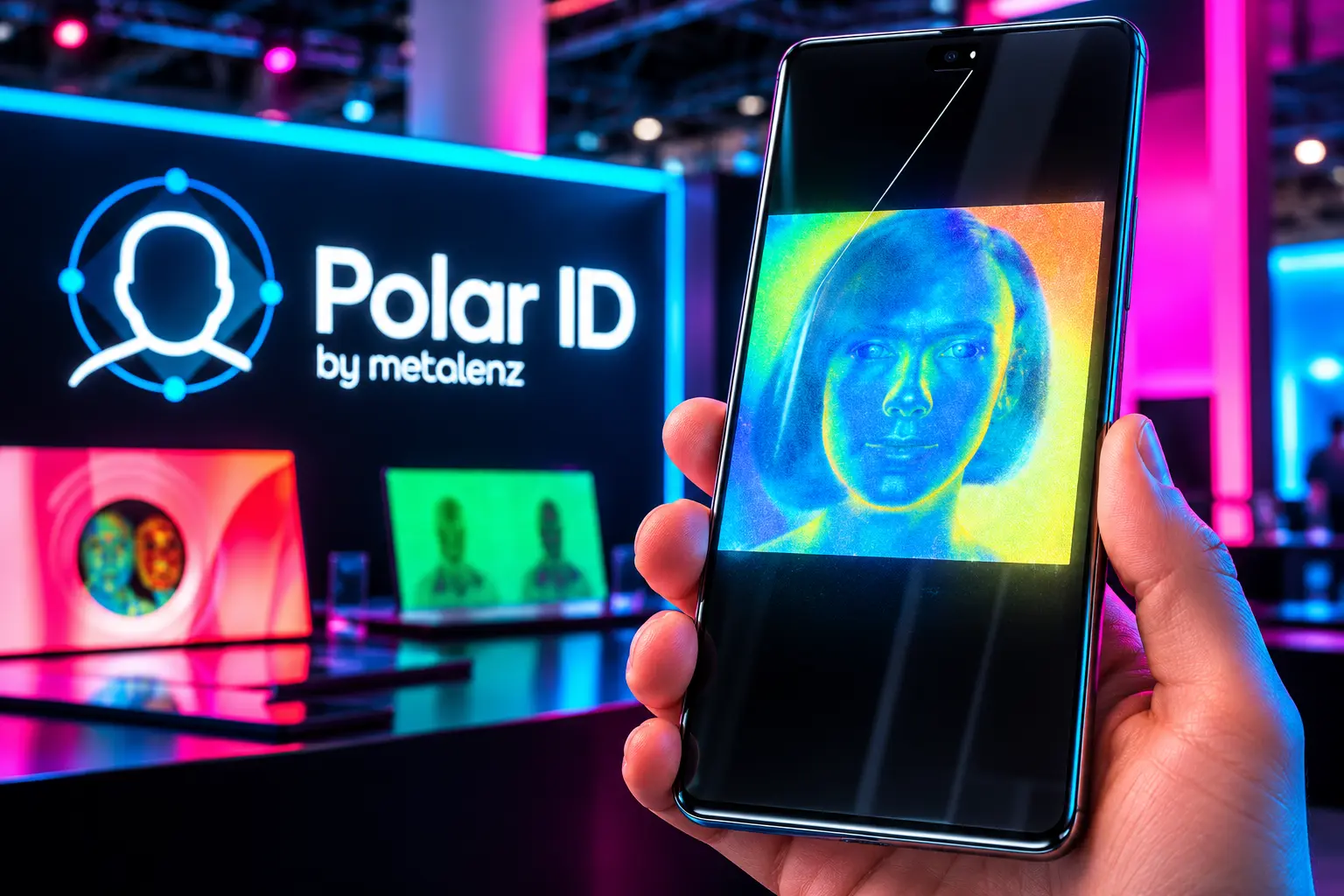
Polarization Survives Glass That Ruins Selfie Photos
Phone makers have tried cameras under OLED for years, mostly for selfies. Light transmission drops, effective resolution falls, and diffraction blurs the image. Samsung put an under-display camera in several Galaxy Z Fold phones, then went back to a punch-hole on the Z Fold7 because the photos were not good enough.
Polar ID is not trying to take a pretty RGB still. It is a near infrared polarization camera at 940nm with one active illuminator and a meta-optic that reads how light is polarized when it bounces off a face. Skin returns a different polarization signature than a photo, a silicone mask, or a prosthetic, which is why Metalenz argues a 3D mask fails even when it fools a selfie-camera unlock.
Devlin said hiding the sensor under OLED distorts the signal a little and cuts intensity, while the polarization data stays largely the same. That is the whole trick. A selfie under-display camera is judged on a picture people look at. Polar ID is judged on a material signature people never see.
WHERE SELFIE UNDER-DISPLAY CAMERAS BREAK
- Light loss: OLED pixels block and scatter most of the light a normal camera needs, so portraits look soft and dim.
- Diffraction blur: The pixel grid acts like a filter and throws patterned artifacts across the image.
- Yield and cost: Aligning a camera under a working panel is harder than cutting a punch-hole, which is why only a few brands even tried.
- Polar ID’s bet: The 940nm polarization map can take that hit and still separate live skin from a mask, so image prettiness is not the pass/fail test.
Metalenz builds that thin optic as a metasurface, a single flat lens covered in nanostructures that bend light the way a stack of plastic elements used to. The firm, spun out of Harvard’s Capasso Lab with an exclusive license on core metasurface patents, now lists 150+ patents and patent applications. The same class of optic already replaced bulkier lens stacks in time-of-flight modules; Metalenz said in November 2025 that more than 140 million of its optics sit in consumer devices.
Payment-Grade Face Without a Dot Projector
Apple’s Face ID still needs a structured-light module: a flood illuminator plus a dot projector that sprays a known pattern onto the face, read by an infrared camera. That package is why the iPhone keeps Apple’s Dynamic Island camera cutout, the largest front hole in a major phone. Most Android phones never shipped an equivalent, so they never needed that island. They shipped 2D face unlock from the selfie camera, which is fast in good light and weak against a high-quality 3D mask, and they put the payment-grade check in a fingerprint sensor.
Polar ID’s product page says it drops the projector. One low-profile near-infrared polarization camera and one 940nm lamp replace the two-illuminator structured-light stack. Authentication is a single image, not a depth map built from a dot pattern. Metalenz claims more than 10x the resolution of structured light, enough to work with sunglasses and a surgical mask, and it says the 940nm band holds up in daylight, at night, indoors, and outdoors. In a February 26, 2024 release it put the size and cost cut at 50% versus traditional face unlock.
That is the Android opening Metalenz has sold since October 26, 2023, when Polar ID debuted at Qualcomm’s Snapdragon Summit on a Snapdragon 8 Gen 3 reference phone. Pawel Latawiec, Metalenz’s CTO, said the firm ran critical pieces of the model inside Qualcomm’s Hexagon NPU secure framework so the unlock would be hard to pull off the chip. Judd Heape, then vice president of product management at Qualcomm Technologies, said Spectra ISP and Hexagon NPU were built for this class of imaging.
FOUR WAYS PHONES CHECK A FACE OR A FINGER
| System | How it reads you | Front cutout | What it is trusted for |
|---|---|---|---|
| Polar ID (Metalenz) | 940nm polarization, single image, no dot projector | None for the auth camera if under OLED; selfie hole stays | Metalenz calls it payment-grade; 0% spoof rate claimed |
| Apple Face ID | Structured light (dots plus IR camera) | Dynamic Island, still the largest major-phone cutout | Unlock, Apple Pay, and app passkeys on-device |
| Android 2D face unlock | RGB selfie camera | Punch-hole | Convenience unlock; not treated as a payment biometric |
| Ultrasonic in-display fingerprint | Sound map of the finger under glass | None | Unlock and mobile payments on current Galaxy flagships |
Payment-grade, in this market, is a testing bar as much as a slogan. Passkey programs and banks lean on FIDO biometric testing thresholds for mobile, where BioLevel 2 caps the impostor attack presentation accept rate at 7%. Metalenz’s 0% figure, if an accredited lab ever posts it, would clear that cap. Until a named lab does, it remains the company’s claim.
On February 23, 2026, Metalenz added Polar 3D on the same Polar ID hardware: one-shot shape-from-polarization for relightable selfies and on-device avatars. The security camera and the face scanner for a digital double become one module. That is the second product Devlin is really selling to phone makers, a sensor that both unlocks the wallet and feeds an on-device face model.
Why Galaxy Flagships Still Trust Fingerprints
If Polar ID only had to beat 2D face unlock, the demo would be enough. It has to beat a fingerprint reader that already lives under the glass and already signs for Google Wallet on a Galaxy. That sensor needs no thinned OLED zone, no 940nm lamp beside the selfie hole, and no new foundry module in the 2027 bill of materials.
Samsung’s name is already on Polar ID, which is what fed the Galaxy rumor. On February 26, 2024, at Mobile World Congress in Barcelona, Metalenz named Samsung’s ISOCELL Vizion 931 as Polar ID’s sensor. That deal is a camera-chip supply line from Samsung’s System LSI group. It is not a promise that a Galaxy S phone will ship the stack.
In November 2025, firmware tipsters said early Galaxy S27 Ultra builds mentioned Polar ID v1.0 and a polarized-light path tied to a front Vizion sensor. In early September 2026, other tipsters pushed the other way: no sign of dedicated face hardware on the next Ultra, and a plan to keep refining the ultrasonic fingerprint reader plus the usual selfie-camera face unlock. Samsung has not confirmed either version.
WHAT WE KNOW
- The sensor deal: Metalenz publicly chose the ISOCELL Vizion 931 as Polar ID’s image sensor on February 26, 2024.
- The foundry path: Polar ID was declared ready for mass production through UMC on November 12, 2025, for devices in 2027.
- The hidden camera: The under-display unit was demoed May 4, 2026, and Devlin put it on the market in 2028.
WHAT IS UNCONFIRMED
- A Galaxy win: No public Samsung Mobile commitment puts Polar ID in the S27 Ultra or any other 2027 flagship.
- The September skip: Tipsters said in early September 2026 that dedicated face hardware is off the Ultra; Samsung has not said so.
- Lab paperwork: Devlin cites unnamed third-party mask tests; no public FIDO or iBeta letter is attached to the under-display camera.
Waiting for 2028 is a rational OEM move even if Polar ID works. A 2027 Polar ID that still sits next to a selfie punch-hole does not give Android the uninterrupted front Apple lacks. An ultrasonic fingerprint already does the payment job without a new optical hole. Polar ID has to win on speed, spoof resistance, and agent-style continuous checks, not on “we hid a camera.”
UMC Bonds the Meta-Optic onto the Sensor
The module is a semiconductor product, not a tiny webcam glued under glass. On November 12, 2025, Metalenz and United Microelectronics Corporation said Polar ID was ready for mass production. UMC makes the meta-optic on a 40nm process and bonds it to the image sensor wafer-on-wafer in its 300mm (12-inch) lines. Steven Hsu, UMC vice president of technology development, said the foundry has worked with Metalenz on metasurfaces since 2021.
Devlin used that announcement to talk about volume, not about one flagship. “Polar ID is ready to meet the demands of high-volume consumer electronics, and to bring secure, affordable face authentication to billions of devices,” he said. Hsu called the work an expansion into sensor-integrated metasurfaces. The 140 million optics already in the market are the older lens-replacement parts; Polar ID is the first time Metalenz is selling a new sensing mode at that scale.
Display integration is a second factory problem. Devlin said the OLED needs a thinner pocket and that Metalenz was in early talks with a few of the bigger phone makers, with no names. Until a panel supplier signs that pocket, the I-Zone unit is a demo sitting under someone else’s glass.
POLAR ID’S PATH FROM SUMMIT DEMO TO HIDDEN CAMERA
- October 26, 2023: Metalenz unveils Polar ID at Qualcomm’s Snapdragon Summit on a Snapdragon 8 Gen 3 reference phone, with no dot projector.
- February 26, 2024: Metalenz names Samsung’s ISOCELL Vizion 931 as the Polar ID image sensor at MWC in Barcelona, citing a 50% size and cost cut.
- November 12, 2025: Metalenz and UMC say Polar ID is ready for mass production on 40nm, wafer-on-wafer, 300mm lines.
- February 23, 2026: Polar 3D extends the same hardware into one-shot 3D faces for avatars and relightable selfies.
- May 4, 2026: Polar ID Under Display runs under a powered OLED at Display Week in Los Angeles; Devlin points to a 2028 market date.
- September 2026: Galaxy tipsters split, with one camp reading Polar ID out of S27 Ultra firmware and another saying the Ultra keeps the ultrasonic fingerprint path.
That sequence is a supply chain looking for a phone, not a phone looking for a camera. Qualcomm silicon, a Samsung sensor, and a UMC optic can still miss a flagship if the display group will not thin a zone, or if the biometric group will not reopen a payment stack that already works with a finger.
Polar ID Reaches Phones in 2027, Under Glass in 2028
Two dates now sit on the same brand. Polar ID, the projector-free polarization camera, is supposed to land in laptops and phones in 2027, which is the window UMC opened in November 2025. Polar ID Under Display, the unit that hides beside the selfie camera, is “likely an extra year out” and should reach the market in 2028, Devlin said in May.
Those are not the same product. A 2027 Polar ID can still need a small front opening, which is exactly the hole Android brands have spent a decade shrinking. The 2028 unit is the one that matches the “kills the cutout” headline, and even then only for the security camera. Selfies stay in a punch-hole unless a separate under-display RGB camera gets good enough, which Samsung already walked away from on the Z Fold7.
Devlin’s other line from the May briefing is the one phone makers will actually weigh. “Folks have decided to differentiate along a continuous display versus Apple’s interrupted display,” he said. Polar ID Under Display is how Android keeps that bet while adding a Face ID-class check. It is also how Metalenz sells a module into the mid-range, where a structured-light island was never going to fit the cost sheet.
The missing signature is still a display partner and a phone brand willing to swap, or even sit beside, an ultrasonic fingerprint that already authorizes a payment. Polar ID is on a foundry process and a Snapdragon reference board. The under-display camera is on a show-floor OLED. Between 2027 and 2028, the question is which of those two facts a flagship will ship.

Instagram Plus Tests a Read-Only Mode That Cuts Stories

Altman Asks the Public to Accept Some AI Harm

Google Freezes OSS VRP Product Reports After AI Flood

AI Agents Make Payment Rails the Scarce Prize

Turkey’s Crypto Boom Now Runs Through Three Banks

Fable 5 Came Back Under a Commerce On-Off Switch

Google’s SpaceX GPU Lease Has a Sept. 30 Deadline

Plasma One’s XPL Locks Face a 1.81 Billion Cliff

DGO’s Rs 549 World Cup Pass Cost Fans Sleep and Data

Moonshot AI’s $30 Billion Ask Became a $35 Billion Close
-
 AI4 months ago
Fable 5 Came Back Under a Commerce On-Off Switch
-
 AI5 months ago
Google’s SpaceX GPU Lease Has a Sept. 30 Deadline
-
 CRYPTO4 months ago
Plasma One’s XPL Locks Face a 1.81 Billion Cliff
-
 APPS4 months ago
DGO’s Rs 549 World Cup Pass Cost Fans Sleep and Data
-
 AI5 months ago
Moonshot AI’s $30 Billion Ask Became a $35 Billion Close
-
 NEWS5 months ago
ColorOS 17 Device List Spans Oppo, OnePlus and Realme
-

 GAMING4 months ago
Xbox Cuts 3,200 Jobs After Five Years of Thin Returns
-

 GAMING4 months ago
The RTX 4050 Under Rs 70,000 Hides a Wattage Gap