
AI
ChatGPT Table Booking Favors Yelp Guest Manager Restaurants
ChatGPT books Yelp waitlists only for Guest Manager restaurants, while OpenTable and Resy share the same chat desk in the U.S. and Canada.

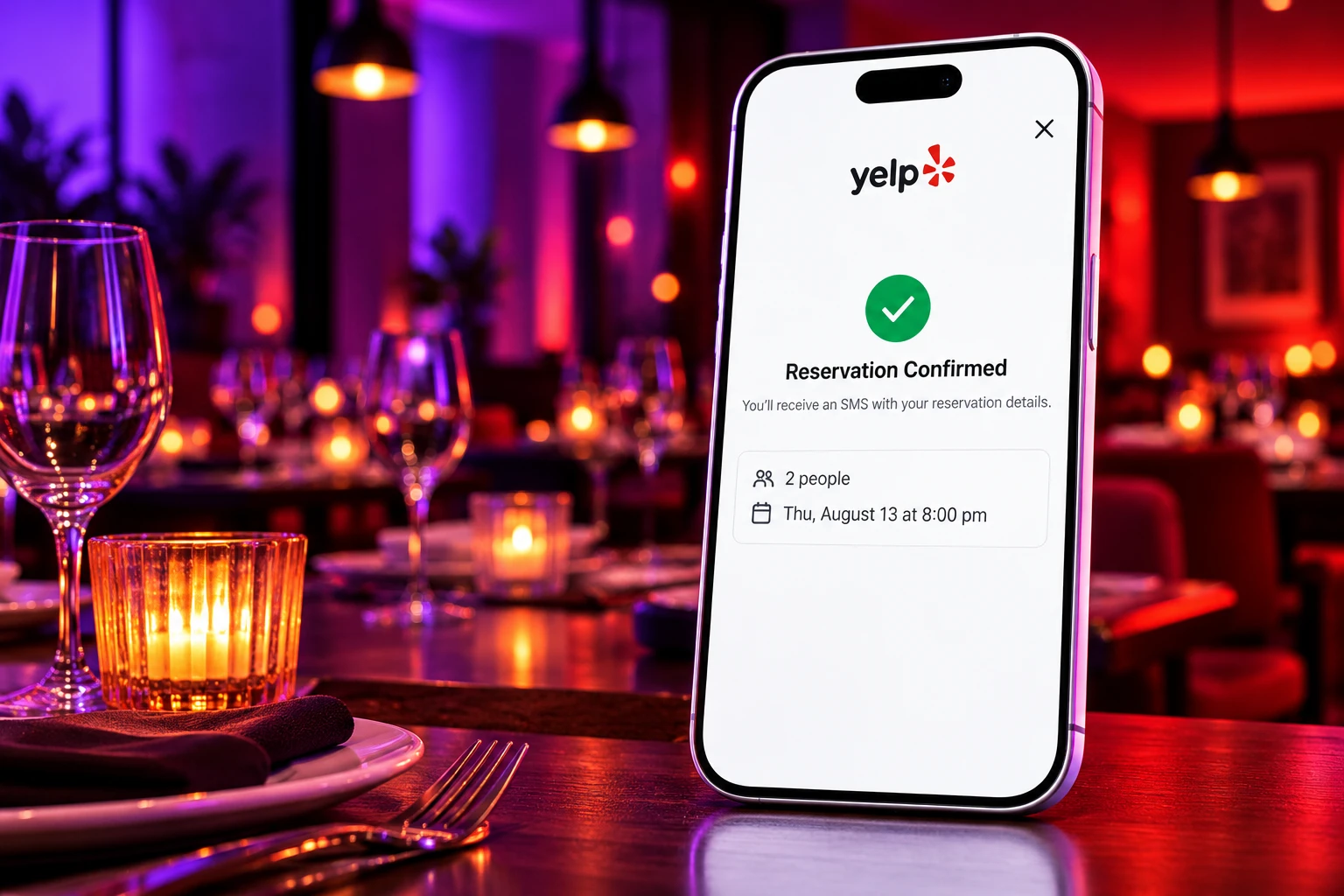
ChatGPT now books restaurant tables through OpenTable, Resy, and Yelp, and Yelp waitlists only for Guest Manager rooms. OpenAI switched that on August 10, 2026, for diners in the U.S. and Canada on eligible consumer plans.
Yelp framed the launch as a faster night out. The party that actually gets a new door is a restaurant already running Yelp Guest Manager, because that system is what the chat reads for Yelp times and the waitlist.
No Extra Setup for Guest Manager Rooms
Yelp told restaurants the ChatGPT hook arrives with no extra setup. If a dining room already uses Guest Manager, its open tables show in the chat on their own, and a finished booking lands next to every other reservation in that host-stand tool.
The product site now asks those rooms to list those tables inside ChatGPT, alongside Yelp, Reserve with Google, Apple Maps, Facebook, and Instagram. Chad Richard, Yelp’s senior vice president of business and corporate development, wrote that the gain for the restaurant is reach at the moment someone is already picking a place.
For restaurants using Yelp Guest Manager this integration expands their access to the largest restaurant consumer network in the U.S., helping them fill more tables and reach more guests exactly when discovery happens.
Chad Richard, Senior Vice President of Business and Corporate Development, Yelp
Yelp’s restaurant site says 11,000+ rooms already seat diners with Guest Manager, which is the pool that inherits the chat booking. A room on OpenTable or Resy can still be booked in ChatGPT through those other pipes. It does not get Yelp’s waitlist button unless it also runs Guest Manager.
Yelp prices Guest Manager at $129 to $349 a month with no cover fees, and it says restaurants that switched from OpenTable saved an average of $163 a month. Its comparison table puts Yelp at 74 million monthly visitors against OpenTable’s 8.5 million, and it says OpenTable still charges $1 to $1.50 per network cover. Those figures are Yelp’s sales math, not an independent count of who actually holds the tables.
OpenAI Turned On Three Booking Networks
Yelp’s own post asked people to book a table or join a waitlist without leaving ChatGPT. The same morning, the @ChatGPT account posted a wider desk than Yelp’s blog described, naming OpenTable and Resy next to Yelp.
Ask. Book. Eat. Repeat.
ChatGPT can now help you find and book a table with @OpenTable, Resy, and @Yelp 🍽️ pic.twitter.com/pkDLvWH6uS
— ChatGPT (@ChatGPT) August 10, 2026
OpenAI’s help center says ChatGPT may show availability from OpenTable, Resy, or Yelp, then let you reserve or send you to the provider to finish. OpenTable times run globally. Resy is United States only. Yelp is the United States and Canada. Waitlists in that mix are the Yelp product.
HOW THE ASSISTANTS SPLIT THE DESK
| Assistant | Booking networks | Where it works | After the hold |
|---|---|---|---|
| ChatGPT | OpenTable, Resy, Yelp | OpenTable global; Resy in the U.S.; Yelp in the U.S. and Canada | Yelp changes go through Yelp, not the chat |
| Gemini | OpenTable via Reserve with Google | Documented for U.S. diners on Gemini | Can find, book, and manage OpenTable holds |
| Microsoft Copilot | OpenTable | In the Copilot app | Cancel and edit in the OpenTable app |
A kitchen that sits on OpenTable can still get booked in ChatGPT even if it never paid Yelp for Guest Manager. Yelp’s waitlist is the piece that does not travel with those other networks, which is why the Guest Manager invoice suddenly sits on an AI distribution channel rather than only on a host iPad.
Who Can Book a Table Inside ChatGPT?
The help center is narrower than the marketing posts. Restaurant search is tied to specific consumer models and plans, and work seats are left out.
WHO GETS THE BOOKING BUTTON
- The models: OpenAI says reservation search runs on GPT-5.6 Sol or GPT-5.6 Luna.
- The plans: It is limited to eligible consumer plans on web, mobile, and desktop.
- The lockout: ChatGPT Work, plus Business, Enterprise, and Edu plans, do not get restaurant search.
- The map: OpenTable is global, Resy is the United States, and Yelp is the United States and Canada, with open times varying by restaurant.
Office lunches on a company ChatGPT seat are out. The booking path is a consumer feature, which cuts it off from the team thread and the corporate card. Depending on the provider, you may finish inside ChatGPT or continue on OpenTable, Resy, or Yelp, and OpenAI says a card hold can send you out of the chat to complete the booking.
The Chat Hands the Booking Back to Yelp
Yelp was blunt about the last mile. Once the table is held through its pipe, changes go through Yelp, not through the same thread that booked it. OpenAI’s help center says a reservation is confirmed when OpenTable, Resy, or Yelp says so, which is another way of stating that the chatbot is a front door, not the system of record.
That handoff is the product. ChatGPT can collect party size, date, time, and preferences, then pass the hold to whichever network actually owns the floor plan. For a Guest Manager restaurant, the new cover shows up in the same tool as walk-ins and Yelp-app bookings. For the diner, Saturday night at 7:30 still lives in Yelp’s app if the time has to move.
Yelp leaned on Morning Consult to argue that people want that last step on a name they already know. In that survey, 65% of respondents said being able to take action, such as making a reservation, on trusted platforms matters when they use AI for local discovery.
WHAT YELP CITED FROM MORNING CONSULT
- AI search use: 65% of Americans have used AI search, a separate figure from the take-action share above.
- Thin trust: Only 15% trust AI search “a lot.”
- Show the source: 72% say AI platforms should always show where information comes from.
Yelp’s July content deal is what puts those sources in the answer. Reviews, ratings, photos, and business details now feed local replies, with Yelp branding attached and OpenAI still in control of the layout. Yelp CEO Jeremy Stoppelman said, “If you want to answer local queries, you really need Yelp.” The August booking button is the conversion step bolted onto that feed, and it only converts on networks ChatGPT is allowed to write into.
Gemini, Copilot, and OpenTable’s Search Door
Google already treated OpenTable as the default restaurant rail. Gemini can find, book, and manage OpenTable reservations through Reserve with Google, which is a wider in-chat life cycle than Yelp currently gives ChatGPT after the hold. Microsoft Copilot can book OpenTable tables in its app, then sends edits and cancellations back to OpenTable, matching Yelp’s ChatGPT limit on that point.
OpenTable’s own restaurant pitch is that its Reserve with Google integration puts a reserve button on search and, through Gemini Spark, can complete a booking from a line like an upscale table Friday at 7 p.m. Ask Maps can take a date, time, and party size and book from live OpenTable inventory. OpenTable calls itself first to market with Google on that path.
So the assistants did not pick one winner. Gemini and Copilot sit on OpenTable. ChatGPT sits on OpenTable, Resy, and Yelp at once. Yelp’s unique SKU in that split is the waitlist, plus a sales story it can take to rooms that have not yet left OpenTable: pay Guest Manager, and ChatGPT’s Yelp path lights up without another install.
Yelp Host Already Drops Calls Into OpenTable
The ChatGPT waitlist pitch lands beside a quieter deal Yelp struck 13 days earlier. On July 28, 2026, Yelp Host, the company’s voice bot for restaurant phone lines, began writing reservations into OpenTable. Guests can book, modify, and cancel by phone in the U.S. and Canada, and the hold syncs to OpenTable in real time.
Devana Bhargava, Yelp’s director of product for restaurants, said Host had handled more than 1 million calls by then, growing an average of 38% month over month since an October 2025 launch, measured as of June 2026. On Mother’s Day weekend it handled more than 40,000 calls. Host starts at $249 a month, or $199 a month when bundled with Guest Manager.
Guests have walked up to us in the restaurant to compliment the way their call was handled. That’s not something I expected when we signed up for an AI answering service.
John Gabriel, Owner, The Metropolitan American Diner & Bar
On September 10, 2026, Yelp put OpenAI’s GPT-Live-1 model into Host and into Hatch, its voice tool for home-service firms. The ChatGPT waitlist is one surface. The phone bot is another. Both keep Yelp in the middle of the booking, even when the floor plan still belongs to OpenTable.
HOW YELP GOT INTO THE CHAT
- October 2025: Yelp Host launches as an AI phone answering service for restaurants.
- July 23, 2026: Yelp licenses reviews, ratings, photos, and business details to OpenAI for ChatGPT local answers.
- July 28, 2026: Yelp Host begins booking, editing, and canceling OpenTable reservations by phone.
- August 10, 2026: ChatGPT turns on table booking with OpenTable, Resy, and Yelp, including Yelp waitlists for Guest Manager rooms.
- September 10, 2026: Yelp puts OpenAI’s GPT-Live-1 model into Host and Hatch.
If a restaurant is on none of those three booking networks, ChatGPT can still describe it from reviews, then put the reservation in a room that is actually bookable. The diner sees a helpful chat. The cover goes to whoever already paid for a pipe the assistant is allowed to write into.

Instagram Plus Tests a Read-Only Mode That Cuts Stories

Altman Asks the Public to Accept Some AI Harm

Google Freezes OSS VRP Product Reports After AI Flood

AI Agents Make Payment Rails the Scarce Prize

Turkey’s Crypto Boom Now Runs Through Three Banks

Fable 5 Came Back Under a Commerce On-Off Switch

Google’s SpaceX GPU Lease Has a Sept. 30 Deadline

Plasma One’s XPL Locks Face a 1.81 Billion Cliff

DGO’s Rs 549 World Cup Pass Cost Fans Sleep and Data

Moonshot AI’s $30 Billion Ask Became a $35 Billion Close
-
 AI4 months ago
Fable 5 Came Back Under a Commerce On-Off Switch
-
 AI5 months ago
Google’s SpaceX GPU Lease Has a Sept. 30 Deadline
-
 CRYPTO4 months ago
Plasma One’s XPL Locks Face a 1.81 Billion Cliff
-
 APPS4 months ago
DGO’s Rs 549 World Cup Pass Cost Fans Sleep and Data
-
 AI5 months ago
Moonshot AI’s $30 Billion Ask Became a $35 Billion Close
-

 NEWS5 months ago
ColorOS 17 Device List Spans Oppo, OnePlus and Realme
-

 GAMING4 months ago
Xbox Cuts 3,200 Jobs After Five Years of Thin Returns
-

 GAMING4 months ago
The RTX 4050 Under Rs 70,000 Hides a Wattage Gap