
GAMING
A Fan Decomp Unlocked Paper Mario Star Nova on PC
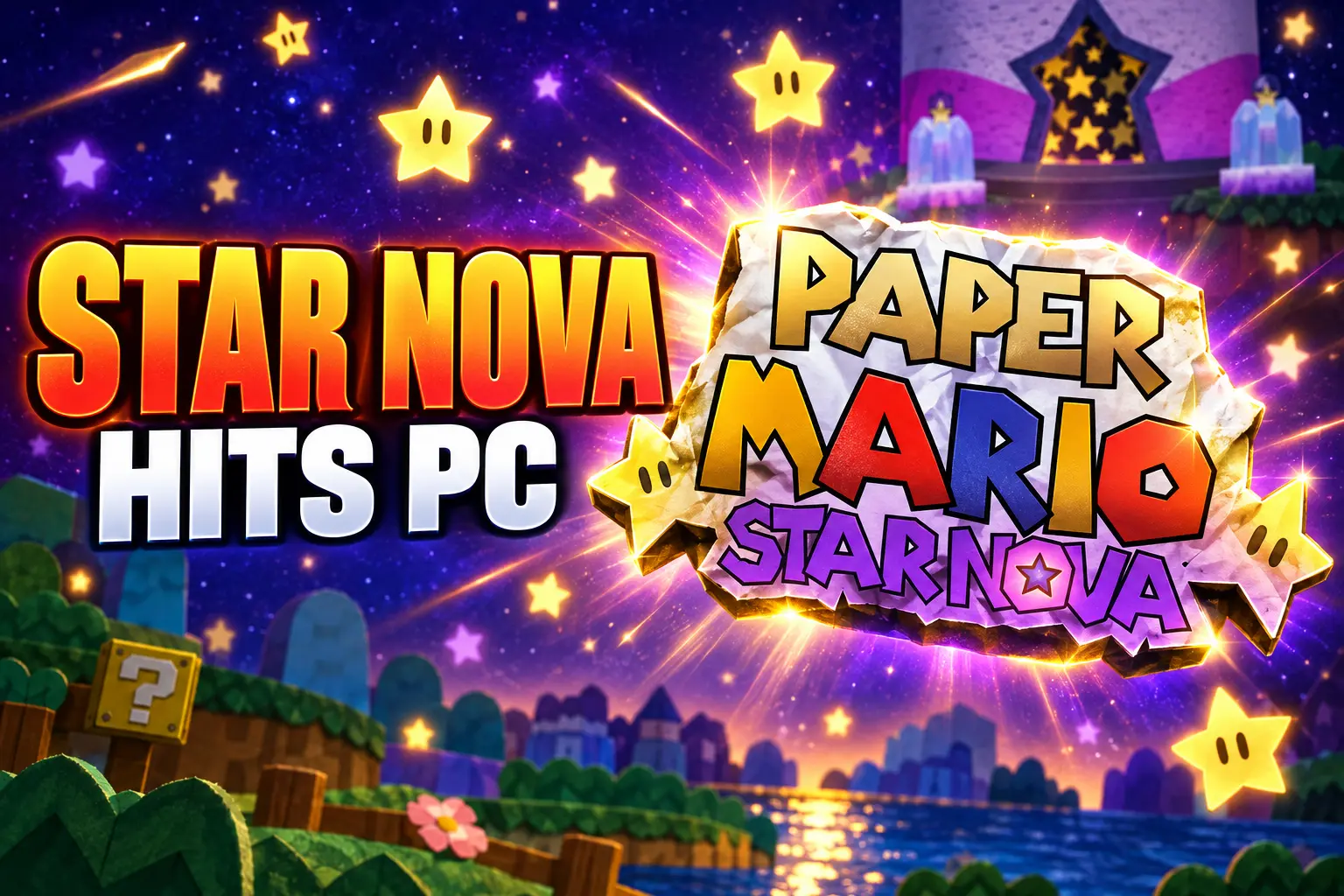
Paper Mario Star Nova is a free Stellaria total conversion on PC, built on the 2023 Paper Mario decomp and still patched as version 1.3.0.

Paper Mario: Star Nova shipped on May 5, 2026 as a free PC patch that swaps the Nintendo 64 RPG for a new kingdom called Stellaria. NicTube, a Paper Mario modder working mostly alone, built it. You still need a Paper Mario 64 ROM from a copy you own, because the download is only the patch.
Launch posts sold it as a cute free Mario RPG. The quieter fact is that a fan decomp team had already rebuilt the original game’s code, and Nintendo has not put a new chapter RPG of this kind on a shelf of its own.
Star Nova Rebuilds Paper Mario From the Ground Up
NicTube’s itch.io page calls Star Nova a full-scale story-based Paper Mario 64 mod. Mario is dumped in Stellaria, a sacred kingdom with a sun-and-star myth glued onto the old battle system, partner slots, and Star Piece hunt. The list on that page is blunt: multiple new chapters, new lore, a new map, new partners, new bosses, and 70+ new Star Pieces.
The free 5.5 MB patch on itch.io is file PMSN_1.3.0.bps. User ratings there sit at 3.9 out of 5 from 12 votes, and the page tags the project as using no generative AI. A secret line on the same page says not to press down during the intro, which can brick that save.
NicTube posted a personal note next to the download, and it is the clearest statement of what this file actually is.
Please keep in mind that, aside from some graphics, it’s only me who worked on this project (which would normally be done by a team of multiple developers) and I put most of my free time into it, so this has been a huge challenge in itself. It might therefore not be perfectly polished or on the same level as a mod/game made by a whole team. To some extent, this project has been more of a personal stepping stone towards my future in actual game development.
NicTube, Paper Mario: Star Nova itch.io page
The full release trailer went up on May 3, 2026 on NicTube’s YouTube channel, two days before the patch. He thanks people for years of support and tells them to enjoy Stellaria.
The Decomp That Made Star Nova Possible
Small Paper Mario hacks already existed. NicTube himself entered Star Haven Jam 2 in 2023 with Paper Mario: Sacred Trio, and his itch.io account also lists Paper Mario: Mystical Mission. Star Nova is a different size of job, a total conversion that throws out the original chapters instead of retinting them.
That scale tracks a quieter project. On April 19, 2023, coder Ethan Roseman said the pmret team had matched every compiled US function after more than three years on a Paper Mario decomp. The public Paper Mario decompilation on GitHub now shows 2,714 commits, 1.6k stars, and 165 forks. The project’s own site later said it had reached 100 percent on the US, PAL, and iQue releases.
Matching the code does not hand anyone Nintendo’s art or music. It does let people rewrite maps, partners, and scripts in C instead of fighting raw N64 assembly. Star Nova is the first widely circulated Paper Mario 64 story mod that treats that opening as a given. Roseman’s team is the party that did the unglamorous work and then watched a one-person RPG ship on top of it.
FROM TRAILER TO 1.3.0
- November 1, 2021: NicTube posts the first Star Nova trailer and lists eight chapters plus sidequests, new partners, and a new villain.
- April 19, 2023: pmret reports a 100 percent match of the US Paper Mario code.
- 2023: NicTube ships jam work such as Sacred Trio while Star Nova stays in the background.
- March 29, 2026: He tells r/papermario the mod took almost five years, will have fewer than eight chapters, and is aimed at April 25.
- May 3, 2026: The date slips from April 25 after bugs and other work, and the release trailer goes live.
- May 5, 2026: The patch launches on itch.io.
- Later in 2026: The public file becomes PMSN_1.3.0.bps, still 5.5 MB, with bug reports pointed at a Discord channel.
The eight-chapter promise from 2021 is the number that stuck to some launch headlines. The game that shipped is shorter than that plan, and Chapter 5 is not a full world.
The Last Original Paper Mario Arrived in 2020
Intelligent Systems and Nintendo have not been idle with the brand. They remade Paper Mario: The Thousand-Year Door for Switch on May 23, 2024, which put the 2004 chapter RPG back in shops with a fresh coat of paint. The last original mainline game, Paper Mario: The Origami King, came out on July 17, 2020, with ring battles and a wide map instead of the old chapter-and-partner RPG loop.
The split in the series is older than Origami King. Paper Mario on N64 (2000 in Japan, 2001 in the US) and The Thousand-Year Door built the template fans still quote: chapters, partners with their own moves, badges, and a collectible hunt. Sticker Star, out November 11, 2012, dropped that RPG skeleton. Color Splash and Origami King kept walking that other path.
Star Nova does not wait for Kyoto to reverse that. It keeps the N64 battle timing, partner switching, and Star Piece checklist, then writes new towns on top. One chapter even pulls unused Sticker Star ideas back into play, including a Chain Chomp partner and a Monty Mole king, which NicTube showed as early as December 7, 2021. The fan game is doing the job the official series left on the table, using the original engine Nintendo is not currently selling as a new adventure.
N64 hackers have a habit of building elaborate sequels instead of small patches, and Star Nova is that habit aimed at Paper Mario. It also sits in a legally dull gray zone. The patch does not ship the ROM. Nintendo has been busy with Switch emulator repos and circumvention gadgets, and as of September the Star Nova page was still up. That is not a blessing. It is a gap.
What Stellaria Puts on the Map
Bowser attacks Toad Town by airship. Mario and Luigi fight him, the ship is hit, and Mario wakes in Stellaria. An amnesiac Biddybud named Solin joins him. The kingdom runs on a future-telling Sunstone that has been smashed, and a Ztar named Cosmozar wants the pieces for a universe-ending event the game calls the Star Nova. Princess Peach is written out on vacation and never appears.
Partners include Solin, Chompy the Chain Chomp (barks translated in parentheses), fire-hat Sunbrero, plant mage Lunara, and Luigi as an optional recruit after Chapter 6. Bowser shows up more than once and even grabs a Sunstone fragment as Infernowser. Merlury, a local shaman, does the lore dumping. Chapter 4 is a fighting tournament in the Sakura Mountains, with Mario billed as Waluigi and a challenger nod to Geno.
STELLARIA’S CHAPTER MAP
| Chapter | Place | What it is |
|---|---|---|
| 1 | Stellaria, after the crash | Setup, Solin, the broken Sunstone |
| 2 | Whittle woods | A poisoned mayor and a plant on a Wiggler’s head |
| 3 | Wild West and Permafrost Palace | Ice tyrant Peepicia; the palace later vanishes from the map |
| 4 | Sakura Mountains | Tournament arc for a Sunstone piece |
| 5 | Nightmare, not a full world | A vision of the Star Nova plus a Dark Mario fight |
| 6 | Myshroomia | Dream logic, shrink mushrooms, a house of cards, Bowser as boss |
| 7 | Finale | Cosmozar, the wish, and an abrupt stop |
Chapter 5 is the tell. Getlucky’s walkthrough labels it “There is no Chapter 5,” and the story jumps from the tournament to Myshroomia with a nightmare in between. The 2021 eight-chapter pitch did not survive contact with a solo schedule.
Crashes, Borrowed Sprites, and a Wish That Ends the Game
Players who finished the patch tend to split the same way. The new partners and chapter ideas carry the run. The script, the last fight, and the crashes do not. One itch commenter, TurretCrow, finished in just under 14 hours and said patches cleaned up some of the snags while they played. A no-commentary longplay of the whole path runs 5:30:46, which is a straight shot rather than a completionist crawl.
WHERE THE HACK STILL SNAGS
- Softlocks: Talking to a master with Chompy out can hang the game, and the Chapter 2 shopkeeper stands close enough that buy and talk can fire at once.
- Crashes: Palace entry on some emulators, a final-boss Star Storm crash in one Rosalie’s Mupen GUI run, and older 1.0.0 footage that NicTube says later builds already fixed.
- The last fight: A second phase that is mostly more health, which one player called a grind that kills the pace for anyone not farming.
- The ending: Cosmozar wishes, seems to become the Star Rod, and the story cuts before Mario or anyone else gets a landing scene; a later patch has in-game storytellers shrug and leave the rest to you.
Credits got messy too. NicTube says the project is solo aside from some graphics, and he names dreaming_melo for the logo, title screen, map, and partner portraits, with a Google doc for the rest. A commenter on the itch page wrote that the game used uncredited work from other modders and that the solo claim was insulting; a later edit on that comment said the issue was, slowly, being resolved. Treat that as a dispute, not a verdict. The art help is on the record. The rest is still a fight inside the same small scene that made the decomp.
Someone even bought YouTube ads for the hack, which prompted a warning on the download page about Nintendo lawyers. That fear is rational and, so far, not a takedown.
Patch the ROM You Already Own
Star Nova is not a native PC port. It is a BPS patch on the N64 ROM, then an emulator. NicTube does not host the ROM and does not plan Everdrive support, because he says that extra workload would be crushing. People with SummerCart64 boards said the same thing in plainer language: they wanted it on a real N64 and cannot have it.
WHAT YOU NEED TO RUN IT
- The base game: A Paper Mario 64 ROM from a copy you own. The patch file does not include that ROM.
- The patch: PMSN_1.3.0.bps from NicTube’s itch.io page, 5.5 MB.
- A patcher: NicTube points at the Floating IPS patching tool or the Hack64 online patcher.
- An emulator: He recommends Parallel Launcher for Nintendo 64. Project 64 and Wii U Virtual Console are listed as less smooth backups.
Parallel Launcher is a front end for a ParallelN64 core with simpler controller setup and optional romhacking.com hooks, which is why N64 hack players already have it. Some itch commenters ran the game in Rosalie’s Mupen GUI instead and had only one major crash. Delta on iPhone produced a black screen at the Chapter 3 palace for at least one player, so phones are a gamble.
If you do not already own Paper Mario 64, this hack does not magically become a free Nintendo game. It is a fan script wearing a game you have to bring with you.
The Itch Page Was Still Live in September
Four months after Star Nova’s May PC launch, the 1.3.0 file was still the download. People were still posting Steam Deck snapshots and chapter streams in August and September. No public Nintendo notice had pulled the page. The decomp repo was still taking commits. NicTube was still pointing bug reports at Discord.
That is a strange calm. A one-person Stellaria RPG is doing the chapter work Intelligent Systems last put into an original Paper Mario in 2020, on code a volunteer team matched in 2023, in a patch Nintendo could erase with one letter. Players keep installing it anyway, then arguing about the shopkeeper and the wish.
Frequently Asked Questions
Does Paper Mario Star Nova include the original ROM?
No. The public download is only the BPS patch, currently named PMSN_1.3.0.bps and listed at 5.5 MB, and NicTube’s page does not offer a ROM link. You have to supply a Paper Mario 64 ROM from a copy you own, then run that patched file in an emulator.
Can you play Star Nova on a real Nintendo 64?
Not through any path NicTube supports. He says there are no Everdrive plans because the extra work would be crushing, and SummerCart64 owners on the itch page said the hack will not run on that cart plus a real N64. Parallel Launcher is the recommended route, with Project 64 and Wii U Virtual Console as lesser backups.
Is Star Nova a sequel or a prequel to Paper Mario 64?
It plays like a new chapter RPG in the old engine, but the ending hints it may sit before the N64 game. Cosmozar’s last wish appears to turn him into the Star Rod, Bowser talks about building villages and a castle under Peach’s, and a parent-reading-to-a-child frame treats the original Paper Mario as the next story. Peach never appears because she is on vacation.
How long does Paper Mario Star Nova take to finish?
A no-commentary longplay of the full path, including the finale, runs 5:30:46. One itch commenter who meandered and chased extras finished in just under 14 hours. Chapter 5 is a short nightmare, so a lot of that clock sits in Chapters 2 through 4 and in Myshroomia.
The 1.3.0 patch is still a small file on itch.io, sitting on a decomp Nintendo did not ask for. Stellaria is what a five-year hobby looks like when the official series will not make this game.

Instagram Plus Tests a Read-Only Mode That Cuts Stories

Altman Asks the Public to Accept Some AI Harm

Google Freezes OSS VRP Product Reports After AI Flood

AI Agents Make Payment Rails the Scarce Prize

Turkey’s Crypto Boom Now Runs Through Three Banks

Fable 5 Came Back Under a Commerce On-Off Switch

Google’s SpaceX GPU Lease Has a Sept. 30 Deadline

Plasma One’s XPL Locks Face a 1.81 Billion Cliff

DGO’s Rs 549 World Cup Pass Cost Fans Sleep and Data

Moonshot AI’s $30 Billion Ask Became a $35 Billion Close
-
 AI4 months ago
Fable 5 Came Back Under a Commerce On-Off Switch
-
 AI4 months ago
Google’s SpaceX GPU Lease Has a Sept. 30 Deadline
-
 CRYPTO4 months ago
Plasma One’s XPL Locks Face a 1.81 Billion Cliff
-
 APPS4 months ago
DGO’s Rs 549 World Cup Pass Cost Fans Sleep and Data
-
 AI4 months ago
Moonshot AI’s $30 Billion Ask Became a $35 Billion Close
-
 NEWS4 months ago
ColorOS 17 Device List Spans Oppo, OnePlus and Realme
-
 GAMING4 months ago
Xbox Cuts 3,200 Jobs After Five Years of Thin Returns
-
 GAMING4 months ago
The RTX 4050 Under Rs 70,000 Hides a Wattage Gap