
Connect with us

COMPUTERS

ZOTAC’s 20-Year Bet: Gaming Brand Pushes Enterprise AI at COMPUTEX

Published

on

ZOTAC arrives at COMPUTEX on June 2 with a 20-year retrospective and a forward bet that reads less like a birthday party and more like a product-line expansion into territory the company has never occupied at scale. The Singapore-based hardware maker, founded in September 2006 as a graphics card specialist under PC Partner’s umbrella, is using its anniversary showcase to present enterprise GPU servers, industrial compute modules, and AI inference hardware alongside the gaming graphics cards and mini PCs that built the brand.

The pivot mirrors ZOTAC’s 2016 COMPUTEX debut of the MAGNUS EN980, the first mini PC that NVIDIA certified as VR-ready. That machine proved compact systems could handle demanding workloads. The 2026 lineup tests whether enterprise buyers will trust a brand historically associated with RGB lighting and overclocked GeForce cards to deliver rack-mounted GPU servers with extended product lifecycles through 2036.

What ZOTAC Is Showing Across Four Product Tiers

The booth at Nangang Exhibition Hall spans gaming, consumer mini PCs, embedded industrial hardware, and enterprise AI infrastructure. ZOTAC is presenting the full GeForce RTX 50 Series graphics card lineup built on NVIDIA’s Blackwell architecture, including liquid-cooled prototypes and a water block design for custom loop builders. The ZOTAC GAMING ALLOY mATX case, previously available only in select Asia-Pacific markets, gets a wider showcase with a 20th Anniversary Edition variant in titanium-themed colorways.

Two new MAGNUS ONE mini PCs anchor the consumer tier. The MAGNUS ONE ULTRA EU275080C fits a full desktop GeForce RTX 5080 inside a chassis ZOTAC claims is the world’s smallest for that GPU configuration. The MAGNUS ONE ER98N5070C pairs an AMD Ryzen processor with Zen 5 architecture and a GeForce RTX 5070, marking the first time ZOTAC has shipped an AMD CPU in the MAGNUS ONE flagship line. Both units use socketed desktop components, preserving upgrade paths.

The industrial and embedded tier includes ZBOX PRO units powered by NVIDIA Jetson T5000 system-on-modules, which deliver 2,070 FP4 TFLOPS of AI compute on Blackwell GPU architecture for agentic AI, humanoid robotics, and real-time sensor processing. ZOTAC is also showing the ZBOX PRO PICO-CM5, a compute module built around the Raspberry Pi CM5 that the company describes as the most feature-dense CM5-based module currently shipping. All ZBOX PRO offerings carry extended availability commitments through January 2036, a requirement for embedded hardware with long development cycles.
Enterprise GPU Servers Target Omniverse and LLM Workloads

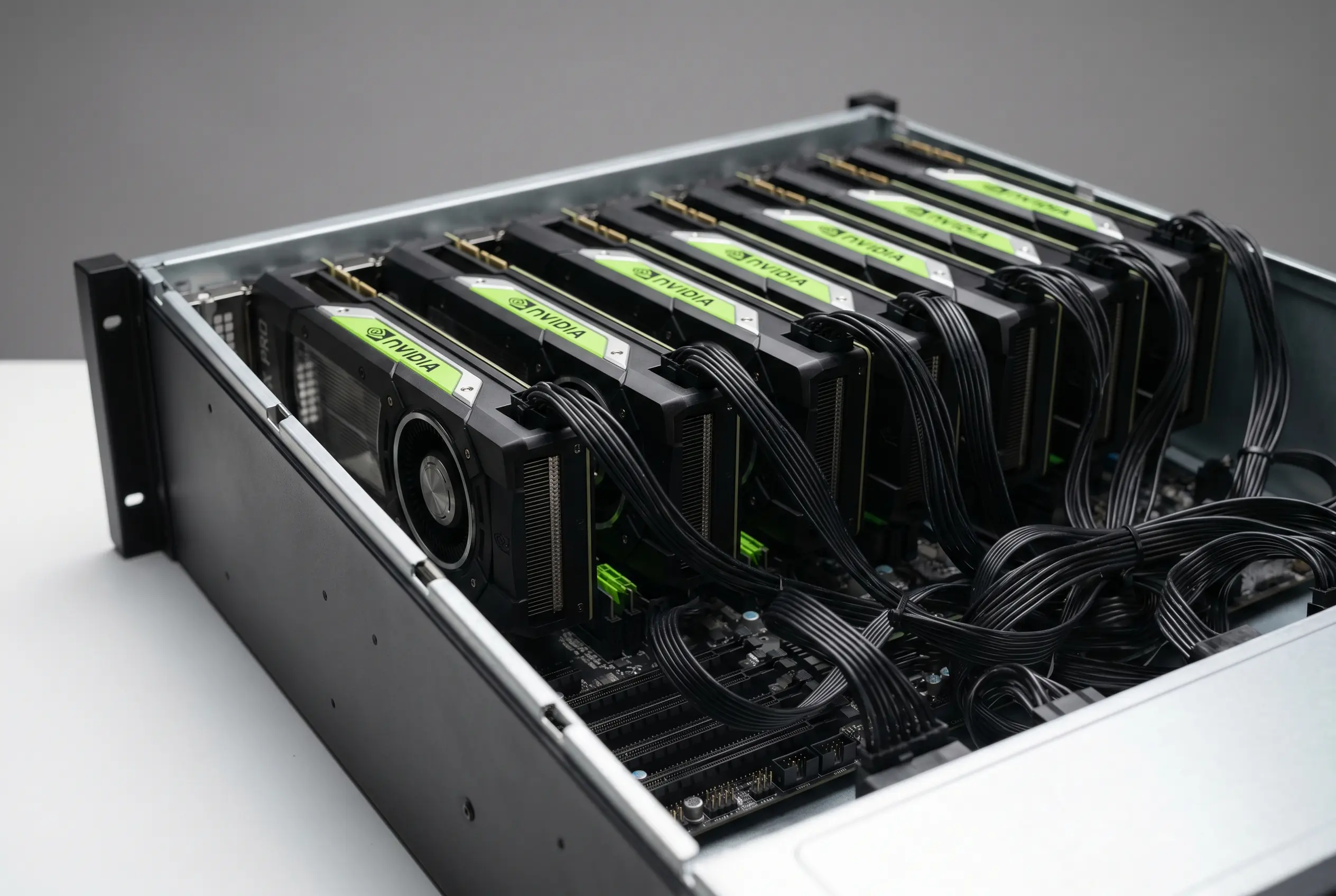
The enterprise hardware on display includes NVIDIA MGX 4U GPU servers and 6U rack-mounted units capable of supporting up to eight graphics cards, including NVIDIA RTX PRO 6000 Blackwell Server Edition GPUs. These cards are designed for Physical AI workloads and high-fidelity digital twins built with NVIDIA Omniverse libraries. ZOTAC is positioning the servers for Large Language Model (LLM) training, fine-tuning, and inference, as well as simulation workloads that require massive parallel compute density.

On-site demonstrations include LLM assistants and fire-detection computer vision applications running entirely on ZOTAC hardware without cloud connectivity. A workstation unit serves as an entry point into NVIDIA Omniverse, targeting smaller studios and engineering teams that need local rendering and simulation capabilities before scaling to rack infrastructure.

The Blackwell Architecture Bet Across Consumer and Enterprise

Every product tier at the booth shares one common thread: NVIDIA’s Blackwell GPU architecture. The GeForce RTX 50 Series brings DLSS 4.5 with multi-frame generation to gaming. The Jetson T5000 modules bring Blackwell’s tensor cores to edge AI. The RTX PRO 6000 Server Edition cards bring the same architecture to data center racks. ZOTAC is betting that a unified architecture across gaming, embedded, and enterprise creates a product narrative that justifies the brand’s expansion beyond its core gaming audience.

DLSS 4.5, NVIDIA’s latest upscaling and frame generation technology, supports all GeForce RTX GPUs from the 20 Series forward, but the multi-frame generation feature that can multiply frame rates by up to 6× is exclusive to RTX 50 Series Blackwell cards. ZOTAC’s gaming GPU lineup includes flagship models with custom cooling and factory overclocks, alongside the liquid-cooled prototypes designed for enthusiasts chasing benchmark records.

How the 20-Year Timeline Shaped the Current Portfolio

ZOTAC’s first product in 2007 was the GeForce 7300 GT graphics card. The company spent its first decade focused exclusively on NVIDIA GeForce GPUs and mini PCs, establishing the ZBOX line as a pioneer in compact computing. The 2016 MAGNUS EN980 marked the brand’s first attempt to position mini PCs as performance machines rather than office appliances. The 2017 launch of the ZOTAC GAMING sub-brand formalized the company’s gaming focus, introducing the MEK Gaming PC and a Thunderbolt 3 external GPU enclosure.

The current portfolio reflects a decade of incremental category additions. The ZBOX PRO embedded line launched to serve industrial customers who needed ruggedized hardware with long support windows. The enterprise GPU server push is newer, emerging as NVIDIA’s data center GPU sales outpaced gaming GPU revenue and as hyperscalers and AI labs became the dominant buyers of high-end silicon.

Product Tier Target Customer Key Hardware Lifecycle Commitment
Gaming Graphics Cards Enthusiasts, gamers GeForce RTX 50 Series, liquid-cooled prototypes Standard consumer (2-3 years)
Consumer Mini PCs Gamers, creators MAGNUS ONE ULTRA (RTX 5080), MAGNUS ONE (Ryzen + RTX 5070) Socketed upgrades, standard consumer
Embedded / Industrial OEMs, robotics, edge AI ZBOX PRO with Jetson T5000, ZBOX PRO PICO-CM5 Extended to January 2036
Enterprise AI / HPC Data centers, AI labs, studios NVIDIA MGX 4U/6U servers, RTX PRO 6000 Blackwell Server Edition Enterprise support (typically 5+ years)

The Giveaway Campaign and Anniversary-Exclusive Hardware

ZOTAC is running a global giveaway leading up to COMPUTEX, distributing over 20 products including 20th Anniversary Edition graphics cards and mini PCs in titanium-themed finishes. The giveaway is promoted across the company’s Instagram, Facebook, and X accounts, with entry details hosted on a dedicated event page. The anniversary hardware carries visual design cues distinct from the standard product line, including titanium colorways and commemorative branding.

The giveaway serves dual purposes: it generates social engagement ahead of the booth opening, and it seeds anniversary-edition hardware into the hands of content creators and enthusiasts who will produce coverage and benchmarks during the show’s run. ZOTAC has used product giveaways at prior COMPUTEX events, but the 20-product scale and the inclusion of flagship RTX 50 Series cards mark the largest campaign the company has run.

Why the Enterprise Push Carries Risk for a Gaming Brand

ZOTAC’s brand equity sits almost entirely in gaming and consumer hardware. The company’s name appears on GPU leaderboards, in gaming rig builds, and in mini PC reviews. It does not appear in enterprise procurement guides, data center RFPs, or industrial OEM catalogs at the scale of competitors like Supermicro, Dell, or HPE. The enterprise GPU server market is dominated by established system integrators with existing relationships, compliance certifications, and multi-year support contracts.

The extended lifecycle commitment through 2036 for ZBOX PRO products addresses one barrier: industrial customers need hardware that remains available and supported for a decade or longer. But lifecycle guarantees are table stakes. The harder sell is convincing a data center operator or an automotive OEM that a brand known for RGB-lit graphics cards can deliver the same reliability, documentation, and support infrastructure as incumbents who have been shipping rack servers for 20 years.

ZOTAC’s advantage is vertical integration through parent company PC Partner, which manufactures all ZOTAC products in factories in Batam, Indonesia, and Dongguan, China. That control over the supply chain allows faster iteration and tighter quality oversight than brands that outsource manufacturing. The disadvantage is that enterprise buyers often require third-party validation, compliance certifications, and reference architectures that take years to accumulate.

What the AMD Ryzen Integration Signals

The MAGNUS ONE ER98N5070C’s use of an AMD Ryzen processor with Zen 5 architecture is a quiet but significant shift. ZOTAC has historically paired Intel CPUs with NVIDIA GPUs across its mini PC lineup, reflecting the dominant Intel-NVIDIA partnership in gaming and workstation markets. The Zen 5 integration suggests ZOTAC is willing to diversify CPU suppliers to capture performance or cost advantages, and it opens the door to future AMD-heavy SKUs if Ryzen continues to gain share in gaming and creator workloads.

Zen 5 architecture, introduced in mid-2024 with the Ryzen 9000 Series desktop processors, brought IPC (instructions per cycle) improvements and efficiency gains over Zen 4. Pairing Zen 5 with the GeForce RTX 5070 creates a balanced gaming and creator system without the thermal or power constraints that plagued earlier mini PC designs. The socketed CPU and GPU design means buyers can swap components as newer silicon ships, extending the useful life of the chassis and motherboard.

How COMPUTEX Timing Amplifies the Announcement

COMPUTEX runs June 2-5 at Taipei’s Nangang Exhibition Center, drawing 1,500 exhibitors from 33 countries and an audience of system builders, OEMs, distributors, and press. The show’s 2026 theme, “AI Together,” aligns with ZOTAC’s enterprise AI hardware push. NVIDIA, Intel, AMD, and other silicon vendors use COMPUTEX as a launch platform for next-generation products, creating a news cycle where hardware announcements compete for attention.

ZOTAC’s booth is located at N0513a on the 4th floor of Nangang Exhibition Hall. The company is running live demos of NVIDIA GeForce RTX-accelerated workflows, including gaming, productivity, and creative applications. The demos are designed to show real-time performance rather than pre-rendered footage, a tactic that works when the hardware can deliver frame rates and render times that justify the on-stage claims.

  • Gaming tier: GeForce RTX 50 Series cards with DLSS 4.5 multi-frame generation, liquid-cooled prototypes, ZOTAC GAMING ALLOY case
  • Consumer mini PC tier: MAGNUS ONE ULTRA with desktop RTX 5080, MAGNUS ONE with AMD Ryzen Zen 5 and RTX 5070
  • Embedded tier: ZBOX PRO with NVIDIA Jetson T5000 (2,070 FP4 TFLOPS), ZBOX PRO PICO-CM5 with Raspberry Pi CM5
  • Enterprise tier: NVIDIA MGX 4U and 6U GPU servers supporting up to 8× RTX PRO 6000 Blackwell Server Edition cards
  • On-site demos: Local LLM inference, fire-detection computer vision, NVIDIA Omniverse workstation workflows

The 2016 Parallel and What It Predicts

When ZOTAC debuted the MAGNUS EN980 at COMPUTEX 2016, the company was making a bet that VR headsets would drive demand for compact, powerful PCs that could sit in living rooms rather than under desks. The bet paid off in the short term: the EN980 won press coverage, NVIDIA’s VR-ready certification gave it credibility, and the product established ZOTAC as a serious player in performance mini PCs. But VR adoption stalled, and the broader market for high-end mini PCs remained niche.

The 2026 enterprise push carries similar risk. If AI inference workloads move to the edge and if studios adopt local Omniverse rendering at scale, ZOTAC’s early positioning in embedded AI and rack servers could pay off. If enterprise buyers stick with established vendors and if AI workloads consolidate in hyperscale clouds, the investment in MGX servers and Jetson modules becomes a costly side bet that never scales.

ZOTAC’s 20-year timeline shows a company that has survived by iterating on NVIDIA’s roadmap and by finding niches where compact form factors or aggressive pricing create openings. The anniversary showcase is both a celebration of that survival and a test of whether the same playbook works when the customer is a data center operator rather than a gamer.

Logan Pierce is a writer and web publisher with over seven years of experience covering consumer technology. He has published work on independent tech blogs and freelance bylines covering Android devices, privacy focused software, and budget gadgets. Logan founded Oton Technology to publish clear, no nonsense tech news and reviews based on real hands on testing. He has personally tested and reviewed dozens of mid range and budget Android phones, written extensively about app privacy, and built and managed multiple WordPress publications over the past decade. Logan holds a bachelor's degree in English and studied digital marketing at a certificate level.

Continue Reading
Click to comment

Leave a Reply

Your email address will not be published. Required fields are marked *

COMPUTERS

BlackBerry Stock Tops $8 as QNX Backlog and FedRAMP Renewal Reset the Story

Published

on

BlackBerry’s U.S. listing closed Tuesday at $8.39, up roughly 6.1% on the first session after Memorial Day, with about 39.7 million shares changing hands and an intraday high of $8.77. The price sits well above the $5.16 average target that eight analysts on S&P Global Market Intelligence were still publishing before CIBC raised its number this week.

The gap is the story. A Canadian software name once shorthand for failed phones is now trading on a QNX automotive backlog of roughly $950 million, a fresh FedRAMP renewal at the U.S. government’s highest civilian-cloud bar, and a share repurchase authorization that started two weeks ago.

The Setup Behind the $8.39 Close

Tuesday was the first U.S. trading session after the Memorial Day holiday closure, and BlackBerry walked into it with a strong Friday tape and a wave of fresh attention on its government-security business. The broader market did not hurt: S&P 500 and Nasdaq names rallied on AI optimism, and the Invesco QQQ ETF added 1.4%.

The trading session put the stock back into the same volume class as other mid-cap software names, a place its float had not reliably occupied for years.

BlackBerry (NYSE: BB), Tuesday session Value
Closing price $8.39
Day’s high $8.77
Session move +$0.48 (+6.1%)
Volume ~39.7 million shares
Analyst consensus rating Hold (eight covering)
Consensus average target $5.16

What the table does not show is the catalyst stack feeding the bid. Three distinct items hit the wire in the two weeks before Tuesday’s open, and the market spent the session pricing them as one story rather than three.

CIBC’s Number, FedRAMP’s Renewal, the Buyback’s Window

CIBC Capital Markets lifted its BlackBerry price target from $6 to $8.50 and kept an Outperform rating, citing clearer visibility into profitable growth across QNX and Secure Communications. The bank flagged QNX demonstrations on Intel and NVIDIA hardware and pointed to a new robotics architecture benchmark report as evidence that the operating system is no longer confined to dashboards.

That note landed on a market already digesting two earlier items.

  • On May 8, the company filed an SEC disclosure renewing its normal course issuer bid, the Canadian-market term for a buyback. The authorization lets BlackBerry repurchase up to 26,785,714 shares, about 4.58% of the public float as of April 30, and runs from May 12, 2026 through May 11, 2027. Any shares bought back are cancelled.
  • On May 20, BlackBerry AtHoc, the emergency-communications platform, secured its 2026 FedRAMP Class D (High) re-certification, the U.S. federal cloud-approval bar for sensitive unclassified data where a loss of confidentiality or availability would cause severe or catastrophic consequences. The company says 80% of U.S. federal agencies use the platform.
  • QNX, the embedded operating-system unit, posted a record quarter in early April, with $78.7 million in revenue and a royalty backlog the company now puts at roughly $950 million.

Stacked, those items read less like three press releases and more like a balance-sheet thesis. A buyback program signals management confidence in cash generation. The FedRAMP renewal locks in the federal customer base for another certification cycle. The royalty backlog effectively pre-sells revenue that has not yet been recognized.

That is what CIBC’s upgrade was paying for. The peer reaction was muted: CrowdStrike rose 1.7%, Palo Alto Networks slipped 0.9%, and SentinelOne fell 0.6%, so this was not a cyber-sector rally riding along.

QNX Is the Engine, Not the Logo

The brand is what makes the chart screenshot interesting. The business is what makes Tuesday’s close defensible.

The Revenue Mix Has Tilted

QNX (the safety-certified real-time operating system embedded in cars, medical devices, and industrial controllers) brought in $268.0 million in fiscal 2026 (the year ended February 28), or close to half the company’s full-year revenue of $549.1 million. Fourth-quarter QNX revenue of $78.7 million was up 20% year over year, and the segment grew 14% for the full year, per BlackBerry’s Q4 fiscal 2026 results filed with the SEC.

Secure Communications, the older institutional-software unit that houses AtHoc and the SecuSUITE encryption stack, generated $258.9 million for the year, with $72.5 million in the fourth quarter, up 8% from a year earlier.

The Backlog Tells the Forward Story

The figure that anchors the bull case is the $950 million QNX royalty backlog, meaning per-unit license revenue that will be recognized as vehicles roll off production lines. The backlog represents more than twice the segment’s current annualized royalty recognition rate, which is what gives the multi-year revenue visibility that CIBC and other constructive analysts have started leaning on.

For fiscal 2027, BlackBerry guided to total revenue of $584 to $611 million, with QNX at $290 to $307 million and adjusted EBITDA (earnings before interest, taxes, depreciation, and amortization) of $110 to $130 million. The Q1 fiscal 2027 quarter wraps May 31, with results scheduled for June 25.

The Design Wins Behind the Number

QNX software is now embedded in more than 275 million vehicles globally, up roughly 100 million since 2020. Named original equipment manufacturer (OEM) customers include BMW, Bosch, Continental, Geely, Honda, Hyundai, Mercedes-Benz, Toyota, Volkswagen, and Volvo. Fresh design wins disclosed alongside the fiscal year results include BMW Group and Volvo Cars, plus a Johnson & Johnson contract for an artificial-intelligence-enabled medical device.

That is the second-order shift the share price is starting to reflect: a software company whose largest single segment now sells embedded operating systems into the auto and medical hardware stack, with revenue visibility extending years out.

Why Secure Communications Still Matters

The federal half of the business is the part most often left out of the QNX story. FedRAMP (the Federal Risk and Authorization Management Program, the U.S. government’s cloud-service approval framework) does not hand out Class D (High) authorizations often, and an expired certification can effectively lock a vendor out of federal procurement until a renewal lands.

BlackBerry’s AtHoc re-certification announcement on May 20 kept the platform inside that procurement perimeter.

We are the only CEM platform to reach this bar in 2025, and this re-certification reflects our sustained investment in helping organizations coordinate faster, operate more securely, and respond effectively when conditions are most demanding.

That is Ramon Pinero, general manager of BlackBerry AtHoc, speaking in the company’s May 20 release. Dubhe Beinhorn, senior vice president for the public sector inside BlackBerry Secure Communications, framed the renewal as a signal to existing federal customers that the platform will continue to meet rising compliance and resilience requirements.

Read against the QNX numbers, AtHoc is the customer-stickiness floor: 80% of U.S. federal agencies, an installed base that does not flip vendors casually, and a renewed certification that buys time before the next compliance review.

The Analyst Gap That Hasn’t Closed

The argument against Tuesday’s price is published every morning. S&P Global Market Intelligence aggregates eight covering analysts at a Hold rating with an average price target of $5.16, well below where the stock is trading and well below CIBC’s new mark. Those numbers were compiled before this week’s upgrade, but only one of the eight has moved publicly so far.

Reference point Price Implied stance vs Tuesday close
S&P Global Market Intelligence consensus (8 analysts) $5.16 average target, Hold ~38% below the close
CIBC Capital Markets, updated $8.50, Outperform ~1% above the close
Tuesday’s close $8.39 n/a

The dispersion is the trade. CIBC’s number prices in the QNX backlog and FedRAMP renewal as durable. The consensus number prices in the prior three years, when stagnant top-line growth and Secure Communications softness offset the QNX story and kept the share count moving the wrong way.

The June 25 print is the first quarterly result that will let the rest of the desk decide which number is right.

What Could Undo This

The mixed read is not about whether the operating numbers improved. They did. The risk is whether the price has run ahead of what the next quarter can confirm.

  • Project deferrals at QNX customers. RBC has flagged the risk that platform launch delays inside automotive customers push royalty recognition out of fiscal 2027 and into later years. The $950 million backlog does not vanish, but the timing line can shift.
  • Secure Communications drag. The unit grew 8% in the fourth quarter but has spent years as a flat-to-down business. If the FedRAMP renewal does not translate into net new federal contract value, the segment becomes a maintenance line item rather than a growth driver.
  • Sentiment unwind. The stock is rallying in part on AI-rotation flows. If big tech sells off through June or Middle East risk reasserts itself in the macro tape, BlackBerry’s beta to that mood is high enough to give back the move quickly.
  • Valuation reset. Even with the fiscal 2027 guidance, a price near $8.40 implies the market is paying for a level of QNX execution that has not yet been printed. A single miss against the high end of the guide can compress the multiple fast.

Chief Executive John Giamatteo’s framing on the April earnings call was direct: “We are no longer a company in transition.” That sentence is now load-bearing. The June print is what tests whether the market lets him keep saying it.

Heading Into June 25

The first quarterly results of fiscal 2027 land Wednesday, June 25, before the U.S. open, with the quarter closing this Sunday, May 31. BlackBerry’s guidance points to Q1 QNX revenue of $60 to $64 million and Secure Communications revenue of $66 to $70 million, with consolidated non-GAAP earnings per share of 15 to 19 cents for the full year.

If QNX prints inside or above its quarterly range and management edges the full-year backlog number up, the CIBC framework wins and the $5.16 consensus number gets revised on contact. If QNX prints below the range or the company walks back any portion of the fiscal 2027 EBITDA guide, the gap between consensus and tape closes from the other direction, and the buyback program becomes the only structural bid left under the share price.

Disclaimer: This article is for informational purposes only and does not constitute investment advice. Equity securities such as BlackBerry Limited carry market, execution, and macroeconomic risk, and past performance does not indicate future results. Readers should consult a qualified financial professional before making investment decisions. Prices, analyst targets, and operating figures are accurate as of publication.

Continue Reading

COMPUTERS

UBM Development’s Q1 Turnaround Signals European Real Estate Shift

Published

on

UBM Development AG posted its first positive quarterly result in over a year, closing Q1 2026 with €0.3m in earnings before and after tax. The Vienna-based developer’s equity ratio hit 33.7%, liquidity jumped 43% to €168m, and apartment sales matched the record pace set in early 2025. While the figures are modest in absolute terms, the directional shift marks a clean break from the loss-making quarters that defined 2024 and early 2025.

The turnaround arrives as European construction costs stabilize and regulatory pressure on affordable housing intensifies. UBM’s net debt dropped to its lowest level since 2021, falling 8.3% year-over-year to €484m. The company now holds enough cash to retire both its Sustainability-Linked UBM Bond 2021 and Sustainability-Linked Hybrid Bond 2021 ahead of step-up, with no further bond maturities until late 2027.

What Changed in Three Months

Total Output surged 62.6% to €95.3m, driven by accelerated project handovers in Vienna and Munich. Revenue climbed 10.9% to €31.6m, a smaller gain that reflects UBM’s shift toward share deals and joint ventures that book revenue proportionally rather than upfront. The gap between Total Output and revenue widened because UBM now consolidates several projects at equity rather than fully, a structural change CEO Thomas G. Winkler flagged in the 2025 annual report.

Earnings before tax swung from a €6.3m loss in Q1 2025 to a €0.3m gain. Earnings after tax mirrored the move, reversing a €6.6m loss. The improvement came from three levers: lower financing costs as UBM refinanced short-term debt at tighter spreads, reduced SG&A as headcount fell 7.7% to 203, and margin recovery on premium residential units in Frankfurt and Prague where asking prices rose 4-6% year-over-year.

The Equity and Liquidity Picture

Equity rose 7.6% to €377m, pushing the equity ratio from 32.1% at year-end to 33.7%. UBM targets a 30-35% band, so the current level sits at the upper boundary with minimal room for further leverage. Total assets grew 2.3% to €1.12bn, a slower pace than equity, which explains the ratio gain.

Cash and cash equivalents jumped 43.1% quarter-over-quarter to €168m, the result of two large asset sales that closed in March: a standing office property in Vienna’s 3rd district and a land parcel in Munich’s Schwabing neighborhood. Combined proceeds were €61m. UBM used €17m to pay down a floating-rate construction loan and parked the rest in cash, anticipating bond redemptions in July.

Net debt fell to €484m, down from €528m at year-end and €527m a year earlier. The metric excludes lease liabilities, so the headline figure understates UBM’s total obligations by roughly €22m. Still, the trajectory is clear: UBM has reduced net debt by €44m in three months, the fastest deleveraging pace since Q2 2022.

Bond Repayment Calendar

UBM will retire two bonds before step-up clauses trigger higher coupons. The Sustainability-Linked UBM Bond 2021, a €150m issue with a 2.75% coupon, matures in July 2026. The Sustainability-Linked Hybrid Bond 2021, a €100m perpetual with a 4.0% coupon that steps to 5.5% in October 2026, will be called early. After these repayments, UBM’s next maturity is a €200m senior unsecured note due October 2029.

The company’s liquidity position supports both redemptions without new issuance. UBM has €168m in cash, €150m in undrawn credit lines, and expects €40-50m in additional asset-sale proceeds by June. Total available liquidity is roughly €360m against €250m in near-term obligations.

Residential Segment Faces Cost and Regulatory Squeeze

UBM sold 147 apartments in Q1, repeating the 149-unit pace from Q1 2025 that set a company record. Average selling prices held steady at €5,800 per square meter in Vienna and €7,200 in Munich, both premium-segment figures. The volume came despite a 12% year-over-year drop in building permits issued across Austria and Germany, a sign that UBM’s hybrid timber construction and renewable-energy positioning is pulling buyers even as the broader market contracts.

Winkler’s statement on the “paradigm shift” in housing affordability points to a structural problem: construction costs have risen faster than wages, pricing large sections of the population out of ownership. UBM cites pure construction costs of €2,000 per square meter for new housing systems, but regulatory add-ons, land costs, and financing push the all-in figure to €4,500-5,000 in Vienna and €6,000-7,000 in Munich. The gap between what builders can deliver and what buyers can afford is widening, and UBM is betting that authorities will respond with zoning changes, density bonuses, or direct subsidies.

Affordable Housing Strategy

UBM plans to pivot a portion of its pipeline toward affordable housing in secondary cities, targeting households earning 60-80% of area median income. The company has identified sites in Graz, Linz, and Innsbruck where land costs are 40-50% lower than Vienna. Projects in this segment will use modular timber construction to hit the €2,000 per square meter cost target, with units priced at €3,200-3,800 all-in.

The strategy requires selling standing assets to free up capital. UBM has listed three office properties in Vienna and one mixed-use building in Frankfurt, with a combined book value of €110m. Proceeds will fund land acquisition and pre-construction costs for the affordable pipeline. The company expects to break ground on the first projects in Q4 2026.

Premium Segment Holds Despite Macro Headwinds

UBM’s premium residential business, which accounts for 70% of apartment sales, showed no signs of weakening in Q1. The company sold 103 units in the premium tier at an average price of €6,400 per square meter, up 2% from Q4 2025. Demand came from two buyer groups: domestic upgraders trading up from older stock, and international buyers, primarily from the Middle East and Asia, seeking European real estate exposure.

Vienna’s premium market is benefiting from a supply shortage. Only 1,200 new premium units will come to market in 2026, down from 1,800 in 2025 and 2,400 in 2024. UBM’s projects in the 1st, 3rd, and 9th districts are pre-selling at 85-90% before completion, a rate that supports asking-price discipline.

Munich’s premium segment is tighter still. UBM’s Schwabing and Bogenhausen projects are fully reserved, with waiting lists for units that won’t deliver until 2027. The company is exploring a fourth Munich site but faces land-cost constraints; prime parcels in central districts now trade at €3,000-4,000 per square meter of buildable area, up from €2,000-2,500 in 2023.

Timber Construction and ESG Positioning

UBM’s focus on hybrid timber construction is both a cost play and a regulatory hedge. Timber structures reduce embodied carbon by 30-40% versus concrete, a metric that matters as the EU’s Energy Performance of Buildings Directive tightens. Austria and Germany are phasing in carbon-intensity caps for new construction, and UBM’s timber projects already meet the 2028 thresholds.

The cost advantage is narrower. Timber framing costs €1,800-2,000 per square meter versus €1,600-1,800 for concrete, but timber projects qualify for green financing at 50-75 basis points below standard construction loans. On a €50m project, the financing discount offsets the material premium.

UBM has completed four timber projects since 2023, totaling 620 units. The company plans to deliver another 800 timber units by end-2027, split between Vienna, Munich, and Prague. All projects use cross-laminated timber (CLT) panels sourced from Austrian and German mills, with lead times of 12-16 weeks.

What the Market Is Missing

UBM’s share price fell 10.8% in Q1 to €17.70, underperforming the STOXX Europe 600 Real Estate Index by 14 percentage points. Market capitalization dropped to €132m, a 35% discount to book value. The disconnect reflects two concerns: first, that UBM’s turnaround is fragile and dependent on asset sales rather than operating leverage; second, that the affordable-housing pivot will compress margins.

Both concerns are overstated. UBM’s Q1 result was positive even before asset-sale gains, which the company books below the operating line. The €0.3m EBT came from project margins and overhead reduction, not one-time windfalls. On margins, UBM’s affordable projects target 12-15% returns on cost, below the 18-22% the company earns on premium units but well above the 8-10% threshold for acceptable risk-adjusted returns in European residential development.

The broader miss is that UBM is positioning for a regulatory shift that will favor developers with affordable-housing pipelines and ESG credentials. Austria’s coalition government, formed in January 2026, has committed to subsidizing 15,000 affordable units annually through 2030. Germany’s federal housing ministry is drafting similar measures. UBM’s pivot puts it ahead of peers who are still optimizing for premium-only portfolios.

Comparable Developers and Valuation

UBM trades at 0.65× book value, a steeper discount than peers. CA Immo, another Vienna-based developer, trades at 0.78× book despite a lower equity ratio and no affordable-housing pipeline. S Immo, which focuses on office and retail, trades at 0.72× book. The valuation gap suggests the market is pricing in execution risk on UBM’s affordable pivot, or simply hasn’t noticed the turnaround.

On a price-to-earnings basis, UBM’s Q1 annualized EPS of €0.04 (after hybrid interest) implies a trailing P/E of 442×, a meaningless figure given the small denominator. Forward estimates are more useful: consensus expects UBM to earn €0.80-1.00 per share in 2026, implying a forward P/E of 18-22×, in line with European residential developers.

Developer Price/Book Equity Ratio Net Debt (€m) Affordable Pipeline
UBM Development 0.65× 33.7% 484 Yes
CA Immo 0.78× 29.4% 1,120 No
S Immo 0.72× 31.2% 890 No
Buwog (private) N/A 35.1% 620 Yes

Risks and Conditional Outcomes

UBM’s turnaround depends on three variables: continued strength in premium residential demand, successful execution of asset sales, and regulatory follow-through on affordable-housing subsidies. If premium demand softens, UBM’s revenue mix shifts toward lower-margin affordable units, compressing consolidated margins by 200-300 basis points. If asset sales stall, the company will need to tap credit lines or delay bond redemptions, both of which increase financing costs.

The regulatory variable is the hardest to model. Austria’s housing subsidies are subject to annual budget approval, and Germany’s measures are still in draft form. If either government scales back commitments, UBM’s affordable pipeline becomes less attractive, and the company may revert to a premium-only strategy.

On the upside, if all three variables align, UBM could deliver 15-18% ROE by 2027, above the 12-14% the market currently prices in. The company’s timber-construction expertise and ESG positioning give it a structural advantage in a market where regulatory tailwinds are strengthening.

Disclaimer: This article is for informational purposes only and does not constitute investment advice. Real estate development involves significant financial risk, including market, regulatory, and execution risks. Readers should consult a qualified financial advisor before making investment decisions. Figures are accurate as of publication.

Continue Reading

COMPUTERS

UBM Development’s Q1 Profit Hides the Affordability Trap Ahead

Published

on

UBM Development AG posted a positive result before and after tax in Q1, the first profitable quarter since the European real estate downturn began. Equity rose €27 million to €377 million, net debt dropped €44 million to €484 million (the lowest level since 2021), and cash climbed 43% to €168 million. Apartment sales matched the record set in Q1 2025. The Vienna-based timber construction developer is operating from what CEO Thomas G. Winkler calls “a position of strength,” but the paradigm shift that made the turnaround possible is the same force that could limit how far it runs.

Rising construction costs and intensified regulation have priced large sections of the European population out of rental and ownership markets. The construction sector responded with housing systems delivering pure construction costs of €2,000 per square metre of living space, but regulatory adjustments have stalled. UBM’s premium residential segment is thriving in this environment, yet the company’s forward strategy depends on releasing cash from standing assets to fund affordable housing, a segment where margin compression is structural.

The Balance Sheet Rebuilt

UBM’s equity ratio reached 33.7%, the upper end of its 30-35% target range. Net debt of €484 million represents an 8.3% reduction versus Q1 2025 and marks the lowest level since 2021, before the sector-wide repricing began. Cash and cash equivalents of €168.4 million are up 43.1% from year-end, giving the company liquidity headroom that most European developers lack.

The financial position allows UBM to repay both the Sustainability-Linked UBM Bond 2021 and the Sustainability-Linked Hybrid Bond 2021 before step-up. No further bond repayments are due between July 2027 and October 2029, a three-year window free of refinancing pressure. Competitors facing near-term maturities in a higher-rate environment do not have that luxury.

Earnings Swing From Loss to Profit

Total Output rose 62.6% to €95.3 million in Q1 versus €58.6 million in the prior-year period. Revenue increased 10.9% to €31.6 million. Earnings before tax reached €0.3 million, reversing a €6.3 million loss in Q1 2025. Earnings after tax also landed at €0.3 million, up from a €6.6 million loss.

The swing reflects disciplined cost management and selective asset sales rather than a broad market recovery. UBM sold five land sites in Prague’s Arcus City to a Czech construction company, disposed of a building in Warsaw’s Poleczki Business Park to the sitting tenant, and exited a minority stake in the Andaz hotel in Prague. Each transaction prioritized liquidity over margin.

Apartment Sales Repeat Record Pace

The number of individual apartments sold in Q1 equaled the record set in the first quarter of 2025, when sales more than doubled the prior year. UBM has not disclosed the absolute unit count, but the trajectory confirms sustained demand in the premium residential segment. Buyers are absorbing inventory in Vienna, Munich, Frankfurt, and Prague at prices that reflect scarcity rather than affordability.

Share Price Lags the Recovery

UBM’s share price closed at €17.70 on March 31, down 10.8% from €19.85 at year-end. Market capitalization fell 11.4% to €132.3 million. Earnings per share improved to negative €0.29 from negative €1.08, but the stock is trading below the equity value per share implied by the balance sheet. The discount reflects investor skepticism that the turnaround can sustain once the premium pipeline thins.

Metric Q1 2026 Q1 2025 Change
Total Output (€m) 95.3 58.6 +62.6%
Revenue (€m) 31.6 28.5 +10.9%
Earnings before tax (€m) 0.3 -6.3 Positive swing
Earnings after tax (€m) 0.3 -6.6 Positive swing
Equity (€m) 376.9 350.2 +7.6%
Net debt (€m) 483.6 527.6 -8.3%
Cash (€m) 168.4 117.7 +43.1%
Equity ratio (%) 33.7 32.1 +1.6 PP

Timber Construction Pipeline Dominates

Over 77% of UBM’s development pipeline is now in timber-hybrid construction, positioning the company as one of Europe’s leading developers of mass timber projects. The €1.9 billion pipeline is concentrated in Germany (45%) and Austria (45%), with the remaining 10% in Czech Republic. Residential projects account for 56% of the pipeline, light industrial and office assets for 44%.

Timber construction offers lower embodied carbon and faster on-site assembly than conventional concrete, but it does not solve the affordability equation. Material cost advantages are offset by higher design and engineering fees, and the regulatory environment in Austria and Germany has not adjusted zoning or permitting timelines to match the construction method’s speed. UBM’s timber projects are premium-priced, targeting buyers who can absorb the sustainability premium.

The Affordability Trap

UBM’s forward strategy calls for selling standing assets and non-strategic holdings to release cash for affordable housing. The logic is sound: supply gaps are widest in the affordable segment, and rent levels are rising across all UBM markets. But the economics are punishing. Construction costs of €2,000 per square metre are achievable only with standardized designs, reduced finishes, and volume scale. Margins compress to single digits, and any cost overrun or permitting delay erases profitability.

The construction sector has delivered the cost innovation. Regulatory bodies have not. Zoning restrictions, environmental impact reviews, and local opposition slow affordable projects more than premium ones, because affordable developments are larger and denser. UBM’s ability to pivot from premium to affordable depends on policy changes that are not yet visible.

Portfolio Rebalancing Ahead

CEO Winkler stated that “all the conditions are ready for successful portfolio rebalancing.” The company plans to accelerate sales of standing assets during the coming quarters, converting completed projects into cash that can fund the affordable pipeline. The risk is execution timing: if the premium residential market softens before the affordable segment scales, UBM will be caught between a shrinking high-margin business and a low-margin business that has not yet reached breakeven volume.

What the Market Missed

The Q1 results confirm that UBM survived the downturn with its balance sheet intact, but survival is not the same as a durable recovery. The company’s equity ratio, net debt, and liquidity are all stronger than they were in 2021, yet the share price trades at a discount to book value. Investors are pricing in the affordability trap: the premium segment that drove the turnaround is finite, and the affordable segment that represents the growth opportunity is structurally low-margin.

UBM’s timber construction expertise is a competitive advantage, but it is not a margin advantage. The company can build faster and greener than conventional developers, but it cannot build cheaper unless regulators accelerate permitting and relax density restrictions. The paradigm shift in European housing is real. The question is whether it shifts far enough to make affordable housing profitable at scale, or whether it simply transfers value from developers to landowners and permitting authorities.

Frequently Asked Questions

What is UBM Development’s equity ratio in Q1 2026?

UBM Development’s equity ratio reached 33.7% in Q1 2026, at the upper end of the company’s 30-35% target range. Equity rose €27 million to €377 million during the quarter.

How much did UBM Development’s net debt decrease in Q1 2026?

Net debt decreased by €44 million to €484 million in Q1 2026, an 8.3% reduction compared to Q1 2025. This is the lowest net debt level UBM has recorded since 2021.

What percentage of UBM Development’s pipeline is timber construction?

Over 77% of UBM Development’s €1.9 billion development pipeline is in timber-hybrid construction. The company is positioning itself as one of Europe’s leading developers of mass timber projects.

When are UBM Development’s next bond repayments due?

UBM Development will repay the Sustainability-Linked UBM Bond 2021 and the Sustainability-Linked Hybrid Bond 2021 before step-up. No further bond repayments are due between July 2027 and October 2029.

What is the construction cost target for affordable housing in Europe?

The construction sector has developed housing systems with pure construction costs of €2,000 per square metre of living space. UBM Development plans to release cash from standing assets to fund affordable housing projects at this cost level.

Where is UBM Development’s pipeline concentrated geographically?

UBM Development’s pipeline is concentrated 90% in Germany and Austria, with 45% in each country. The remaining 10% is in Czech Republic, primarily in Prague. Residential projects account for 56% of the pipeline.

Continue Reading

Trending





