
AI
Indosat Bets $2 Billion in Loans on AI Chips and a Neocloud Future
Indosat is hunting a $2 billion chip loan while launching Zankore with Ooredoo, Nvidia and Nokia, turning a telco into a high-stakes AI infrastructure bet.

Indonesian telco Indosat Ooredoo Hutchison is seeking around $2 billion in loans to buy advanced chips for AI data centers, according to people familiar with the matter cited by Bloomberg on 5 August 2026. Citigroup is arranging the facility and testing bank appetite for a syndication.
The same week the company and its major shareholder Ooredoo unveiled Zankore, a dedicated AI compute and neocloud platform targeting 1 GW of NVIDIA capacity. The loan chase and the platform launch together turn a connectivity operator into a high-stakes infrastructure wager.
The $2 Billion Chip Loan Lands Beside a Bigger Platform
Indosat, Indonesia’s second-largest mobile carrier, still draws roughly 84 percent of revenue from mobile connectivity. It has spent two years building sovereign AI pieces: a GPU cloud, the Sahabat-AI large language model tuned for Indonesian language and context, and early AI-factory capacity with NVIDIA.
Bloomberg reported the company wants the loans specifically to purchase advanced chips for local operations. Indosat did not comment. Citigroup declined to discuss the matter. The size alone marks a step-change. Independent analysis circulating on X put Indosat’s market capitalisation near $3.4 billion, making a $2 billion facility equal to roughly 59 percent of equity value and potentially transformative for leverage already described as near 2x debt-to-equity.
- $2 billion target loan size for advanced chips
- Citigroup as arranger, banks being sounded for syndication
- Same-week Zankore launch with 1 GW long-term ambition
- Q1 2026 record revenue of IDR 15.2 trillion (about $0.87 billion)
The financing is not incremental tower or spectrum spend. It is a direct bet that chip-powered capacity will produce recurring cash flows large enough to cover interest, principal and refresh cycles.
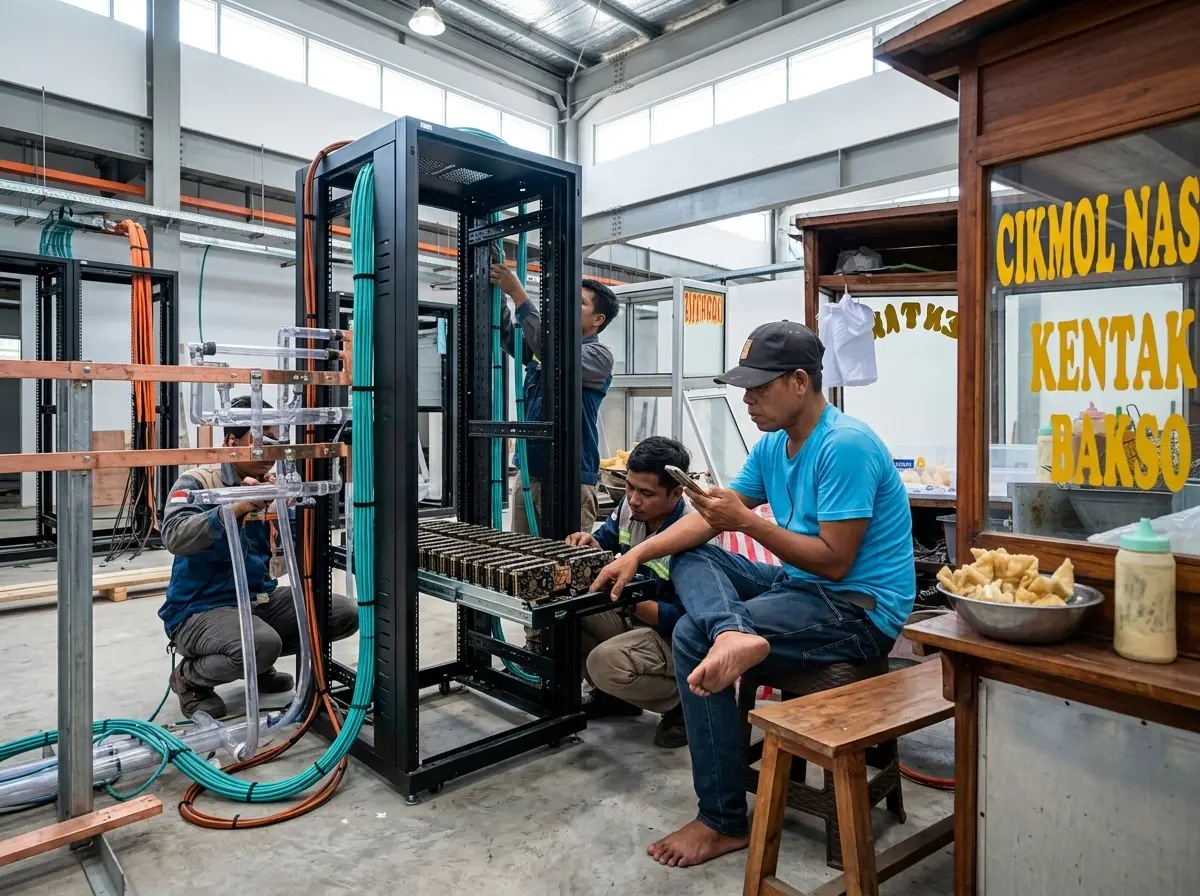
Why Buying GPUs Differs From Building Towers
Traditional telecom assets earn over long lives. Towers, fibre and spectrum support diversified subscription revenue for a decade or more. Advanced AI accelerators depreciate on a different clock. Performance per watt and software stacks move every generation. A rack that is competitive today can become commercially unattractive while the loan is still being repaid.
Analysts noting the mismatch point out that lenders will likely demand strong collateral, parent support, staged drawdowns or evidence of contracted utilisation. Chips also require the rest of the stack: power, cooling, high-speed networking, storage, orchestration software and specialised staff. A pure hardware facility can leave the borrower exposed if supporting infrastructure lags or electricity costs spike.
Indonesia’s data-protection rules and push for sovereign compute create structural demand for local capacity. That demand still has to materialise as paid, multi-year contracts rather than forecasts if debt is the funding tool.
Early Numbers From the Neo Cloud Bet
Indosat already has operating proof points, even if they remain small relative to a $2 billion hardware ticket. Its Neo Cloud sovereign business generated $35 million in 2025 and $16 million in the first quarter of 2026 alone. Management has guided to approximately $170 million in contracted AI-cloud revenue over the next three years.
Capacity targets are aggressive. The company aims to move from about 10 MW of AI capacity in 2024 to 100 MW by the end of 2026 and 1 GW by 2030. Those figures sit beside the new Zankore platform’s own 200 MW target for the first half of 2027 using NVIDIA GB300 NVL72 systems.
| Milestone | Figure | Timeframe |
|---|---|---|
| AI capacity baseline | 10 MW | 2024 |
| Near-term AI capacity goal | 100 MW | End-2026 |
| Long-term company goal | 1 GW | 2030 |
| Zankore initial tranche | 200 MW | H1 2027 |
| Neo Cloud 2025 revenue | $35 million | Full year |
| Neo Cloud Q1 2026 | $16 million | Quarter |
| Contracted AI cloud revenue | ~$170 million | Next 3 years |
Q1 2026 delivered the company’s highest quarterly revenue on record and a 26 percent year-on-year profit rise to IDR 1.5 trillion. AI-driven hyper-personalisation of consumer offers is credited as one growth driver. The AI infrastructure line is still a fraction of the mobile base, which is why the chip loan reads as a leap rather than a bolt-on.
Ooredoo Puts $800 Million Behind Zankore
On 6 August 2026 Ooredoo Group announced it would lead Zankore as founding shareholder with a 49 percent stake and Ooredoo’s $800 million commitment. The platform pairs Indosat Ooredoo Hutchison, Nokia for networking and NVIDIA for accelerated computing, software and ecosystem access. Ooredoo expects roughly $600 million in cumulative EBITDA contribution over the first five years of the investment.
We believe AI will define the next decade of value creation in emerging markets. Our role is to invest alongside the right partners, in scalable platforms that create long-term value for our shareholders while supporting the digital ambitions of the markets we serve.
Aziz Aluthman Fakhroo, Group Chief Executive of Ooredoo, said the move extends the group’s digital-infrastructure portfolio into dedicated AI compute. Zankore will start in Indonesia before expanding across Southeast Asia. Industry analysis cited by Ooredoo sees regional data-centre capacity demand growing approximately 3.5 times by 2030, driven mainly by AI workloads.
The platform will incorporate NVIDIA DSX MaxLPS technology intended to recover stranded power and deliver up to 40 percent more compute inside the same facility power envelope. That efficiency claim matters because power, not just silicon, is the binding constraint for many AI builds. Earlier roots of the partnership include the $200 million AI centre plans from 2024 in Central Java.
Power, Currency and Obsolescence Constraints
Even with partner equity and efficient rack designs, three practical risks sit in plain sight. First is electricity. High-density GPU clusters need reliable, affordable power and cooling at scale. Indonesia has land and growing renewable resources, yet grid queues and local supply quality remain live issues for AI facilities everywhere. Many operators have turned to on-site power builds for AI data centers precisely because waiting on the grid can stretch years.
Second is currency. Chips are typically priced in dollars. If the loan is dollar-denominated while most Indosat customer revenue arrives in rupiah, a weaker local currency raises both the debt burden and servicing cost. Hedging a multi-year $2 billion exposure is possible but not free. Dollar-linked or multinational contracts would reduce the mismatch.
Third is technological life. GPU generations turn over faster than fibre or towers. The borrower can still be paying principal after customers have migrated to newer architectures. Banks and equity holders will watch utilisation rates, take-or-pay terms and refresh-cycle funding closely. The $2 billion figure itself appears aimed at chips; the full ecosystem of buildings, power and networking could push total commitment higher.
These pressures sit inside Asia’s wider AI export and compute surge, where supply of hardware and demand for sovereign capacity are both rising quickly and unevenly.
Minority Holders Sit Downstream of the Wager
Strategic logic is clear. Indonesia’s Personal Data Protection Law and national AI ambitions favour local compute. Indosat already owns nationwide connectivity, enterprise relationships, edge locations and an early sovereign stack. Combining those assets with GPU capacity could make it a regional neocloud gateway rather than a pure mobile operator.
Financial structure decides who bears the residual risk. If the loan sits on the corporate balance sheet without ring-fencing, staged draws or anchor contracts, minority shareholders absorb under-utilisation, obsolescence, power-cost overruns and refinancing risk while chip vendors and lenders take more secured positions. Project-level financing, vendor support, customer prepayments or additional strategic equity would shift that balance.
Chirag Sukhadia, Indosat’s chief data and AI officer, has framed the opportunity as evolving into a regional AI cloud delivering sovereign and scalable capabilities beyond Indonesia. Early financial results show the consumer AI layer is already contributing. The infrastructure layer now needs the same proof at far larger scale. Parallel regional AI infrastructure roadmaps in South Asia show other operators and platforms racing along similar sovereign tracks.
Until final loan terms, draw schedules and customer commitments appear, the $2 billion chip financing remains a bold statement of intent whose cash-flow safety cannot yet be verified from public data.
Indosat is placing a large, visible bet that Indonesia and Southeast Asia will pay for dense local AI compute on terms that service the debt. The Zankore partnership supplies equity, technology and a clear capacity roadmap. The open question is whether contracted demand arrives on the same timetable as the chips and the interest bills.


South Korea Retail Investors Face Reckoning After KOSPI AI Rally Collapses

Surrey AI Maps Three Heart Attack Paths and Their Molecular Roots

Germany Locks Neutral Apple ATT Prompts Across Most of Europe

Apple’s 5% EU Fee Quietly Rewrites Alternative App Store Math

Apple’s EU Fee Truce Cuts Complexity but Leaves Rivals Fuming

Pixel 11 Pro Fold Trades Thinness for Durability and Seven-Year Stay

Mayo AI Flags HCM Obstruction From Everyday Ultrasound Videos

Indian Brands Quietly Scale Landmark Screens and Home Tech

Navin Vatsa Turns Grief Into a Lifetime of Quiet Seeing

Google Bets Pixel 11 Agentic AI Will Redefine Phones

Oracle Cuts 21,000 Jobs in a Year, Cites AI in 10-K Filing

Fable 5 and Mythos 5 Return as US Lifts Anthropic Export Controls

SpaceX’s Google Deal Turns a Rocket Company Into a Cloud Landlord

CD Projekt Red Co-CEO: Redemption Arc Isn’t Done, Witcher 4 in 2027

XPL Rallies 30% Ahead of Plasma One Card Tier Launch

Google Search Profiles Build a Follow Graph Inside Discover

DGO App Brings Rs 549 Mobile Pass for FIFA World Cup 2026 in Nepal

Moonshot AI Targets $30 Billion in China’s Fastest AI Funding Sprint

Oppo’s ColorOS 17 Eligibility List Leaves A-Series Buyers Behind

Microsoft Xbox Layoffs Start in July as Sharma Slams 3% Margin
-
 AI2 months ago
Oracle Cuts 21,000 Jobs in a Year, Cites AI in 10-K Filing
-
 AI2 months ago
Fable 5 and Mythos 5 Return as US Lifts Anthropic Export Controls
-
 AI3 months ago
SpaceX’s Google Deal Turns a Rocket Company Into a Cloud Landlord
-
 GAMING2 months ago
CD Projekt Red Co-CEO: Redemption Arc Isn’t Done, Witcher 4 in 2027
-
 CRYPTO3 months ago
XPL Rallies 30% Ahead of Plasma One Card Tier Launch
-
 NEWS3 months ago
Google Search Profiles Build a Follow Graph Inside Discover
-
 APPS3 months ago
DGO App Brings Rs 549 Mobile Pass for FIFA World Cup 2026 in Nepal
-
 AI3 months ago
Moonshot AI Targets $30 Billion in China’s Fastest AI Funding Sprint