
COMPUTERS
Why RTX Spark’s Gaming Battery Promise Comes With a Catch

Nvidia’s RTX Spark gaming battery life could stretch past anything seen on a current RTX laptop, at least for light work, but the company’s own marketing lead would not attach a number to an actual gaming session. At a pre-Computex briefing, Mark Aevermann, Nvidia’s product marketing lead for the platform, called the Arm-based system-on-chip (SoC, the single piece of silicon that bundles processor and graphics) the most efficient pc chip ever built. Then he hedged on what that means the moment a game starts drawing real power.
The reason sits in plain hardware math. The efficiency that buys all-day endurance for email and video mostly disappears once a 6144-core graphics engine wakes up, and Windows on Arm adds a second toll when a game has to be translated from x86 on the fly. The headline applies far more to the spreadsheet than to the frame rate.
What Nvidia’s Marketing Lead Promised, and What He Hedged
Aevermann was generous with the framing and careful with the specifics. He told the briefing that buyers “should expect it to be much better than anything you’ve seen before on RTX laptops,” a line that traveled fast. He stopped short of any definitive battery claim, especially under load.
His caveat is the part worth keeping. Gaming endurance, he said, depends on frame-rate targets, in-game settings, and the size of the battery a given laptop maker chooses to fit. Push the hardware to its limit and the ceiling collapses fast.
Just like any laptop out there, literally any laptop, if you pull the maximum you can out of a battery you’re only going to get 45 minutes to an hour. That’s true of every laptop on the market.
That admission came from the person selling the chip, not a skeptic. It reframes the promise: the efficiency story is real for the way most people use a laptop most of the day, and it gets thin precisely when the marketing word “gaming” is doing the work.
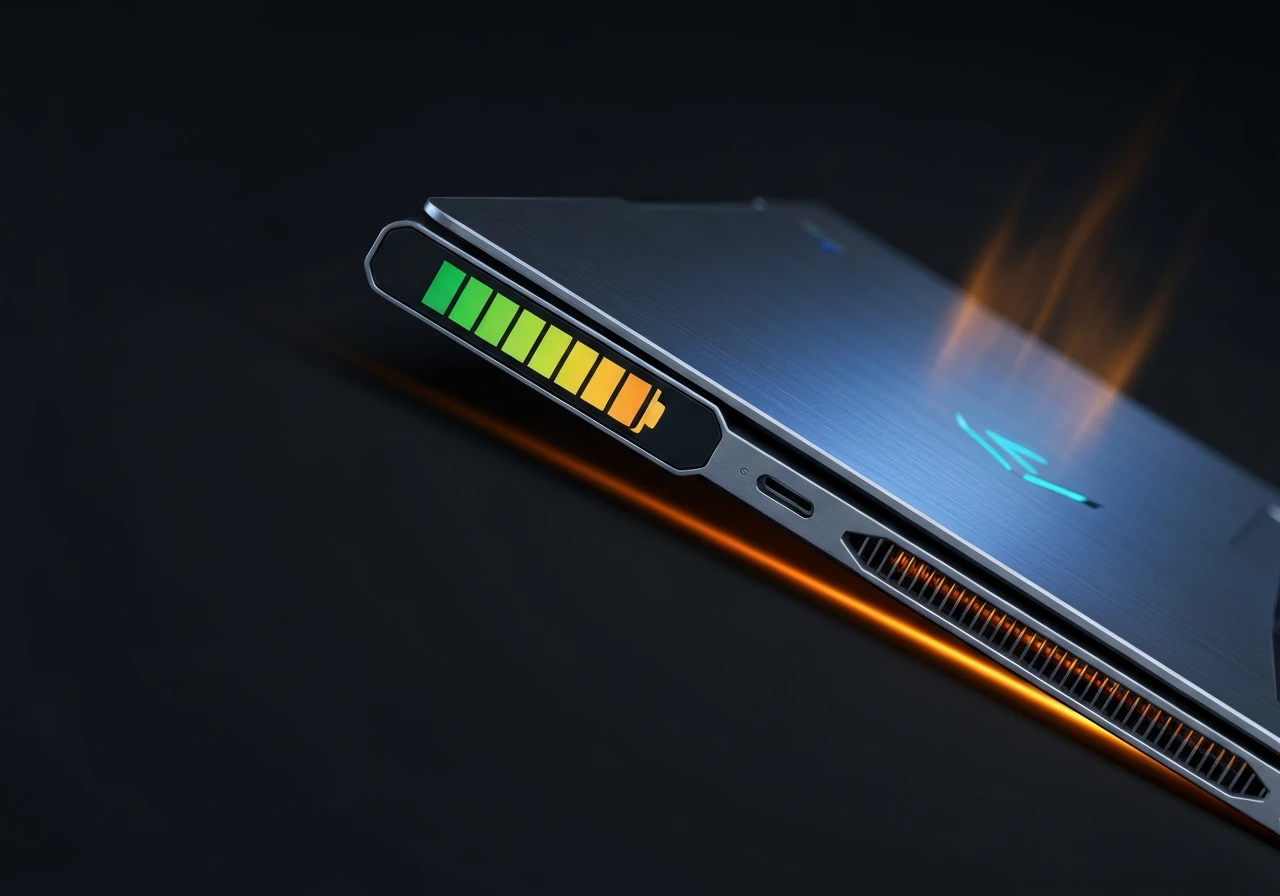
Why Gaming Watts Ignore the Arm Advantage
Arm cores earn their reputation on the small stuff. Idle a machine, scroll a document, stream a video, and the processor sips power while most of the silicon stays parked. That is where Apple’s M-series built its battery legend, and it is the same lane Nvidia is targeting with a 20-core Grace CPU.
Where the Efficiency Pays Off
For everyday productivity, the gains should be genuine. Microsoft and Nvidia both point to all-day battery life for thin-and-light Spark machines, and the chip’s heterogeneous core design lets background tasks run on low-power cores while the heavy hitters sleep. None of that is in dispute. A laptop that lasts a full workday unplugged is a real upgrade over the four-hour x86 gaming notebook.
The GPU Sets the Power Floor
Gaming flips the equation. A modern 3D title keeps the graphics processor near full tilt, and the GPU, not the CPU, dominates the power budget when frames are being rendered. An efficient processor cannot rescue a battery that a hungry graphics engine is draining. This is why Aevermann’s 45-minute floor is not a Nvidia weakness; it is physics that applies to every gaming laptop ever shipped. The Arm advantage simply does not reach the part of the workload that empties the battery fastest.
The Blackwell Engine Behind the Battery Math
The graphics side of RTX Spark is not a token integrated chip. Nvidia pairs the Grace CPU with a Blackwell GPU carrying up to 6144 CUDA cores (Compute Unified Device Architecture, the parallel-processing units that render game frames), roughly in the league of a desktop-class mainstream card. That is the same hardware responsible for the endurance hit.
The wider spec sheet explains both the appeal and the appetite:
- 6144 CUDA cores on a Blackwell GPU, capable of serious frame rates and the watts that come with them.
- 128GB of unified memory shared across CPU and GPU, with up to 300 GB/s of bandwidth.
- 1 petaflop of AI compute, aimed at on-device agents and creative tools rather than games.
- Chassis as slim as 14 millimeters and as light as 3 pounds, in 14 to 16-inch sizes with tandem OLED (organic light-emitting diode) G-SYNC displays.
Read that list and the tension is obvious. The numbers that make Spark exciting for gamers are the same numbers that make all-day gaming endurance a stretch. A thinner chassis also means less room for a large battery and less thermal headroom, both of which cut the other way once a game runs.
Prism Emulation Puts a Tax on x86 Games
There is a second drain that has nothing to do with raw watts. Most PC games are built for x86 processors, and an Arm chip has to translate them through Microsoft’s Prism emulator. Translation costs cycles, and cycles cost power, so an emulated game can pull more from the CPU than the same title would on native silicon.
Microsoft has narrowed that gap. Prism now handles 32-bit and 64-bit x86 apps and supports AVX and AVX2 (Advanced Vector Extensions, the instruction sets many modern games rely on), and native anti-cheat from Epic’s Easy Anti-Cheat and BattlEye has unlocked competitive multiplayer titles that used to be blocked outright. Several headline games arrive with native or supported builds, including:
- League of Legends
- VALORANT
- PUBG: Battlegrounds
- Alan Wake 2
The compatibility story has improved enough that Nvidia is willing to call this a gaming platform, a claim explored in this breakdown of how RTX Spark challenges x86 and Qualcomm on Windows. For details on the translation layer itself, Microsoft documents the changes in its Windows on Arm Prism update notes. Still, anti-cheat remains the hardest edge case, and any title leaning on emulation rather than a native build pays a quiet efficiency penalty that erodes the very battery advantage being advertised.
What Intel’s Handheld Curve Tells Us About the Bar
For a sense of what efficient gaming silicon can do, look sideways at Intel’s handheld push. Its Arc G3 Extreme chips run in an 8 to 35 watt thermal design power (TDP, the heat and power envelope a chip is built to sustain) window, with an Endurance mode that drops the whole package toward 17 watts. The payoff scales directly with frame-rate caps.
In Intel’s own testing, a 30 fps cap on lighter games pushed run time close to 12 hours, while a 60 fps target in the same conditions projected closer to 4 hours, as detailed in Intel’s Arc G-Series handheld gaming brief. Those are handheld chips with far smaller GPUs than Spark’s, which is exactly why the comparison matters.
| Platform | Architecture | Power range | Gaming battery reality |
|---|---|---|---|
| RTX Spark laptop | Arm (Grace) + Blackwell GPU | Thin-and-light envelope, no stated gaming figure | All-day for light work; capped by GPU draw under load |
| Intel Arc G3 Extreme handheld | x86 (Panther Lake) + Xe3 GPU | 8 to 35 W, 17 W Endurance mode | ~12 hrs at 30 fps light, ~4 hrs at 60 fps |
| Conventional x86 RTX laptop | x86 + discrete RTX GPU | High under load | Roughly 45 min to 1 hr at full draw |
The takeaway is not that Spark will fail. It is that gaming endurance is a frame-rate decision more than a chip decision. Cap a game at 30 or 40 fps and a Spark laptop could post numbers that genuinely embarrass older RTX notebooks. Run it flat out and the same machine lands near Aevermann’s floor. The Surface Laptop Ultra and the rest of the launch fleet, covered in this look at Microsoft’s renewed Arm bet on RTX Spark, will be the first real test. If the fall review units deliver two hours of unplugged gameplay at sensible settings, Nvidia will have moved the bar it set out to move. If they land near the 45-minute mark Aevermann described, the battery story that sold the chip will read very differently once the games actually load.
Frequently Asked Questions
Does the Nvidia RTX Spark really last longer on battery while gaming?
It depends heavily on settings. The Arm-based chip is built for strong everyday efficiency and all-day battery life for light tasks, but Nvidia made no specific gaming-battery promise. Its marketing lead noted that pulling maximum power from any laptop yields only 45 minutes to an hour, so capped frame rates matter far more than the chip alone.
How many CUDA cores does the RTX Spark have?
The top configuration carries a Blackwell GPU with up to 6144 CUDA cores, paired with a 20-core Grace CPU, 128GB of unified memory, and up to 1 petaflop of AI compute. That GPU is the main reason gaming sessions draw heavy power despite the efficient Arm processor.
Will my x86 games run on RTX Spark laptops?
Most will, through Microsoft’s Prism emulator, which now supports 32-bit and 64-bit x86 apps plus AVX and AVX2 instruction sets. Native anti-cheat from Easy Anti-Cheat and BattlEye unlocks more multiplayer titles, though some games with unsupported anti-cheat may still be blocked.
When do RTX Spark laptops launch and who is making them?
RTX Spark laptops are due this fall from ASUS, Dell, HP, Lenovo, Microsoft Surface, and MSI, with Acer and GIGABYTE models to follow. Nvidia expects more than 30 laptops and around 10 desktops across the platform.
How does RTX Spark gaming battery life compare to Intel’s handheld chips?
Intel’s Arc G3 Extreme handhelds project close to 12 hours at a 30 fps cap on lighter games and about 4 hours at 60 fps, but those use much smaller GPUs. Spark’s larger Blackwell engine can hit higher frame rates while drawing more power, so its endurance will hinge on frame-rate limits.


AI Boom Leaves Pre-ChatGPT Startups in a Funding Drought

Carnival Data Breach Exposes 6 Million in a Repeat Failure

US Smartphone Shipments Slip 3% as Memory Costs Loom

Microsoft Fixes Windows 11 KB5089549 Update Install Failure

Oregon Upgrades 911 for Smartphones in a Slow National Shift

AI Outages Drive Downtime Costs to a Record $600 Billion

Xbox’s Own Game Pass Page Leaked Seven Showcase Games Early

How to Set Up Android Guest Mode (and Why Samsung Lacks It)

Samsung Boosts Galaxy Z Fold 8 Output as Flip 8 Gets Cut

Singapore Bets on Parent Coaching, Not a Ban, on Kids’ Screens

Andreessen Horowitz Bets $2.2B on Crypto’s Quiet Cycle

Cathie Wood Calls SpaceX IPO Demand ‘Voracious’ Ahead Of $1.75T Debut

Ghana CSA Plants Office In Ho As Volta Cybercrime Climbs

Hormuud Bets $19 Down Will Finally Pull Somalia Online

Google’s Buried Page Reveals 500 Niche Websites Still Making Cash

Apple Strikes Preliminary Deal For Intel To Make iPhone And Mac Chips

Metalenz Polar ID Hides Face Unlock Under OLED Smartphone Screens

Google AI Overviews Adds Subscribed Label, Reddit Quotes Inline

Asha Sharma Reshuffles Xbox Leadership In Race To Project Helix

Audible Faces Nationwide Class Action Over Expiring Credits
-
 CRYPTO4 weeks ago
Andreessen Horowitz Bets $2.2B on Crypto’s Quiet Cycle
-
 CRYPTO3 weeks ago
Cathie Wood Calls SpaceX IPO Demand ‘Voracious’ Ahead Of $1.75T Debut
-
 NEWS4 weeks ago
Ghana CSA Plants Office In Ho As Volta Cybercrime Climbs
-
APPS4 weeks ago
Google’s Buried Page Reveals 500 Niche Websites Still Making Cash
-
 NEWS4 weeks ago
Hormuud Bets $19 Down Will Finally Pull Somalia Online
-
 NEWS3 weeks ago
Apple Strikes Preliminary Deal For Intel To Make iPhone And Mac Chips
-
 NEWS4 weeks ago
Metalenz Polar ID Hides Face Unlock Under OLED Smartphone Screens
-
 AI3 weeks ago
Google AI Overviews Adds Subscribed Label, Reddit Quotes Inline