
GAMING
GeForce RTX Partners Push Cooling and Size at COMPUTEX 2026

Every new GeForce RTX graphics card NVIDIA’s partners brought to COMPUTEX 2026 runs the same Blackwell silicon that reached shelves more than a year ago. So the contest on the Taipei show floor, where a record 6,000-plus booths fill four venues this week, has shifted off the chip itself and onto the parts around it: the cooler, the chassis, the screen, and the software stacked on top.
That shift cuts two ways for anyone shopping. Buyers get quieter cards, smaller boxes, and brighter panels than the 2025 models offered, yet nobody walking out of the show with a fresh 2026 card should expect a raw speed jump over what was already on sale.
Same Silicon, a New Contest in the Box
NVIDIA’s own COMPUTEX headlines leaned on software and a new computing platform rather than a faster gaming chip. The company confirmed DLSS 4.5 (Deep Learning Super Sampling, its AI image upscaling and frame generation suite) is spreading to more titles, and it unveiled RTX Spark, an Arm-based superchip aimed at slim laptops and compact desktops. None of that is a new desktop GeForce tier.
The partner products tell the same story from the other side. There is no new GPU tier here. The cards on display carry familiar names: GeForce RTX 5090, 5080, 5070 Ti, 5070 and 5060 Ti, all built on the Blackwell architecture that launched in the prior cycle. With the engine fixed, the differentiation moves outward to everything a partner can actually change.
That is the through-line our team flagged when the show opened, and it shapes how to read the whole lineup. As covered in our look at how the 2026 GeForce lineup leans on DLSS 4.5 rather than new silicon, the headline gear at the official COMPUTEX Taipei show is mostly a reworking of last year’s chips inside better hardware.
Cooling Becomes the Spec War
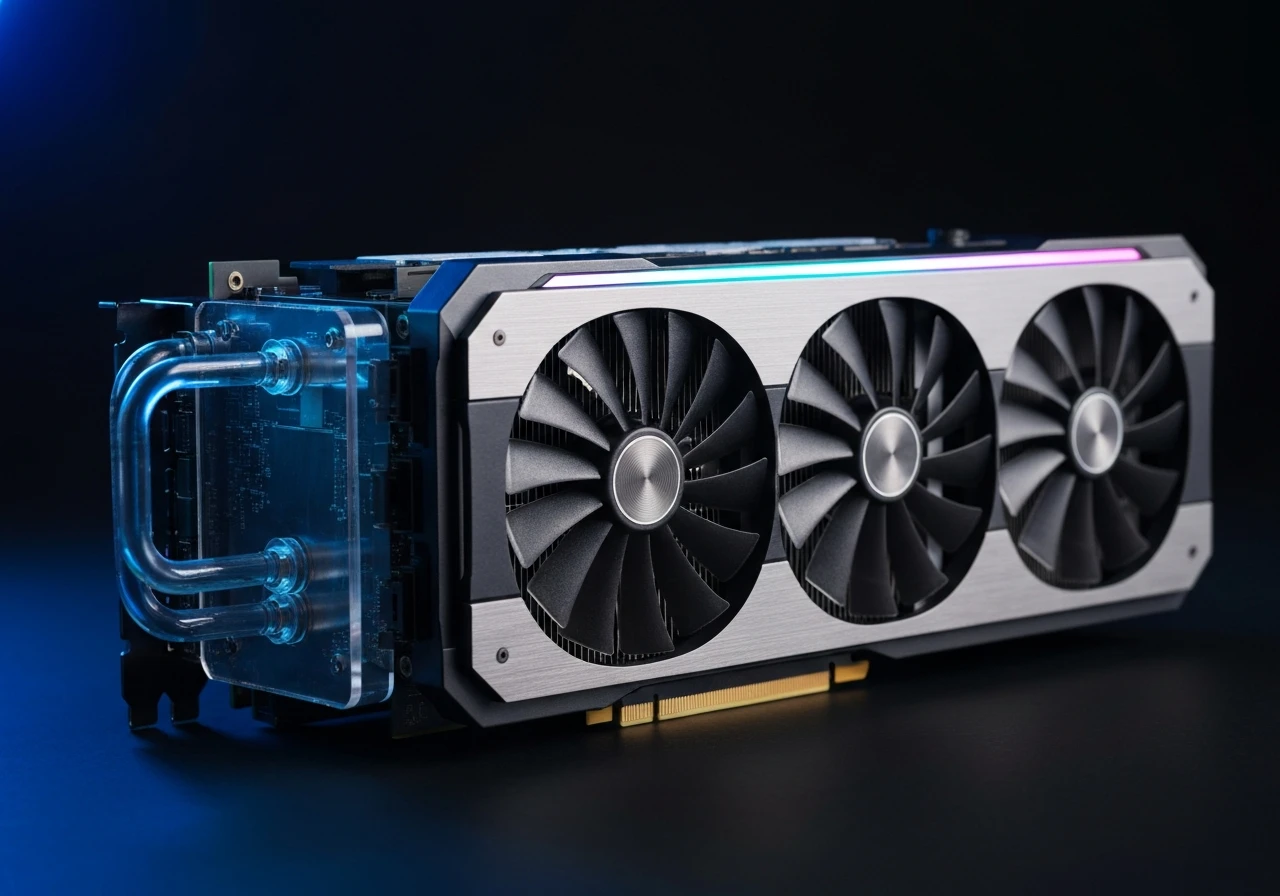
When the GPU stops getting faster on paper, cooling is where partners chase real-world gains. A cooler card holds higher boost clocks for longer and runs quieter doing it, so the thermal solution has become the headline feature on flagship models. Three new GeForce RTX 5090 variants on the floor make the point.
| Card | Cooling approach | Standout feature |
|---|---|---|
| PNY GeForce RTX 5090 32GB | All-in-one liquid (full-cover waterblock) | Quick-connect loop you can extend to a CPU |
| MSI RTX 5090 32G GAMING TRIO Next-Gen | Revised air cooler | Quieter at low load, cooler at peak |
| MSI RTX 5090 32G SUPRIM Safeguard | High-clock air cooler | Real-time power monitoring and eFuse protection |
PNY Commits Fully to Liquid
PNY’s first GeForce RTX 50 Series all-in-one (AIO) liquid cooled card wraps the world’s fastest consumer gaming GPU in a full-cover waterblock built with LYNK+. The pump is tuned to stay quiet under load, and the shroud carries controllable ARGB lighting. The detail that stands out is the plumbing: the AIO connects through a quick connect and disconnect system, the kind usually reserved for custom loops, so an owner can later add a CPU block or swap parts without draining the whole setup.
MSI Splits Air Cooling Into Two Tiers
MSI is widening its top end with two air-cooled paths. The GAMING TRIO Next-Gen reworks the original cooler for quieter operation when idle and lower temperatures when the GPU is pushed hard. The SUPRIM Safeguard targets extreme overclockers instead, adding real-time power monitoring, warning alerts and advanced eFuse protection so a card can survive aggressive tuning. Same chip, two very different buyers.
The Shrink Race Reaches Mini-PC Scale
The other place partners are competing is size. If you cannot make the chip faster, you can make the system that holds it smaller, and several launches push hard on that front. ZOTAC, the Singapore graphics specialist, rates its new MAGNUS One Ultra as the world’s smallest pre-built system carrying a desktop GeForce RTX 5080.
- ZOTAC MAGNUS One Ultra packs a desktop RTX 5080, a 20-core CPU and two sticks of DDR5-6400 memory into just 11.46 liters, with eight USB ports and Thunderbolt 4.
- ASUS T1 GeForce RTX 5070 is validated as an SFF-Ready (small form factor) card, meaning it is checked to fit inside many compact cases.
- MECHREVO YaoShi 16 Air is a 16-inch laptop just 18mm thick and as light as 1.65kg, with up to an RTX 5070 Laptop GPU under a magnesium alloy chassis.
ZOTAC’s small-box push fits a wider pivot at the company, which we explored in coverage of its 20-year shift toward enterprise AI servers. The miniaturization theme runs through NVIDIA’s own announcements too, where the slim and compact form factors are doing a lot of the marketing work this year.
Touchscreens and AI Companions Bolt Onto the Tower
With the spec sheet static, some partners are adding features that have nothing to do with frames per second. MSI’s MEG Vision X AI 2nd pre-built drops a 13-inch touchscreen onto the case, complete with a built-in mic and speaker, so owners can adjust system settings with voice commands or use it as a second display during play. It ships with either a GeForce RTX 5090 or 5080, 64GB of memory and a 360mm liquid cooler.
The companion sibling goes further into novelty. The MEG Vision X2 AI+ adds an AI Holostage and a local AI mascot called LuckyClaw that responds to natural speech, letting users toggle performance profiles, monitor settings and RGB lighting hands-free, with GPU options up to the RTX 5090.
Acer brings its own AI angle to the screen. The Predator XB273K 3D is a 27-inch glasses-free 3D monitor running 4K at up to 180Hz, with an onboard AI model that taps a connected machine’s graphics power to convert standard 2D content into 3D in real time. These are differentiators a frozen GPU roadmap practically invites, and they signal where partner R&D budgets are flowing.
Displays Chase Higher Refresh and Deeper Black
Monitors may be the clearest beneficiary of a quiet GPU year, because panel technology kept moving even as the silicon sat still. NVIDIA’s G-SYNC Compatible badge, which validates a baseline variable refresh rate (VRR) experience that syncs the display to the GPU to cut tearing and stutter, now covers hundreds of screens, and Acer brought a stack of new ones.
- Acer Predator X34 F1: a curved 34-inch 3440×1440 QD-OLED panel using Samsung Display’s Penta Tandem tech, running up to 360Hz with peak brightness up to 1,300 nits.
- Acer Nitro XV345CKR P: a curved 34-inch 5120×2160 MiniLED with 1,152 backlight zones, which can halve its resolution to 2560×1080 and hit 360Hz through Dynamic Frequency and Resolution (DFR).
- Acer Nitro XV273U F5: a 27-inch 1440p IPS screen at a blistering 500Hz, overclockable to 540Hz, dropping to 720p at up to 1000Hz with DFR.
- Acer Predator XB273K 3D: the glasses-free 3D 4K model, paired with Acer’s new SpatialLabs 3D Hub app.
For buyers who skipped the last display cycle, this is where a GeForce upgrade now pays off visually. The full G-SYNC Compatible display directory lists the validated models across sizes and price points.
DLSS 4.5 Carries the Performance Story
If a card cannot get faster in hardware, NVIDIA’s answer is to make it faster in software. DLSS 4.5 is the lever doing the heavy lifting this cycle, and COMPUTEX added to it. The company announced DLSS 4.5 Ray Reconstruction, which uses a second-generation transformer model trained on a larger dataset to clean up ray-traced reflections, global illumination and ambient occlusion with cleaner results and lower memory cost than older denoisers.
- This August is when DLSS 4.5 Ray Reconstruction is set to arrive, with a Blender 5.3 version following in the fall.
- 11 more games were confirmed to add DLSS 4.5, including Marvel Rivals, Phantom Blade Zero and the Gothic 1 Remake.
- 4K at 240 FPS ShadowPlay recording landed in the NVIDIA app beta for RTX 50 and 40 Series cards with dual encoders.
NVIDIA also used the show to position RTX Spark, an Arm-based chip pairing a Blackwell GPU with 6,144 CUDA cores against a 20-core CPU and 128GB of unified memory, a platform we unpacked in our piece on how RTX Spark challenges x86 and Qualcomm on Windows. The full rundown sits on NVIDIA’s COMPUTEX 2026 GeForce announcement page.
Where the Upgrade Money Goes This Cycle
For a shopper, the practical read is simple. The card you buy in mid-2026 will perform like the one you could have bought in 2025, so the reasons to upgrade are the wrapper, not the engine: a quieter or liquid cooler, a smaller chassis, a faster panel, or a software feature like DLSS 4.5 that lifts frame rates without new hardware.
The catalog of choices is wider than ever. Across partner sites sit dozens of new GeForce-powered cards, laptops, mini PCs and displays, plus the games library on GeForce.com that now spans more than a thousand RTX-enhanced titles. The trade is refinement over raw power.
If the next genuine speed jump arrives with new silicon rather than a new cooler, this year’s buyers will have paid for polish in the meantime. If it does not land soon, the cooling, the shrinkage and the software seen in Taipei this week are the upgrade story for a while yet.
Frequently Asked Questions
Do the new COMPUTEX 2026 GeForce cards use a new GPU?
No. Every new partner graphics card shown at COMPUTEX 2026 runs the existing Blackwell-based GeForce RTX 50 Series silicon, including the RTX 5090, 5080, 5070 Ti, 5070 and 5060 Ti. The changes are in cooling, form factor, lighting and bundled features, not the core chip.
When does DLSS 4.5 Ray Reconstruction arrive?
DLSS 4.5 Ray Reconstruction is scheduled for this August, with a version for Blender 5.3 following in the fall. It uses a second-generation transformer model to reconstruct ray-traced effects with cleaner output and lower memory use than traditional denoisers, and it requires a GeForce RTX card.
What does SFF-Ready mean on the ASUS T1 RTX 5070?
SFF-Ready means the card has been validated by NVIDIA to fit inside many small-form-factor PC cases. The ASUS T1 GeForce RTX 5070 carries that badge, so builders can use it in compact systems without guessing whether it physically fits.
Which new card is fully liquid cooled?
PNY’s GeForce RTX 5090 32GB is the new all-in-one liquid cooled model, using a full-cover waterblock co-designed with LYNK+ and a quick connect and disconnect fitting that lets owners later extend the loop to a CPU or other components.


Carnival Data Breach Exposes 6 Million in a Repeat Failure

US Smartphone Shipments Slip 3% as Memory Costs Loom

Microsoft Fixes Windows 11 KB5089549 Update Install Failure

Oregon Upgrades 911 for Smartphones in a Slow National Shift

AI Outages Drive Downtime Costs to a Record $600 Billion

Xbox’s Own Game Pass Page Leaked Seven Showcase Games Early

How to Set Up Android Guest Mode (and Why Samsung Lacks It)

Samsung Boosts Galaxy Z Fold 8 Output as Flip 8 Gets Cut

Singapore Bets on Parent Coaching, Not a Ban, on Kids’ Screens

Preston’s Red Phone Boxes Return as LED Screens With Ad Consent

Andreessen Horowitz Bets $2.2B on Crypto’s Quiet Cycle

Cathie Wood Calls SpaceX IPO Demand ‘Voracious’ Ahead Of $1.75T Debut

Ghana CSA Plants Office In Ho As Volta Cybercrime Climbs

Hormuud Bets $19 Down Will Finally Pull Somalia Online

Google’s Buried Page Reveals 500 Niche Websites Still Making Cash

Apple Strikes Preliminary Deal For Intel To Make iPhone And Mac Chips

Metalenz Polar ID Hides Face Unlock Under OLED Smartphone Screens

Google AI Overviews Adds Subscribed Label, Reddit Quotes Inline

Asha Sharma Reshuffles Xbox Leadership In Race To Project Helix

Audible Faces Nationwide Class Action Over Expiring Credits
-
 CRYPTO4 weeks ago
Andreessen Horowitz Bets $2.2B on Crypto’s Quiet Cycle
-
 CRYPTO3 weeks ago
Cathie Wood Calls SpaceX IPO Demand ‘Voracious’ Ahead Of $1.75T Debut
-
 NEWS4 weeks ago
Ghana CSA Plants Office In Ho As Volta Cybercrime Climbs
-
APPS4 weeks ago
Google’s Buried Page Reveals 500 Niche Websites Still Making Cash
-
 NEWS4 weeks ago
Hormuud Bets $19 Down Will Finally Pull Somalia Online
-
 NEWS3 weeks ago
Apple Strikes Preliminary Deal For Intel To Make iPhone And Mac Chips
-
 NEWS4 weeks ago
Metalenz Polar ID Hides Face Unlock Under OLED Smartphone Screens
-
 AI3 weeks ago
Google AI Overviews Adds Subscribed Label, Reddit Quotes Inline