
CRYPTO
SpaceX Crypto Perp Traders Bet on a $2.2 Trillion IPO Debut
Crypto perpetual futures tied to SpaceX are trading at $165, implying a $2.2T valuation, well above the $1.8T IPO target, and a bet on a 20% first-day pop.

Crypto perpetual futures tied to SpaceX traded around $165 on Hyperliquid and Binance on Thursday morning, pricing Elon Musk’s rocket, satellite, and AI company at roughly $2.2 trillion. That sits well above the $1.8 trillion valuation the company is targeting in its Nasdaq initial public offering, scheduled to price the same day. The gap is the only visible price signal for the deal before Nasdaq opens the stock.
For the traders piling into these contracts, the bet is that SpaceX will debut with at least a 20% pop above its $135 offer price, according to Pratik Kala, a portfolio manager at the digital-asset hedge fund Apollo Crypto. Morningstar sits on the other side of the same trade, with the gap between the perps and the IPO reading as a more public version of what the stock market already does when it ignores a valuation. The perps were still trading 24 hours a day, the only venue that had priced SpaceX in real time before the bell.
The $400 Billion Spread Between Crypto and Wall Street
SpaceX is offering shares at a fixed price of $135 in the largest IPO in history, a deal led by Goldman Sachs and backed by demand for more than four times the available shares, per the fixed $135 share price and $1.77 trillion targeted valuation. At that price, the company would raise about $75 billion at a valuation of around $1.8 trillion. The terms of the offering are unlikely to change, people familiar with the matter have said.
Crypto traders are not waiting for Wall Street to set the number. The SPCX-USDC contract on Hyperliquid, a synthetic perpetual launched by Trade.xyz on May 17 at a $150 reference price, has hovered above $200 for most of the past month. Even after cooling to the $165 area, the implied valuation is $2.2 trillion, $400 billion above the IPO target.
| Reference | Implied share price | Implied valuation |
|---|---|---|
| IPO offering price | $135 | About $1.8 trillion |
| Hyperliquid/Binance perps | Around $165 | About $2.2 trillion |
| Morningstar fair value | $63 | Not stated in source |
How a Synthetic Market for a Private Stock Got Built
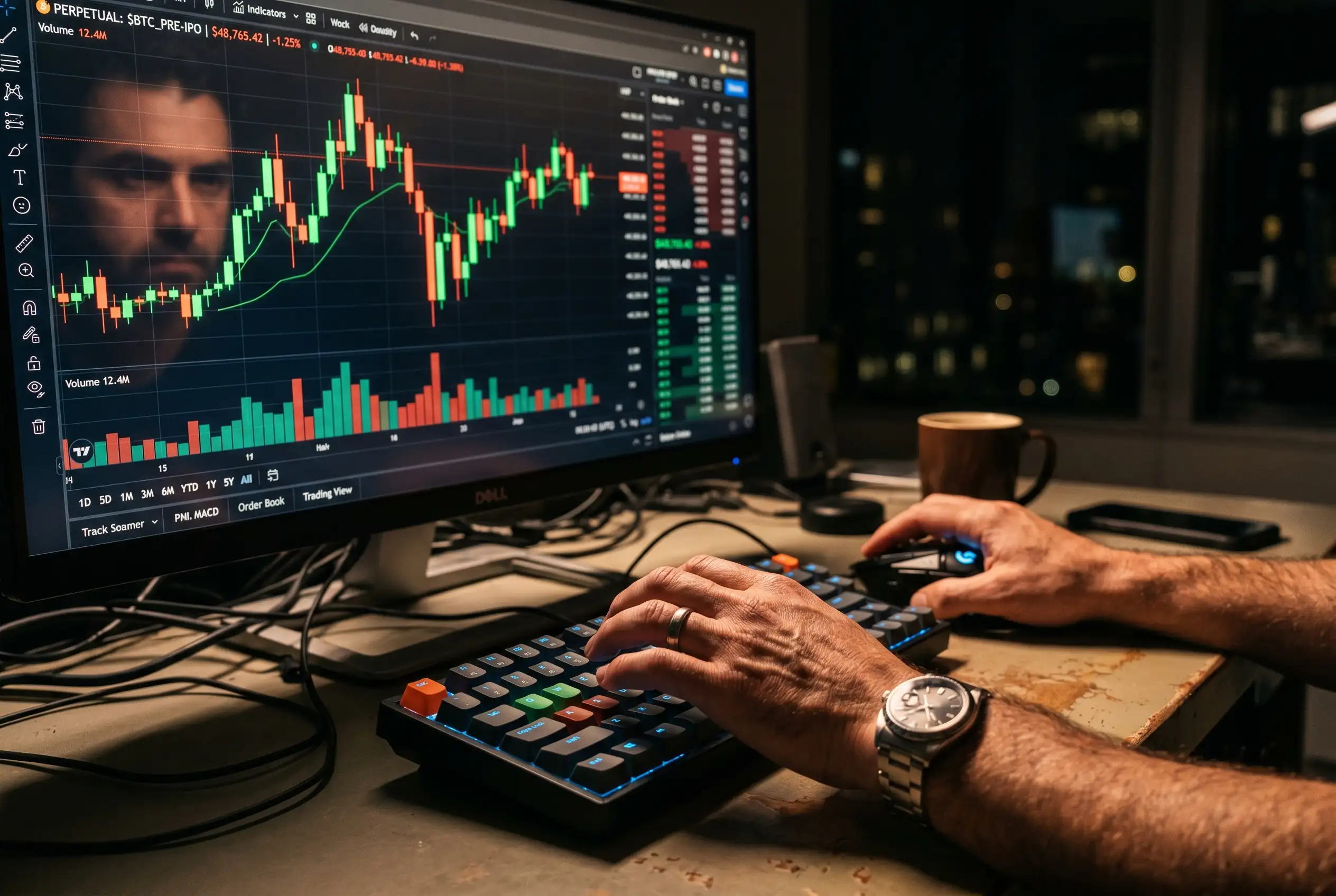
SpaceX is a private company, so retail traders cannot simply buy shares. Instead, Trade.xyz, a decentralized interface running on the Hyperliquid blockchain, staked 500,000 of the exchange’s native HYPE token, roughly $28 million, to deploy a perpetual futures market with the ticker SPCX-USDC. The contract settles in USDC and tracks the implied SpaceX share price, with no underlying shares, no voting rights, and no claim on the company.
That structure is now central to Hyperliquid’s strategy. Trade.xyz’s contracts account for 94% of HIP-3 open interest, the framework that lets any staker deploy a custom perp market. The SpaceX contract is the second pre-IPO perpetual launched by Trade.xyz, following the CBRS contract tied to AI chipmaker Cerebras Systems in early May. Together, the two products are the most visible test of whether on-chain perps can do price discovery for a private company, a job normally reserved for secondary markets and tender offers.
Beyond the synthetic share, SpaceX also disclosed 18,712 Bitcoin in an S-1 filing published in May. About 8,285 BTC sit in Coinbase Prime custody at a value near $637 million, per the May launch of the SPCX-USDC contract.
The Numbers Behind the Frenzy
Volume has scaled with the IPO date. The SpaceX perps averaged more than $26 million in daily volume between the May 18 launch and this week, per Hyperliquid data, and the first 12 hours of trading alone generated more than $40 million in volume.
The flow has concentrated in the past 24 hours. On Trade.xyz, the SpaceX contract cleared over $69 million in 24-hour volume with roughly $145 million in open interest, and open interest on Hyperliquid has held above $100 million through the slide.
On Binance, the same contract moved $182 million in 24 hours with $184 million in open interest, the deepest pool for the wager. The Cerebras pre-IPO perp averaged just $3.6 million in daily USDC volume in the run-up to its May listing.
- Average daily SpaceX perp volume since May 18: more than $26 million
- Binance 24-hour SpaceX perp volume: $182 million
- Trade.xyz 24-hour SpaceX perp volume: over $69 million
- Cerebras pre-IPO perp average daily volume: $3.6 million
The same flow has been pulling capital out of the rest of crypto. The pattern is documented in 13-day Bitcoin ETF outflows tracking the SpaceX listing, and the same retail dollars that once rotated through altcoins now sit on a USDC-settled SpaceX bet.
The Cerebras Precedent
The only data point on whether this bet works is Cerebras. The AI chipmaker, known for its dinner-plate-sized Wafer-Scale Engine, priced its May IPO at $185, with Hyperliquid traders including billionaire Arthur Hayes pushing the pre-IPO contract to a peak of $320 to $323. Cerebras opened on Nasdaq at $350, within about 8% of where the perp was pointing, and ran far above the $185 IPO price the bankers set.
The SPCX contract opened at $216 on May 18 and went as high as $230, about 70% above the $135 IPO offer, per a summary of the pre-IPO trading pattern. Those levels did not last, and the contract has since drifted lower into the $165 range as June 12 approached, while open interest held above $100 million on Hyperliquid through the slide.
When the Order Book Disappeared
The same synthetic market that traders trust as a price signal nearly broke on May 28. Hyperliquid’s SPACEX-USDH contract plunged from an open of $2,277 to a low of $1,254 in a 30-minute window, a 45% flash crash, before recovering to about $2,169. The move liquidated 405 users across 1,393 positions and wiped out $1.51 million in notional value, per the 45% crash that liquidated 405 users in 30 minutes, and the median liquidated position held $31 in margin, mostly small retail accounts running 3x leverage.
The cause was thin liquidity. Over the 24 hours before the crash, the contract had generated just $4.87 million in total volume on an open interest base under $2.9 million. One large sell order absorbed most of that depth, and even after the recovery, the mark price still sat $220 above the oracle price, a sign that the contract was trading on sentiment rather than any verified SpaceX valuation.
For veteran short sellers, that fragility is the case against the listing. Jim Chanos has called the offering a “hopes-and-dreams IPO,” and the thin liquidity that drove the May 28 crash is the same thin liquidity that the perp bulls are betting will resolve in their favor once the real stock trades.
What Bulls and Bears Are Saying
The bulls say the synthetic market is filling a real gap. OKX Chief Executive Officer Star Xu said on X on Wednesday that his exchange’s perps are “providing a real-time, transparent, and global market expectations and price discovery.” Christophe Boucher, chief investment officer at ABN Amro Investment Solutions, told journalists that SpaceX stock looks a lot like crypto.
I see something very similar to crypto in the sense that, at worst, you lose 100%, but at best, imagine he’s right, it’s exponentially upward.
That was Boucher, referring to Musk’s predictions. The line lays out the asymmetry the perps are pricing in, where the worst case is a total loss and the best case reflects whatever Musk’s other bets eventually pay out, with the perp market sitting directly on that spread.
The bears counter with arithmetic. At the $1.8 trillion IPO valuation and an estimated $29.7 billion in sales this year, SpaceX would trade at 60 times annual revenue, a level that looks expensive even against other AI-infrastructure names. Morningstar’s equity analyst Nicolas Owens values the stock at $63 per share, a 53% discount to the $135 offer, in the firm’s case for why the IPO is overvalued. His model assigns a 7% probability to the most optimistic scenario in which Starship is fully reusable and orbital data centers scale commercially, and in that case SpaceX would be worth $154 per share, only 14% above the IPO price.
The bull case also leans on SpaceX’s AI and cloud contracts, a side of the business captured in the $29.4 billion Google cloud deal announced before the IPO. The $135 IPO price reflects the roadshow marketing range, and the perps have moved to incorporate a deal that landed just before pricing.
What Happens When the Bell Rings
Perp holders do not become shareholders. The contract tracks the implied SpaceX share price, settles in USDC, and converts into a standard real-world-asset perpetual tracking the live stock once the IPO lands, per the explainer on what happens to SPCX at listing, and the Cerebras case offers a template since the pre-IPO perpetual for CBRS traded within 1.3% of the eventual Nasdaq opening price before converting.
- SPCX holders keep their USDC-settled positions through the listing; no shares are issued to them.
- The pre-IPO contract transitions into a standard real-world-asset perpetual tracking the live SpaceX stock.
- The implied pre-IPO price stops being the mark; the live Nasdaq price takes over as the reference.
- The CBRS perp at the Cerebras IPO traded within 1.3% of the Nasdaq open before converting.
For the bet to pay off, SpaceX needs to open above $165 on Nasdaq. Below that, perp traders sit on a mark-to-market loss on the largest pre-IPO synthetic position on Hyperliquid. Above that, the contract sets a precedent for a market structure that US regulators have not yet decided how to police, and the deal is set to price Thursday with the fixed $135 share price and $1.77 trillion target as the benchmark.
Frequently Asked Questions
What are SpaceX crypto perpetual futures?
A SpaceX crypto perpetual future is a synthetic contract, most commonly the SPCX-USDC pair on Hyperliquid, that lets traders bet on the implied share price of SpaceX without owning any actual stock. The contract settles in USDC, has no expiry, and gives holders no voting rights or claim on the underlying company.
Why are crypto traders pricing SpaceX above the IPO range?
SpaceX’s synthetic perpetual contract on Hyperliquid is trading above the IPO offer, mirroring a pattern set by the Cerebras pre-IPO deal in May. Apollo Crypto’s Pratik Kala said buyers are effectively pricing in a 20% first-day premium for SpaceX.
How much money is in the SpaceX perpetual futures market?
Binance leads the field on liquidity, with $184 million in open interest and over $182 million cleared in 24 hours. Trade.xyz, the interface that deployed the contract, has seen $145 million in open interest on $69 million in 24-hour volume. The average daily volume since the May 18 launch has been more than $26 million.
What is Morningstar’s SpaceX valuation?
Morningstar’s equity team, led by analyst Nicolas Owens, puts fair value at $63 per share, well below the $135 IPO. The most optimistic scenario in the firm’s model, in which Starship is fully reusable and orbital data centers scale, is assigned a 7% probability. In that case SpaceX would be worth $154 per share.
What happened during the Hyperliquid SpaceX flash crash?
A 30-minute cascade on May 28, 2026 wiped $1.51 million in notional value from 1,393 positions on the Hyperliquid SpaceX contract. The median liquidated account held $31 in margin, and the crash exposed how thin the order book remained on the eve of a record IPO.
Do SpaceX perpetual futures become real stock at IPO?
No. SPCX positions stay synthetic at listing. They convert into a standard real-world-asset perpetual tracking the live stock, but the contract never grants ownership, voting rights, or any claim on SpaceX itself.
Disclaimer: This article discusses crypto derivative products and a private company’s planned IPO. Pre-IPO perpetual futures are high-risk synthetic instruments that do not confer ownership of the underlying asset. Investment decisions carry the risk of total loss. Figures are accurate as of publication and may change. Consult a qualified financial professional before acting on any information in this article.


South Korea Retail Investors Face Reckoning After KOSPI AI Rally Collapses

Surrey AI Maps Three Heart Attack Paths and Their Molecular Roots

Germany Locks Neutral Apple ATT Prompts Across Most of Europe

Apple’s 5% EU Fee Quietly Rewrites Alternative App Store Math

Apple’s EU Fee Truce Cuts Complexity but Leaves Rivals Fuming

Pixel 11 Pro Fold Trades Thinness for Durability and Seven-Year Stay

Mayo AI Flags HCM Obstruction From Everyday Ultrasound Videos

Indian Brands Quietly Scale Landmark Screens and Home Tech

Navin Vatsa Turns Grief Into a Lifetime of Quiet Seeing

Google Bets Pixel 11 Agentic AI Will Redefine Phones

Oracle Cuts 21,000 Jobs in a Year, Cites AI in 10-K Filing

Fable 5 and Mythos 5 Return as US Lifts Anthropic Export Controls

SpaceX’s Google Deal Turns a Rocket Company Into a Cloud Landlord

CD Projekt Red Co-CEO: Redemption Arc Isn’t Done, Witcher 4 in 2027

XPL Rallies 30% Ahead of Plasma One Card Tier Launch

Google Search Profiles Build a Follow Graph Inside Discover

DGO App Brings Rs 549 Mobile Pass for FIFA World Cup 2026 in Nepal

Moonshot AI Targets $30 Billion in China’s Fastest AI Funding Sprint

Oppo’s ColorOS 17 Eligibility List Leaves A-Series Buyers Behind

Microsoft Xbox Layoffs Start in July as Sharma Slams 3% Margin
-
 AI2 months ago
Oracle Cuts 21,000 Jobs in a Year, Cites AI in 10-K Filing
-
 AI2 months ago
Fable 5 and Mythos 5 Return as US Lifts Anthropic Export Controls
-
 AI3 months ago
SpaceX’s Google Deal Turns a Rocket Company Into a Cloud Landlord
-
 GAMING2 months ago
CD Projekt Red Co-CEO: Redemption Arc Isn’t Done, Witcher 4 in 2027
-
 CRYPTO2 months ago
XPL Rallies 30% Ahead of Plasma One Card Tier Launch
-
 NEWS3 months ago
Google Search Profiles Build a Follow Graph Inside Discover
-
 APPS2 months ago
DGO App Brings Rs 549 Mobile Pass for FIFA World Cup 2026 in Nepal
-
 AI3 months ago
Moonshot AI Targets $30 Billion in China’s Fastest AI Funding Sprint