
APPS
Interactive Learning Apps Sell the Streak, Not the Skill
Interactive learning apps cite real retrieval practice, then wrap it in streaks and feeds. Duolingo now counts 58.7 million people a day.

Duolingo counted 58.7 million people opening the app each day in the quarter ended June 30, 2026. That is a 23 percent jump from 47.7 million a year earlier, and it is the number the company now steers by.
The interactive learning apps that fill “best of 2026” lists still quote a real memory finding. They also borrowed the loops that keep a social feed alive: a two-minute task, a streak, a rank against strangers, a For You page. Retrieval practice works. The product that wins the education chart is still the one you are afraid to skip tomorrow.
The 2006 Test Every Learning App Now Cites
Cognitive psychologists Henry L. Roediger III and Jeffrey D. Karpicke, then at Washington University in St. Louis, had students study short science passages and either reread them or try to recall them with no feedback. In their second experiment, published in the March 2006 issue of Psychological Science, four straight study sessions beat one study plus three recall tests on an immediate quiz, 83 percent to 71 percent. One week later the ranking flipped. The rereaders were down to 40 percent. The group that had spent most of its time testing held 61 percent.
That crossover is the whole sales pitch for quiz apps. Looking at a page again feels like work and fades fast. Pulling an answer out of memory feels worse in the moment and sticks. The 2006 test-enhanced learning paper used free recall of prose, not a four-tile translation, and it measured idea units a week later, not whether you opened an app the next morning.
ROEDIGER AND KARPICKE, EXPERIMENT 2
| Study mix in the first session | Recall after 5 minutes | Recall after 1 week |
|---|---|---|
| Four study sessions, no tests | 83% | 40% |
| One study session, then three tests | 71% | 61% |
Corrective feedback, which most of these apps add after a tap, can make retrieval even stronger than the no-feedback version in the lab. The catch the paper never tested is what happens when the thing you retrieve is a tile order, and the reward you chase is a number next to a flame.
Duolingo Grows Daily Users Faster Than Subscribers
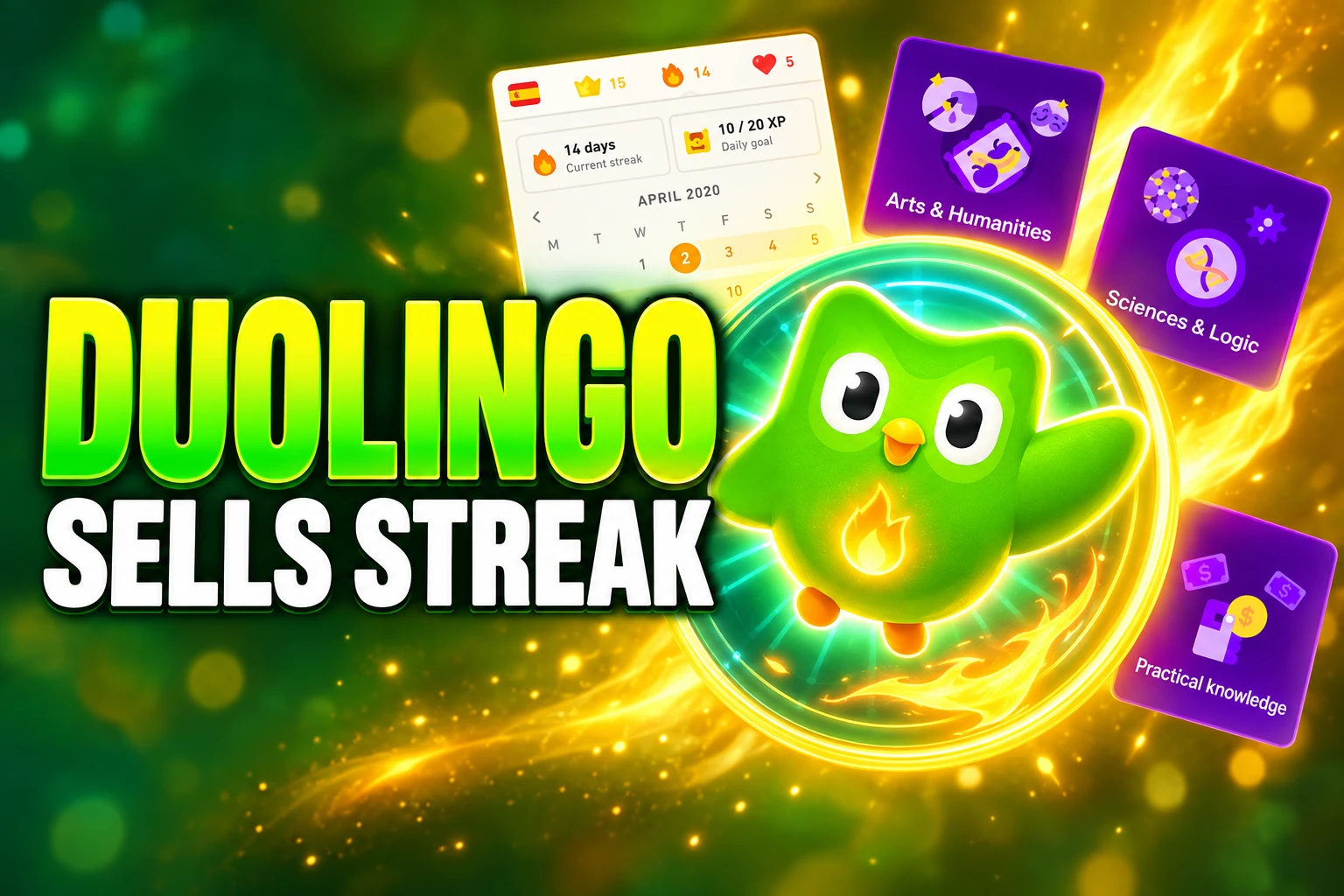
Duolingo, Inc. reported 58.7 million daily active users for the three months ended June 30, 2026, with 140.6 million monthly users and 12.7 million paid subscribers. Daily users rose 23 percent. Paid subscribers rose 17 percent, to 12.7 million from 10.9 million. Revenue rose 18 percent to $298.5 million. Bookings rose 8 percent to $289.1 million. Net income fell to $33.2 million from $44.8 million as the company spent to grow the top of the funnel.
Co-founder and chief executive Luis von Ahn has been blunt about the scoreboard. Daily active users are the metric a team actually watches. Monthly users get reported. No team sits on them. Current user retention, the share of recent daily users who come back the next day, hit an all-time high of 84 percent. The flagship app remained the top-grossing education title in the app stores and listed more than 250 language courses, plus math, music, and chess.
DUOLINGO, QUARTER ENDED JUNE 30, 2026
- Daily users: 58.7 million, up 23 percent from 47.7 million.
- Paid subscribers: 12.7 million at period end, up 17 percent from 10.9 million.
- Monthly users: 140.6 million, up 10 percent from 128.3 million.
- Next-day retention: 84 percent among current users, an all-time high.
The company calls its tuning loop the Green Machine: hundreds of small tests, then more of whatever lifts retention, learning scores, or revenue. For 2026 it put the first two ahead of the third. A one-time Streak Revival campaign brought lapsed counters back, and von Ahn told shareholders that product changes plus marketing should keep daily-user growth above the 20 percent pace the company had earlier guided to. Full-year 2026 revenue is still pegged at about $1.207 billion.
Q2 was a strong quarter, with DAU growth of 23% compared to the prior year, an acceleration from Q1. The results reinforce our strategy to improve the product and prioritize user growth. Our ambition is to teach a billion people, and every step we take toward a better product brings us closer to that goal.
Luis von Ahn, Co-Founder and CEO, Q2 2026 shareholder letter
Duolingo’s own efficacy work finds real gains on the tasks the app tests, especially reading and listening through about CEFR A2. Independent reviews of that research keep drawing the same line: recognition and tile-order production move; open speech in a shop does not. A multi-year Spanish streak can still leave someone unable to hold a conversation on holiday. That is not a glitch in the streak. It is the streak doing its job.
Two Best-Of Slots, One Parent Company
June roundups that ranked “ten best” interactive learning apps often put Nibble first and Headway second, as if they were rival picks. Both are products of Headway Inc, the Kyiv-born company founded in 2019 by Anton Pavlovsky. The Headway app alone claims 55 million-plus downloads and 172,000-plus five-star reviews. Across the portfolio the company says it reaches 170 million users. Nibble’s own product page lists 10 million-plus downloads.
Headway is the book-summary habit. An in-house team writes and voices summaries that take 12 to 20 minutes, from a library of 2,500-plus nonfiction titles, with recaps, highlights, and a Shorts tab of scrollable lesson cards. A session built to protect the streak can be as short as three minutes. Nibble is the general-knowledge sibling: 670-plus lessons across 35 topics, bites from 1.5 to 15 minutes, quizzes, games, audio, and chat-style turns with historical figures. Both products sell themselves as the thing you open instead of a social feed. Both track consecutive days. Nibble ships a personalized For You page.
That is the product idea in plain terms. Take the testing effect, cut the lesson to the length of a station stop, and borrow the home-screen grammar of a feed. Headway Inc also runs other consumer apps in the same family, including Impulse, plus later products such as AddMile and Skillsta. The June lists were not a survey of ten unrelated labs. Two of the top slots were a commute bundle from one company.
Brilliant and SoloLearn Force an Actual Answer
Not every title on those lists is a snack with a counter. Brilliant still throws out long text in favor of visual STEM puzzles, the kind where you drag a lever and watch a shape’s area change before anyone writes the formula. SoloLearn puts a code editor in the lesson and makes the first task typing Python, JavaScript, or SQL and hitting run, with the app flagging a missing bracket on the spot. Those sessions are still short. They are not multiple choice about someone else’s sentence.
Coursera sits further from the phone quiz. It hosts university modules and corporate certificates, including programs from Yale and Google, with weekly work, peer review, and capstone projects. Coursera’s FY2025 figures put registered learners at 197 million and revenue at $757 million, up 9 percent, with a catalog above 13,500 courses. Google’s Career Certificates, sold on that platform, tell a slower story on purpose: three to six months at under 10 hours a week, and a 2025 U.S. graduate survey in which 70 percent report a career outcome such as a new job, a promotion, or a raise within six months of finishing.
Khan Academy, the nonprofit in the same roundups, still looks like a school sequence. You watch a short video, then pass mastery problems before the next unit unlocks. Its report for the 2024 to 2025 school year logged 189.6 million registered users and 104.9 million yearly active learners. There is no flame on that home screen. There is a gap you cannot skip.
WHAT THE HOME SCREEN ACTUALLY REWARDS
| App | What you do in a session | Typical length | What the home screen counts |
|---|---|---|---|
| Nibble | Short lessons, then quizzes and games | 1.5 to 15 minutes | Daily streak, For You feed |
| Headway | Read or hear a book summary, then recap | 12 to 20 minutes (3-minute streak save) | Daily streak |
| Duolingo | Tile translations, audio match, short speaking prompts | About 2 minutes | Streak, leagues, daily users |
| Brilliant | Visual STEM puzzles and live graphs | Varies | Lesson completion |
| Quizlet | Custom flashcards with spaced repetition | Varies | Cards marked known |
| Khan Academy | Video, then mastery problems in order | Longer units | Topic badges, accuracy |
| Elevate | Timed reading, writing, and math games | 5 to 10 minutes | Score versus age group |
| Coursera | Weekly modules, peer work, capstones | Hours per week | Certificate |
| Memrise | Native-speaker clips plus mnemonic “mems” | Short lessons | Course progress |
| SoloLearn | Type code in the lesson and run it | Short lessons | Working output |
Quizlet, launched in 2007 by Andrew Sutherland, is still the blunt instrument for a certification vocab list: you build the deck, the scheduler shoves back the cards you miss, and in 2026 the company layered on AI study guides and a ChatGPT hook after buying the note app Coconote in February. Memrise still bets on clips of actual speakers in the street rather than studio audio. Both are retrieval tools. Neither pretends a 600-day counter is the skill.
The FTC Already Billed This Category Once
Elevate, from The Mind Company, drills reading, writing, and mental math in short timed games and compares you with people in your age band. Google Play lists 10 million-plus downloads and more than 40 games. Used as a five-minute writing warm-up, it is a timer with a paragraph. Used as proof that your brain is younger, it walks into a fight the category already lost.
In January 2016, Lumos Labs, the maker of Lumosity, paid $2 million to settle Federal Trade Commission charges that it had advertised school, work, and disease benefits the evidence did not support. The major brain-training apps narrowed their claims after that. Near transfer, getting better at the exact game you play, is real. Far transfer, a cleaner email or a faster analysis at work because you cleared redundant adjectives against a clock, is the claim that still outruns the studies. Elevate is more honest than the 2014 brain-training ads when it talks about communication drills. It is still a game with a leaderboard.
Match the App to the Skill You Need
Adults who mix a quiz on the train with a course that has a due date tend to keep more than adults who only protect a number. The useful split is not free versus paid. It is whether the session ends when you recall a fact, or when you have made something a stranger could mark.
PICK BY THE OUTPUT, NOT THE BADGE
- A language you must speak: Use Duolingo or Memrise for daily contact, then add real conversation. The tree will not do the talking.
- A book you will not finish: Headway will hand you the spine of Atomic Habits in one commute. It will not replace the book if you need the examples.
- Trivia between meetings: Nibble is built for that slot, and it will keep the streak alive on 1.5 minutes if you let it.
- STEM intuition or a first script: Brilliant and SoloLearn make you produce an answer, which is closer to the 2006 recall test than a tile match is.
- A credential a hiring manager can check: Coursera plus a Google Career Certificate is weeks of work, not a flame. Khan Academy is the free ladder when you have a gap in the basics.
- A vocab dump for an exam: Quizlet’s scheduler is still the point. Pay for the extra modes only if you will live in the deck for months.
Von Ahn’s letter also said Super subscribers were getting Video Call, the paid conversation feature, with the rest of that tier due later in 2026. That is the company trying to buy the skill the streak never required. Until the home screen counts a conversation you could not script, the chart will keep rewarding the open.
Frequently Asked Questions
What Is Retrieval Practice and Why Do Apps Use It?
Retrieval practice is the finding that trying to recall a fact teaches it better than looking at it again. In the 2006 studies the tests had no answer key, and students who only reread the passages were more confident they would remember them a week later, even though they remembered less. Apps add instant correction so a wrong tap is less likely to harden, which is a fair upgrade on the lab version, then they hang a streak on the same loop so you repeat the test tomorrow.
Does Duolingo Make You Fluent on Its Own?
No. The courses are built to land around A2 on the CEFR scale, upper beginner, with reading and listening ahead of speaking and writing. Duolingo has published work claiming that learners who finish five sections of French or Spanish, about half of its B1 material, matched university students after five semesters on the kinds of tests those studies used. That is a placement result, not a waiter in Madrid. Fluency in the ordinary sense sits at B2 and above and needs open speech the app still cannot grade like a person can.
Who Owns Nibble and the Headway App?
Headway Inc owns both. Pavlovsky launched the parent in 2019; the Headway summary app was the first consumer hit, and Nibble followed as the broader-knowledge product, with later titles including Impulse, AddMile, and Skillsta. In July 2025 the company took a Series A led by Bullhound Capital, and in 2025 it ranked fourth on TIME’s list of top edtech firms. The two names on a “best apps” list are a product line, not a coincidence.
Do Google Career Certificates Help With Hiring?
Google says more than 150 U.S. employers, including Deloitte and Verizon, treat the certificates as a signal for entry-level roles, and the programs run three to six months at under 10 hours a week with no degree required. The 70 percent career-outcome figure is from a 2025 survey of U.S. graduates, not a controlled hiring study, and it counts a raise or a promotion as a win. The certificate helps most when it sits next to a portfolio of actual work, which is the opposite of a three-minute streak save.
Super’s Video Call is the closest Duolingo has come to grading the thing a streak cannot fake. Until that conversation is the default, not a paid extra, the education chart will keep belonging to whoever makes skipping a day feel like a loss.

Instagram Plus Tests a Read-Only Mode That Cuts Stories

Altman Asks the Public to Accept Some AI Harm

Google Freezes OSS VRP Product Reports After AI Flood

AI Agents Make Payment Rails the Scarce Prize

Turkey’s Crypto Boom Now Runs Through Three Banks

Fable 5 Came Back Under a Commerce On-Off Switch

Google’s SpaceX GPU Lease Has a Sept. 30 Deadline

Plasma One’s XPL Locks Face a 1.81 Billion Cliff

DGO’s Rs 549 World Cup Pass Cost Fans Sleep and Data

Moonshot AI’s $30 Billion Ask Became a $35 Billion Close
-
 AI4 months ago
Fable 5 Came Back Under a Commerce On-Off Switch
-
 AI4 months ago
Google’s SpaceX GPU Lease Has a Sept. 30 Deadline
-
 CRYPTO4 months ago
Plasma One’s XPL Locks Face a 1.81 Billion Cliff
-
 APPS4 months ago
DGO’s Rs 549 World Cup Pass Cost Fans Sleep and Data
-
 AI4 months ago
Moonshot AI’s $30 Billion Ask Became a $35 Billion Close
-

 NEWS4 months ago
ColorOS 17 Device List Spans Oppo, OnePlus and Realme
-
 GAMING4 months ago
Xbox Cuts 3,200 Jobs After Five Years of Thin Returns
-

 GAMING4 months ago
The RTX 4050 Under Rs 70,000 Hides a Wattage Gap