
GADGETS
Hisense RGB MiniLED Ads Opened a Category Rivals Took
Hisense used FIFA World Cup 2026 to brand RGB MiniLED as its own, then Omdia showed Samsung and Sony cutting that share to 42.9%.

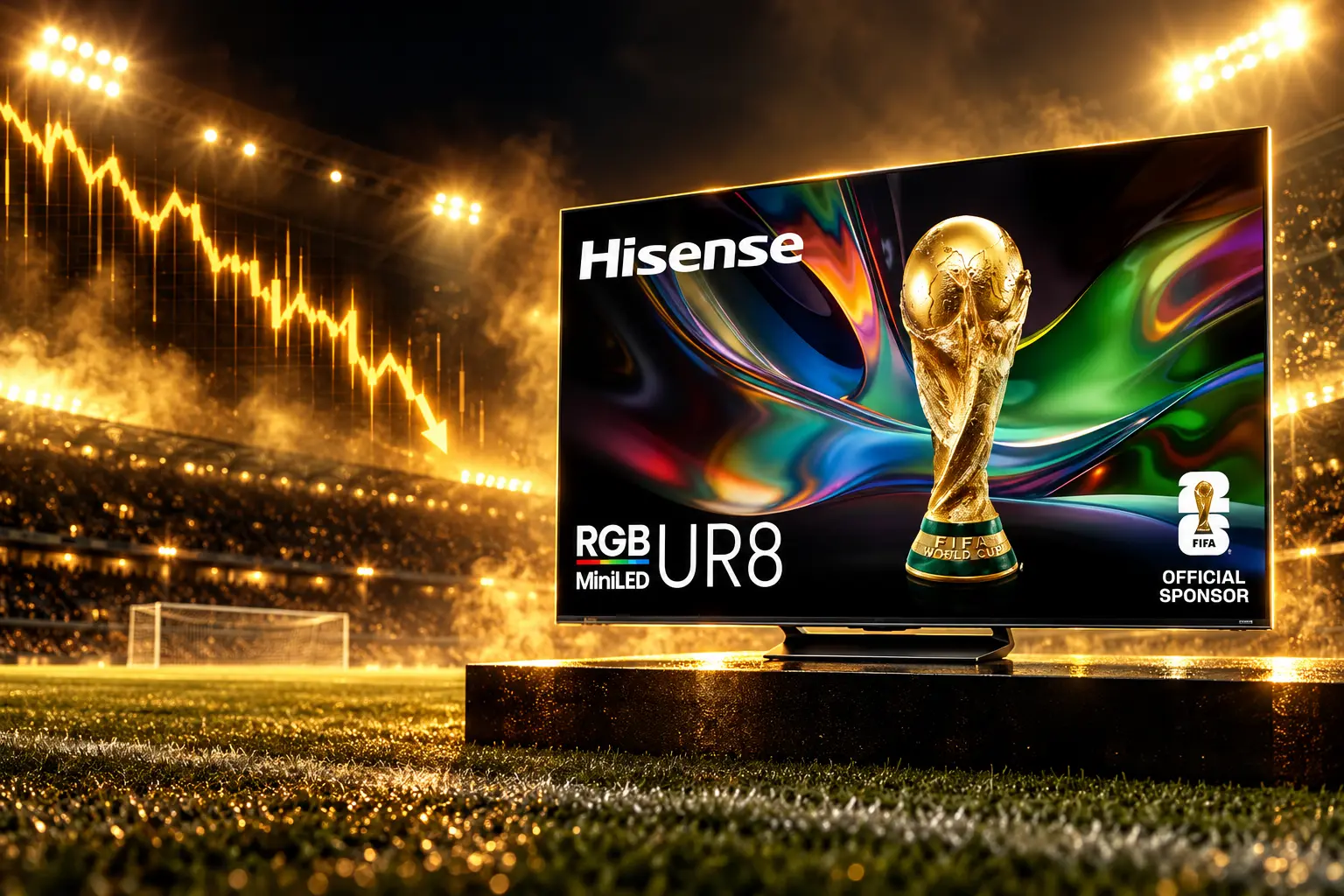
Hisense’s RGB MiniLED share fell to 42.9% in the second quarter of 2026, according to Omdia, after a World Cup campaign built to own the term. The Qingdao company spent the tournament as an Official Sponsor and as FIFA’s Official VAR Review TV Provider, putting “The Origin of RGB MiniLED TV” on pitch-side boards from kickoff on June 11.
The ads worked on the category. They did not lock the brand. Samsung and Sony used the same summer to ship RGB LED sets of their own, and Hisense’s share of that young market slid from 77.2% at the start of the year.
Pitch-Side Boards Named a Category
Hisense has now been an Official Sponsor at three straight FIFA World Cups, a run that began in 2018. For 2026 it added a second badge that mattered more to engineers than to ticket holders: Official VAR Review TV Provider. The screens in the review room and the boards around the pitch carried the same claim, that Hisense is the origin of RGB MiniLED, a backlight that makes red, green, and blue light in the LEDs themselves.
That line sat next to “Innovating a Brighter Life,” the house slogan, through a 48-team tournament spread across the United States, Canada, and Mexico. The earlier World Cup RGB MiniLED push had already tied the brand to the tournament; kickoff week turned the phrase into a product demo that fans could walk through in New York and that officials could sit in front of in Dallas.
Hisense, founded in 1969, now lists operations in over 180 countries. The World Cup spend was meant to make a Chinese set maker feel like a display company that writes the rules. In March 2026, as a member of the Consumer Technology Association, it helped the CTA Video Division Board publish a formal definition of RGB LED TVs. Then the tournament taught shoppers the words, and other factories filled the orders.
What RGB MiniLED Changes for Match Night
A conventional Mini LED TV still starts with white light. A quantum-dot film and a color filter then try to turn that white into a picture. Hisense’s RGB MiniLED design skips the quantum-dot layer and puts color right at the source, with thousands of tiny red, green, and blue LEDs behind the LCD. Each cluster can raise or cut one primary without waiting on a filter.
Hisense rates the shipping UX, UR9, and UR8 sets at up to 100% of BT.2020, the wide color space used in premium HDR. The company first showed a consumer 116UX at CES 2025 and put a full range on sale after CES 2026, from 55 inches up to 116 inches, which is a wider spread than most rivals had in stores when the first whistle blew.
HOW RGB MINILED MAKES COLOR
- Direct primaries: Each backlight element carries its own red, green, and blue diodes instead of a white LED plus a color film.
- No quantum-dot layer: Hisense drops the QD sheet used on many premium LCDs, so less light is thrown away in the filter stack.
- Two controls per zone: A zone can change brightness and hue together, which is how the set tries to keep a yellow sunset from blowing out to white.
- Hi-View AI Engine RGB: Hisense’s own processor is built to keep the backlight array and the LCD pixels in step on every frame.
The practical pitch for football is a bright room. OLED still looks cleaner in a dark den, but a daytime living room with open blinds is where Hisense wants RGB MiniLED to win, because the backlight can stay vivid without the burn-in worry that comes with organic panels. Motion is the other boast: the UR9 and UR8 lines are rated at a native 180Hz refresh, aimed at fast breaks and VAR slo-mo that still has to look sharp on a 100-inch wall.
Hudson Yards Sold Jerseys as a Color Test
From June 9 to 13, Hisense ran an RGB-themed pop-up beside The Vessel at Hudson Yards in New York. The company said the site showed three 116-inch UX sets and one 85-inch U9, under LED skins that turned “RGB” into a slogan, “Real Game Begins with Hisense.”
Adidas and FIFA were in the room. A Digital Mirror let visitors stand in front of an RGB MiniLED panel and try on virtual adidas kits, with Chromagic rendering the shirt colors onto a fan avatar. A shooting game unlocked a co-branded mural for social posts. Quizzes spat out R, G, or B “fan identity” posters and pushed people toward the U.S. shop with coupon draws, which is a long way from a logo on a boarding.
Hisense’s own recap tied the New York site to other stops: a commercial display zone, the FIFA Museum in Toronto, the FIFA Fan Festival in Mexico City, a stadium fan setup in the New York New Jersey venue, and the VAR operation in Dallas. The hardware was the thread. The week was a color lab with a gift shop attached.
The official Hisense clip from the yard is a 55-second walk through those screens, not a spec sheet. Color accuracy, motion, a wall-size picture, and eye comfort are the four claims it repeats, which is also the four-part sales pitch the brand took into living rooms for the rest of the tournament.
Match Officials Reviewed Replays on RGB MiniLED
FIFA’s International Broadcast Centre in Dallas opened in June with Hisense RGB MiniLED sets as the display hardware for coverage and for video review. Hisense said FIFA President Gianni Infantino Infantino tried the VAR screens on site and posted a clip of the visit. Infantino called the IBC “the most technologically advanced and top of the art international broadcast centre that the world has ever seen.”
Nick Brown, FIFA’s director of commercial partnerships, put the screens inside the match, not only beside it.
This is a step forward towards delivering exceptional picture quality and accuracy. It is a testament to how technology can actively support and enhance aspects of the game during the tournament.
Nick Brown, FIFA Director Commercial Partnerships
Hisense’s own channels spent July on a shorter line, “See what VAR sees,” which is a clever way to sell a living-room set with an officiating badge. The public feed around those posts was almost all brand video and almost no argument about price, firmware, or who else was shipping RGB LED. That quiet is part of the story. Shoppers were being taught a category name, not a single SKU.
Share Fell From 77.2% to 42.9% After Kickoff
Omdia’s second-quarter TV tally, covering the World Cup window, is where the campaign meets a packing list. Global TV shipments rose 3.6% year on year to 48.8 million sets, helped by the tournament and by Amazon Prime Day, even as China shipments fell 15.1% after local stimulus ended. Western Europe rose 9.5%. North America, home to two of the three host countries, rose 4.7%.
RGB LED is still a thin slice of that pile. Omdia counted 295,000 RGB LED shipments in the quarter. Hisense had 77.2% of RGB LED at the start of 2026, when China accounted for 88.8% of the category and almost nobody else was in it. By the second quarter its share was 42.9%, a drop of 34.3 points, as Samsung and Sony took volume.
THE WORLD CUP SHARE SHIFT
| Measure | Figure | Period |
|---|---|---|
| Hisense RGB LED shipment share | 77.2% | Start of 2026 |
| Hisense RGB LED shipment share | 42.9% | Q2 2026 |
| RGB LED TV shipments | 295,000 | Q2 2026 |
| Global TV shipments | 48.8 million | Q2 2026 |
| Mini LED share of all TVs | 13% | Q2 2026 |
| Samsung Mini LED shipment share | 28.2% | Q2 2026 |
| Hisense 100-inch-and-above share | 55.1% | H1 2026 |
Mini LED as a whole, the wider white-LED-plus-zones family, is a different fight. It was 13% of all TV shipments in the quarter. TCL had led that group at 30.2% in the first quarter; Samsung moved from third to first at 28.2% in the second. Hisense is in that scrum too, but the World Cup boards were not selling “Mini LED.” They were selling RGB.
Prominent promotion of RGB LED TVs during the World Cup has undoubtedly helped increase consumer awareness of the technology. As adoption grows, RGB LED will increasingly compete with OLED in the premium segment.
Matthew Rubin, Research Manager, TV Set Research, Omdia
Rubin’s second point is the one Hisense cannot put on a banner. Once buyers can say “RGB MiniLED” out loud, they can compare a Hisense UR9 with a Samsung or Sony set that uses the same idea. The tournament that was supposed to make Hisense the default name also made the spec shoppable.
Hisense Still Ships More Than Half of 100-Inch Sets
The share Hisense did not give up is the giant wall. Omdia figures released by the company put it at 55.1% of global shipments of TVs 100 inches and above in the first half of 2026, No. 1 in that cut from 2023 through that half. Those sets are a mix of RGB MiniLED, conventional Mini LED such as the U7 and U6 Pro lines, and Laser TV, where Hisense says it took more than 70% of global shipments in 2025.
A 100-inch Hisense is still the product a World Cup party actually buys. RGB MiniLED is how the brand wants that wall to look more expensive than the price. The UR9 series, the retail RGB line in 65, 75, 85, and 100-inch sizes, is rated up to 5,500 nits with native 180Hz. The UR8 series stretches from 55 to 100 inches at up to 3,800 nits, which is how Hisense tries to put the new backlight under $3,000 in some sizes rather than leaving it on a 116-inch pedestal.
THE HISENSE FIFA TRAIL
- 2018: First FIFA World Cup sponsorship, the start of the three-tournament run.
- 2022: Second World Cup as an official partner, with FIFA+ content work around the Qatar tournament.
- March 2026: CTA Video Division Board issues an industry definition of RGB LED TVs, with Hisense as a member in that work.
- June 9 to 13, 2026: Hudson Yards RGB pop-up opens beside The Vessel in New York.
- June 11, 2026: FIFA World Cup 2026 kicks off, with Hisense pitch-side as Official Sponsor.
- June 18, 2026: Hisense says VAR operations at the Dallas IBC are running on its RGB MiniLED sets.
- September 2026: 116UXS makes its European debut at IFA in Berlin with a fourth, cyan, primary.
Read as a brand plan, the trail is clean. Read as a shipment plan, it is a company that still owns the super-size aisle and no longer owns the backlight it named.
Berlin’s Answer Is a Fourth Primary Color
IFA 2026 in Berlin, in the first half of September, was Hisense’s first big stage after the final. The 116UXS, already shown at CES as an RGB-plus-cyan set, made its European debut with Chromagic 2.0. Hisense’s IFA release describes a four-color backlight with cyan added to red, green, and blue, reaching 110% of BT.2020, with a peak of 10,000 nits, the Hi-View AI Engine RGB, and an Obsidian panel. The set carries Pantone Validated RGB MiniLED and Pantone Color marks, plus a TÜV Rheinland Low Blue Light hardware rating.
The older 116UX, the set that started the consumer line, is still the brightness-and-zones workhorse at 8,000 nits, 3,584 dimming zones, more than 20,000 color control units, 100% BT.2020, and 165Hz. The UXS moves the story from three primaries to four and from 8,000 nits to 10,000. IFA also hung Eye Comfort marks on the UR9S and UR8S, so the comfort claim is no longer only a flagship footnote.
HISENSE RGB MINILED LINEUP 2026
| Model | Sizes | Peak brightness | Color claim |
|---|---|---|---|
| 116UX | 116-inch | 8,000 nits | 100% BT.2020 |
| 116UXS | 116-inch | 10,000 nits | Up to 110% BT.2020 |
| UR9 series | 65, 75, 85, 100-inch | Up to 5,500 nits | Up to 100% BT.2020 |
| UR8 series | 55, 65, 75, 85, 100-inch | Up to 3,800 nits | Up to 100% BT.2020 |
The 116UXS is how Hisense answers a summer in which it taught the market a three-color name and then watched Samsung and Sony ship against it. Cyan is a new noun for the next spec war. The sets that actually moved during the tournament were the ones already in the 55-to-100-inch band, and that is the band where a 34.3-point RGB share slide shows up first.
Frequently Asked Questions
What is RGB MiniLED on a Hisense TV?
It is an LCD television whose backlight uses separate red, green, and blue Mini-LEDs in each zone, so hue is mixed behind the panel instead of being filtered from white light. Hisense’s Hi-View AI Engine RGB is the chip that tells those zones and the LCD pixels what to do on every frame, which is why the company talks about a blue star on a black sky leaving a faint dark-blue halo rather than a gray bloom.
How does Hisense RGB MiniLED differ from OLED?
OLED lights each pixel and can turn a pixel fully off, which is why it still wins in a dark room. RGB MiniLED keeps an inorganic LED backlight, so Hisense sells it as a no-burn-in choice for tickers, score bugs, and long gaming sessions, with enough output for rooms that stay lit. Hisense also says typical Mini LED covers about 75% of BT.2020, against up to 100% on its RGB sets.
Which Hisense models shipped RGB MiniLED in 2026?
The 116UX and 116UXS sit at the top of the wall. The UR9 series covers 65, 75, 85, and 100 inches with HDMI 2.1 plus DisplayPort and a 330Hz mode at 1080p. The UR8 series adds 55 inches, four HDMI 2.1 ports, Pantone certification, and Devialet-tuned sound, and the U.S. pages put the whole RGB group on Google TV with Gemini. All of those lines were on Hisense’s 2026 list before IFA added the cyan UXS story in Europe.
What was Hisense’s official role at FIFA World Cup 2026?
It was an Official Sponsor, the second-highest FIFA partner tier for the tournament, and the Official VAR Review TV Provider. Pitch-side boards ran “The Origin of RGB MiniLED TV” and “Innovating a Brighter Life.” Fan sites in New York, Toronto, and Mexico City used the same screens for kit try-ons and games, including the adidas Digital Mirror at Hudson Yards.
What did the CTA say an RGB LED TV is?
In March 2026 the Consumer Technology Association’s Video Division Board defined RGB LED televisions as LCD sets that use individually controlled red, green, and blue LEDs inside each backlight element. Hisense, a CTA member, says it helped write that line so a “real” RGB MiniLED set could be told apart from a white Mini LED with aggressive marketing. The definition is about the backlight, not about who sold the most of them in June.

Instagram Plus Tests a Read-Only Mode That Cuts Stories

Altman Asks the Public to Accept Some AI Harm

Google Freezes OSS VRP Product Reports After AI Flood

AI Agents Make Payment Rails the Scarce Prize

Turkey’s Crypto Boom Now Runs Through Three Banks

Fable 5 Came Back Under a Commerce On-Off Switch

Google’s SpaceX GPU Lease Has a Sept. 30 Deadline

Plasma One’s XPL Locks Face a 1.81 Billion Cliff

DGO’s Rs 549 World Cup Pass Cost Fans Sleep and Data

Moonshot AI’s $30 Billion Ask Became a $35 Billion Close
-
 AI4 months ago
Fable 5 Came Back Under a Commerce On-Off Switch
-
 AI5 months ago
Google’s SpaceX GPU Lease Has a Sept. 30 Deadline
-
 CRYPTO4 months ago
Plasma One’s XPL Locks Face a 1.81 Billion Cliff
-
 APPS5 months ago
DGO’s Rs 549 World Cup Pass Cost Fans Sleep and Data
-
 AI5 months ago
Moonshot AI’s $30 Billion Ask Became a $35 Billion Close
-
 NEWS5 months ago
ColorOS 17 Device List Spans Oppo, OnePlus and Realme
-
 GAMING4 months ago
The RTX 4050 Under Rs 70,000 Hides a Wattage Gap
-
 AI4 months ago
Boris Cherny’s Loops Still Demand a Higher Production Bar