
GAMING
Online Gaming Helps Neurodivergent Young People Connect, Study Finds
A 480-family study finds 90% of neurodivergent young people game online, 51% say it helps them make friends, but safety gaps remain.

The new research from Internet Matters and Roblox lands four days before Neurodiversity Pride Day on 16 June 2026, and it puts a number on something many parents and teachers have heard anecdotally for years. 90% of neurodivergent young people play video games online or offline, according to the joint study of 480 families, and a clear majority of them say the medium helps them make friends, relax, and feel part of a community. The same study also surfaces a quieter finding that the two organisations now say they have to act on: nearly half of parents say they do not know how to use the parental controls already on the devices in their home.
The result is a portrait of a generation that has found one of its most consistent social spaces inside a game client, and a parent cohort that is broadly positive about what their children are getting out of it, yet under-equipped to manage what they are getting into.
What 480 Families Told the Researchers
Internet Matters, a UK not-for-profit focused on online safety, and Roblox ran the study through an online survey and focus groups in September and October 2023, working with neurodivergent children aged 12 to 17 and their families in the United Kingdom and the United States. The research hub for the project lists 480 completed surveys. 56% of parents who responded had at least one child on the autism or autistic spectrum, and 48% had at least one child with ADHD.
Children in the study played games in large numbers, with 90% reporting they play video games online or offline, and 80% saying they make their own content online. Roblox itself sat at the centre of that activity: 93% of neurodivergent young people in the study play the platform, more than any other title the survey asked about.
Why Gaming Hits Different for Neurodivergent Players
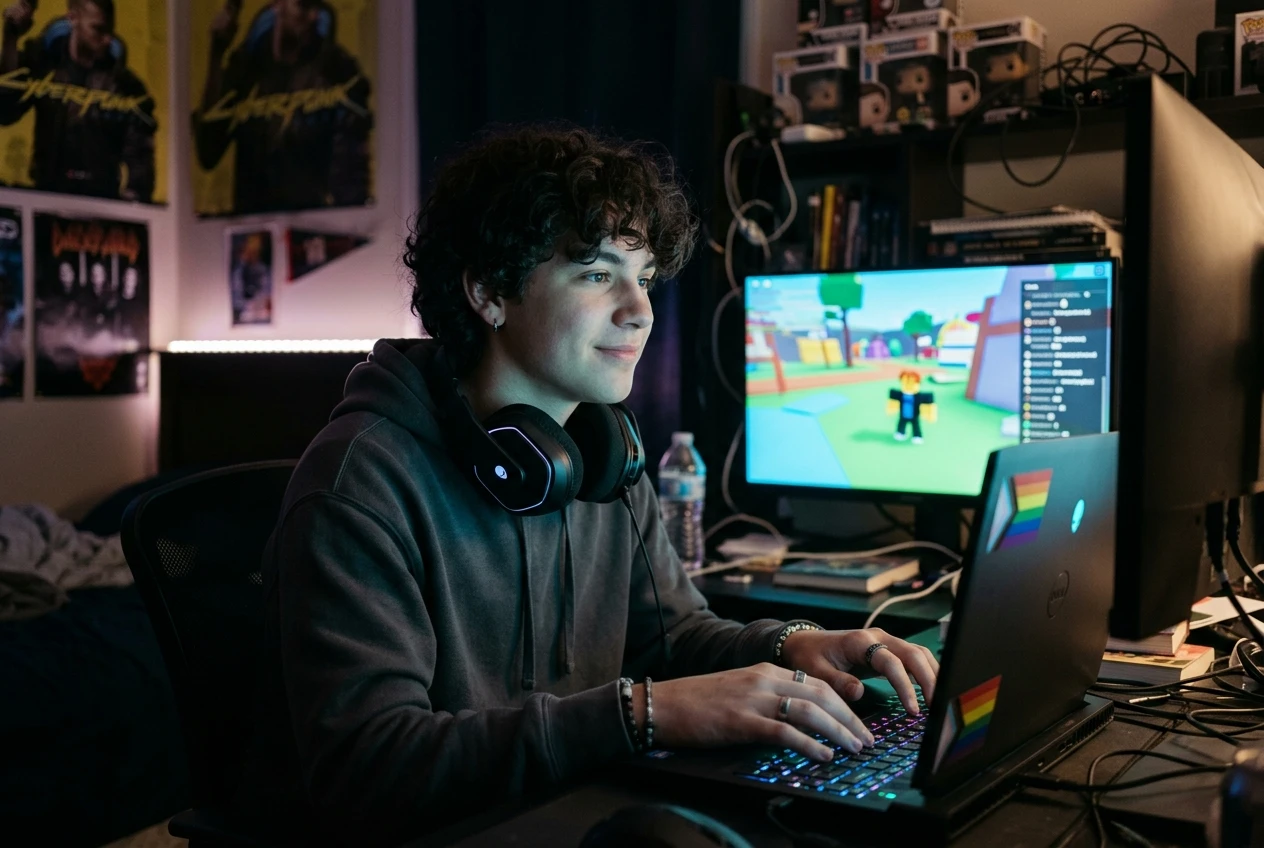
Three figures from the study, each drawn from the same group of respondents, capture the social upside. Over half (51%) said online gaming helps them make friends. Around 3 in 10 (31%) said it gives them a sense of community. 42% said gaming helps them relax. Separately, 58% of neurodivergent young people told Internet Matters that gaming makes them happy, the highest single positive response the survey recorded.
The contrast with offline life is part of why the medium lands so hard. The Australian Institute of Health and Welfare reports that the most common schooling difficulty for students with autism is fitting in socially, at 63%, ahead of learning difficulties (62%) and communication difficulties (52%). For neurodivergent young people more broadly, 56% say fitting in socially is their biggest challenge at school. Inside a game, those same social mechanics can run on a different clock, with text, time to think, and the ability to leave and rejoin.
The Risks Travel at the Same Amplitude
The benefits are not free, and the study reads the costs as scaled by the same mechanism that amplifies the gains. 1 in 5 respondents (21%) said gaming can make them unhappy. 27% (1 in 4) said they found the sensory aspect of gaming difficult, a category that covers everything from sudden loud audio to flashing visuals and rapid on-screen motion. 23% said they struggled with the accessibility of video games, and only 44% said they know how to report upsetting content or users.
The pattern is consistent with what researchers have seen in other populations of neurodivergent children online: the features that make a space welcoming, low-demand, text-rich, and async, are also the features that leave less room for a built-in safety net when something goes wrong. The very tools most young respondents in the study had not yet learned to use, block and report, are the tools that turn a bad session into a recovered one.
Where Parents Say They Are Stuck
The parental side of the data tells a similar story with the cost shifted. Nearly two thirds of parents (63%) of neurodivergent children find gaming beneficial, and 59% agreed their child had developed better communication skills through online gaming. Many parents reported their child had learned important offline skills from gaming online. Just under half (48%) said they are unaware of, or do not intend to use, parental controls.
That gap is the lever the study is built to move. Parents broadly see the upside, broadly see the offline skill transfer, and broadly have not been walked through the settings on the devices their children are already using. The tools exist; the guided path to them has not.
The Guide Roblox and Internet Matters Built
In response, Internet Matters and Roblox co-developed a practical guide for parents of neurodivergent young gamers, with printable resources, short videos, and a game built into the Roblox platform itself. Rachel Huggins, chief executive officer of Internet Matters, framed the research in terms of the gap it identified. Laura Higgins, senior director of community safety and civility at Roblox, framed it in terms of the platform’s role in closing it.
Our research shows that gaming is not just about entertainment – for many neurodivergent young people, it can offer a genuine space to connect, build confidence, and feel understood in ways that aren’t always accessible offline. But the study also highlights a clear need for tailored guidance to help neurodivergent young people and their families navigate online gaming in a safe and healthy way. With the right support, playing video games online can bring a real sense of community and belonging.
Huggins’ remarks, given ahead of Neurodiversity Pride Day, set the tone for what the two organisations want the guide to do. The next paragraph from Roblox is the platform’s own answer to the gap. Higgins described the research as identifying a real need for greater support, and pointed parents to the guide Roblox and Internet Matters built together.
Online gaming can be an incredibly positive space for neurodivergent young people, but it’s not without its challenges. This research found that there’s a real need for greater support to help young people and their families navigate online spaces safely and confidently. That’s why we’ve worked together with Internet Matters to develop useful guidance, designed specifically for parents of neurodivergent young people, to help them enjoy the benefits of gaming while understanding and managing potential issues.
What the Research Tells Parents to Try
Internet Matters’ guidance breaks the work into five habits, each tied to a different part of the risk surface the study identified. None of them requires a parent to become a power user of the platform in question.
- Set clear boundaries while gaming. Agree on time limits, build in regular breaks, and use visual schedules or timers to make the rules legible. Where possible, display the agreed rules where the child usually plays.
- Keep conversations honest and open. Run regular, judgment-free check-ins, ask who the child is playing with, and set time aside to play together. Open-ended prompts work better than yes-or-no questions.
- Support confidence in online interactions. Talk through what positive and respectful behaviour looks like, consider writing it down and putting it on the wall, role-play responses to tricky moments, and reinforce that it is fine to leave a game that stops feeling right.
- Build digital safety skills together. Define what personal information looks like, agree a list of red flag behaviours, and walk through how and when to report and block users. Read safety resources with the child rather than handing them over.
- Combine parental controls with regular check-ins. Use parental control tools to manage screen time and spending, adjust the settings as the child’s confidence grows, and stay involved in the platforms and games they use.
The first three habits address the social upsides; the last two address the safety gap. The 48% of parents who said they are not using parental controls sit inside the same group that, in the study’s other half, agreed their child had learned real communication skills from gaming. The guide’s pitch is that the two halves can be reconciled without giving up either one.
The Offline Backdrop
An estimated 15 to 20% of Australians are neurodivergent, a figure that tracks closely with global population estimates. The Australian data on autism in particular shows that 85% of school-age children with autism report some kind of difficulty at school, and that 56% receive special tuition, with another 44% using a counsellor or disability support person. The offline scaffolding exists; it is uneven and slow. Online, the same children are reporting, in their own words and in the largest survey of its kind, that they have found something the offline scaffolding has struggled to provide on a consistent schedule.
Higgins’ framing, that gaming can be a powerful way to build communication skills for many neurodivergent young people, sits inside that backdrop. The guide is the attempt to give the same scaffolding to the side of the experience that parents, schools, and platforms have so far had the least reach into.
Frequently Asked Questions
What did the Roblox and Internet Matters study actually find?
Of 480 families surveyed in the UK and US in late 2023, 90% of neurodivergent young people play video games, 51% said gaming helps them make friends, 31% said it gives them a sense of community, and 42% said it helps them relax. The same study recorded challenges: 21% said gaming can make them unhappy, 27% found the sensory aspect difficult, 23% struggled with accessibility, and only 44% knew how to report upsetting content or users.
Is Roblox safe for neurodivergent children?
93% of neurodivergent young people in the study play Roblox, more than any other platform the survey asked about. Internet Matters and Roblox have published a guide for parents of neurodivergent children that covers block and report tools, parental controls, and how to start conversations about online play.
How many parents use parental controls for neurodivergent children?
48% of parents of neurodivergent children in the study said they are unaware of, or do not intend to use, parental controls. The same survey found 59% of parents agreed their child had developed better communication skills through online gaming.
What is Neurodiversity Pride Day?
Neurodiversity Pride Day is held on 16 June each year, with ND Pride Week running 11 to 17 June in 2026. The 2026 calendar lists more than 100 registered events worldwide, including online sessions, summits, and local meetups.
What should a parent of a neurodivergent child do first?
Internet Matters recommends starting with the parental controls already on the device, then building a routine of regular, judgment-free check-ins about who the child is playing with and how the game is making them feel. The Roblox parents guide walks through both in printable form.


Sony’s 10 Percent Disc Drop Leaves the 2028 Cutoff Intact

Chip Allocation Sidelines the Base iPhone 18 This Fall

Miami-Dade Fights the Vice City Brand It Already Wears

IFA 2026 Awards Put Tecno Ahead of Flagship Phones

USB-C Gadgets Made the Junk Drawer Rechargeable

Pixel 11 Pro Asks $1,099 for a Light Google Locked

The iPhone Ultra Sells Two Retired Minis as One Foldable

Google Opens Gmail to Voice and Gates Docs Live

Lenovo Prices the IdeaPad Vibe Against Apple’s $699 Neo

Xbox Caps Game Pass Cloud Gaming at 15 Hours

Oracle Cuts 21,000 Jobs in a Year, Cites AI in 10-K Filing

Fable 5 and Mythos 5 Return as US Lifts Anthropic Export Controls

SpaceX’s Google Deal Turns a Rocket Company Into a Cloud Landlord

CD Projekt Red Co-CEO: Redemption Arc Isn’t Done, Witcher 4 in 2027

XPL Rallies 30% Ahead of Plasma One Card Tier Launch

Google Search Profiles Build a Follow Graph Inside Discover

DGO App Brings Rs 549 Mobile Pass for FIFA World Cup 2026 in Nepal

Moonshot AI Targets $30 Billion in China’s Fastest AI Funding Sprint

Oppo’s ColorOS 17 Eligibility List Leaves A-Series Buyers Behind

Microsoft Xbox Layoffs Start in July as Sharma Slams 3% Margin
-
 AI3 months ago
Oracle Cuts 21,000 Jobs in a Year, Cites AI in 10-K Filing
-
 AI2 months ago
Fable 5 and Mythos 5 Return as US Lifts Anthropic Export Controls
-
 AI3 months ago
SpaceX’s Google Deal Turns a Rocket Company Into a Cloud Landlord
-
 GAMING3 months ago
CD Projekt Red Co-CEO: Redemption Arc Isn’t Done, Witcher 4 in 2027
-
 CRYPTO3 months ago
XPL Rallies 30% Ahead of Plasma One Card Tier Launch
-
 NEWS3 months ago
Google Search Profiles Build a Follow Graph Inside Discover
-
 APPS3 months ago
DGO App Brings Rs 549 Mobile Pass for FIFA World Cup 2026 in Nepal
-
 AI3 months ago
Moonshot AI Targets $30 Billion in China’s Fastest AI Funding Sprint