
COMPUTERS
The INNOCN 49C1S 49-Inch Ultrawide Lands at $624.97 Ahead of Prime Day
INNOCN’s 49C1S ultrawide is 22% off at $624.97 ahead of Prime Day, with 240Hz, HDR400, 95% DCI-P3, and a 65W USB-C port for laptops.

The INNOCN 49C1S is a 49-inch curved ultrawide gaming monitor sitting at $624.97 on Amazon, a 22% cut from its usual list price, and the deal has gone live a couple of weeks before the main Prime Day window. It is the kind of display that, three years ago, would have lived in the $1,000-and-up tier: a 5120 x 1440 Dual QHD panel, 240Hz refresh, and a color stack that does not embarrass itself next to dedicated creator displays. INNOCN is not a household name the way Samsung or LG is, and that is the only reason a 49-inch 240Hz panel is sitting at $624.97 in the first place.
Prime Day is the obvious reason the price is where it is, and the broader story is that 49-inch ultrawide deals have been getting aggressive for months. The $624.97 figure on the 49C1S is one of several sub-$700 entries in a category that was firmly $900+ a year ago, and the spec sheet on this one is dense enough that it earns a closer look rather than a scroll past.
What’s Actually on Sale This Week
The deal is on the INNOCN 49C1S specifically, not the QD-OLED 49Q1S the brand also sells. The 49C1S is the VA-panel model with a 240Hz refresh rate, and the 49C1S retail listing with current price shows it at $624.97, marked down 22% from the $799.99 list. The timing is deliberate: the cut landed in early June, ahead of the Prime Day sales event that historically runs in mid-July.
At $624.97, the 49C1S is now cheaper than several of the 49-inch Samsung entries that get cited as the default pick. The Samsung Odyssey G9 G95C, a 240Hz VA alternative with a more aggressive 1000R curve and HDR1000 brightness, has been hovering at $699.99 with a 30% discount attached. The INNOCN, on the spec sheet at least, gives up the HDR brightness tier to land $75 lower.
The deal is not bundled with a game code or a gift card. It is a straight price cut on the monitor, and Amazon currently has it in stock. The full ultrawide deal roundup from the INNOCN brand page shows other models discounted as well, including the 40-inch 5K panel and the 40-inch 1440p variant, but the 49C1S is the headline.
- 22% off list price
- $624.97 final price on Amazon
- 49-inch curved VA panel, 32:9 aspect ratio
- 240Hz native refresh rate, 1ms OD accelerated
- 95% DCI-P3 color coverage with Delta E under 2
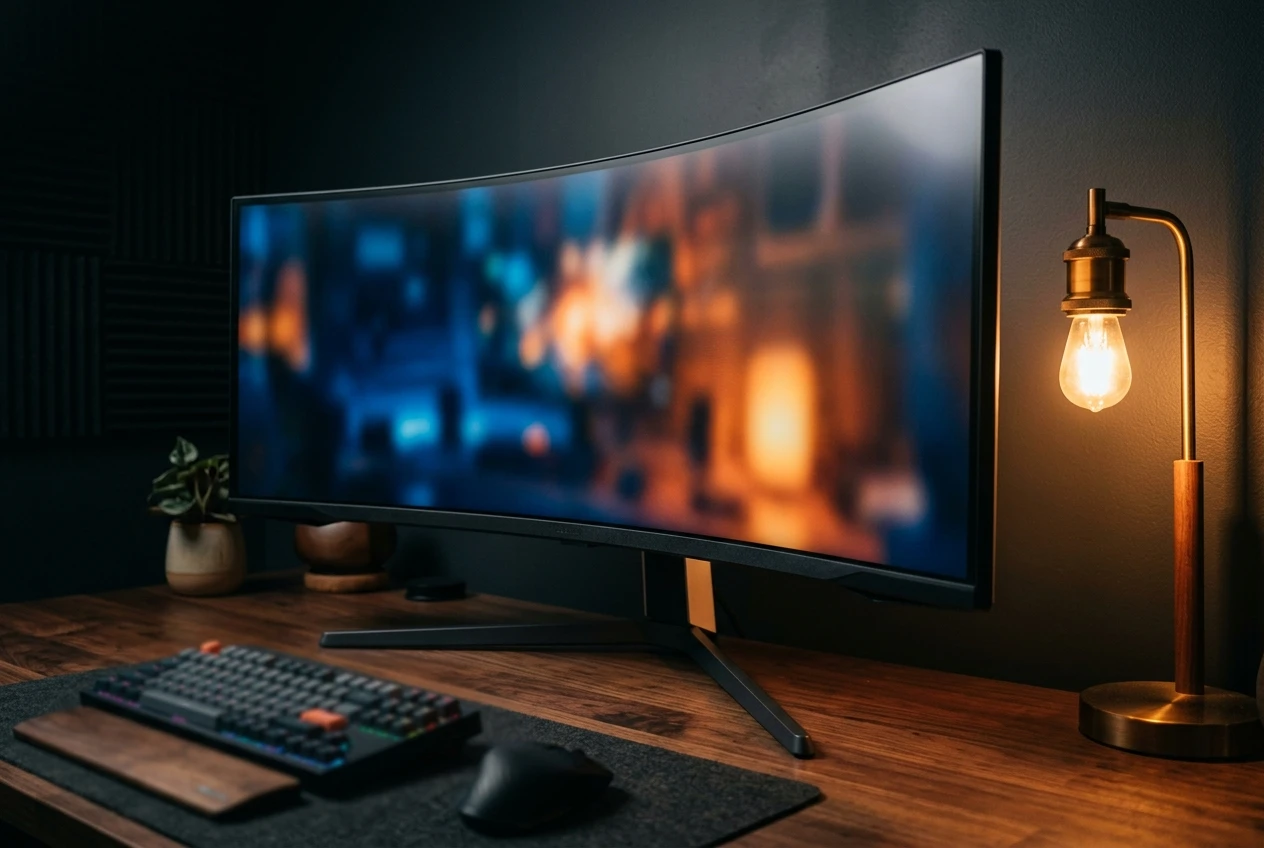
The Panel: 49 Inches of Dual QHD at 240Hz
The 49C1S is a VA panel, not an OLED, and that choice shows up in two specific places: contrast and viewing angle. The static contrast ratio is 3000:1, well above what an IPS panel manages and a step above the 1000:1 baseline most VA screens ship with, and the 178-degree viewing angles on both axes are wide enough that the corners do not wash out when the screen is set at desk distance. The full 49C1S spec sheet lists 1.07 billion display colors via 8-bit plus FRC, which is standard for the category.
The resolution is 5120 x 1440, branded by INNOCN as Dual QHD. That is two 2560 x 1440 panels fused into one, which gives the screen its 32:9 aspect ratio. The active display area measures 1191.936mm wide by 335.232mm tall, which is roughly the same vertical space as a 27-inch 16:9 display, just with another 27-inch panel glued to its right side. For productivity, that is two full-width windows side by side with no bezel between them. For gaming, it depends on the title: most modern games support 32:9 ultrawide, some do not, and a small number get a black bar on the sides.
The 240Hz refresh rate is the headline spec for competitive players, and it is paired with a 3ms GTG response time native, dropping to 1ms with the overdrive accelerator engaged. AdaptiveSync is on board, and INNOCN does not specify a FreeSync or G-Sync tier on the product page, so treat it as a generic adaptive sync implementation. The 1800R curvature is mild by 49-inch standards; the Samsung G95C runs a more aggressive 1000R curve, which some users prefer for immersion and others find disorienting. The 49C1S sits closer to a gentle wrap than a deep bend.
- Panel type: VA, E-LED backlight
- Screen size: 49 inches, 32:9 aspect ratio
- Curvature: 1800R
- Resolution: 5120 x 1440 (Dual QHD)
- Refresh rate: 240Hz
- Response time: 3ms GTG native, 1ms OD accelerated
- Display colors: 1.07 billion (8-bit + FRC)
- Viewing angle: 178 degrees horizontal, 178 degrees vertical
- Sync technology: AdaptiveSync
Where It Stops Feeling Budget: Color and HDR
The color spec is the part of the 49C1S that does not look like a $625 monitor. INNOCN rates the panel at 99% sRGB coverage, 95% DCI-P3 (CIE 1976), and 83% Adobe RGB, with a color accuracy of Delta E under 2 out of the box. The 95% DCI-P3 number matters because that is the color space most modern HDR content is graded in, and it is also the space most current games target when they offer wide-gamut modes. The Delta E under 2 figure is the threshold most professional calibration services aim for, and it is uncommon on gaming-leaning displays at this price.
HDR support tops out at HDR400, the entry-level VESA certification, and the panel hits 400 nits in HDR mode and 320 nits with HDR off. That is enough to register HDR metadata and stop the screen from looking flat in HDR-branded content, but it is not enough to deliver the specular highlights that make HDR1000 or HDR True Black 400 screens feel transformative. The 3000:1 contrast ratio does a lot of the heavy lifting in SDR, and dark scenes look deep enough that the missing brightness is easier to forgive than it would be on a lower-contrast panel.
The Ports, the Stand, and a KVM in the Mix
The port layout is denser than the price suggests. The 49C1S ships with one HDMI 2.1 port, two DisplayPort 1.4 ports, and one USB Type-C port that supports 65W power delivery to a connected laptop, dropping to 45W when the panel is running HDR. The USB hub is built around two USB-A 3.0 ports and one USB-B 3.0 upstream, and there is a 3.5mm audio jack and a pair of 5W integrated speakers for backup. The USB-C port runs the full 240Hz signal, so a single-cable laptop connection is genuinely a single-cable connection, not a compromise.
The KVM switch is the under-discussed feature. It lets a user run two computers into the panel, share a keyboard and mouse through the USB hub, and switch between them via the on-screen menu. The PIP and PBP modes are also wired in, so a player can have a console on one input and a PC on another and view them as picture-in-picture or side-by-side. For anyone running a work laptop and a personal desktop through the same screen, that eliminates a second monitor.
This monitor has phenomenal colors. Right out of the box, it’s calibrated to be more accurate than the samsung and LG non OLED offerings. This product swings way above it’s price range.
The line above is from a verified Amazon buyer who came to the 49C1S from a 34-inch Gigabyte 1440p panel at 144Hz, and the throughline in the longer review is the same as the spec sheet: color and connectivity punch above the price.
The stand offers tilt forward 5 degrees and back 15 degrees, 95mm of height adjustment, and ±15 degrees of swivel. That is enough range to find a usable position on most desks, though the VESA mount is 75×75, the smaller of the two common patterns, so third-party arm buyers will need to check compatibility before ordering. The stand is functional rather than pretty, and the recessed VESA mount location on the rear of the panel means the screen does not sit flush against a wall.
- 1x HDMI 2.1 (up to 240Hz)
- 2x DisplayPort 1.4 (up to 240Hz)
- 1x USB Type-C (65W PD, 45W with HDR, up to 240Hz)
- 2x USB-A 3.0, 1x USB-B 3.0 upstream
- 1x 3.5mm audio out, 2x 5W integrated speakers
- KVM switch, PIP/PBP, AdaptiveSync
- Tilt 5 degrees forward, 15 degrees back; 95mm height; ±15 degrees swivel
How It Stacks Up in the 49-Inch Class
The 49-inch ultrawide category splits cleanly into three tiers right now: the OLED and QD-OLED flagships at $899 and up, the 240Hz VA workhorses in the $625 to $750 range, and the budget 120Hz entries that have fallen to $500. The 11-monitor 49-inch comparison tested over at PropelRC puts the 49C1S squarely in tier two, and at $624.97 it is the cheapest 240Hz entry in that group.
The direct comparison is with the Samsung Odyssey G9 G95C, which has been discounted to $699.99 with a 30% cut, saving $300. The Samsung ships a more aggressive 1000R curve, a 1ms GtG response time, VESA DisplayHDR 1000 certification, and 1,000-nit peak brightness. The INNOCN gives up the HDR tier and the curve depth, lands $75 cheaper, and matches the 240Hz refresh, the 5120×1440 resolution, and the 1ms-class response time.
Below the 49C1S sits the Acer Nitro 49-inch entry at $499.99, a 17% discount that saves $100. The Acer is a 120Hz panel with a 3ms response time, 300 nits of brightness, and no HDR certification. It is the right pick for buyers who care more about screen real estate than refresh rate, and the wrong pick for anyone who games competitively.
| Model | Price | Refresh | Response | HDR | Curve |
|---|---|---|---|---|---|
| INNOCN 49C1S | $624.97 (22% off) | 240Hz | 3ms GTG, 1ms OD | HDR400, 400 nits | 1800R |
| Samsung Odyssey G9 G95C | $699.99 (30% off) | 240Hz | 1ms GtG | HDR1000, 1000 nits | 1000R |
| Acer Nitro 49″ | $499.99 (17% off) | 120Hz | 3ms | None, 300 nits | 1000R |
The OLED class, anchored by the Samsung Odyssey OLED G93SC at $899.99 and the MSI MPG 491CQPX QD-OLED at $949.99, sits well above this conversation. Those are 0.03ms response time panels with true blacks and infinite contrast. They are also $275 to $325 more expensive than the 49C1S at its current price, and they target a different buyer.
Who Should Pull the Trigger (and Who Shouldn’t)
The 49C1S is the right pick for three specific buyers. First, anyone with a mid-to-high tier GPU who games on a 240Hz ultrawide and wants to step up from a 34-inch 21:9 panel without crossing $700. The 5120×1440 resolution is demanding, so anything below an RTX 4070 or RX 7800 XT will struggle to push high frame rates at native resolution, and a 240Hz panel demands a real frame budget. For a sanity check on what to pair with this thing, the 2026 CPU and GPU pairing guide maps resolution targets to GPU tiers and is the right starting point.
Second, the multitasker who wants one screen to replace two. The PIP and PBP modes turn the 49C1S into a true two-input workstation, and the KVM switch means a work laptop and a personal desktop can share the same keyboard, mouse, and webcam. Third, the laptop user who wants a single-cable setup. The 65W USB-C power delivery is enough to charge most 13-inch and 14-inch ultrabooks at full speed, and the panel runs the full 240Hz signal over the same cable.
It is the wrong pick for HDR purists, OLED seekers, and anyone who specifically wants 4K vertical resolution. The HDR400 ceiling means HDR content looks better than SDR but does not pop the way an HDR1000 or HDR True Black 400 screen does, and the 1440p vertical resolution is half of a standard 4K panel. For pure single-window 4K work, a 32-inch 4K display is the right tool.
Frequently Asked Questions
Is the INNOCN 49C1S actually a good gaming monitor?
For 240Hz ultrawide gaming, yes. The 1ms OD accelerated response time, the 240Hz native refresh, and the AdaptiveSync implementation cover the core gaming spec set. The 5120×1440 resolution is heavy on the GPU, but at the price the trade-off is reasonable.
What’s the difference between the 49C1S and the 49Q1S?
The 49C1S is the VA-panel model with 240Hz refresh, and the 49Q1S is the QD-OLED model with 240Hz refresh. The OLED version delivers true blacks and a 0.03ms response time, and it has historically been priced around $899.99 on deal.
Does the USB-C port really charge a laptop?
Yes, at 65W with HDR off and 45W with HDR on. That covers most 13-inch and 14-inch ultrabooks at full charge speed, and the same USB-C cable carries the full 240Hz video signal.
Is the $624.97 deal a real Prime Day price?
The discount landed in early June, ahead of the main Prime Day sales event in mid-July, so it is an early deal rather than a peak Prime Day cut. The price could move lower during the main event, but the 22% discount is a real number on a real listing right now.
How does the 49C1S compare to the Samsung Odyssey OLED G9?
The Samsung Odyssey OLED G9 is a QD-OLED panel with 0.03ms response time, true blacks, and HDR True Black 400, and it sells for $899.99. The INNOCN 49C1S is a VA panel with a 3ms native response time and HDR400. The Samsung is the better display; the INNOCN is $275 cheaper and 240Hz instead of 240Hz with OLED-grade pixel response.
The $624.97 price on the 49C1S is the kind of deal that defines a category for a quarter, and the 22% cut on a 240Hz 49-inch panel with a 95% DCI-P3 color spec is the number to anchor on for anyone who has been waiting on the 49-inch ultrawide class to get affordable.


Sony’s 10 Percent Disc Drop Leaves the 2028 Cutoff Intact

Chip Allocation Sidelines the Base iPhone 18 This Fall

Miami-Dade Fights the Vice City Brand It Already Wears

IFA 2026 Awards Put Tecno Ahead of Flagship Phones

USB-C Gadgets Made the Junk Drawer Rechargeable

Pixel 11 Pro Asks $1,099 for a Light Google Locked

The iPhone Ultra Sells Two Retired Minis as One Foldable

Google Opens Gmail to Voice and Gates Docs Live

Lenovo Prices the IdeaPad Vibe Against Apple’s $699 Neo

Xbox Caps Game Pass Cloud Gaming at 15 Hours

Oracle Cuts 21,000 Jobs in a Year, Cites AI in 10-K Filing

Fable 5 and Mythos 5 Return as US Lifts Anthropic Export Controls

SpaceX’s Google Deal Turns a Rocket Company Into a Cloud Landlord

CD Projekt Red Co-CEO: Redemption Arc Isn’t Done, Witcher 4 in 2027

XPL Rallies 30% Ahead of Plasma One Card Tier Launch

Google Search Profiles Build a Follow Graph Inside Discover

DGO App Brings Rs 549 Mobile Pass for FIFA World Cup 2026 in Nepal

Moonshot AI Targets $30 Billion in China’s Fastest AI Funding Sprint

Oppo’s ColorOS 17 Eligibility List Leaves A-Series Buyers Behind

Microsoft Xbox Layoffs Start in July as Sharma Slams 3% Margin
-
 AI3 months ago
Oracle Cuts 21,000 Jobs in a Year, Cites AI in 10-K Filing
-
 AI2 months ago
Fable 5 and Mythos 5 Return as US Lifts Anthropic Export Controls
-
 AI3 months ago
SpaceX’s Google Deal Turns a Rocket Company Into a Cloud Landlord
-
 GAMING3 months ago
CD Projekt Red Co-CEO: Redemption Arc Isn’t Done, Witcher 4 in 2027
-
 CRYPTO3 months ago
XPL Rallies 30% Ahead of Plasma One Card Tier Launch
-
 NEWS3 months ago
Google Search Profiles Build a Follow Graph Inside Discover
-
 APPS3 months ago
DGO App Brings Rs 549 Mobile Pass for FIFA World Cup 2026 in Nepal
-
 AI3 months ago
Moonshot AI Targets $30 Billion in China’s Fastest AI Funding Sprint